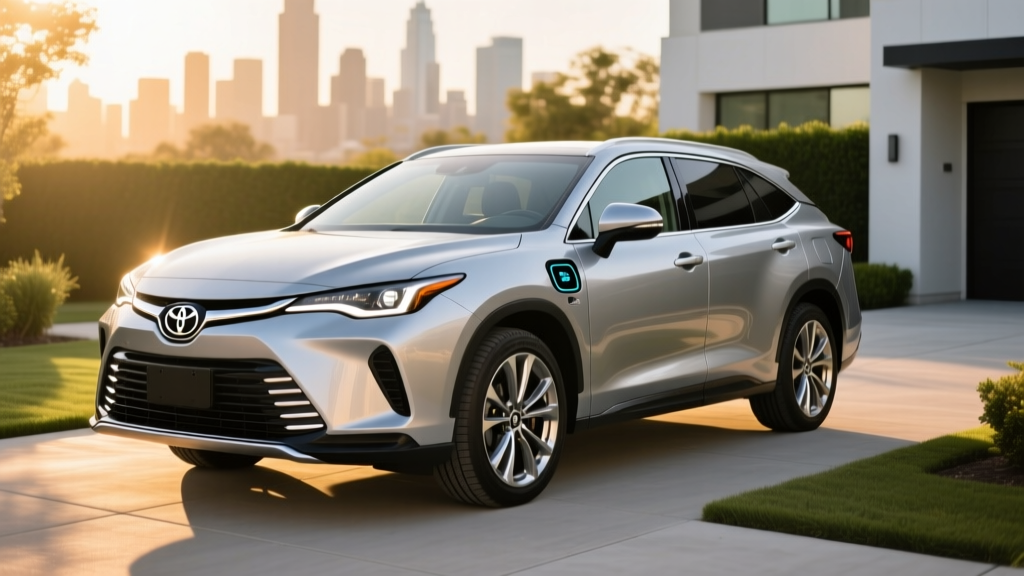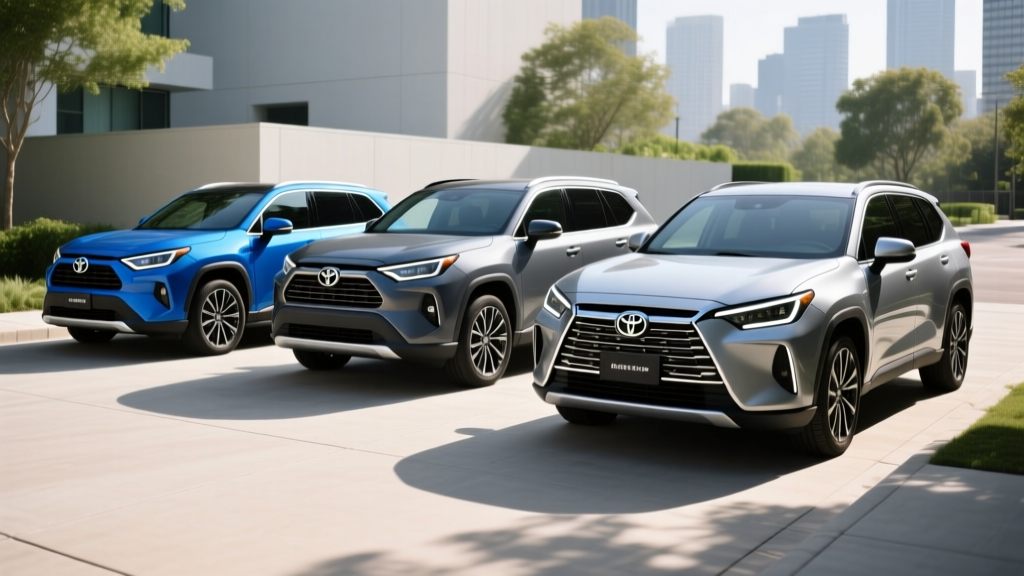
If you're researching a hybrid SUV Toyota offers more options than nearly any other automaker. For 2026, Toyota's hybrid SUV roster spans the compact RAV4 Hybrid, the midsize three-row Highlander Hybrid, and the wagon-style Crown Signia — each pairing a gasoline engine with electric motors for strong fuel economy without the need to plug in. This guide breaks down exact EPA MPG figures, powertrain specs, real-world efficiency, pricing, battery warranties, and whether a conventional hybrid (HEV), plug-in hybrid (PHEV), or full battery-electric vehicle (BEV) is the right fit for your driveway.
Toyota's 2026 Hybrid SUV Lineup at a Glance
Toyota builds three core hybrid SUVs for the US market in 2026. All three are conventional hybrids (HEVs), meaning the battery recharges through regenerative braking and the gasoline engine — you never plug them in. Toyota discontinued the RAV4 Prime (a plug-in hybrid variant) after the 2025 model year, consolidating its plug-in strategy around the Prius Prime and bZ-series BEVs.
| Model | Class | Powertrain | Combined HP | EPA Combined MPG | Starting MSRP |
|---|---|---|---|---|---|
| RAV4 Hybrid | Compact SUV | 2.5L 4-cyl + 3 motors (AWD) | 219 hp | 39 MPG | $34,025 |
| Highlander Hybrid | Midsize 3-row SUV | 2.5L 4-cyl + 2 motors (AWD) | 243 hp | 35 MPG | $42,720 |
| Crown Signia | Midsize wagon/SUV | 2.5L 4-cyl + 2 motors (AWD) | 240 hp | 38 MPG | $44,985 |
Source: fueleconomy.gov and Toyota Motor Corporation 2026 model-year specifications. MSRP excludes destination charges.
Fuel Economy Breakdown: EPA MPG and Real-World Results
Hybrids shine in stop-and-go driving, where regenerative braking recovers energy that a conventional gas car wastes as heat. That's why Toyota's hybrid SUVs often post higher city MPG than highway MPG — the opposite of most gasoline-only vehicles.
| Model | City MPG | Highway MPG | Combined MPG | Real-World Expectation |
|---|---|---|---|---|
| RAV4 Hybrid (AWD) | 41 | 38 | 39 | 37–42 MPG (city-heavy); 34–37 MPG (highway) |
| Highlander Hybrid (AWD) | 35 | 35 | 35 | 33–37 MPG (city); 31–34 MPG (highway) |
| Crown Signia (AWD) | 39 | 37 | 38 | 37–41 MPG (city); 34–36 MPG (highway) |
HEV vs PHEV vs BEV: Which Electrified SUV Fits You?
Toyota's 2026 hybrid SUVs are all HEVs. Understanding the distinction between hybrid types is essential before you buy.
Conventional Hybrid (HEV) — RAV4 Hybrid, Highlander Hybrid, Crown Signia
- No plug required. The battery (typically 1.1–1.9 kWh) charges via regen braking and the gas engine.
- Electric-only driving: Brief low-speed EV mode only (typically under 1 mile at low speeds).
- Best for: Drivers without home charging access, apartment dwellers, high-mileage commuters, and those who want simplicity.
Plug-In Hybrid (PHEV) — e.g., Toyota Prius Prime (not an SUV)
- Plugs in to charge. Larger battery (typically 13–18 kWh) provides 25–44 miles of electric-only range.
- Gas engine kicks in after battery depletes, functioning like a conventional hybrid.
- Best for: Drivers with home Level 2 charging who want short electric commutes plus gas-engine road-trip flexibility.
- Tax credit: May qualify for up to $3,750–$7,500 under IRS §30D depending on battery sourcing and buyer income.
Battery Electric Vehicle (BEV) — e.g., Toyota bZ4X
- 100% electric. No gasoline engine. Large battery (typically 65–85 kWh).
- Range: 220–300+ miles EPA depending on model.
- Best for: Drivers with reliable home charging who want zero tailpipe emissions and lower per-mile fuel costs.
- You don't have access to home or workplace charging
- You want maximum range flexibility without planning charging stops
- You drive 12,000+ miles/year and want to cut fuel costs 30–40% vs. a gas-only SUV
- You want Toyota's long-proven hybrid reliability track record
- You have Level 2 home charging and a short commute (under 40 miles round-trip)
- You want to maximize electric-only driving and minimize gasoline use
- You qualify for the federal tax credit, which can offset a PHEV/BEV's higher purchase price
Powertrain Deep Dive: How Toyota's Hybrid System Works
All three 2026 Toyota hybrid SUVs use variations of Toyota's Hybrid Synergy Drive, pairing a 2.5-liter Dynamic Force four-cylinder engine with one or more electric motors through a planetary gearset (eCVT). There are no traditional gear shifts — the system continuously blends engine and motor power for optimal efficiency.
RAV4 Hybrid Powertrain
The RAV4 Hybrid uses a front-mounted electric motor (88 kW) and a rear-mounted motor (40 kW) for standard electronic AWD. Combined system output is 219 horsepower. The 1.6 kWh nickel-metal hydride (NiMH) battery sits under the rear seat, preserving cargo space. The rear motor engages automatically during acceleration, slippery conditions, or when the front wheels lose traction — there's no mechanical driveshaft connecting the axles.
Highlander Hybrid Powertrain
Despite its larger size, the Highlander Hybrid also uses the 2.5L engine but tuned for 243 combined horsepower with front and rear electric motors. The AWD system is similar to the RAV4's electronic setup. Curb weight is approximately 4,500 lbs, which is why combined MPG drops to 35 vs. the RAV4's 39 — physics demands more energy to move a heavier vehicle.
Crown Signia Powertrain
The Crown Signia slots between the RAV4 and Highlander in size and uses a closely related 2.5L hybrid system producing 240 combined horsepower. Its lower, more aerodynamic wagon body helps it achieve 38 MPG combined — nearly matching the RAV4 despite more interior volume. Standard AWD with electronic rear motor.
Pricing, Trims, and Tax Credit Eligibility
Toyota's hybrid SUVs carry a modest price premium over their gas-only counterparts (where available), but the fuel savings typically offset that premium within 3–5 years for average drivers.
| Model | Base Trim MSRP | Mid Trim (XLE/XSE) | Top Trim (Limited/Platinum) | Federal Tax Credit |
|---|---|---|---|---|
| RAV4 Hybrid | $34,025 (LE) | $36,550 (XLE) | $40,850 (Limited) | Not eligible (§30D requires plug-in) |
| Highlander Hybrid | $42,720 (LE) | $46,170 (XLE) | $52,300 (Platinum) | Not eligible (§30D requires plug-in) |
| Crown Signia | $44,985 (XLE) | $48,500 (Nightshade) | N/A (two trims) | Not eligible (§30D requires plug-in) |
Battery Warranty, Reliability, and Replacement Costs
Hybrid battery longevity is the single most common concern among first-time hybrid buyers. Toyota has the deepest track record in the industry, having sold millions of hybrids since the 2000 Prius.
- Coverage: 10 years / 150,000 miles (whichever comes first) on all hybrid battery components
- Hybrid system warranty: 8 years / 100,000 miles on inverters, control modules, and electric motors
- Capacity retention: Toyota warranties the hybrid battery against defects and abnormal loss of function — not a specific percentage threshold like BEV warranties
How Long Do Toyota Hybrid Batteries Last?
Real-world data from fleet operators and long-term owners shows Toyota's NiMH hybrid batteries routinely last 150,000–200,000+ miles before significant degradation. The smaller battery capacity (1.1–1.9 kWh) means the system operates in a narrow state-of-charge window (roughly 40–80%), which dramatically reduces cell stress compared to a BEV that cycles from 10–90% daily. Many first-generation Prius taxis exceeded 300,000 miles on the original battery.
Battery Replacement Cost
If your hybrid battery does fail outside warranty, replacement costs have dropped substantially:
- RAV4 Hybrid: $3,000–$4,500 (OEM battery pack, installed)
- Highlander Hybrid: $3,500–$5,000 (OEM battery pack, installed)
- Crown Signia: $3,500–$5,000 (OEM battery pack, installed)
- Refurbished/aftermarket options: $1,500–$2,500 from third-party specialists
Individual cell module replacement (only the degraded cells) can cost $500–$1,200 at a hybrid-specialist shop — a fraction of a full pack swap.
Overall Reliability
Toyota's hybrid SUVs consistently rank at or near the top of their segments in Consumer Reports reliability surveys and J.D. Power dependability studies. The eCVT planetary gearset has no friction bands, clutches, or torque converters to wear out — it's mechanically simpler than a conventional automatic transmission. Brake pad life is also extended significantly (often 80,000–100,000+ miles) because regenerative braking handles most deceleration, reducing friction brake use.
Toyota Hybrid SUV vs. the Competition
Toyota dominates the hybrid SUV market, but it's not without rivals. Here's how the RAV4 Hybrid stacks up against key competitors:
| Attribute | Toyota RAV4 Hybrid | Honda CR-V Hybrid | Hyundai Tucson Hybrid |
|---|---|---|---|
| Combined MPG (EPA) | 39 | 40 | 38 |
| Combined HP | 219 | 204 | 226 |
| AWD Type | Electronic (rear motor) | Electronic (rear motor) | Mechanical (driveshaft) |
| Cargo (rear seats up) | 37.5 cu ft | 36.3 cu ft | 38.7 cu ft |
| Hybrid Battery Warranty | 10 yr / 150,000 mi | 8 yr / 100,000 mi | 10 yr / 100,000 mi |
| Starting MSRP | $34,025 | $36,200 | $34,425 |
The CR-V Hybrid edges out the RAV4 by 1 MPG combined, while the Tucson Hybrid offers slightly more cargo space and a turbocharged engine for stronger passing power. The RAV4 Hybrid's advantages are its longer battery warranty mileage limit, proven long-term reliability data across millions of units, and strong resale value — Kelley Blue Book consistently ranks Toyota hybrids among the best for retained value.
Ownership Economics: 5-Year Cost Comparison
Here's what five years of ownership looks like for a RAV4 Hybrid vs. a comparably equipped gas-only compact SUV, assuming 15,000 miles/year and $3.50/gallon regular unleaded:
| Cost Factor | RAV4 Hybrid (39 MPG) | Gas Compact SUV (26 MPG) |
|---|---|---|
| Fuel cost (5 yr / 75,000 mi) | $6,731 | $10,096 |
| Maintenance (estimated) | $2,800 | $3,200 |
| Insurance (avg, 5 yr) | $7,500 | $7,200 |
| Purchase price premium | +$1,500 | Baseline |
| Total 5-yr operating cost | $18,531 | $20,496 |
Net savings with the hybrid: approximately $1,965 over five years, or about $393/year. That savings grows if gas prices rise above $3.50/gallon and is amplified for high-mileage drivers covering 20,000+ miles annually.
Pros
- 39 MPG combined (RAV4) — real-world city often exceeds EPA
- No charging infrastructure needed — fill up at any gas station
- 10-year/150,000-mile hybrid battery warranty
- Standard electronic AWD across all trims
- Strong resale value; proven long-term reliability
- Extended brake life from regenerative braking
- Smooth, quiet low-speed electric operation
Cons
- Not eligible for the $7,500 federal EV tax credit
- Highway MPG advantage narrows vs. efficient gas SUVs
- Cargo space slightly reduced vs. some gas-only rivals
- Engine noise under hard acceleration (eCVT drone)
- Infotainment system lags behind some competitors in responsiveness
- No plug-in hybrid SUV option in Toyota's 2026 lineup
Frequently Asked Questions
How many MPG does the Toyota RAV4 Hybrid get?
The 2026 RAV4 Hybrid is EPA-rated at 41 city / 38 highway / 39 combined MPG. In real-world city and suburban driving, owners commonly report 39–42 MPG. Highway-only driving at 75+ mph typically yields 34–37 MPG.
Do Toyota hybrid SUVs need to be plugged in?
No. The 2026 RAV4 Hybrid, Highlander Hybrid, and Crown Signia are conventional hybrids (HEVs). The battery charges automatically through regenerative braking and the gasoline engine. You never plug them in — just fill up at any gas station.
Does Toyota make a plug-in hybrid SUV in 2026?
Toyota discontinued the RAV4 Prime (PHEV) after the 2025 model year. As of 2026, Toyota's plug-in hybrid offerings are limited to the Prius Prime sedan. If you need a PHEV SUV, consider the Ford Escape PHEV, Hyundai Tucson PHEV, or Subaru Crosstrek PHEV.
Is the Toyota hybrid battery expensive to replace?
A full OEM hybrid battery replacement runs $3,000–$5,000 installed, but most Toyota hybrid batteries last 150,000–200,000+ miles. The battery is covered by a 10-year/150,000-mile warranty. Individual cell module repair can cost as little as $500–$1,200.
How does Toyota's hybrid reliability compare to competitors?
Toyota has produced over 25 million hybrid vehicles globally since 1997. Its hybrid powertrains consistently earn top marks from Consumer Reports and J.D. Power. The planetary eCVT design has fewer wear components than a traditional automatic transmission, contributing to long-term durability.
Are Toyota hybrid SUVs good in winter and cold weather?
Yes. The electronic AWD system on all three models provides confident traction in snow and rain. Cold weather does reduce fuel economy by 2–5 MPG because the gasoline engine runs more frequently to provide cabin heat and maintain battery temperature. This is normal for all hybrids and does not indicate a problem.
Which Toyota hybrid SUV is best for a family?
If you need three rows of seating, the Highlander Hybrid (35 MPG combined, 7–8 seats) is the clear choice. For families of four or fewer, the RAV4 Hybrid offers the best fuel economy (39 MPG) and lowest price. The Crown Signia provides a premium, wagon-like driving experience with excellent cargo versatility at a higher price point.
Does any Toyota hybrid SUV qualify for a federal tax credit?
No. The IRS §30D Clean Vehicle Credit applies only to plug-in electric vehicles (PHEVs and BEVs). Conventional hybrids like the RAV4 Hybrid, Highlander Hybrid, and Crown Signia are not eligible. Check the IRS Clean Vehicle Credits page for current rules, and consult a tax professional for your specific situation. Some states offer separate hybrid rebates — search the AFDC state incentive database for programs in your area.