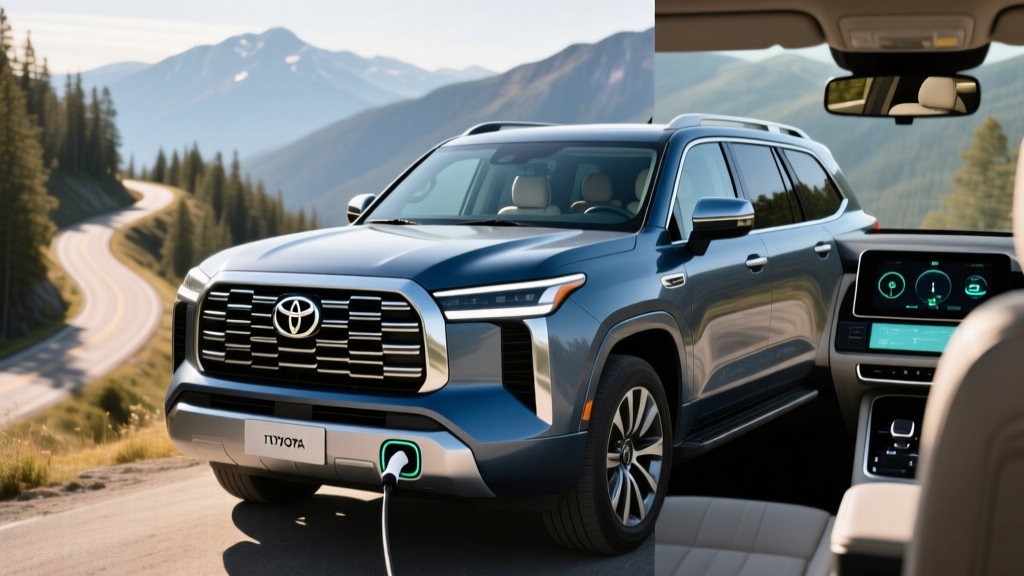
The Toyota Sequoia is proof that you don't need to sacrifice size to gain efficiency. As a full-size, three-row SUV with body-on-frame construction, it competes directly with the Chevrolet Tahoe and Ford Expedition — but unlike those rivals, every 2026 Sequoia comes exclusively with Toyota's i-FORCE MAX hybrid powertrain. There is no gas-only option. For buyers searching for a Toyota hybrid Sequoia, the proposition is straightforward: genuine truck capability wrapped in a hybrid system that cuts fuel costs without plugging in.
This guide breaks down the 2026 Sequoia's real-world fuel economy, powertrain specs, towing limits, pricing, and long-term battery reliability — with the exact numbers you need to decide if this hybrid SUV fits your garage.
HEV vs PHEV: What Kind of Hybrid Is the Sequoia?
Before evaluating the Sequoia, it's critical to understand what it is — and isn't.
- Conventional Hybrid (HEV): The Sequoia is a standard hybrid. It has no plug. The battery recharges through regenerative braking and the gasoline engine. You fuel it like any other vehicle.
- Plug-in Hybrid (PHEV): A PHEV like the Toyota RAV4 Prime has a larger battery you charge from a wall outlet, delivering 20–40 miles of electric-only driving before the gas engine engages.
- Battery Electric (BEV): A full EV like the Tesla Model X runs solely on battery power and must be plugged in to recharge.
The Sequoia is an HEV only. Toyota does not offer a plug-in Sequoia variant for 2026. If you want plug-in electric range in a Toyota SUV, you'll need to look at the RAV4 Prime or the bZ-series EVs.
2026 Sequoia Powertrain: i-FORCE MAX Hybrid Specs
| Specification | 2026 Toyota Sequoia |
|---|---|
| Engine | 3.4L twin-turbo V6 + electric motor (i-FORCE MAX) |
| Combined Horsepower | 437 HP |
| Combined Torque | 583 lb-ft |
| Transmission | 10-speed automatic |
| Drivetrain | RWD standard; 4WD available |
| Hybrid Battery | ~1.87 kWh (NiMH, self-charging) |
| 0–60 mph | ~5.6 seconds (4WD) |
| Max Towing Capacity | 9,600 lbs (RWD); 9,300 lbs (4WD) |
| Seating | 7 or 8 passengers (trim-dependent) |
The i-FORCE MAX pairs a twin-turbocharged V6 with an electric motor sandwiched between the engine and transmission. This isn't a mild efficiency assist — the electric motor fills in torque at low RPMs, giving the Sequoia the kind of off-the-line pull you'd expect from a much larger engine. The 583 lb-ft of torque arrives at just 2,000 RPM, which matters when you're merging onto a highway with a trailer in tow.
Fuel Economy: EPA Ratings and Real-World MPG
| Drivetrain | City MPG | Highway MPG | Combined MPG |
|---|---|---|---|
| RWD | 21 | 24 | 22 |
| 4WD | 19 | 22 | 20 |
Source: EPA / fueleconomy.gov
For a 6,000-pound body-on-frame SUV, 22 MPG combined (RWD) is a meaningful improvement over the previous-generation Sequoia's 15 MPG combined with its 5.7L V8. That's roughly a 47% gain in fuel efficiency.
Real-World MPG: What Owners Actually See
EPA estimates are a starting point, not a guarantee. Based on owner-reported data and third-party testing, here's what to expect:
- City driving: Hybrid systems shine here. Expect 20–23 MPG in stop-and-go traffic, where regenerative braking recaptures energy constantly. Some owners report briefly exceeding the EPA city figure in heavy urban congestion.
- Highway driving: Aerodynamic drag dominates at 70+ mph. Expect 19–22 MPG on the highway for RWD models, and 17–20 MPG for 4WD. The hybrid system offers less benefit at sustained high speeds.
- Towing: Fuel economy drops sharply when pulling a trailer. Expect 10–14 MPG depending on trailer weight, terrain, and speed. This is typical for the segment — the Expedition and Tahoe return similar numbers under load.
- Cold weather: Expect a 5–10% reduction in winter. The engine runs more often to provide cabin heat and maintain operating temperature, reducing the hybrid system's efficiency contribution.
Pricing, Trims, and Tax Credit Eligibility
The 2026 Toyota Sequoia is offered across a wide trim range. Pricing starts in the mid-$60,000s and climbs past $80,000 for top trims:
- SR5 (base): ~$63,000 MSRP
- Limited: ~$69,000 MSRP
- Platinum: ~$74,000 MSRP
- TRD Pro: ~$78,000 MSRP
- Capstone (top trim): ~$82,000 MSRP
Note: Prices are approximate MSRPs and exclude destination charges. Check Toyota's official site for current pricing.
Does the Sequoia Qualify for a Federal Tax Credit?
No. Under IRS §30D rules, the federal clean vehicle credit applies only to plug-in electric vehicles (BEVs and PHEVs) that meet battery sourcing, MSRP caps, and buyer income requirements. The Sequoia is a conventional hybrid (HEV) with no plug, so it does not qualify for the §30D credit.
Some states offer separate incentives for hybrid vehicles, but these are uncommon and vary by jurisdiction. Check your state's energy office or department of revenue for any local hybrid rebates. Toyota's official Sequoia page may also list current incentive information.
Battery Reliability, Warranty, and Replacement Cost
Hybrid battery longevity is consistently the top concern for first-time hybrid buyers. Here's what the data shows:
How Long Do Toyota Hybrid Batteries Last?
Toyota's hybrid system is among the most proven in the industry — the Prius has been on US roads since 2000. The Sequoia's NiMH hybrid battery is relatively small (~1.87 kWh) and operates within a conservative state-of-charge window, meaning it rarely cycles to full charge or full depletion. This shallow-cycling approach dramatically extends battery life.
Based on historical Toyota hybrid data:
- Most Toyota hybrid batteries last 150,000–200,000+ miles without replacement.
- Failures within the warranty period are uncommon and covered at no cost.
- Out-of-warranty replacement (if needed after 10+ years) typically costs $2,000–$4,000 for a refurbished or new OEM battery pack, including labor.
For context, the Sequoia's hybrid battery is far smaller and less expensive to replace than a full EV battery pack (which can cost $8,000–$20,000+). The hybrid system's simplicity is an ownership advantage.
Overall Reliability
Toyota consistently ranks at or near the top of J.D. Power and Consumer Reports reliability surveys. The i-FORCE MAX powertrain, shared with the Tundra pickup, has been in production since the 2022 model year, giving Toyota several years of real-world durability data. The 10-speed automatic and hybrid motor assembly carry the same powertrain warranty as the engine.
Sequoia vs. the Competition: Hybrid Advantage
| Vehicle | Combined MPG | Max Towing | Starting MSRP |
|---|---|---|---|
| 2026 Toyota Sequoia (4WD) | 20 MPG | 9,300 lbs | ~$63,000 |
| 2026 Chevrolet Tahoe (5.3L V8, 4WD) | 17 MPG | 8,400 lbs | ~$58,000 |
| 2026 Ford Expedition (3.5L EcoBoost, 4WD) | 18 MPG | 9,300 lbs | ~$60,000 |
| 2026 Jeep Wagoneer (3.0L Hurricane, 4WD) | 17 MPG | 10,000 lbs | ~$63,000 |
The Sequoia's hybrid powertrain gives it a 2–3 MPG advantage over key competitors, which translates to $400–$700 in annual fuel savings for a typical driver. It also delivers the highest combined horsepower in the segment (437 HP) while matching or exceeding towing capacity. The trade-off is a slightly higher starting price and less cargo space behind the third row compared to the Tahoe.
Who Should Buy the Toyota Hybrid Sequoia?
Pros
- Best-in-class fuel economy for a body-on-frame 3-row SUV
- 437 HP and 583 lb-ft provide effortless acceleration and towing
- 10-year/150,000-mile hybrid battery warranty
- Proven Toyota reliability and strong resale value
- No plug-in charging required — fuel it like a normal vehicle
- 9,600-lb max towing (RWD) handles boats, campers, and horse trailers
Cons
- No plug-in or EV option — still burns gasoline exclusively
- Third-row cargo space is tighter than Tahoe/Expedition
- Higher starting MSRP than some gas-only competitors
- No federal tax credit eligibility
- Fuel economy drops to 10–14 MPG when towing heavy loads
Hybrid vs PHEV vs EV: Which Powertrain Fits You?
Choose the Sequoia HEV if: You need a three-row SUV with genuine towing capacity (9,000+ lbs), you don't have reliable access to home or workplace charging, and you want lower fuel costs without changing your refueling habits.
Choose a PHEV (like the RAV4 Prime) if: You have home charging, your daily commute is under 40 miles, and you want electric-only weekday driving with gas-engine flexibility for road trips. PHEVs require behavioral change (plugging in nightly) to capture their efficiency advantage.
Choose a full EV (like the Rivian R1S or Tesla Model X) if: You have Level 2 home charging, you rarely tow heavy loads, and you want the lowest per-mile energy cost and zero tailpipe emissions. EVs eliminate oil changes and reduce brake wear through regen, but upfront costs and charging logistics remain barriers for some households.
Frequently Asked Questions
How many MPG does the Toyota hybrid Sequoia get?
The 2026 Sequoia RWD achieves an EPA-estimated 21 city / 24 highway / 22 combined MPG. The 4WD model returns 19 city / 22 highway / 20 combined. Real-world results vary: city driving often matches or slightly exceeds EPA figures thanks to regenerative braking, while sustained highway driving at 75+ mph typically returns 1–2 MPG below the sticker.
Does the Toyota Sequoia need to be plugged in?
No. The Sequoia is a conventional hybrid (HEV), not a plug-in hybrid (PHEV). Its small hybrid battery recharges automatically through regenerative braking and the gasoline engine. You never plug it in — just fill up at any gas station.
Is the Sequoia hybrid reliable, and what does battery replacement cost?
Toyota's hybrid systems have two decades of proven reliability. The Sequoia's hybrid battery is covered by a 10-year/150,000-mile warranty. Most Toyota hybrid batteries last well beyond 150,000 miles. If replacement is needed out of warranty, expect to pay $2,000–$4,000 for a refurbished or new OEM pack — significantly less than an EV battery replacement.
Does the Sequoia qualify for any federal tax credit?
No. The federal §30D clean vehicle credit applies only to plug-in vehicles (BEVs and PHEVs). The Sequoia is a conventional hybrid and does not qualify. Check your state's incentive programs for any local hybrid rebates, and consult a tax professional for personalized guidance.
How much can the Sequoia tow?
The 2026 Sequoia RWD can tow up to 9,600 pounds when properly equipped. The 4WD model is rated for 9,300 pounds. This is competitive with the Ford Expedition and exceeds the Chevrolet Tahoe's maximum rating. Expect fuel economy to drop to 10–14 MPG while towing.
Is the Sequoia a good choice for a large family?
Yes, with a caveat. The Sequoia seats seven or eight depending on trim and configuration. However, cargo space behind the third row is tighter than the Tahoe or Expedition. If maximum cargo volume with all seats in use is a priority, compare dimensions carefully. For families that prioritize fuel efficiency and reliability over maximum cargo space, the Sequoia is an excellent fit.
For the latest EPA fuel economy data, visit fueleconomy.gov. For current federal tax credit rules, see the IRS clean vehicle credit page. Always verify pricing and specifications on Toyota's official Sequoia page before purchasing.