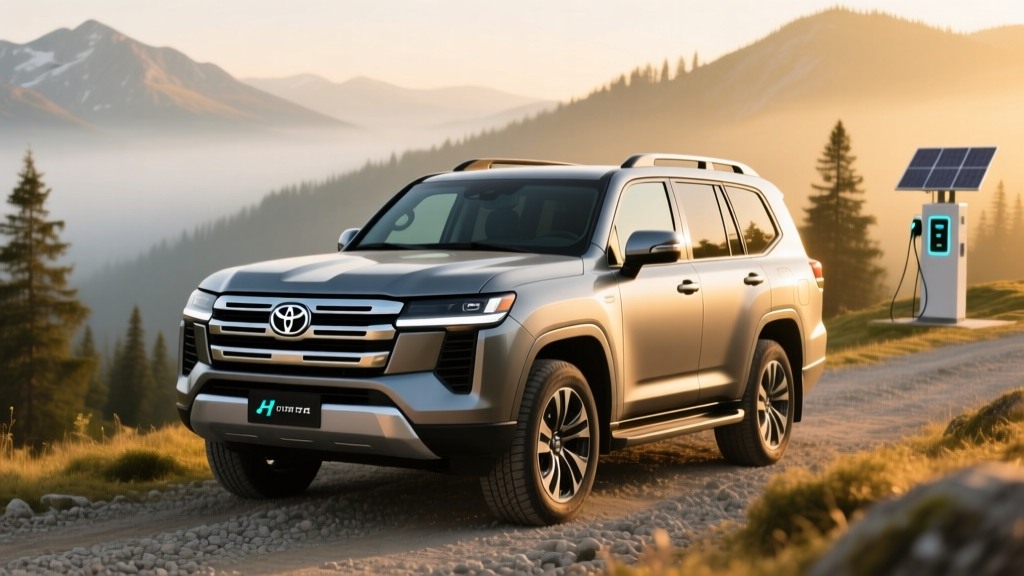
The 2026 Toyota Land Cruiser returns to its rugged roots with a turbocharged hybrid powertrain as the only engine option. Built on the TNGA-F body-on-frame platform shared with the 4Runner and Sequoia, this midsize SUV pairs serious off-road hardware with a hybrid system that keeps fuel consumption reasonable for a vehicle of its capability. But how efficient is the Toyota hybrid Land Cruiser in daily driving, and does it make financial sense over a conventional SUV or a full electric alternative?
Here's everything you need to know about the 2026 Land Cruiser's i-FORCE MAX hybrid powertrain, real-world MPG, battery longevity, and total cost of ownership.
HEV vs PHEV: Where the Land Cruiser Fits
Conventional Hybrid (HEV): The 2026 Land Cruiser is a self-charging hybrid. It uses a small battery pack charged by the engine and regenerative braking — no plug, no outlet required. You fuel it like any gas vehicle and the hybrid system recaptures energy automatically.
Plug-in Hybrid (PHEV): A PHEV like the Toyota RAV4 Prime offers 42 miles of electric-only range and requires plugging in to maximize efficiency. The Land Cruiser does not offer a PHEV variant in the US market.
This distinction matters because some shoppers confuse Toyota's hybrid branding. The Land Cruiser's i-FORCE MAX system is a conventional full hybrid — you'll never search for a charging station, but you also won't drive any meaningful distance on electric power alone. The electric motor exists to assist the turbocharged engine and improve efficiency, not to replace it.
i-FORCE MAX Powertrain: Engine + Motor Specs
| Specification | 2026 Toyota Land Cruiser |
|---|---|
| Engine | 2.4L turbocharged 4-cylinder |
| Electric Motor | Integrated between engine and transmission |
| Combined Output | 326 hp / 465 lb-ft torque |
| Transmission | 8-speed automatic (Direct Shift-8AT) |
| Drivetrain | Full-time 4WD with locking center differential |
| Hybrid Battery | ~1.87 kWh nickel-metal hydride (NiMH) |
| Towing Capacity | 6,000 lbs (est.) |
| 0-60 mph | ~6.6 seconds |
| Curb Weight | ~5,070 lbs |
The i-FORCE MAX places a 48-hp electric motor between the 2.4L turbo four-cylinder and the 8-speed automatic transmission. This sandwich-style layout delivers seamless torque fill — the electric motor provides instant low-end response while the turbo spools up, eliminating the lag typical of turbocharged engines. The result is 465 lb-ft of torque available from very low RPMs, which matters both on the highway and when crawling over obstacles.
The hybrid battery is a compact ~1.87 kWh NiMH pack mounted under the rear seat. It's small by design — this is a performance-assist hybrid, not an electric-range extender. Toyota's choice of NiMH over lithium-ion here reflects their prioritization of long-term durability and temperature resilience over energy density.
Fuel Economy: EPA MPG and Real-World Results
| Driving Cycle | EPA Estimate | Real-World Expectation |
|---|---|---|
| City | 22 MPG | 23-25 MPG (hybrids excel in stop-and-go) |
| Highway | 25 MPG | 22-24 MPG (aero drag and weight at 75+ mph) |
| Combined | 23 MPG | 22-24 MPG |
According to fueleconomy.gov, the 2026 Land Cruiser achieves an EPA-estimated 23 MPG combined. That figure places it well ahead of its predecessor (the V8-powered 200-series Land Cruiser managed roughly 14-15 MPG combined) and competitive with the Jeep Wrangler 4xe when the Jeep is running on gasoline only.
Real-world caveat: Like most body-on-frame SUVs, the Land Cruiser's boxy aerodynamics and 5,000+ lb curb weight hurt highway efficiency. Expect 22-24 MPG on a flat interstate cruise at 70-75 mph. In city driving, however, the hybrid system's regenerative braking and engine-off coasting can push you to 24-25 MPG — hybrids routinely beat their EPA city numbers in traffic-heavy conditions. Cold weather, heavy cargo loads, and aggressive off-road use will drop these numbers by 10-15%.
For context, the non-hybrid 2026 Toyota 4Runner with the same i-FORCE MAX powertrain achieves 23 MPG combined as well, while the Ford Bronco with the 2.7L EcoBoost V6 returns roughly 20 MPG combined. The hybrid advantage is modest but meaningful over the life of the vehicle.
Pricing, Trims, and Tax Credit Eligibility
The 2026 Toyota Land Cruiser is offered in two primary trims:
- Land Cruiser 1958: Starting at approximately $57,345 (including destination)
- Land Cruiser (standard): Starting at approximately $62,395 (including destination)
Federal Tax Credit: The Land Cruiser is a conventional hybrid (HEV), not a plug-in hybrid or battery-electric vehicle. It does not qualify for the federal §30D Clean Vehicle Credit, which requires plug-in capability and minimum battery capacity. Some states offer modest rebates for conventional hybrids — check your state energy office or IRS §30D guidelines for current rules. Toyota's hybrid tax credit days (the original Prius credit) ended years ago under the previous manufacturer cap system.
At $57,000-$62,000 before options, the Land Cruiser competes with the Jeep Wrangler Unlimited Rubicon (~$52,000-$58,000), Ford Bronco Badlands (~$50,000-$56,000), and the Lexus GX 550 (~$64,000). The Lexus shares the TNGA-F platform and i-FORCE MAX powertrain but trades off-road focus for luxury appointments.
Battery Warranty, Lifespan, and Replacement Cost
Hybrid Battery Warranty: Toyota covers the Land Cruiser's hybrid battery for 10 years or 150,000 miles, whichever comes first. This warranty guarantees the battery will retain sufficient capacity for normal hybrid operation. If the pack degrades beyond Toyota's threshold, they will repair or replace it at no cost.
Toyota's NiMH hybrid batteries have an exceptional longevity track record. The Prius — using similar chemistry — routinely surpasses 200,000 miles on its original hybrid battery. The Land Cruiser's pack is smaller and less stressed than a PHEV or BEV battery, which works in its favor for longevity. NiMH chemistry is less susceptible to thermal degradation than lithium-ion, and Toyota's battery management system is conservative by design.
Out-of-warranty replacement cost: If the hybrid battery fails after the 10-year/150,000-mile window, replacement runs approximately $2,500-$4,000 for the battery pack itself, plus $500-$1,000 in labor. This is dramatically less than a BEV battery replacement ($10,000-$20,000+) because the pack is small and NiMH cells are less expensive. Some independent hybrid specialists offer refurbished packs for $1,500-$2,500 installed.
The conventional 12V auxiliary battery and all other powertrain components carry Toyota's standard 3-year/36,000-mile basic and 5-year/60,000-mile powertrain warranties.
Who Should Buy the Toyota Hybrid Land Cruiser?
Pros
- Legendary Toyota off-road durability with modern tech
- 465 lb-ft of torque for towing and trail crawling
- 23 MPG combined — 60%+ improvement over the old V8 Land Cruiser
- 10-year/150,000-mile hybrid battery warranty
- No plug-in charging required — fuel and go
- Strong resale value (Land Cruiser historically retains 65%+ at 5 years)
Cons
- No electric-only driving range (HEV, not PHEV)
- 23 MPG is still thirsty compared to crossovers and sedans
- No federal tax credit eligibility
- Starting price above $57,000 with limited trim options
- Third-row seat not available (two-row only)
- Cargo space limited by body-on-frame packaging
Choose the Land Cruiser hybrid if:
You need serious off-road capability and towing (6,000 lbs), want Toyota's proven long-term reliability, don't have access to home charging, and value the heritage and resale value of the Land Cruiser nameplate. This is the buyer who'd otherwise purchase a Wrangler or Bronco but prefers Toyota's durability record and doesn't need a plug-in.
Consider a PHEV instead if:
Your daily commute is under 40 miles and you have home charging. A Toyota RAV4 Prime (42 miles electric-only, 94 MPGe) or Jeep Wrangler 4xe (22 miles electric, 49 MPGe) will deliver far lower fuel costs on daily drives while still offering off-road capability. PHEVs also qualify for the $7,500 federal tax credit (subject to income, MSRP, and battery-sourcing requirements under current IRS rules).
Consider a full EV if:
You want zero tailpipe emissions, have reliable home Level 2 charging, and don't need to tow more than 5,000 lbs or venture into remote areas without charging infrastructure. Vehicles like the Rivian R1S (EPA 352 miles, ~$79,900) offer comparable off-road chops with far lower per-mile energy costs — but at a significantly higher purchase price.
Land Cruiser vs. the Electrified Alternatives
| Vehicle | Powertrain | EPA Combined | Electric Range | Starting Price | Fed. Credit |
|---|---|---|---|---|---|
| 2026 Toyota Land Cruiser | HEV (i-FORCE MAX) | 23 MPG | None | $57,345 | None |
| Jeep Wrangler 4xe | PHEV | 49 MPGe / 20 MPG gas | 22 mi | ~$54,595 | Up to $7,500* |
| Toyota RAV4 Prime | PHEV | 94 MPGe / 38 MPG gas | 42 mi | ~$44,590 | Up to $7,500* |
| Rivian R1S (Dual-Motor) | BEV | 111 MPGe | 352 mi | ~$79,900 | Up to $7,500* |
* Federal §30D credit eligibility depends on buyer income caps, vehicle MSRP caps, battery critical-mineral sourcing, and point-of-sale transfer rules. Verify current eligibility at irs.gov before purchasing.
The Land Cruiser occupies a unique niche: body-on-frame, full-time 4WD, and heritage credibility — but without the plug. If your priority is maximum off-road capability with minimum lifestyle change (no charging routine, no range planning), the hybrid Land Cruiser delivers. If your priority is fuel cost savings and you can charge at home, a PHEV or BEV will save you $1,500-$3,000+ annually in fuel and may net a $7,500 tax credit that the Land Cruiser cannot.
Frequently Asked Questions
How many MPG does the Toyota hybrid Land Cruiser get?
The 2026 Land Cruiser with the i-FORCE MAX hybrid achieves an EPA-estimated 22 city / 25 highway / 23 combined MPG. In real-world city driving with frequent stops, owners often see 24-25 MPG thanks to regenerative braking. Highway cruising at 75+ mph typically drops to 21-22 MPG due to the vehicle's aerodynamics and weight.
Can the Land Cruiser drive on electric power only?
Not in any practical sense. The i-FORCE MAX is a conventional hybrid (HEV), meaning the electric motor assists the gas engine but cannot propel the vehicle for meaningful distances on its own. You may experience brief electric-only movement at very low speeds (parking lots, traffic creep), but there is no EV mode button and no electric-only range specification. For electric-only commuting, you'd need a PHEV like the RAV4 Prime or a full BEV.
Is the Toyota hybrid Land Cruiser reliable?
Toyota's hybrid systems are among the most proven in the industry, with over 25 years of real-world data since the original Prius. The i-FORCE MAX is newer (introduced in the Tundra for 2022), but uses Toyota's well-established hybrid synergy drive architecture. The Land Cruiser nameplate carries Toyota's highest durability standards. The hybrid battery is warranted for 10 years / 150,000 miles, and NiMH chemistry has historically shown excellent longevity with minimal degradation.
What does a Land Cruiser hybrid battery replacement cost?
Out-of-warranty hybrid battery replacement for the Land Cruiser is estimated at $2,500-$4,000 for the NiMH pack plus $500-$1,000 labor, totaling roughly $3,000-$5,000. This is far less than a BEV battery replacement because the pack is small (~1.87 kWh). Given Toyota's 10-year/150,000-mile hybrid battery warranty and the proven track record of NiMH packs exceeding 200,000 miles, most owners will never face this cost.
Does the Land Cruiser hybrid qualify for any tax credit?
No. The federal §30D Clean Vehicle Credit applies only to plug-in electric vehicles (PHEVs and BEVs) that meet battery capacity, sourcing, MSRP, and buyer income requirements. The Land Cruiser is a conventional hybrid (HEV) with no plug, so it does not qualify. Some states or local utilities may offer small incentives for hybrid purchases — check your state energy office. The EPA fueleconomy.gov site lists current federal and state incentive eligibility by vehicle.
How does the Land Cruiser hybrid compare to the old V8 Land Cruiser on fuel economy?
The final V8 Land Cruiser (2021 model year, 5.7L V8) achieved roughly 14 MPG combined. The 2026 i-FORCE MAX hybrid at 23 MPG combined represents a ~64% improvement. Over 15,000 annual miles and $3.50/gallon gas, that's roughly 750 fewer gallons per year — a savings of about $2,625 annually in fuel costs alone.
Does the hybrid system affect off-road capability?
No — it enhances it. The electric motor's instant torque fills in the gap before the turbo spools, giving smoother low-speed crawling control. The Land Cruiser retains full-time 4WD with a locking center differential, Multi-Terrain Select, and Crawl Control. Ground clearance, approach/departure angles, and water fording depth are unchanged from what the platform supports. The hybrid system adds roughly 150 lbs over a conventional powertrain but lowers the center of gravity slightly due to battery placement.