If you've ever watched a Toyota Prius glide silently away from a stoplight and wondered what's actually happening under the hood, you're not alone. Toyota has sold over 25 million hybrid vehicles worldwide, making its Hybrid Synergy Drive system one of the most proven electrified powertrains on the road. But "hybrid" means different things depending on which Toyota you're looking at — and understanding the distinction between a conventional hybrid (HEV) and a plug-in hybrid (PHEV) is the first step to choosing the right one.
This guide explains exactly how Toyota's hybrid systems work, the real-world MPG you can expect, battery longevity, and whether an HEV, PHEV, or full battery-electric vehicle (BEV) fits your driving life in 2026.
The Two Flavors: Toyota HEV vs. Toyota PHEV
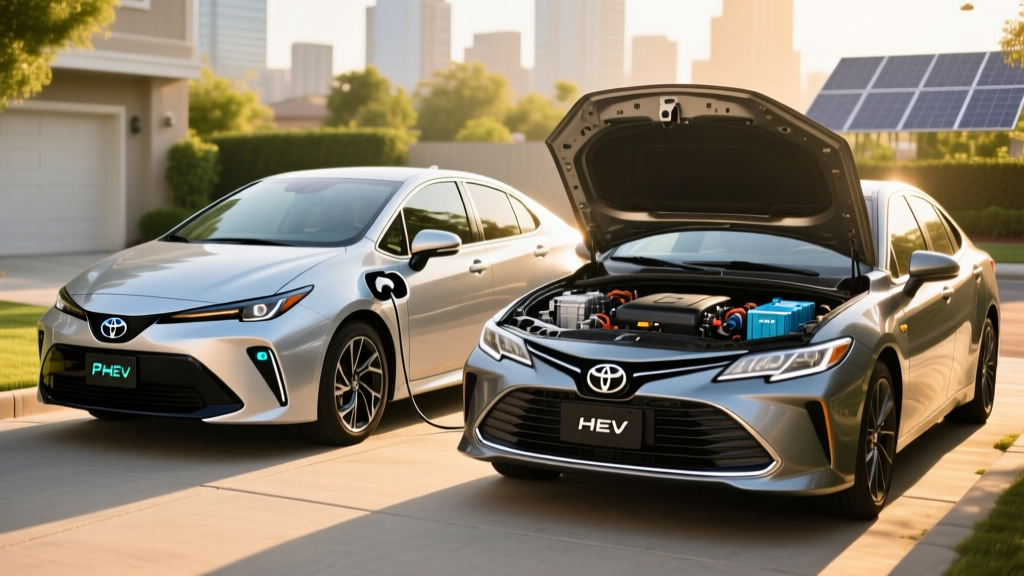
Toyota sells two fundamentally different types of hybrid vehicles, and confusing them is the most common mistake buyers make. Here's the quick distinction:
Conventional Hybrid (HEV)
Examples: 2026 Toyota Prius, Camry Hybrid, RAV4 Hybrid, Highlander Hybrid, Corolla Hybrid, Sienna
- No plug required — the battery charges via regenerative braking and the gasoline engine
- Small battery: typically 0.9–1.6 kWh (not enough for meaningful electric-only driving)
- Electric motor assists the gas engine; brief EV mode at very low speeds only
- Fuels exclusively with gasoline — you never plug it in
Plug-in Hybrid (PHEV)
Examples: 2026 Toyota Prius Prime, RAV4 Prime
- Plug-in capable — charges from a wall outlet, Level 2 charger, or (in some cases) DC fast charger
- Larger battery: 13.6–18.1 kWh usable, enabling 39–42 miles of electric-only driving
- Drives as a full EV until the battery depletes, then seamlessly transitions to hybrid mode
- Uses both electricity and gasoline depending on charge state
The critical takeaway: a conventional Toyota HEV never needs to be plugged in. If someone tells you "hybrids need charging," they're confusing HEVs with PHEVs or full EVs.
How Toyota's Hybrid Synergy Drive Actually Works
At the core of most Toyota hybrids is the Hybrid Synergy Drive (HSD) system, which uses a power-split device — essentially a planetary gearset — to seamlessly blend power from the gasoline engine and one or more electric motors. Here's what happens in each driving scenario:
Starting from a Stop
The gasoline engine stays off. The electric motor (powered by the hybrid battery) propels the car silently. This is why hybrids excel in city traffic — the engine, which is least efficient at low speeds and idling, simply isn't running.
Normal Cruising
The power-split device routes engine power to the wheels while simultaneously spinning a generator to keep the battery topped up. The engine operates in its most efficient RPM range, which is where hybrids gain their advantage over conventional gas cars.
Hard Acceleration
Both the gasoline engine and electric motor deliver torque simultaneously. In the 2026 Prius, this combines for up to 196 horsepower — a dramatic improvement from earlier generations that prioritized efficiency over performance.
Braking and Deceleration
The electric motor reverses function and becomes a generator, converting kinetic energy into electricity to recharge the hybrid battery. This regenerative braking captures energy that a conventional car would waste as heat in the brake pads.
Toyota's PHEVs (Prius Prime, RAV4 Prime) use the same fundamental architecture but with a larger battery pack and a more powerful electric motor, enabling sustained electric-only driving at highway speeds up to 84 mph before the engine kicks in.
EPA MPG Breakdown: 2026 Toyota Hybrid Lineup
Fuel economy varies significantly across Toyota's hybrid range. Here are the official EPA figures for current models, sourced from fueleconomy.gov:
| Model | Type | City MPG | Highway MPG | Combined MPG | EV-Only Range (mi) | Total Range (mi) |
|---|---|---|---|---|---|---|
| Prius (FWD) | HEV | 57 | 56 | 57 | N/A | ~600 |
| Prius (AWD) | HEV | 53 | 54 | 54 | N/A | ~570 |
| Prius Prime | PHEV | 52 (hybrid mode) | 48 (hybrid mode) | 50 (hybrid mode) | 44 (127 MPGe) | ~480 |
| Camry Hybrid (FWD) | HEV | 53 | 50 | 52 | N/A | ~580 |
| Corolla Hybrid (AWD) | HEV | 53 | 46 | 50 | N/A | ~540 |
| RAV4 Hybrid (AWD) | HEV | 41 | 38 | 40 | N/A | ~520 |
| RAV4 Prime (AWD) | PHEV | 40 (hybrid mode) | 36 (hybrid mode) | 38 (hybrid mode) | 42 (94 MPGe) | ~600 |
| Highlander Hybrid (AWD) | HEV | 36 | 35 | 36 | N/A | ~540 |
| Sienna (FWD) | HEV | 36 | 36 | 36 | N/A | ~620 |
Real-World MPG vs. EPA Sticker
Toyota hybrids consistently match or exceed their EPA city ratings in real-world driving — the opposite of what many gas-only cars deliver. The reason is physics: regenerative braking and engine-off idle are most beneficial in stop-and-go traffic, which is exactly the condition where EPA city tests operate. In practice:
- City driving: Expect EPA numbers or slightly better. Many Prius owners report 58–62 MPG in warm-weather urban commuting.
- Highway driving: Expect EPA numbers or 2–4 MPG less. At sustained 75+ mph, the engine does most of the work and aerodynamic drag dominates.
- Cold weather (below 32°F): Expect a 10–15% MPG reduction. The engine runs more often to provide cabin heat and warm up the catalytic converter.
Powertrain Specs: Engine, Motor, and Combined Output
| Model | Engine | Engine HP | Electric Motor HP | Combined Net HP | 0–60 mph | Drivetrain |
|---|---|---|---|---|---|---|
| Prius (FWD) | 2.0L 4-cyl | 150 | 83 | 196 | 7.2 sec | FWD |
| Prius (AWD) | 2.0L 4-cyl | 150 | 83 + 40 (rear) | 196 | 7.0 sec | AWD |
| Prius Prime | 2.0L 4-cyl | 150 | 161 | 220 | 6.6 sec | FWD |
| Camry Hybrid | 2.5L 4-cyl | 184 | 134 | 225 (FWD) / 232 (AWD) | 6.9 sec | FWD / AWD |
| RAV4 Hybrid | 2.5L 4-cyl | 176 | 118 + 54 (rear) | 219 | 7.4 sec | AWD |
| RAV4 Prime | 2.5L 4-cyl | 177 | 180 + 54 (rear) | 302 | 5.7 sec | AWD |
The RAV4 Prime's 302 combined horsepower deserves a callout: it's the quickest RAV4 Toyota has ever sold, and its 5.7-second 0–60 time outpaces many sport sedans. The PHEV powertrain doesn't just save fuel — it delivers substantial performance gains from instant electric torque.
PHEV Deep Dive: Battery, Charging, and Electric Range
If you're considering a Toyota PHEV, the battery and charging specs determine how much of your daily driving can be electric-only.
| Spec | Prius Prime (2026) | RAV4 Prime (2026) |
|---|---|---|
| Battery capacity (usable) | 13.6 kWh | 18.1 kWh |
| Battery chemistry | Lithium-ion (NMC) | Lithium-ion (NMC) |
| EPA electric-only range | 44 miles | 42 miles |
| EV mode top speed | 84 mph | 84 mph |
| Level 1 charging (120V) | ~10 hours (full) | ~12 hours (full) |
| Level 2 charging (240V, 3.3 kW) | ~4 hours (full) | ~5.5 hours (full) |
| DC fast charging | Not supported | Not supported |
Critical note on DC fast charging: Neither Toyota PHEV currently supports DC fast charging. This is typical for PHEVs — the battery is small enough that Level 2 overnight charging fully replenishes it, and adding DC fast-charge hardware would increase cost and weight for minimal benefit. If you need rapid public charging, a full BEV is the better choice.
Real-World Electric Range
In moderate temperatures (55–80°F) with mixed city/highway driving, expect the Prius Prime to deliver close to its 44-mile EPA rating. In cold weather (below freezing), anticipate 30–35 miles of electric range — a 20–25% reduction due to cabin heating demand and reduced battery efficiency. Highway-only driving at 70+ mph will also reduce EV range to roughly 35–38 miles.
Pricing and Tax Credit Eligibility
Here's where Toyota's hybrid lineup gets interesting from a value perspective. Base MSRPs for 2026 models:
- Corolla Hybrid: ~$24,000
- Prius (LE): ~$29,000
- Prius Prime (SE): ~$34,000
- Camry Hybrid (LE): ~$30,000
- RAV4 Hybrid (LE): ~$33,500
- RAV4 Prime (SE): ~$44,500
- Highlander Hybrid (LE): ~$42,000
- Sienna (LE): ~$39,000
Federal Tax Credit: PHEVs Only
Under current IRS §30D rules, only Toyota's plug-in hybrids may qualify for the federal clean vehicle credit — conventional HEVs do not qualify. However, eligibility is far from guaranteed and depends on several factors:
- Battery sourcing and critical minerals: The PHEV must meet escalating domestic-content thresholds for battery components and critical minerals. These requirements tighten annually and may reduce or eliminate the credit for certain model years.
- MSRP cap: Vans, SUVs, and pickups must have an MSRP ≤ $80,000; sedans ≤ $55,000. Both Toyota PHEVs currently fall under these caps.
- Buyer income cap: Adjusted gross income must not exceed $150,000 (single), $225,000 (head of household), or $300,000 (joint filers).
- Point-of-sale transfer: As of 2024, eligible buyers can transfer the credit to the dealer for an immediate price reduction at purchase rather than waiting for tax filing.
Conventional Toyota hybrids (Prius, Camry Hybrid, RAV4 Hybrid, etc.) do not qualify for the §30D federal credit because they cannot be plugged in. Some states and utilities offer separate rebates for HEVs, but these vary by jurisdiction — check your state energy office or utility provider for current programs.
Battery Warranty, Lifespan, and Replacement Cost
Toyota Hybrid Battery Warranty
Coverage: 10 years / 150,000 miles (whichever comes first) for the hybrid battery pack on all 2020-and-newer Toyota hybrids and PHEVs.
What's covered: Defects and capacity loss below a specified threshold (typically ~70% of original capacity, though Toyota does not publish an exact degradation floor publicly).
Powertrain warranty: 5 years / 60,000 miles for the hybrid transaxle, inverter, and related components.
How Long Do Toyota Hybrid Batteries Actually Last?
This is the single most common concern among hybrid buyers, and the data is reassuring. Toyota's hybrid battery packs are engineered with a significant state-of-charge buffer — the system never fully charges or fully depletes the battery, keeping it in the 40–80% SoC sweet spot where lithium-ion degradation is minimal. This is fundamentally different from a full EV, which routinely cycles through a wider SoC range.
Real-world longevity data from fleet operators and high-mileage owners shows:
- Prius taxi fleets: Routinely reach 200,000–300,000 miles on the original hybrid battery
- Consumer Reports data: Hybrid battery failure rates for Toyota remain below 5% through the first 10 years of ownership
- Typical lifespan: Most Toyota hybrid batteries outlast the vehicle itself. Failures before 150,000 miles are uncommon and usually covered under warranty
Battery Replacement Cost
If you do need a replacement outside warranty:
- New OEM battery: $2,000–$4,000 depending on model (Prius: ~$2,500; RAV4 Prime: ~$4,000+)
- Refurbished/remanufactured: $1,000–$2,000 from third-party suppliers
- Individual module replacement: Some specialists can replace only the failed cells within the pack for $500–$1,000
For context, a conventional car's transmission replacement often costs $3,000–$5,000. The hybrid battery is not the financial time bomb some skeptics suggest.
Toyota Hybrid vs. PHEV vs. Full EV: Which Is Right for You?
Choose a Toyota HEV (Prius, Camry Hybrid, RAV4 Hybrid) if:
- You cannot charge at home (no garage, no outlet access, apartment living)
- You want maximum fuel savings with zero behavior change — just fill up with gas
- Your budget is under $35,000 and you want proven reliability
- You drive primarily in city/suburban traffic where regenerative braking shines
- You want the lowest total cost of ownership without worrying about charging infrastructure
Choose a Toyota PHEV (Prius Prime, RAV4 Prime) if:
- You can charge at home (even a standard 120V outlet works overnight)
- Your daily commute is under 40 miles round-trip — you may rarely use gasoline
- You want EV-like daily driving but need gas-engine range for road trips
- You may qualify for the federal tax credit or state PHEV incentives
- You want strong acceleration (RAV4 Prime's 302 HP is genuinely quick)
Choose a Full BEV (e.g., Tesla Model Y, Hyundai Ioniq 5, Toyota bZ4X) if:
- You have reliable home Level 2 charging and access to DC fast-charging networks
- You want zero tailpipe emissions and minimal maintenance (no oil, no spark plugs)
- Your daily driving is predictable and within the vehicle's range
- You want the lowest per-mile fuel cost (electricity is typically $0.04–$0.06/mile vs. $0.12–$0.15/mile for a 50-MPG hybrid on $3.50/gal gas)
- You qualify for the full $7,500 federal EV tax credit
Pros and Cons at a Glance
Toyota HEV — Pros
- Exceptional city MPG (53–57 EPA)
- No charging infrastructure needed
- Proven 25-year reliability track record
- 10-year/150,000-mile battery warranty
- Competitive pricing starting ~$24,000
- Strong resale value
Toyota HEV — Cons
- No federal tax credit eligibility
- No meaningful electric-only driving
- Still burns gasoline 100% of the time
- Highway MPG advantage over efficient gas cars is smaller
Toyota PHEV — Pros
- 39–44 miles of electric-only range covers most commutes
- Gas engine eliminates range anxiety on road trips
- RAV4 Prime delivers 302 HP and 5.7-sec 0–60
- Potential federal tax credit eligibility
- Charges on standard 120V outlet overnight
Toyota PHEV — Cons
- Higher base price ($34,000–$44,500)
- No DC fast charging support
- Tax credit eligibility depends on sourcing rules and income caps
- Heavier than HEV counterparts (affects handling)
- RAV4 Prime frequently has limited dealer availability
Frequently Asked Questions
How many MPG does a Toyota hybrid get?
It depends on the model. The 2026 Prius FWD achieves 57/56/57 MPG (city/highway/combined). The Camry Hybrid gets 53/50/52. The RAV4 Hybrid delivers 41/38/40. In real-world city driving, many owners match or slightly exceed these EPA figures thanks to aggressive regenerative braking.
How far can the Toyota Prius Prime go on electric only?
The 2026 Prius Prime has an EPA-rated 44 miles of electric-only range at speeds up to 84 mph. The RAV4 Prime offers 42 miles. In cold weather, expect roughly 30–35 miles from the Prius Prime and 28–33 miles from the RAV4 Prime due to cabin heating demand and reduced battery efficiency.
Do Toyota hybrids need to be plugged in?
No. Conventional Toyota hybrids (HEVs) never need to be plugged in. The battery charges through regenerative braking and the gasoline engine. Only Toyota's plug-in hybrids — the Prius Prime and RAV4 Prime — benefit from being plugged in, and even they operate perfectly fine as regular hybrids if you never charge them.
Is a Toyota hybrid reliable and what does battery replacement cost?
Toyota hybrids are among the most reliable vehicles in their segments, consistently earning top marks from Consumer Reports and J.D. Power. The hybrid battery carries a 10-year/150,000-mile warranty, and real-world data shows most batteries last well beyond 200,000 miles. If replacement is needed out of warranty, expect $2,000–$4,000 for a new OEM pack, or $1,000–$2,000 for a refurbished unit.
Does a Toyota hybrid qualify for a tax credit?
Conventional Toyota hybrids (Prius, Camry Hybrid, RAV4 Hybrid, etc.) do not qualify for the federal §30D clean vehicle credit because they cannot be plugged in. Toyota PHEVs (Prius Prime, RAV4 Prime) may qualify depending on current battery-sourcing requirements, MSRP caps, and your income. Check the IRS clean vehicle credit page for current eligibility details, and consult a tax professional for your specific situation. Some states offer additional incentives for both HEVs and PHEVs.
How does Toyota's hybrid system differ from a full EV?
A Toyota HEV always uses its gasoline engine as the primary power source, with the electric motor assisting for efficiency. A full EV (like the Toyota bZ4X) uses no gasoline at all — it's 100% battery-electric with 200+ miles of range. A Toyota PHEV splits the difference: it drives as an EV for 39–44 miles, then operates as a conventional hybrid. Think of it as a spectrum from gas-dominant (HEV) to electric-dominant (BEV), with PHEV in the middle.
Is the RAV4 Prime worth the premium over the RAV4 Hybrid?
If you can charge at home and your daily driving is under 42 miles, the RAV4 Prime pays for its ~$11,000 premium through fuel savings, dramatically stronger acceleration (302 HP vs. 219 HP), and potential tax credit eligibility. If you can't charge at home or regularly drive more than 50 miles daily, the RAV4 Hybrid offers excellent efficiency at a significantly lower price.