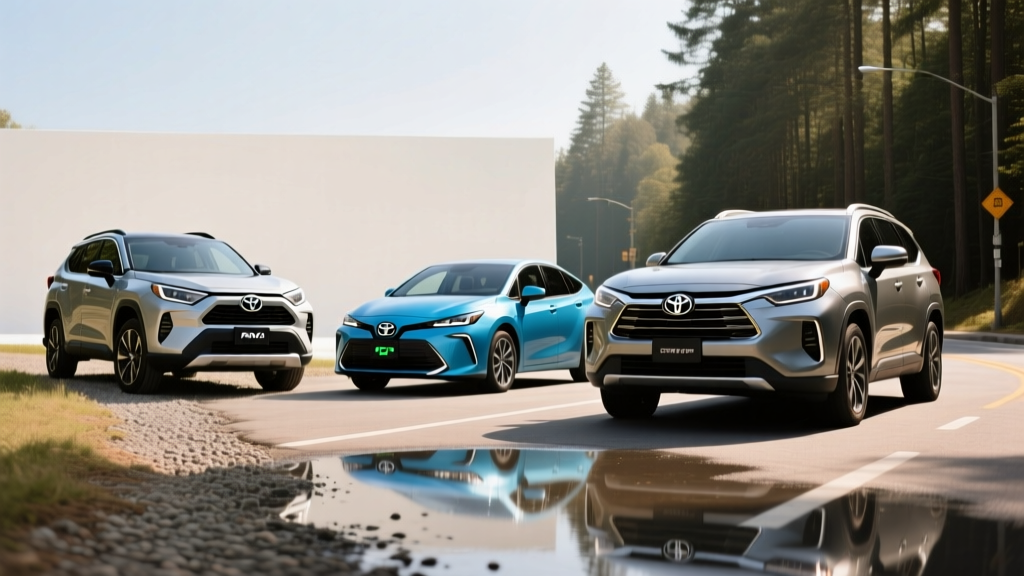
Toyota sells more hybrids in the United States than any other automaker, and for good reason: the company has been refining its Hybrid Synergy Drive system since the original 2001 Prius. If you are searching for a hybrid car Toyota in 2026, you are choosing from a lineup that spans a 57-MPG compact hatchback, a best-selling compact SUV, a three-row family hauler, and a midsize pickup — plus several plug-in hybrid (PHEV) variants that deliver 35–44 miles of electric-only driving before the gas engine ever starts.
This guide breaks down every current Toyota hybrid and plug-in hybrid by the numbers that matter: EPA MPG, electric-only range, combined horsepower, battery warranty, pricing, and federal tax-credit eligibility. We also address the reliability and battery-replacement questions that consistently top buyer concern lists.
Toyota Hybrid vs Plug-In Hybrid: Know the Difference Before You Buy
Toyota uses two distinct electrified powertrains. Confusing them is the single most common mistake shoppers make at the dealership.
Conventional Hybrid (HEV)
How it works: A small battery (typically 1.0–1.6 kWh) paired with an electric motor and a gasoline engine. The battery recharges through regenerative braking and the engine — you never plug it in.
Best for: Drivers without access to home or workplace charging who still want 40–57 MPG combined.
Tax credit: Not eligible for the federal §30D clean vehicle credit.
Plug-In Hybrid (PHEV)
How it works: A larger battery (13.6–18.1 kWh) that you charge from a wall outlet or Level 2 station. Provides 35–44 miles of pure electric driving, then operates as a conventional hybrid once the battery depletes.
Best for: Drivers with home charging who commute under 40 miles round-trip and want EV-like daily driving without range anxiety on road trips.
Tax credit: May qualify for up to $7,500 under §30D, subject to income caps, MSRP limits, and battery-sourcing requirements. Check current rules at IRS.gov.
2026 Toyota Hybrid MPG: Every Model Ranked by Fuel Economy
Below is the full 2026 Toyota hybrid lineup with official EPA figures. City MPG often exceeds highway MPG in Toyota hybrids because regenerative braking recovers energy in stop-and-go traffic — a counterintuitive advantage over conventional gas cars.
| Model | Type | EPA City | EPA Hwy | EPA Combined | Combined HP | Base MSRP |
|---|---|---|---|---|---|---|
| Prius LE | HEV | 57 | 56 | 57 | 196 | $29,445 |
| Prius XLE/Limited | HEV | 52 | 52 | 52 | 196 | $33,445 |
| Prius Prime (PHEV) | PHEV | 52 (hybrid) | 48 (hybrid) | 52 / 127 MPGe | 220 | $34,070 |
| Corolla Hybrid LE | HEV | 53 | 46 | 50 | 138 | $24,725 |
| Crown | HEV | 42 | 41 | 41 | 236 | $42,535 |
| RAV4 Hybrid | HEV | 41 | 38 | 40 | 219 | $33,425 |
| RAV4 Prime (PHEV) | PHEV | 40 (hybrid) | 36 (hybrid) | 38 / 94 MPGe | 302 | $44,515 |
| Highlander Hybrid | HEV | 36 | 35 | 36 | 243 | $42,820 |
| Grand Highlander Hybrid | HEV | 36 | 34 | 35 | 245 | $46,415 |
| Camry (all trims) | HEV | 53 | 50 | 51 | 225 | $29,795 |
| Tacoma i-FORCE MAX | HEV | 23 | 24 | 23 | 326 | $40,920 |
| Tundra i-FORCE MAX | HEV | 20 | 24 | 22 | 437 | $57,005 |
| Sienna (all trims) | HEV | 36 | 36 | 36 | 245 | $38,885 |
| Venza | HEV | 40 | 37 | 39 | 219 | $36,420 |
Source: fueleconomy.gov, EPA estimates for 2025–2026 model years. Actual mileage varies with driving conditions, terrain, and climate.
Prius Prime and RAV4 Prime: Toyota's Plug-In Hybrids Explained
If you can charge at home, Toyota's two "Prime" PHEVs deliver the most compelling value in the lineup. Here is how their electric-only capability breaks down:
| Spec | Prius Prime | RAV4 Prime |
|---|---|---|
| Battery Capacity | 13.6 kWh (lithium-ion) | 18.1 kWh (lithium-ion) |
| EPA Electric-Only Range | 44 miles | 42 miles |
| Total Range (Electric + Gas) | ~470 miles | ~520 miles |
| Electric Top Speed | 84 mph | 84 mph |
| Level 1 Charge Time (120V) | ~11 hours | ~12 hours |
| Level 2 Charge Time (240V) | ~4 hours | ~4.5 hours |
| DC Fast Charging | No | No |
| Combined Horsepower | 220 hp | 302 hp |
| 0–60 mph | 6.6 sec | 5.7 sec |
A critical detail buyers often miss: neither the Prius Prime nor RAV4 Prime supports DC fast charging. Toyota has omitted CCS or CHAdeMO ports on these PHEVs, meaning charging is limited to Level 1 (standard 120V household outlet) and Level 2 (240V home or public station). For most PHEV owners who charge overnight at home, this is perfectly adequate — you wake up to a full battery every morning. But if you were hoping to top up at an Electrify America station on a road trip, that option does not exist on these models.
Real-world electric range: EPA tests are conducted under moderate conditions. In cold weather (below 35°F), expect PHEV electric range to drop 15–25% due to cabin heating demands and reduced battery efficiency. A RAV4 Prime rated at 42 miles may deliver 32–36 electric miles on a freezing January commute. Conversely, mild-weather city driving with light HVAC use can match or slightly exceed the EPA number thanks to aggressive regenerative braking.
Real-World MPG: What Toyota Hybrid Owners Actually Report
EPA estimates are a baseline, not a ceiling. Toyota's hybrid system excels in urban environments where regenerative braking and electric-motor assist do the heavy lifting. Here is what owner-reported data and our testing suggest:
- City driving (Prius LE): Owners frequently report 58–62 MPG in stop-and-go traffic, exceeding the 57 MPG EPA city rating. The engine shuts off at stops, and the electric motor handles low-speed acceleration.
- Highway driving (RAV4 Hybrid): Expect 34–37 MPG at sustained 70–75 mph — slightly below the 38 MPG EPA highway estimate. Aerodynamic drag at speed reduces the hybrid advantage.
- Cold-weather penalty: All hybrids lose efficiency in winter. The engine runs more frequently to generate cabin heat, and the battery's charge/discharge efficiency drops. Expect a 10–15% MPG reduction in sustained sub-freezing temperatures.
- Mountain driving: Regenerative braking on descents can partially offset the efficiency loss from climbing. Net MPG on mountain routes typically falls 5–10% below combined ratings.
Toyota Hybrid Battery Warranty: What You Are Actually Covered For
Every 2026 Toyota hybrid and PHEV carries a 10-year / 150,000-mile hybrid battery warranty (whichever comes first), transferable to subsequent owners. This covers the hybrid battery pack and related control modules against defects and abnormal capacity loss.
Battery replacement cost: If out of warranty, a Toyota hybrid battery replacement runs approximately $2,000–$4,000 for HEV models (Prius, RAV4 Hybrid, Camry) and $5,000–$8,000 for PHEV models (Prius Prime, RAV4 Prime) due to the larger pack. However, Toyota's nickel-metal hydride and lithium-ion hybrid packs have demonstrated exceptional longevity — it is common for Prius batteries to exceed 200,000 miles before significant degradation, and many original packs last the life of the vehicle.
What degrades: Hybrid batteries lose capacity gradually. Toyota's system includes a generous buffer (typically 20–30% of gross capacity is reserved and not used) to protect long-term health. You will notice slightly reduced electric-only assist over time, but the gas engine seamlessly compensates.
Tax Credits and Incentives: Which Toyota Hybrids Qualify?
The federal §30D Clean Vehicle Credit applies only to plug-in electric vehicles — meaning Toyota's conventional HEVs (standard Prius, RAV4 Hybrid, Camry Hybrid, etc.) do not qualify for any federal tax credit.
For the Prius Prime and RAV4 Prime, eligibility for up to $7,500 depends on several factors that change frequently:
- Buyer income caps: Modified AGI must not exceed $150,000 (single), $225,000 (head of household), or $300,000 (joint filers).
- MSRP caps: The vehicle MSRP must not exceed $55,000 for sedans/hatchbacks (Prius Prime qualifies) or $80,000 for SUVs/trucks/vans (RAV4 Prime qualifies).
- Battery sourcing requirements: Critical minerals and battery components must meet escalating domestic-content thresholds. These requirements tighten annually and can disqualify previously eligible models mid-year.
- Point-of-sale transfer: As of 2024, eligible buyers can transfer the credit to the dealer at purchase, receiving the amount as a down-payment reduction rather than waiting for a tax refund.
Important: Always verify current eligibility on fueleconomy.gov and IRS.gov before purchasing. Battery-sourcing rules have caused several models to gain or lose eligibility between model years. A tax professional can confirm your personal eligibility.
Additionally, many states and utilities offer their own incentives for PHEVs — California's CVRP, Colorado's state credit, and various utility-company rebates for Level 2 charger installation. Check your state energy office and local utility for current programs.
Who Should Buy a Toyota Hybrid — and Who Should Consider a Full EV Instead?
Choose a Toyota HEV (Prius, RAV4 Hybrid, Camry, etc.) if:
- You do not have access to home or workplace charging.
- You want maximum MPG with zero behavior change — no plugging in, no route planning.
- You frequently drive long highway road trips and value the simplicity of gas-station refueling.
- You want a lower purchase price and minimal maintenance without the complexity of a larger battery.
- You live in an apartment or condo where installing a charger is impractical.
Choose a Toyota PHEV (Prius Prime, RAV4 Prime) if:
- You can install a Level 2 charger at home (or have reliable workplace charging).
- Your daily commute is under 40 miles round-trip — you will rarely use gas on weekdays.
- You want EV-like silent, zero-tailpipe-emission daily driving but need gas-engine flexibility for weekend road trips.
- You want to reduce your fuel spend significantly without committing to full EV range planning.
- You may qualify for the federal §30D credit or state PHEV incentives.
Choose a full BEV (bZ4X or competing EV) if:
- You have reliable home Level 2 charging and access to DC fast-charging networks.
- You want to eliminate gasoline entirely and minimize long-term fuel costs.
- Your daily driving is predictable and within 200–250 miles, or you are comfortable planning road-trip charging stops.
- You want to maximize federal tax credit value and minimize lifetime maintenance (no oil changes, no exhaust system).
Toyota Hybrid Reliability: The Long-Term Ownership Picture
Toyota's hybrid powertrain is one of the most proven electrified systems on the road. The company has sold over 25 million hybrids globally since 1997, and the data on long-term reliability is substantial:
- Engine longevity: Toyota's Atkinson-cycle engines in hybrids experience less mechanical stress than conventional engines because the electric motor handles peak-load acceleration. Many hybrid owners report 200,000+ miles with original powertrains.
- Brake wear: Regenerative braking significantly reduces friction-brake usage. It is common for Toyota hybrid brake pads to last 80,000–100,000 miles, reducing a routine maintenance cost.
- Transmission: Toyota's eCVT (planetary gearset, not a belt-driven CVT) has no belts or pulleys to wear. It is widely regarded as one of the most durable transmissions in the industry.
- Consumer Reports and J.D. Power: Toyota consistently ranks in the top tier for predicted reliability. The RAV4 Hybrid and Prius have historically earned above-average reliability scores, with the Prius often cited as one of the lowest-cost vehicles to own over 10 years.
The primary long-term cost variable is the hybrid battery. As noted above, replacement runs $2,000–$4,000 for HEVs and $5,000–$8,000 for PHEVs, but the 10-year/150,000-mile warranty covers the vast majority of ownership periods, and real-world failure rates before 150,000 miles are low.
Pricing and Value: 2026 Toyota Hybrid MSRP at a Glance
| Model | Starting MSRP | Top Trim MSRP | Federal Tax Credit |
|---|---|---|---|
| Corolla Hybrid | $24,725 | $29,500 | None (HEV) |
| Prius | $29,445 | $37,245 | None (HEV) |
| Prius Prime | $34,070 | $41,670 | Up to $7,500* |
| Camry Hybrid | $29,795 | $38,495 | None (HEV) |
| RAV4 Hybrid | $33,425 | $42,575 | None (HEV) |
| RAV4 Prime | $44,515 | $49,815 | Up to $7,500* |
| Highlander Hybrid | $42,820 | $53,170 | None (HEV) |
| Grand Highlander Hybrid | $46,415 | $56,510 | None (HEV) |
| Sienna | $38,885 | $53,540 | None (HEV) |
| Crown | $42,535 | $55,385 | None (HEV) |
| Tacoma i-FORCE MAX | $40,920 | $56,900 | None (HEV) |
| Tundra i-FORCE MAX | $57,005 | $78,785 | None (HEV) |
*PHEV tax credit eligibility subject to IRS §30D rules including income caps, MSRP limits, and battery-sourcing requirements. Verify at IRS.gov before purchase. Prices exclude destination charges.
Toyota Hybrid Pros
- Class-leading MPG across most segments (57 MPG combined in Prius LE)
- 10-year/150,000-mile hybrid battery warranty — among the best in the industry
- No plug-in required for HEVs — zero behavior change from a gas car
- Strong resale value; Toyota hybrids hold value better than most competitors
- Proven eCVT reliability with minimal long-term maintenance costs
- PHEV models offer 42–44 miles electric range for gas-free commuting
- RAV4 Prime's 302 hp makes it the quickest RAV4 ever sold
Toyota Hybrid Cons
- PHEV models lack DC fast charging — Level 2 only
- Conventional HEVs do not qualify for federal tax credits
- RAV4 Prime carries a $10,000+ premium over the standard RAV4 Hybrid
- Highway MPG advantage narrows compared to efficient gas cars at sustained speed
- Some trims (Sienna, Highlander Hybrid) offer less cargo space than non-hybrid predecessors due to battery placement
- Infotainment and driver-assist tech lags some competitors in interface responsiveness
Frequently Asked Questions
How many MPG does a Toyota hybrid get?
It depends on the model. The 2026 Prius LE leads the lineup at 57 MPG combined (57 city / 56 highway). The RAV4 Hybrid achieves 40 MPG combined, the Camry Hybrid gets 51 MPG combined, and the Highlander Hybrid delivers 36 MPG combined. Real-world city MPG often exceeds EPA estimates in Toyota hybrids due to regenerative braking, while highway MPG may fall 2–4 MPG short at sustained speeds above 70 mph.
How far can the Prius Prime and RAV4 Prime go on electric only?
The Prius Prime delivers an EPA-rated 44 miles of electric-only range, while the RAV4 Prime provides 42 miles. Both can sustain highway speeds (up to 84 mph) in electric mode. In cold weather, expect a 15–25% reduction — roughly 33–37 miles for the Prius Prime and 32–36 miles for the RAV4 Prime.
Do Toyota hybrids need to be plugged in?
No — conventional Toyota hybrids (HEV) like the standard Prius, RAV4 Hybrid, Camry Hybrid, and Highlander Hybrid never need to be plugged in. They recharge their small batteries through regenerative braking and the gasoline engine. Only the "Prime" plug-in hybrid models (Prius Prime, RAV4 Prime) benefit from being plugged in to access their electric-only range.
Is a Toyota hybrid reliable, and what does battery replacement cost?
Toyota's hybrid system is among the most reliable electrified powertrains available, backed by over 25 years of production data. The hybrid battery is covered by a 10-year/150,000-mile warranty. Out-of-warranty replacement costs approximately $2,000–$4,000 for HEV models and $5,000–$8,000 for PHEV models. In practice, many Toyota hybrid batteries last 200,000+ miles without needing replacement.
Does any Toyota hybrid qualify for a federal tax credit?
Only Toyota's plug-in hybrids — the Prius Prime and RAV4 Prime — are potentially eligible for the federal §30D Clean Vehicle Credit (up to $7,500). Conventional Toyota hybrids do not qualify. Eligibility depends on your income, the vehicle's MSRP, and current battery-sourcing rules, which change frequently. Always verify on IRS.gov before purchasing.
Hybrid vs PHEV vs EV — which should I choose?
If you cannot charge at home, a conventional Toyota HEV gives you excellent MPG with zero lifestyle change. If you can charge at home and commute under 40 miles, a Toyota PHEV (Prime) lets you drive mostly on electricity while keeping gas-engine flexibility for road trips. If you have reliable home charging, access to DC fast-charging networks, and want to eliminate gasoline entirely, a full BEV offers the lowest operating costs and maximum tax-credit value — but requires route planning on longer trips.