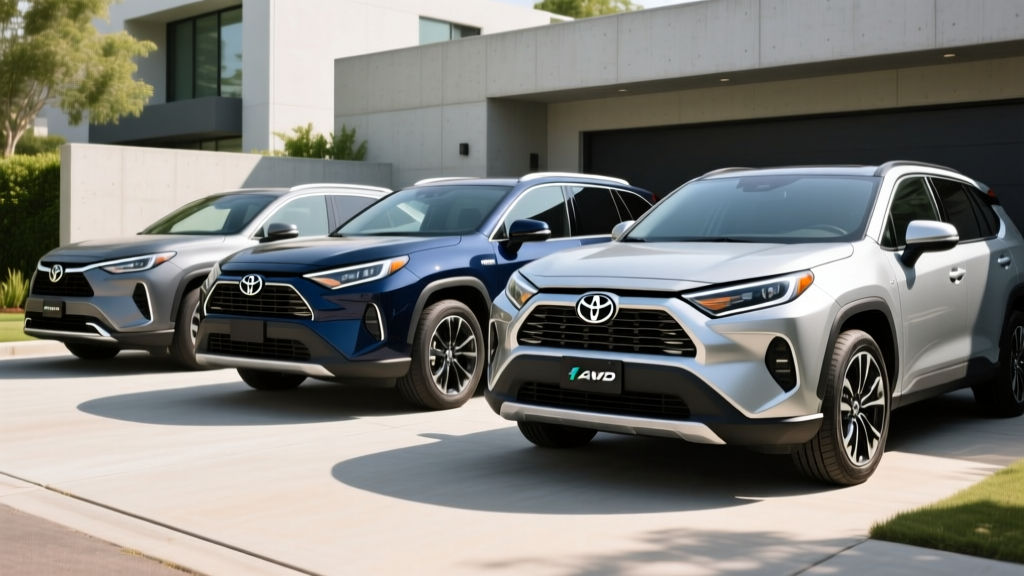
If you want all-wheel-drive traction without the fuel penalty of a conventional AWD gas vehicle, Toyota's hybrid lineup in 2026 offers more options than any other mainstream brand. The keyword here is electronic AWD — most Toyota hybrid AWD models use an independent rear electric motor rather than a mechanical driveshaft, which means instant torque to the rear wheels, zero parasitic drivetrain loss, and EPA fuel economy that often exceeds 35 MPG combined.
But Toyota's hybrid AWD portfolio spans conventional hybrids (HEV) and one plug-in hybrid (PHEV), with very different ownership experiences. This guide breaks down every current Toyota hybrid AWD model with exact specs, real-world MPG expectations, battery warranty details, and a clear decision framework so you can choose the right one.
HEV vs. PHEV: Understanding Toyota's Hybrid AWD Types
Before comparing models, the distinction between Toyota's two hybrid architectures matters for your daily routine and wallet:
| Feature | Conventional Hybrid (HEV) | Plug-in Hybrid (PHEV) |
|---|---|---|
| Plugs in? | No — charges via regenerative braking and engine | Yes — 120V or 240V charging |
| Electric-only range | Less than 1 mile (low-speed assist only) | 38–42 miles (RAV4 Prime) |
| Battery size | 1.0–1.6 kWh (small buffer) | 18.1 kWh usable (RAV4 Prime) |
| Fueling | Gas station only, like a normal car | Gas station + electric outlet/charger |
| Federal tax credit | None (does not meet §30D plug-in requirement) | Up to $7,500 (subject to sourcing/income rules) |
| Best for | Drivers who can't charge at home | Drivers with home charging and short commutes |
Neither Toyota HEV requires you to plug in. The gasoline engine and regenerative braking handle all battery charging automatically. The RAV4 Prime (PHEV) is the exception — it benefits enormously from home Level 2 charging but will still operate as a regular hybrid if you never plug it in.
2026 Toyota Hybrid AWD Models: EPA MPG and Specs
Here's the complete lineup of Toyota hybrid AWD vehicles available for the 2026 model year, with EPA fuel economy figures sourced from fueleconomy.gov:
| Model | Type | EPA City | EPA Highway | EPA Combined | AWD System | Combined HP |
|---|---|---|---|---|---|---|
| Prius AWD | HEV | 53 | 54 | 54 | E-AWD (e-motor) | 196 |
| Corolla Cross Hybrid | HEV | 46 | 43 | 44 | E-AWD (e-motor) | 196 |
| RAV4 Hybrid | HEV | 41 | 38 | 40 | E-AWD (e-motor) | 219 |
| RAV4 Prime (PHEV) | PHEV | 94 MPGe | 84 MPGe | 94 MPGe / 38 MPG (gas) | E-AWD (e-motor) | 302 |
| Highlander Hybrid | HEV | 35 | 35 | 35 | E-AWD (e-motor) | 243 |
| Grand Highlander Hybrid | HEV | 36 | 32 | 34 | E-AWD (e-motor) | 245 |
| Sienna | HEV | 35 | 36 | 35 | E-AWD (e-motor) | 245 |
| Crown (AWD) | HEV | 41 | 38 | 40 | E-AWD (e-motor) | 236 |
| Venza | HEV | 40 | 37 | 39 | E-AWD (e-motor) | 219 |
Key takeaway: Every model above uses Toyota's electronic AWD with a dedicated rear-axle electric motor. There is no mechanical driveshaft connecting the front and rear axles. This means the AWD system engages only when traction is needed — during acceleration, in rain or snow, or when wheel slip is detected — and imposes zero efficiency penalty during steady-state cruising.
RAV4 Prime: The Toyota Hybrid AWD PHEV Deep Dive
The RAV4 Prime deserves its own section because it's the only Toyota hybrid AWD that plugs in — and it fundamentally changes the ownership math if you can charge at home.
| Specification | RAV4 Prime (2026) |
|---|---|
| Battery capacity | 18.1 kWh usable (lithium-ion) |
| Electric-only range (EPA) | 42 miles |
| Total range (electric + gas) | ~600 miles |
| Combined horsepower | 302 hp (2.5L I4 + 3 e-motors) |
| 0–60 mph | 5.7 seconds |
| Level 1 charging (120V) | ~12 hours (full charge) |
| Level 2 charging (240V, 6.6 kW) | ~2.5 hours (full charge) |
| DC fast charging | Not available |
| Gas-only MPG (after battery depleted) | 38 combined |
| Base MSRP | $44,915 (SE trim) |
The RAV4 Prime's 42-mile electric range covers most daily commutes. Charge at home overnight on a standard 120V outlet (if your commute is short) or install a 240V Level 2 charger for a full 2.5-hour replenishment. Note that the RAV4 Prime does not support DC fast charging — this is a deliberate Toyota engineering choice to keep cost and weight down, and it's typical for most PHEVs in this segment.
On the highway with a depleted battery, the RAV4 Prime operates as a conventional RAV4 Hybrid, delivering 38 MPG combined. That's only 2 MPG less than the standard RAV4 Hybrid — a negligible penalty for the electric-range bonus and the 302-hp powertrain.
Real-World MPG vs. EPA: What Toyota Hybrid AWD Owners Actually See
Toyota hybrids consistently outperform their EPA estimates in city driving — this is one of the most reliable patterns in real-world fuel economy testing. Here's why and what to expect:
Real-world MPG expectations for Toyota Hybrid AWD models:
- City driving: Expect to match or exceed EPA city estimates by 2–5 MPG. Regenerative braking recovers energy at every stop, and the engine shuts off frequently at low speeds.
- Highway driving: Expect to fall 2–4 MPG below EPA highway estimates at sustained 75+ mph. Hybrids can't leverage regenerative braking at constant speed, and the engine runs continuously.
- Cold weather (below 30°F): Expect a 10–15% MPG reduction. The engine runs more often to generate cabin heat and warm the catalytic converter.
- RAV4 Prime (electric mode): Expect 35–38 miles of real-world electric range in moderate weather, dropping to ~28–32 miles in freezing temperatures due to cabin heating load.
The Prius AWD is a standout here. Its 54 MPG combined EPA estimate is conservative for city-heavy drivers — many owners report 56–60 MPG in urban commuting, according to crowdsourced data on Fuelly. Highway-heavy drivers will see closer to 48–50 MPG at 80 mph.
Battery Warranty, Lifespan, and Replacement Cost
Hybrid battery longevity is the number-one concern for prospective buyers, and Toyota's track record is among the best in the industry.
| Coverage | Term |
|---|---|
| Hybrid battery warranty (all states) | 10 years / 150,000 miles |
| Hybrid battery warranty (CARB states) | 10 years / 150,000 miles (same) |
| Hybrid system components | 8 years / 100,000 miles |
| Powertrain warranty | 5 years / 60,000 miles |
| Basic warranty | 3 years / 36,000 miles |
Toyota's 10-year/150,000-mile hybrid battery warranty applies in all 50 states for 2026 models. In practice, Toyota hybrid batteries regularly last well beyond the warranty period. Third-generation Prius taxis have logged 300,000+ miles on original batteries, and failures before 150,000 miles are statistically uncommon.
Battery replacement cost if out of warranty:
- RAV4 Hybrid / Prius: $2,500–$4,000 (dealer), $1,800–$2,800 (independent hybrid specialist with refurbished or new modules)
- RAV4 Prime (larger 18.1 kWh pack): $5,000–$7,500 (dealer estimate based on current PHEV battery pricing)
- Highlander / Sienna: $3,000–$4,500 (dealer)
Individual battery module replacement (rather than full pack replacement) is often possible through independent hybrid specialists for $500–$1,200, extending the pack's life at a fraction of the full replacement cost.
How Toyota's Electronic AWD Actually Works
Toyota's hybrid AWD system — branded E-Four or E-AWD depending on the model — uses a separate electric motor mounted on the rear axle. This is fundamentally different from the mechanical AWD systems in competitors like the Subaru Outback or Mazda CX-5, which use a driveshaft and center differential.
The rear e-motor produces between 40 and 54 horsepower depending on the model. It engages automatically in these conditions:
- Acceleration from stop: Rear motor provides torque for the first 1–3 seconds for confident launches
- Wheel slip detected: System sends power rearward within milliseconds — faster than a mechanical coupling
- Low-traction surfaces: Snow, rain, gravel trigger sustained rear-motor engagement
- Cornering: Subtle rear torque for stability in certain driving modes
Because there's no mechanical connection between front and rear axles, there is no drivetrain loss during normal cruising. This is why Toyota hybrid AWD models achieve nearly identical MPG to their FWD counterparts — a 1–2 MPG difference at most, compared to the 3–5 MPG penalty of traditional mechanical AWD.
Pricing and Federal Tax Credit Eligibility
| Model | Base MSRP (AWD) | Federal Tax Credit (§30D) | Effective Price After Credit |
|---|---|---|---|
| Prius AWD (LE) | $29,745 | None (HEV) | $29,745 |
| Corolla Cross Hybrid (S) | $30,195 | None (HEV) | $30,195 |
| RAV4 Hybrid (LE) | $33,425 | None (HEV) | $33,425 |
| RAV4 Prime (SE) | $44,915 | Up to $7,500* | ~$37,415* |
| Highlander Hybrid (LE) | $42,220 | None (HEV) | $42,220 |
| Grand Highlander Hybrid | $45,320 | None (HEV) | $45,320 |
| Sienna (LE) | $39,085 | None (HEV) | $39,085 |
| Crown (XLE AWD) | $42,045 | None (HEV) | $42,045 |
*RAV4 Prime tax credit eligibility for 2026 is subject to IRS §30D requirements. Per IRS rules, the buyer must meet income caps ($150K single / $300K joint AGI), the vehicle must meet critical-mineral and battery-component sourcing requirements, and the MSRP must be under $80,000 (SUVs). The credit can be transferred to the dealer at point of sale for an immediate price reduction. Verify current eligibility at the IRS website or with a tax professional before purchasing, as sourcing rules tighten annually.
No Toyota conventional hybrid (HEV) qualifies for the federal §30D tax credit because the credit requires a plug-in vehicle with at least 7 kWh of battery capacity. However, some states and utilities offer rebates for HEVs — check your state energy office or local utility for current programs.
Toyota Hybrid AWD vs. Full EV vs. Gas: Which Should You Choose?
Choose a Toyota Hybrid AWD (HEV) if:
- You cannot install a home charger (apartment, street parking, no garage)
- You want AWD traction with 35–54 MPG and zero behavior change
- You drive 12,000–18,000 miles/year with mixed city/highway use
- You want Toyota's reliability record and 10-year battery warranty
- You want the lowest upfront cost among electrified AWD options
Choose the RAV4 Prime (PHEV) if:
- You can install a Level 2 home charger (240V, ~$500–$1,500 installation)
- Your daily commute is under 40 miles round-trip (you'll rarely use gas)
- You want 302 hp performance alongside 38 MPG when the battery is depleted
- You qualify for the $7,500 federal tax credit (income + sourcing rules)
- You take occasional long road trips and don't want to plan around DC chargers
Choose a full EV (like the Toyota bZ4X or Hyundai Ioniq 5) if:
- You have reliable home Level 2 charging
- Your daily driving is under 200 miles and you're comfortable with charging stops on road trips
- You want zero tailpipe emissions and the lowest per-mile fuel cost (~$0.04–$0.06/mile on home electricity vs. $0.10–$0.14/mile for a Toyota hybrid on gas)
- You're willing to accept cold-weather range loss (15–30%) and DC charging planning for long trips
Stick with a gas-only AWD vehicle if:
- You drive fewer than 8,000 miles per year (hybrid fuel savings won't offset the higher purchase price)
- You primarily tow heavy loads beyond hybrid capacity (though the Highlander Hybrid tows up to 3,500 lbs)
Reliability: Toyota's Hybrid AWD Track Record
Toyota's hybrid system is one of the most proven electrified powertrains in the world, with over 25 years of continuous production since the original 1997 Prius. Key reliability facts:
- No alternator or starter motor: The hybrid system uses the traction motor for engine starting and electrical generation, eliminating two common failure points in gas cars
- No traditional transmission: Toyota's e-CVT (planetary gearset) has no belts, clutches, or bands to wear — it's one of the simplest and most durable drivetrain components in any vehicle
- Regenerative braking extends pad life: Many Toyota hybrid owners report 80,000–100,000+ miles on original brake pads because regen handles most deceleration
- Consumer Reports and J.D. Power consistently rank Toyota hybrids among the most reliable vehicles in their segments, with the RAV4 Hybrid and Prius frequently earning top marks
The RAV4 Prime's larger battery and more complex powertrain (302 hp, three electric motors) introduce more components than the standard RAV4 Hybrid, but the fundamental architecture is shared. As of 2026, there are no widespread reliability concerns specific to the RAV4 Prime drivetrain. See NHTSA for any active recalls or technical service bulletins.
Frequently Asked Questions
How many MPG does a Toyota hybrid AWD get?
It depends on the model. The Prius AWD leads at 54 MPG combined (53 city / 54 highway). The RAV4 Hybrid AWD achieves 40 MPG combined (41 city / 38 highway). The Highlander Hybrid AWD gets 35 MPG combined. Real-world city MPG often exceeds EPA estimates by 2–5 MPG; highway MPG at 75+ mph typically falls 2–4 MPG below the sticker.
How far can the RAV4 Prime go on electric only?
The EPA rates the RAV4 Prime at 42 miles of electric-only range. In real-world driving, expect 35–38 miles in moderate weather and 28–32 miles in freezing temperatures when cabin heating draws from the battery. After the battery depletes, it operates as a standard hybrid at 38 MPG combined.
Do Toyota hybrid AWD vehicles need to be plugged in?
No — except the RAV4 Prime. All other Toyota hybrid AWD models (Prius, RAV4 Hybrid, Highlander Hybrid, Sienna, Corolla Cross Hybrid, Crown, Grand Highlander, Venza) are conventional hybrids that never need plugging in. The gasoline engine and regenerative braking keep the small hybrid battery charged automatically.
Is the hybrid battery reliable and what does replacement cost?
Toyota covers hybrid batteries for 10 years / 150,000 miles in all 50 states. Real-world data shows these batteries regularly last 150,000–250,000+ miles. If replacement is needed out of warranty, expect $2,500–$4,000 at a dealer for most models, or $1,800–$2,800 through an independent hybrid specialist using refurbished modules. The RAV4 Prime's larger pack costs $5,000–$7,500.
Does any Toyota hybrid AWD qualify for a federal tax credit?
Only the RAV4 Prime (PHEV) is potentially eligible for the federal §30D tax credit of up to $7,500. Conventional Toyota hybrids (HEVs) do not qualify because the credit requires plug-in capability and a minimum 7 kWh battery. RAV4 Prime eligibility depends on buyer income limits, battery-sourcing requirements, and MSRP caps per current IRS rules.
Is Toyota's electronic AWD as capable as mechanical AWD?
For on-road use — rain, snow, gravel, light off-road — Toyota's electronic AWD is highly effective and reacts faster than a mechanical coupling. It is not designed for severe off-roading, rock crawling, or sustained low-traction conditions where a locked center differential (like a Subaru or Jeep system) would excel. For the 95% of drivers who need AWD for weather and road conditions, Toyota's system performs excellently with zero fuel-economy penalty.
What's the cheapest Toyota hybrid AWD?
The 2026 Prius AWD LE starts at $29,745, making it the most affordable Toyota hybrid AWD and one of the most fuel-efficient AWD vehicles sold in the U.S. The Corolla Cross Hybrid S follows at $30,195 for those who prefer a crossover ride height.