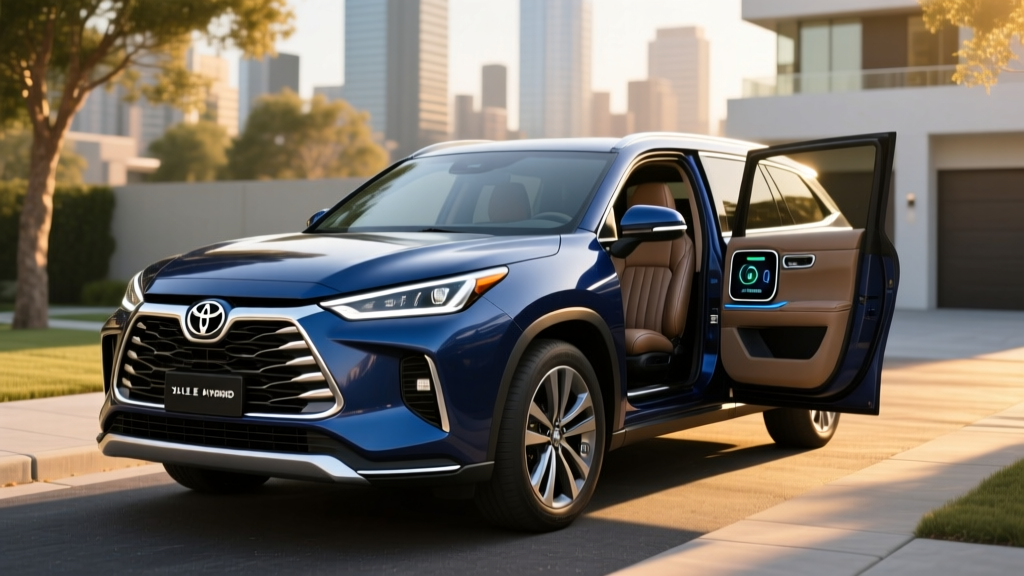
The midsize three-row SUV segment doesn't offer many hybrid options that avoid a plug-in requirement, and the Toyota Highlander Hybrid remains the volume leader in this space. The XLE trim sits in the sweet spot of the lineup — adding power liftgate, SofTex seating, wireless charging, and Toyota Safety Sense 3.0 over the base LE, without pushing into the near-luxury pricing of the Limited or Platinum trims. If you're researching the Highlander XLE Hybrid for a family hauler that sips fuel without range compromises or charging logistics, this guide breaks down every number that matters.
What Is the Highlander XLE Hybrid — HEV or PHEV?
Conventional Hybrid (HEV): The Toyota Highlander Hybrid is a self-charging hybrid. It uses a gasoline engine paired with electric motors and a small battery that recharges through regenerative braking and the engine. You never plug it in. You simply fuel it like a normal gas car, and the hybrid system automatically manages electric assist to reduce fuel consumption.
Plug-in Hybrid (PHEV): A PHEV, like the Toyota RAV4 Prime, has a much larger battery (typically 15–20 kWh) that you plug in to charge, offering 30–40 miles of electric-only driving before the gas engine kicks in. Toyota does not currently offer a Highlander PHEV in the U.S. market. If you want plug-in capability in a Toyota SUV, the RAV4 Prime or the newer Prius Prime are your options.
This distinction matters because some shoppers conflate "hybrid" with "plug-in." The Highlander Hybrid requires zero behavioral change — no home charger, no public charging apps, no range planning. It's a gas car that happens to be remarkably efficient.
Fuel Economy: EPA Ratings and Real-World MPG
| Configuration | City MPG | Highway MPG | Combined MPG |
|---|---|---|---|
| FWD (XLE Hybrid) | 36 | 35 | 36 |
| AWD (XLE Hybrid) | 35 | 35 | 35 |
| Gas-only Highlander (AWD, for comparison) | 21 | 28 | 24 |
Source: EPA / fueleconomy.gov
Real-World Expectations: Toyota's hybrid system excels in city driving, where regenerative braking and low-speed electric assist dominate. Many Highlander Hybrid owners report exceeding the EPA city estimate by 2–4 MPG in stop-and-go traffic. Highway driving at 75+ mph yields closer to 30–32 MPG, as the electric motors contribute less at sustained high speeds. In cold weather (below 30°F), expect a 3–5 MPG drop as the engine runs more frequently to heat the cabin. Overall, 33–37 MPG combined is typical for mixed driving in moderate climates.
The fuel savings over the gas-only Highlander are substantial. At 15,000 miles per year and $3.40/gallon, the hybrid saves roughly $650–$750 annually in fuel costs compared to the non-hybrid AWD model.
Powertrain and Performance Specs
| Specification | Detail |
|---|---|
| Engine | 2.5L 4-cylinder Atkinson-cycle |
| Electric Motors | 2 (FWD) / 3 (AWD, with rear motor) |
| Combined System Horsepower | 243 HP |
| Transmission | eCVT (planetary gearset, not belt-driven) |
| 0–60 mph | ~7.8 seconds |
| Drivetrain (XLE) | FWD standard, AWD available |
| Towing Capacity | 3,500 lbs (AWD) |
| Hybrid Battery | 1.87 kWh (nickel-metal hydride), sealed |
| Fuel Tank | 17.1 gallons |
| Total Driving Range | ~600+ miles (combined) |
The fourth-generation Toyota Hybrid System (THS) pairs a 2.5-liter Atkinson-cycle four-cylinder engine with front-mounted electric motors and, on AWD models, a dedicated rear electric motor that provides on-demand all-wheel drive without a mechanical driveshaft. The combined 243 horsepower is adequate for a 4,500-pound SUV — not quick by EV standards, but responsive enough for highway merging and passing.
Toyota's eCVT is a common source of confusion. Unlike a conventional belt-and-cone CVT found in some competitors, Toyota uses a planetary gearset that seamlessly blends engine and motor power. There are no "rubber band" sensations or artificial gear steps. It's one of the most durable transmission designs in the industry.
How the Highlander Hybrid Compares: HEV vs PHEV vs EV
Choosing between a hybrid, a plug-in hybrid, and a full battery-electric vehicle depends on your driving pattern, home charging access, and willingness to adapt. Here's a practical framework:
Choose the Highlander Hybrid (HEV) if:
- You have no access to home or workplace charging
- You regularly take road trips over 300 miles and don't want to plan charging stops
- You need three rows of seating (few BEV options exist in this segment)
- You want lower fuel costs without any behavioral change
- You tow up to 3,500 lbs
Choose a PHEV (e.g., Toyota Sienna PHEV, if available, or Kia Sorento PHEV) if:
- You can charge at home (Level 2 or even a standard 120V outlet)
- Your daily commute is under 30 miles round-trip (you'd drive mostly electric)
- You want to reduce gas consumption dramatically but keep the option for long road trips
Choose a full EV (e.g., Kia EV9, Tesla Model X) if:
- You have reliable home Level 2 charging
- You want the lowest per-mile energy cost and zero tailpipe emissions
- You're comfortable with 250–310 miles of range and occasional DC fast charging on trips
- You value instant torque, quiet operation, and lower maintenance costs
For families without home charging who need three rows, the Highlander Hybrid occupies a segment of almost one. The Kia Sorento Hybrid and the Ford Explorer Hybrid are the only real competitors, and neither matches Toyota's hybrid system refinement or reliability track record.
Pricing, Trims, and Tax Credit Eligibility
| Trim | MSRP (FWD) | MSRP (AWD) |
|---|---|---|
| LE Hybrid | $41,615 | $43,215 |
| XLE Hybrid | $45,465 | $47,065 |
| Limited Hybrid | $49,965 | $51,565 |
| Platinum Hybrid | $53,615 | $55,215 |
Pricing includes destination charge. Source: Toyota.com
Does the Highlander Hybrid Qualify for a Federal Tax Credit?
No. The Highlander Hybrid is a conventional HEV, not a plug-in vehicle. Under IRS §30D rules, only battery-electric vehicles (BEVs) and plug-in hybrids (PHEVs) with sufficient battery capacity and compliant battery sourcing qualify for the federal clean vehicle credit of up to $7,500. Conventional hybrids like the Highlander Hybrid do not qualify for §30D.
Additionally, the §30D credit has MSRP caps ($80,000 for SUVs), buyer income limits ($300K joint / $150K single), and critical mineral and battery component sourcing requirements. Even qualifying PHEVs must meet these thresholds. See IRS clean vehicle credit guidelines for current eligibility lists.
Some states offer their own rebates or HOV lane access for hybrids — check your state's energy office or DMV for specifics, as these vary widely and change frequently.
Battery Warranty, Reliability, and Replacement Cost
Hybrid Battery Warranty: Toyota covers the Highlander Hybrid's battery under its Hybrid Battery Warranty for 10 years or 150,000 miles (whichever comes first) in all 50 states. This was extended from the previous 8-year/100,000-mile standard starting with the 2020 model year.
Hybrid System Components: The hybrid control module, inverter, and related components carry the same 10-year/150,000-mile coverage under Toyota's Hybrid System Warranty.
Toyota's hybrid battery packs are among the most proven in the automotive industry. The Highlander Hybrid uses a relatively small 1.87 kWh nickel-metal hydride (NiMH) battery that operates in a narrow state-of-charge window — typically between 40% and 80% — which dramatically reduces degradation stress. This conservative battery management is why Toyota hybrid batteries routinely last well beyond the warranty period, often exceeding 200,000 miles with minimal capacity loss.
Battery Replacement Cost
If a hybrid battery does fail outside warranty, replacement cost from a Toyota dealer typically ranges from $2,000 to $3,500 for a refurbished or new OEM pack, including labor. Independent hybrid specialists often offer replacements for $1,500–$2,500. Individual module replacement (the battery pack consists of multiple modules) can sometimes be done for under $1,000 if only one or two modules have degraded.
For context, a full battery-electric vehicle's traction battery replacement can cost $10,000–$20,000+. The Highlander Hybrid's small, conservatively managed battery is one of the lowest-risk, lowest-cost battery systems to own long-term.
Overall Reliability
Toyota's hybrid powertrain has been in continuous production since the 1997 Prius. The eCVT planetary gearset has no belts, clutches, or friction bands to wear out. The Atkinson-cycle engine operates at lower thermal stress than conventional engines. The Highlander Hybrid consistently earns above-average reliability scores from Consumer Reports and has received strong safety ratings from both NHTSA and IIHS.
Who Should Buy the Highlander XLE Hybrid?
Strengths
- 35–36 MPG combined — exceptional for a 4,500-lb, three-row SUV
- No plug-in required; zero behavioral change vs. a gas car
- 10-year/150,000-mile hybrid battery warranty
- 600+ mile total range between fill-ups
- Proven, low-maintenance hybrid powertrain
- XLE trim balances features and value well
- Standard Toyota Safety Sense 3.0 (AEB, lane-keep, adaptive cruise)
- 3,500-lb towing capacity (AWD)
Limitations
- No federal tax credit eligibility (HEV, not PHEV/BEV)
- 7.8-second 0–60 is adequate but not quick for merging
- Third row is tight for adults on longer trips
- Infotainment lags behind competitors in responsiveness
- No plug-in hybrid variant available in the U.S.
- Cargo space behind the third row is limited (16.1 cu ft)
- AWD adds ~$1,600 and drops MPG by 1
The Highlander XLE Hybrid is best suited for families who need three-row utility, want to cut fuel costs significantly, and either lack home charging access or simply don't want to think about charging. It's also a strong choice for high-mileage drivers (15,000+ miles/year) where the fuel savings compound quickly, and for buyers who plan to hold the vehicle for 10+ years given the proven longevity of Toyota's hybrid system.
If you have home charging and a short commute, a PHEV like the Kia Sorento PHEV or a full EV like the Kia EV9 could offer lower operating costs. But for no-plug simplicity, three-row space, and 600-mile range, the Highlander Hybrid remains the default recommendation.
Frequently Asked Questions
How many MPG does the Highlander XLE Hybrid get?
The EPA rates the FWD Highlander Hybrid at 36 city / 35 highway / 36 combined MPG. The AWD version is rated at 35/35/35 MPG. In real-world driving, many owners report 33–38 MPG combined depending on driving mix and climate, with city driving often yielding higher numbers than the EPA estimate.
Does the Highlander Hybrid need to be plugged in?
No. The Highlander Hybrid is a conventional (self-charging) hybrid. Its small battery recharges through regenerative braking and the gasoline engine. You fuel it exactly like a standard gas car — there is no plug and no electric-only driving mode to manage.
Is the Highlander Hybrid available as a plug-in hybrid (PHEV)?
Not in the United States. Toyota does not offer a Highlander PHEV variant. If you want a Toyota plug-in hybrid SUV, the RAV4 Prime (42 miles electric-only range) or the Prius Prime (40–44 miles) are the current options. The Toyota Sienna minivan is offered only as a conventional hybrid, similar to the Highlander.
How long does the Highlander Hybrid battery last?
Toyota's hybrid batteries are designed to last the life of the vehicle. The warranty covers 10 years or 150,000 miles. In practice, many Toyota hybrid batteries exceed 200,000 miles with minimal degradation due to the conservative charge window management (40–80% SoC). Out-of-warranty replacement typically costs $2,000–$3,500.
Does the Highlander Hybrid qualify for any tax credits?
The Highlander Hybrid does not qualify for the federal §30D clean vehicle credit, which is limited to battery-electric vehicles and plug-in hybrids meeting specific battery sourcing and MSRP/income requirements. Some states may offer minor incentives or HOV lane access for hybrids — check your state's energy or DMV website for current programs.
How does the Highlander Hybrid compare to the gas-only Highlander?
The hybrid achieves 35–36 MPG combined versus 24 MPG combined for the gas-only AWD Highlander — a 46–50% improvement. The hybrid also produces 243 HP (versus 265 HP for the turbo-4 gas model), so you sacrifice a small amount of acceleration for dramatically lower fuel costs. At 15,000 miles per year, the hybrid saves approximately $650–$750 in fuel.
Can the Highlander Hybrid tow?
Yes. The AWD Highlander Hybrid is rated to tow up to 3,500 pounds. The FWD hybrid is rated at 3,500 pounds as well for recent model years. This is sufficient for a small boat trailer, light utility trailer, or a pair of jet skis, but not for heavy campers or large boats.