Quick Verdict: The Highlander Hybrid's Sweet Spot
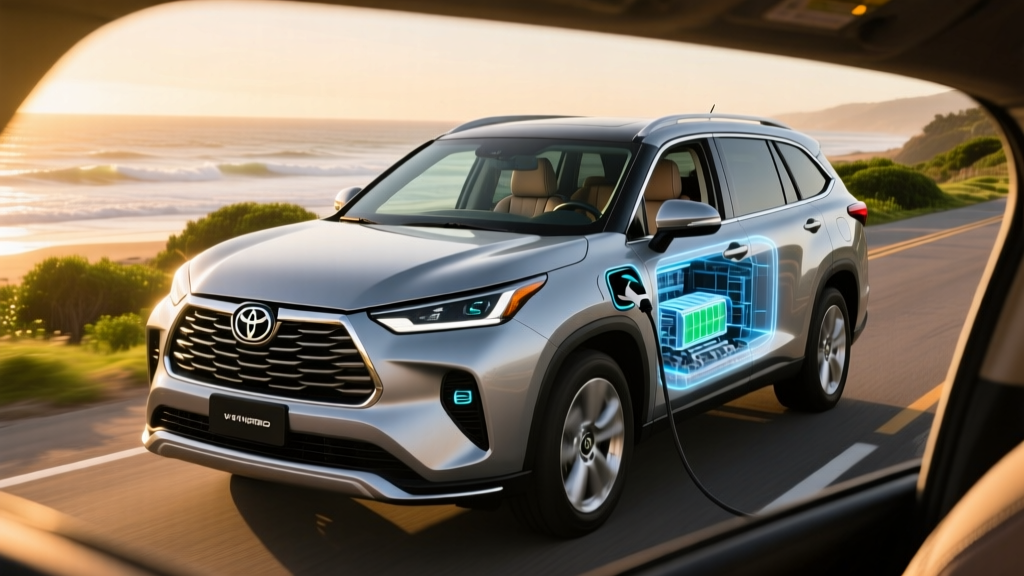
The 2026 Toyota Highlander V6 Hybrid occupies a specific niche that full EVs still struggle to fill: three-row family hauling without range anxiety or charging infrastructure dependence. With an EPA-estimated 35 MPG combined, 243 combined horsepower from its 2.5-liter four-cylinder hybrid powertrain (Toyota dropped the traditional V6 for a turbocharged four-cylinder hybrid in recent model years, though the "V6 Hybrid" search intent persists among buyers familiar with the previous generation's 3.5L V6), and a starting MSRP around $42,320, it remains one of the most practical electrified family SUVs on the market.
This is a conventional hybrid (HEV), not a plug-in hybrid (PHEV). That distinction matters enormously for your ownership experience, your wallet, and your daily routine. Let's break down exactly what the Highlander Hybrid delivers — and where it falls short.
| Spec | Value |
|---|---|
| Powertrain | 2.5L 4-cyl hybrid (HEV) — no plug required |
| Combined Horsepower | 243 hp |
| EPA MPG (City / Hwy / Combined) | 36 / 35 / 35 MPG |
| Drivetrain | AWD standard (electronic rear motor) |
| Seating | 7 passengers (standard) |
| Cargo (behind 3rd / 2nd / 1st row) | 16.1 / 48.4 / 84.3 cu ft |
| Towing Capacity | 3,500 lbs |
| Base MSRP (LE trim) | $42,320 |
| Hybrid Battery Warranty | 10 years / 150,000 miles |
| Federal Tax Credit (§30D) | Not eligible (HEV, not PHEV/BEV) |
HEV vs PHEV: Why the Highlander Hybrid Doesn't Plug In
Buyers searching for the "Toyota Highlander V6 Hybrid" sometimes expect a plug-in option. It's critical to understand what you're getting:
| Feature | HEV (Highlander Hybrid) | PHEV (e.g., Toyota RAV4 Prime) |
|---|---|---|
| Plug-in charging? | No — charges via regenerative braking & engine | Yes — plug into Level 1 or Level 2 |
| Electric-only range | ~1 mile at very low speed | 35–42 miles typical |
| Battery size | ~1.6 kWh (small, self-charging) | 13–18 kWh usable |
| DC fast charging | No | Rarely (most PHEVs lack DCFC) |
| Federal tax credit | Not eligible | Up to $7,500 (if eligible per IRS §30D rules) |
| Best for | No home charging access; want simplicity | Home charging + short daily commutes |
The Highlander Hybrid is a self-charging HEV. Its small nickel-metal hydride (NiMH) hybrid battery recovers energy through regenerative braking and the gasoline engine. You never plug it in, you never need to think about charging, and you never worry about electric range. The trade-off is that you can't drive meaningful distances on electricity alone — the electric motors assist the gas engine but don't replace it.
Toyota does not currently offer a Highlander PHEV (plug-in hybrid) in the U.S. market for 2026. If plug-in capability is a priority, the closest Toyota alternative is the RAV4 Prime (42 miles electric-only, ~94 MPGe) or the Grand Highlander Hybrid (also HEV, slightly larger, 36 MPG combined).
Fuel Economy: EPA Ratings and Real-World MPG
| Driving Condition | EPA MPG |
|---|---|
| City | 36 MPG |
| Highway | 35 MPG |
| Combined | 35 MPG |
According to fueleconomy.gov, the 2026 Highlander Hybrid AWD achieves 36 city / 35 highway / 35 combined MPG. These figures apply to the LE and XLE trims; higher trims with larger wheels (Limited, Platinum) may see a 1 MPG reduction.
Real-World MPG: What Owners Actually Report
Toyota's hybrid system excels in city driving, where regenerative braking and electric motor assist reduce engine load. In real-world ownership:
- City/suburban driving: Many owners report 36–40 MPG, sometimes exceeding the EPA city estimate. Stop-and-go traffic plays to the hybrid system's strengths.
- Highway cruising (70–80 mph): Expect 30–33 MPG. Aerodynamic drag at higher speeds reduces the hybrid advantage. The gasoline engine does most of the work at sustained highway velocity.
- Cold weather (below 30°F): Expect a 10–15% reduction, bringing combined MPG to roughly 30–32. The engine runs more frequently to provide cabin heat and maintain battery temperature.
- Towing or heavy cargo loads: MPG can drop to 22–26 depending on trailer weight and terrain.
For a 3-row, 4,500-lb AWD SUV, these numbers are genuinely impressive. The gas-only Highlander (when it was available) rated around 24 MPG combined — the hybrid saves roughly 150–180 gallons of fuel per year at 15,000 miles, translating to approximately $500–$650 in annual fuel savings depending on local gas prices.
Powertrain and Performance: 243 HP Hybrid System
The 2026 Highlander Hybrid pairs a 2.5-liter inline-four Atkinson-cycle gasoline engine with three electric motor-generators (two front, one rear) through Toyota's eCVT (electronically controlled continuously variable transmission). Total system output is 243 horsepower.
Key powertrain details:
- Gasoline engine: 2.5L 4-cylinder, ~186 hp / 173 lb-ft torque
- Front electric motors: Integrated into the transaxle, providing instant torque and regenerative braking
- Rear electric motor: 54 hp — provides AWD traction without a mechanical driveshaft
- 0–60 mph: Approximately 7.7 seconds (adequate for family use, not sporty)
- Transmission: eCVT — smooth, no traditional gear shifts, but can drone under hard acceleration
The driving experience prioritizes efficiency and smoothness over performance. The eCVT eliminates shift shock, and the electric motors provide immediate low-speed torque that makes the Highlander Hybrid feel responsive around town. On highway merge ramps and steep grades, the engine noise becomes noticeable as the eCVT holds high RPM. This is the primary trade-off versus a turbocharged or V6 gas powertrain.
The electronic AWD system (Toyota calls it AWD-e) engages the rear motor only when front-wheel slip is detected or during hard acceleration. It's not a serious off-road system, but it handles rain, light snow, and gravel roads competently.
Pricing, Trims, and Tax Credit Eligibility
The 2026 Toyota Highlander Hybrid is available across four main trims. Approximate MSRP pricing (destination included):
- LE: ~$42,320
- XLE: ~$45,770
- Limited: ~$50,270
- Platinum: ~$53,620
Federal Tax Credit: Not Eligible
Because the Highlander Hybrid is a conventional HEV (not a plug-in vehicle), it does not qualify for the federal §30D New Clean Vehicle Credit. That credit — up to $7,500 — is reserved for battery electric vehicles (BEVs) and plug-in hybrids (PHEVs) that meet battery sourcing, MSRP caps, and buyer income requirements.
Some states offer separate incentives for conventional hybrids, though these are increasingly rare as state programs shift focus to plug-in vehicles. Check your state's energy or DMV website for current programs.
Total Cost of Ownership Advantage
Despite no tax credit, the Highlander Hybrid's TCO remains competitive. Over five years and 75,000 miles, fuel savings of approximately $2,500–$3,200 versus the gas Highlander (at $3.50/gal average) partially offset the ~$2,000–$3,000 hybrid premium over a comparable gas model. Toyota's strong resale value further supports long-term ownership economics.
Battery Warranty, Reliability, and Replacement Cost
Toyota Hybrid Battery Warranty: 10 years or 150,000 miles (whichever comes first), covering capacity loss below a defined threshold. This applies to all 2026 Toyota hybrids and is one of the longest hybrid battery warranties in the industry.
Longevity Data
Toyota's hybrid system is among the most proven in the automotive industry. The Prius has accumulated over two decades of real-world data, and the Highlander Hybrid's powertrain shares core architecture. Key reliability points:
- Battery chemistry: The Highlander Hybrid uses a nickel-metal hydride (NiMH) pack — less energy-dense than lithium-ion but extremely durable and thermally stable. NiMH packs routinely last 150,000–200,000+ miles with minimal degradation.
- Real-world failure rates: Hybrid battery replacement under 100,000 miles is rare. Most reported failures occur between 130,000–180,000 miles, and many packs exceed 200,000 miles.
- Replacement cost: A new OEM hybrid battery pack costs approximately $3,000–$4,500 installed at a Toyota dealer. Refurbished/remanufactured packs are available for $1,500–$2,500 installed through independent hybrid specialists.
- Individual module replacement: Some hybrid specialists can replace individual battery modules rather than the entire pack, reducing cost to $500–$1,200.
Beyond the hybrid battery, the Highlander Hybrid benefits from Toyota's general reliability reputation. The 2.5L A25A-FXS engine has no turbocharger (reducing complexity), the eCVT has no traditional clutch packs or bands to wear, and the brake pads often last 70,000+ miles thanks to regenerative braking reducing mechanical brake wear.
Toyota's basic warranty covers 3 years / 36,000 miles, and the powertrain warranty covers 5 years / 60,000 miles. The hybrid-specific components (battery, inverter, transaxle) carry the 10-year / 150,000-mile coverage.
Highlander Hybrid vs Full EV vs Gas: Which Fits You?
Choose the Highlander Hybrid if:
- You need 3 rows and AWD but lack reliable home or workplace charging
- You regularly take long road trips (400+ miles) and don't want to plan around charging stops
- You live in an area with sparse DC fast-charging infrastructure
- You want lower fuel costs without changing your refueling habits
- You plan to keep the vehicle 8–12 years (proven long-term reliability)
Choose a full EV (e.g., Kia EV9, Tesla Model X, Rivian R1S) if:
- You have Level 2 home charging and most daily driving is under 250 miles
- You want the lowest per-mile fuel cost (~$0.04–$0.06/mile on home electricity vs ~$0.12–$0.15/mile for the hybrid)
- You qualify for the $7,500 federal tax credit and/or state EV incentives
- You value instant torque, silent operation, and zero tailpipe emissions
Choose a PHEV (e.g., RAV4 Prime, if 2 rows suffice) if:
- You have home charging and a short commute (under 40 miles round-trip)
- You want electric-only daily driving but gas flexibility for road trips
- You want partial eligibility for federal/state plug-in incentives
Stick with a gas SUV if:
- You drive fewer than 8,000 miles per year (the hybrid premium won't pay back)
- Upfront cost is the sole deciding factor
Pros and Cons at a Glance
Pros
- 35 MPG combined in a 3-row AWD SUV — best-in-class efficiency
- No charging required — zero lifestyle change from gas
- 10-year / 150,000-mile hybrid battery warranty
- Strong Toyota resale value and reliability track record
- Standard AWD via rear electric motor (no fuel-economy penalty vs FWD)
- Smooth, quiet city driving with electric motor assist
Cons
- No plug-in option — cannot drive on electric only for meaningful distances
- No federal tax credit eligibility
- eCVT drone under hard acceleration (highway merges, mountain grades)
- Third row is tight for adults; cargo space trails some rivals
- 3,500-lb towing is adequate but not class-leading
- Infotainment and driver-assist tech lag some competitors
Frequently Asked Questions
How many MPG does the Toyota Highlander Hybrid get?
The 2026 Highlander Hybrid AWD is EPA-rated at 36 city / 35 highway / 35 combined MPG. Real-world city driving often matches or slightly exceeds the EPA city figure (36–40 MPG), while sustained highway driving at 75+ mph typically yields 30–33 MPG. Cold weather reduces combined MPG by roughly 10–15%.
Is the Toyota Highlander Hybrid a plug-in?
No. The Highlander Hybrid is a conventional hybrid (HEV). It charges its own small battery through regenerative braking and the gasoline engine. You never plug it in. Toyota does not currently offer a plug-in hybrid (PHEV) version of the Highlander in the United States.
Does the Highlander Hybrid qualify for a tax credit?
Not the federal §30D credit, which requires a plug-in vehicle (BEV or PHEV) meeting battery sourcing, MSRP, and buyer income thresholds. Some states may offer minor hybrid incentives, but these are uncommon. Check your state's energy office for current programs.
How long will the Highlander Hybrid battery last?
Toyota's NiMH hybrid batteries are designed to last the life of the vehicle. Most last 150,000–200,000+ miles. The battery is warranted for 10 years or 150,000 miles. If replacement is needed, expect $3,000–$4,500 for a new OEM pack or $1,500–$2,500 for a refurbished unit.
Is the Highlander Hybrid reliable?
Toyota's hybrid powertrain is one of the most proven in the industry, with over 20 years of Prius-derived data. The Highlander Hybrid has no turbocharger, no traditional automatic transmission (the eCVT is mechanically simpler), and regenerative braking extends brake pad life. IIHS and NHTSA safety ratings have historically been strong for the Highlander platform.
How far can the Highlander Hybrid go on electric only?
Effectively about 1 mile at very low speeds (under 25 mph) in EV mode. This is a conventional hybrid — the electric motors assist the gas engine but are not designed for standalone driving. If you want 35–42 miles of electric-only range, you need a PHEV like the RAV4 Prime.
Is the Highlander Hybrid good for towing?
It's rated for 3,500 lbs, which handles a small boat trailer, a pair of jet skis, or a lightweight camping trailer. For heavier loads (5,000+ lbs), you'd need a body-on-frame SUV or truck. Towing reduces MPG to roughly 22–26 depending on weight and terrain.