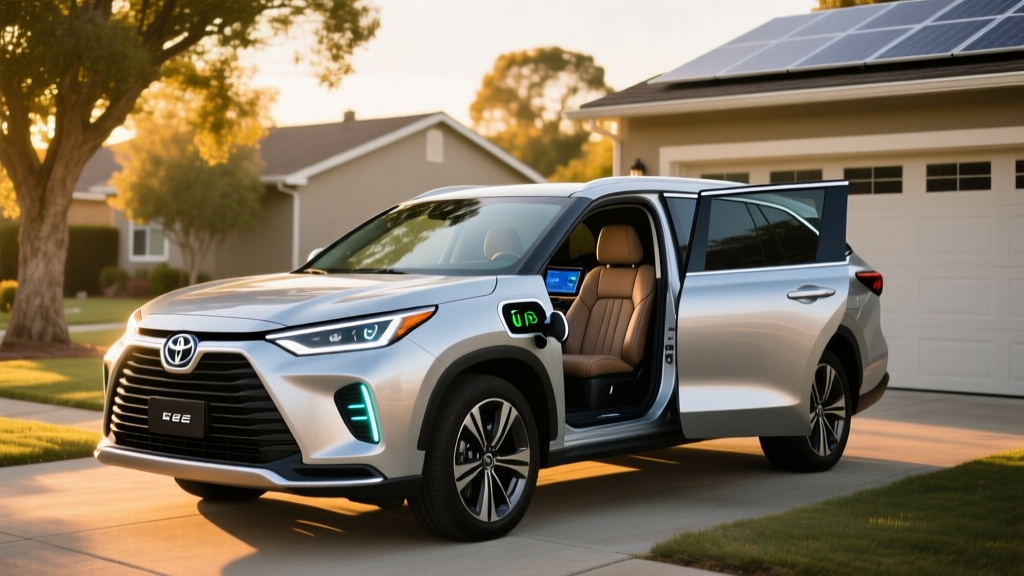
The Toyota Highlander Hybrid has occupied a narrow but valuable lane in the midsize SUV market: three-row family hauling without the fuel-pump penalty. For 2026, the base LE trim continues to anchor the lineup as the most affordable entry point into Toyota's hybrid-only Highlander strategy. If you've been searching for the Toyota Highlander LE Hybrid to see whether it earns a spot in your driveway, this guide covers the exact numbers that matter — EPA fuel economy, real-world MPG expectations, powertrain specs, warranty coverage, and total cost of ownership.
Unlike plug-in hybrids or full EVs, the Highlander Hybrid is a conventional hybrid electric vehicle (HEV). That means it never needs to be plugged in. It generates and recovers all its electrical energy through regenerative braking and its gasoline engine. For buyers who lack home charging access or who regularly take long road trips, that distinction is the entire appeal.
HEV vs. PHEV: Where the Highlander Hybrid Fits
Before examining the numbers, it's worth clarifying what the Highlander LE Hybrid is — and what it isn't. Toyota does not currently offer a plug-in hybrid (PHEV) version of the Highlander in the United States. The Highlander lineup is exclusively conventional hybrid (HEV).
| Feature | HEV (Highlander Hybrid) | PHEV (e.g., RAV4 Prime) | BEV (e.g., Tesla Model X) |
|---|---|---|---|
| Plug-in charging required? | No | Yes (Level 1 or 2) | Yes (Level 2 or DC fast) |
| Electric-only range | ~1 mile at low speed | 30–42 miles typical | 250–350+ miles |
| Gasoline engine? | Yes (primary) | Yes (backup) | No |
| Home charging install needed? | No | Recommended | Essential |
| Federal §30D tax credit? | No | Up to $7,500 (if eligible) | Up to $7,500 (if eligible) |
| Best for | No charger, long trips | Short commute + long trips | Home charging, daily driving |
The practical takeaway: if you want electric-only commuting but also need three rows and 500+ miles of total range without route planning, a PHEV like the Kia Sorento PHEV or a minivan like the Chrysler Pacifica Hybrid may be worth cross-shopping. But if you simply want a three-row SUV that sips fuel and never requires a lifestyle change, the Highlander LE Hybrid delivers exactly that.
EPA Fuel Economy and Real-World MPG
The 2026 Toyota Highlander LE Hybrid carries an EPA-estimated 36 MPG combined (36 city / 35 highway) with front-wheel drive. Opting for all-wheel drive (AWD) drops the rating slightly to 35 MPG combined (35 city / 34 highway). These figures are published on fueleconomy.gov and represent the official baseline.
| Drivetrain | City MPG | Highway MPG | Combined MPG |
|---|---|---|---|
| FWD | 36 | 35 | 36 |
| AWD | 35 | 34 | 35 |
Real-World MPG Expectations
Toyota's hybrid system excels in stop-and-go city driving, where regenerative braking and electric-motor assist do the most work. Many Highlander Hybrid owners report 37–40 MPG in city-heavy commutes, exceeding the EPA city estimate. Highway-only driving at 75+ MPH tends to return 30–33 MPG, as aerodynamic drag dominates and the 2.5L engine carries more of the load. In cold weather (below 30°F), expect a 5–10% fuel economy reduction during short trips as the engine runs more frequently to heat the cabin and warm the catalytic converter.
For a family driving 15,000 miles per year at a blended 35 MPG, the Highlander Hybrid consumes roughly 429 gallons annually. At $3.40 per gallon (national average as of early 2026), that's approximately $1,458 per year in fuel. A comparably sized gas-only midsize SUV averaging 22 MPG would burn 682 gallons — roughly $2,318 annually. The hybrid saves around $860 per year in fuel, or $4,300 over five years.
Powertrain: Engine, Motors, and 243 Horsepower
The Highlander Hybrid pairs a 2.5-liter inline-4 Atkinson-cycle engine with two front-mounted electric motor-generators (and a third rear motor on AWD models) through Toyota's eCVT planetary-gear transmission. There are no traditional gears or belts — the power-split device seamlessly blends engine and electric power.
| Specification | 2026 Highlander LE Hybrid |
|---|---|
| Engine | 2.5L 4-cyl Atkinson cycle |
| Engine horsepower | 186 hp @ 6,000 rpm |
| Combined net horsepower | 243 hp |
| Front electric motors | 2 motor-generators (MG1, MG2) |
| Rear motor (AWD only) | 40 kW independent rear e-motor |
| Transmission | eCVT (power-split device) |
| Hybrid battery | 1.87 kWh nickel-metal hydride (NiMH) |
| 0–60 MPH | ~7.9 seconds |
| Towing capacity | 3,500 lbs |
| Seating | 8 passengers (LE trim) |
| Cargo (behind 3rd row) | 16.1 cu ft |
| Cargo (max, seats folded) | 84.3 cu ft |
The 243 combined horsepower is adequate for merging and passing, though the Highlander Hybrid isn't quick by performance-SUV standards. The eCVT delivers smooth, linear acceleration without the shift-shock of a conventional automatic. The AWD system's independent rear motor provides torque to the rear axle only when needed — there's no mechanical driveshaft, which saves weight and cabin space.
The 1.87 kWh NiMH hybrid battery is small by EV standards (a typical BEV uses 60–100 kWh), but it doesn't need to store much energy. It buffers power between the engine and motors, enabling short electric-only assists at low speeds and storing recaptured braking energy. Toyota has used NiMH chemistry in its mainstream hybrids for decades, prioritizing cycle-life durability and thermal stability over energy density.
Pricing, Trims, and Tax Credit Eligibility
The 2026 Toyota Highlander LE Hybrid starts at approximately $42,620 MSRP (including destination charge) for the FWD configuration. AWD adds roughly $1,600, bringing the LE AWD to around $44,220. Higher trims (XLE, Limited, Platinum) range from $46,000 to over $54,000.
Federal Tax Credit Status
- §30D New Clean Vehicle Credit: The Highlander Hybrid does NOT qualify. Under current IRS rules, the §30D credit applies only to plug-in electric vehicles (PHEVs and BEVs) with a minimum battery capacity of 7 kWh. The Highlander's 1.87 kWh NiMH pack falls well below this threshold.
- Used hybrid credit (§25E): If purchasing a qualifying used Highlander Hybrid (model year at least 2 years old, under $25,000, from a dealer), you may be eligible for up to $4,000 or 30% of the sale price (whichever is less), subject to income limits. See IRS §25E guidelines.
- State incentives: Some states offer rebates or HOV-lane access for hybrids. Check your state's energy or DMV website for current programs — these vary widely and change frequently.
The absence of a federal tax credit is a meaningful cost factor. A competitor like the Chrysler Pacifica Hybrid (a PHEV minivan) may qualify for partial credit depending on battery sourcing, and a BEV like the Kia EV9 can receive the full $7,500 point-of-sale reduction. However, the Highlander Hybrid compensates with a lower base price, no charging infrastructure requirement, and Toyota's historically strong resale value.
Reliability, Battery Warranty, and Replacement Cost
Toyota's hybrid system is among the most proven in the industry, with over 25 years of continuous production since the original Prius. The Highlander Hybrid's powertrain carries Toyota's standard hybrid battery warranty: 10 years or 150,000 miles (whichever comes first), transferrable to subsequent owners. The broader powertrain warranty covers 5 years or 60,000 miles, and the basic limited warranty is 3 years or 36,000 miles.
Hybrid Battery Longevity: What the Data Shows
Toyota's NiMH hybrid batteries are engineered for shallow cycling — they typically operate between 40% and 80% state of charge, never fully depleting or fully charging. This dramatically extends cycle life. Real-world data from fleet operators and long-term owners shows Highlander and Camry Hybrid batteries routinely lasting 150,000–200,000+ miles before significant degradation. Out-of-warranty replacement cost for a Highlander Hybrid battery pack ranges from $2,500 to $4,500 (parts and labor) at a Toyota dealer, though refurbished packs from third-party suppliers can reduce this to $1,500–$2,500. Individual module replacement (repairing a few degraded cells rather than the full pack) can cost as little as $500–$1,000 at specialized hybrid repair shops.
Beyond the battery, the Highlander Hybrid has fewer wear items than a conventional gas SUV. There's no traditional automatic transmission (the eCVT has no clutch packs or torque converter to fail), regenerative braking extends pad and rotor life significantly, and the engine operates under less thermal stress thanks to electric-motor assist. Toyota's warranty documentation details full coverage terms.
Who Should Choose the Highlander LE Hybrid?
Choose the Highlander LE Hybrid If:
- You need three rows and 8-passenger seating for a growing family
- You lack access to home or workplace EV charging
- You take regular road trips exceeding 300 miles and don't want to plan charging stops
- You want to reduce fuel costs without changing any driving or refueling habits
- You prioritize long-term reliability and strong resale value
- Your annual mileage is high enough (12,000+ miles) that fuel savings compound meaningfully
Look at a PHEV or BEV Instead If:
- You have home charging and a commute under 40 miles (a PHEV eliminates most gas use)
- You want the $7,500 federal tax credit to offset purchase price
- You want silent, instant-torque electric acceleration
- You rarely use the third row and can fit into a two-row EV or PHEV
- You want to minimize tailpipe emissions in daily driving
The Highlander LE Hybrid occupies a specific niche: maximum convenience with meaningful fuel savings. It asks nothing of its owner except to fill up with gasoline — the same habit you already have, just less frequently. For families in apartments without charging access, in rural areas with sparse public charging, or in cold climates where EV range loss is a concern, the hybrid's zero-compromise proposition is hard to beat.
Pros
- 36 MPG combined — exceptional for a 3-row, 8-seat SUV
- No plug-in charging required; zero lifestyle adjustment
- 10-year/150,000-mile hybrid battery warranty
- Strong resale value and proven Toyota reliability
- 3,500-lb towing capacity (adequate for small trailers and boats)
- Standard Toyota Safety Sense 3.0 (adaptive cruise, lane-keep, auto emergency braking)
Cons
- No federal §30D tax credit eligibility
- Modest 243 hp — not a performance SUV
- 16.1 cu ft cargo behind third row is tight for the class
- LE base trim uses cloth seats and fewer premium features
- Highway MPG drops to ~30–33 at sustained 75+ MPH speeds
- No PHEV option exists in the Highlander lineup
Frequently Asked Questions
How many MPG does the Toyota Highlander LE Hybrid get?
The EPA rates the 2026 Highlander LE Hybrid at 36 city / 35 highway / 36 combined MPG with FWD, and 35/34/35 with AWD. In real-world city driving, many owners report 37–40 MPG thanks to the hybrid system's regenerative braking advantage. Highway-only driving at higher speeds typically returns 30–33 MPG.
Does the Highlander Hybrid need to be plugged in?
No. The Highlander Hybrid is a conventional HEV, not a plug-in hybrid. Its small 1.87 kWh battery recharges entirely through regenerative braking and the gasoline engine. You simply fill it with gasoline as you would any other vehicle.
Does the Toyota Highlander Hybrid qualify for a federal tax credit?
No. The federal §30D New Clean Vehicle Credit requires a plug-in vehicle with at least 7 kWh of battery capacity. The Highlander Hybrid's 1.87 kWh pack does not meet this threshold. However, a used Highlander Hybrid may qualify for the §25E used clean vehicle credit (up to $4,000) if purchased under $25,000 from a dealer, subject to income limits.
How long will the Highlander Hybrid battery last, and what does replacement cost?
Toyota warranties the hybrid battery for 10 years or 150,000 miles. Real-world data suggests these NiMH packs commonly last 150,000–200,000+ miles before needing replacement. A new OEM replacement battery costs $2,500–$4,500 installed; refurbished packs or individual module repairs can reduce this to $500–$2,500.
Hybrid vs. PHEV vs. EV — which three-row SUV is right for me?
Choose the Highlander Hybrid if you have no home charging, drive long distances regularly, and want zero refueling changes. Choose a PHEV (like the Kia Sorento PHEV) if you can charge at home and want 30+ miles of electric commuting with gas-engine backup. Choose a BEV (like the Kia EV9 or Tesla Model X) if you have reliable home charging, want maximum fuel savings, qualify for the $7,500 tax credit, and are comfortable planning longer road trips around DC fast charging.
Is the Highlander LE Hybrid AWD system good in snow?
The electronic AWD system uses an independent rear motor to send torque to the rear axle when front-wheel slip is detected. It's effective for light snow, wet roads, and moderate winter conditions. It's not a dedicated off-road or heavy-snow system like a mechanical AWD with a locking center differential, but for typical suburban winter driving, it provides confident traction.
What is the towing capacity of the Highlander Hybrid?
The 2026 Highlander Hybrid is rated to tow up to 3,500 pounds across all trims, including the LE. This covers small utility trailers, a pair of jet skis, or a light pop-up camper. For heavier towing (large travel trailers, boats over 4,000 lbs), you'd need to look at a body-on-frame SUV.