Quick Verdict: The Three-Row Hybrid Benchmark
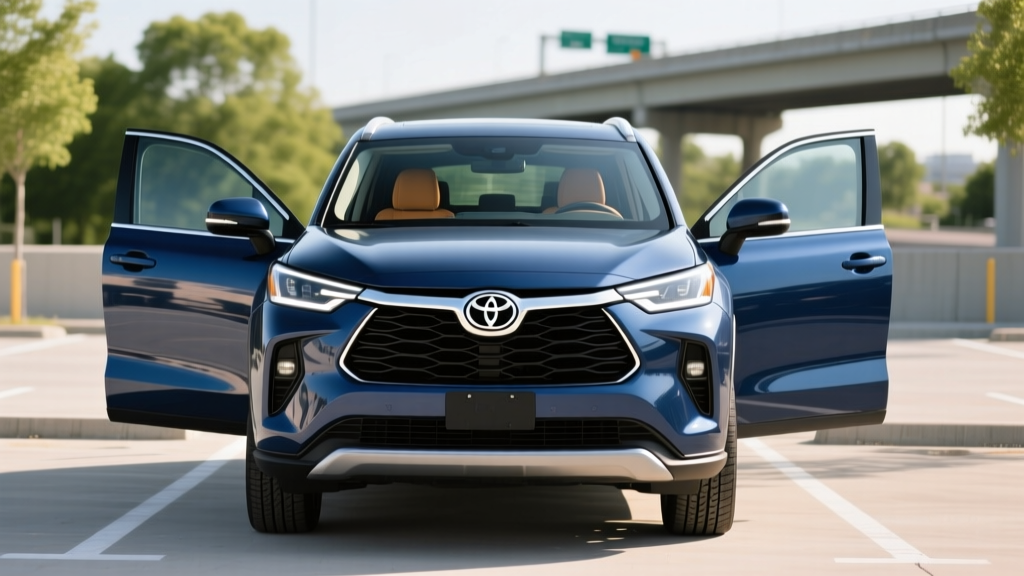
The Toyota Highlander Hybrid remains one of the few three-row SUVs that delivers genuine fuel savings without requiring a plug, a lifestyle change, or a charging infrastructure gamble. For 2026, Toyota continues the fourth-generation Highlander Hybrid with its proven 2.5-liter four-cylinder hybrid powertrain, rated at 35 MPG combined by the EPA — a figure that holds up remarkably well in real-world suburban driving. If you need three rows, want to cut fuel costs roughly in half versus the gas-only Highlander, and aren't ready to commit to a full battery-electric vehicle, this is the default recommendation in the segment.
But the Highlander Hybrid isn't the only electrified three-row option Toyota sells, and it's not the right choice for every buyer. This guide breaks down the Highlander Hybrid's powertrain, real-world MPG, pricing across all trims, battery longevity, and how it stacks up against plug-in hybrid and full EV alternatives.
HEV vs PHEV: Which Highlander Electrification Fits You?
Toyota currently offers the Highlander exclusively as a conventional hybrid (HEV). There is no plug-in hybrid (PHEV) variant of the Highlander for 2026. This is a critical distinction that trips up many shoppers, so let's clarify the difference:
| Feature | Highlander Hybrid (HEV) | Plug-In Hybrid (PHEV) — Not Available |
|---|---|---|
| Plug-in charging required? | No — charges via regenerative braking and engine | Yes — requires Level 1 or Level 2 plug |
| Electric-only driving | Brief, low-speed EV mode only (~1 mile) | Typically 25-45 miles on battery alone |
| Battery size | ~1.6 kWh (small NiMH pack) | Typically 13-18 kWh (large lithium-ion pack) |
| Federal tax credit (§30D) | Not eligible | Potentially up to $7,500 if eligible |
| Best for | Drivers without home charging, high-mileage commuters | Drivers with home charging and short daily commutes |
The Highlander Hybrid's self-charging system means you simply fill it with gas and drive. The hybrid system recovers energy during braking and coasting to recharge the small battery pack. If you're looking for a Toyota PHEV with three rows, the Toyota Grand Highlander Hybrid (also HEV) or the Toyota Sienna (hybrid minivan, also HEV) are the closest alternatives — but neither offers a PHEV variant. For a true plug-in three-row, you'd need to look at competitors like the Mazda CX-90 PHEV or the Volvo XC90 Recharge.
Powertrain & Performance: 243 HP Hybrid System
The 2026 Highlander Hybrid pairs a 2.5-liter inline-four Atkinson-cycle gasoline engine with Toyota's fourth-generation hybrid system. Here's the exact breakdown:
| Specification | Detail |
|---|---|
| Engine | 2.5L 4-cylinder Atkinson cycle |
| Engine output | 186 hp / 173 lb-ft torque |
| Electric motors | Front: 134 kW (180 hp) / Rear: 40 kW (54 hp) on AWD |
| Combined system horsepower | 243 hp |
| Drivetrain | FWD or electronic AWD (AWD-i) |
| Transmission | eCVT (planetary gearset, not a belt CVT) |
| 0-60 mph | ~7.8 seconds (FWD), ~7.6 seconds (AWD) |
| Towing capacity | 3,500 lbs (all trims) |
| Hybrid battery | ~1.6 kWh NiMH (self-charging, no plug) |
The AWD-i system uses a dedicated rear electric motor rather than a mechanical driveshaft, giving the AWD models responsive torque vectoring without the parasitic loss of a traditional all-wheel-drive system. This is the same architecture Toyota uses across its hybrid lineup, refined over two decades of production.
Acceleration is adequate for merging and passing but not thrilling. The eCVT keeps the engine in its most efficient RPM range, which means you'll hear a steady drone under hard acceleration — a characteristic of all Toyota hybrids. In normal driving, the cabin stays reasonably quiet, and the transition between electric and gasoline power is imperceptible.
Fuel Economy: EPA Ratings and Real-World MPG
Here's where the Highlander Hybrid earns its keep. The EPA publishes separate ratings for FWD and AWD configurations:
| Configuration | City MPG | Highway MPG | Combined MPG |
|---|---|---|---|
| FWD (LE, XLE) | 36 | 35 | 36 |
| AWD (all trims) | 35 | 34 | 35 |
Source: fueleconomy.gov (EPA)
The hybrid's advantage is most pronounced in city driving. If your commute is primarily suburban stop-and-go or urban, you'll regularly see 36-38 MPG indicated on the dash. Highway-heavy drivers will see a smaller gap versus the gas model but still save meaningfully at the pump.
Trim Levels, Pricing & Tax Credit Eligibility
For 2026, the Highlander Hybrid is available in four trims. Pricing below reflects base MSRP including destination charge:
| Trim | Drivetrain | MSRP (est.) | Key Features |
|---|---|---|---|
| LE | FWD or AWD | $42,220 (FWD) / $43,820 (AWD) | Toyota Safety Sense 3.0, 8" touchscreen, tri-zone climate, 8-passenger seating |
| XLE | FWD or AWD | $45,220 (FWD) / $46,820 (AWD) | SofTex seats, power liftgate, 7-passenger captain's chairs available, wireless CarPlay/Android Auto |
| Limited | AWD | $50,770 | 12.3" touchscreen, leather, panoramic roof, JBL audio, heated/ventilated front seats |
| Platinum | AWD | $54,070 | Head-up display, 360° camera, panoramic moonroof, heated second-row seats |
Battery Longevity, Warranty & Replacement Costs
Hybrid battery anxiety is the single most common concern among first-time hybrid buyers. Here's what the data shows:
Toyota covers the Highlander Hybrid's battery and hybrid system components under a 10-year / 150,000-mile warranty (whichever comes first). This applies to the hybrid battery pack, the inverter, the electric motors, and the hybrid control module. This warranty has been standard across Toyota's hybrid lineup since the 2020 model year.
If replacement is needed outside warranty, a refurbished Highlander Hybrid battery typically costs between $2,000 and $3,500 installed at a dealership, while a new OEM battery runs approximately $4,000 to $5,000. Independent hybrid specialists can often replace individual cells or modules for $1,000 to $2,000. For context, this is a fraction of the cost of replacing a large EV traction battery, which can exceed $10,000 to $15,000.
The Highlander Hybrid's NiMH chemistry is a deliberate choice for this application. Unlike lithium-ion batteries in EVs, NiMH packs are less sensitive to temperature extremes and don't require active liquid cooling. The trade-off is lower energy density — but since the Highlander Hybrid only needs ~1.6 kWh of storage, the weight and volume penalty is negligible.
Highlander Hybrid vs EV vs PHEV: Which Three-Row Fits You?
The three-row electrified SUV market has expanded significantly. Here's a decision framework based on your actual driving pattern:
- You don't have access to home or workplace Level 2 charging
- You regularly drive more than 300 miles between stops (road trips, towing)
- You want maximum simplicity — no plug, no charging apps, no range planning
- Your annual mileage is high (15,000+ miles) and fuel savings compound
- You want proven long-term reliability with minimal technology risk
- You have reliable home Level 2 charging (240V outlet or hardwired charger)
- Your daily commute is under 40 miles (a PHEV could cover it entirely on electricity)
- You want to qualify for the §30D federal tax credit (up to $7,500 for eligible BEVs/PHEVs)
- You prioritize instant torque, silent operation, and zero tailpipe emissions
- You're willing to plan charging stops on longer road trips (BEV) or accept a smaller vehicle (most PHEVs lack three rows)
The honest reality: for most three-row SUV buyers in 2026, the Highlander Hybrid hits the sweet spot between fuel savings and convenience. The PHEV three-row market remains thin — the Mazda CX-90 PHEV offers only 26 miles of electric range and a smaller third row, while the Volvo XC90 Recharge starts above $73,000. Full electric three-row options like the Kia EV9 offer impressive technology but start around $55,000, require charging infrastructure, and lose meaningful range when towing or in cold weather.
If you can charge at home and your daily driving stays under 30 miles, a BEV like the EV9 will cost less per mile to operate. But the Highlander Hybrid eliminates the two biggest barriers to EV adoption — charging access and range planning — while still cutting your fuel bill by roughly 40%.
Pros & Cons at a Glance
- 35-36 MPG combined — best in the three-row SUV class
- No plug-in charging required; seamless ownership experience
- 10-year/150,000-mile hybrid system warranty
- Standard Toyota Safety Sense 3.0 (adaptive cruise, lane-keep, auto emergency braking)
- 3,500-lb towing capacity with hybrid efficiency
- Strong resale value — Toyota hybrids historically depreciate slower than gas counterparts
- No federal tax credit eligibility (HEV, not PHEV/BEV)
- Modest 243 hp — adequate but not quick for a 4,500-lb SUV
- Engine drone under hard acceleration (eCVT characteristic)
- Third row is tight for adults on long trips
- No plug-in option means no electric-only commuting
- Infotainment interface lags behind competitors in responsiveness
Frequently Asked Questions
How many MPG does the Toyota Highlander Hybrid get?
The EPA rates the 2026 Highlander Hybrid at 36 city / 35 highway / 36 combined MPG for FWD models and 35 city / 34 highway / 35 combined MPG for AWD models. In real-world suburban driving, owners commonly report matching or slightly exceeding these figures. Highway-heavy driving at speeds above 70 mph typically yields 30-32 MPG.
Does the Highlander Hybrid need to be plugged in?
No. The Highlander Hybrid is a conventional hybrid (HEV), not a plug-in hybrid. It charges its small battery through regenerative braking and the gasoline engine. You simply fill it with gas and drive — there is no charging cable, no plug, and no electric-only range to manage.
Does the Toyota Highlander Hybrid qualify for a tax credit?
No. The federal §30D Clean Vehicle Credit applies only to battery-electric vehicles and plug-in hybrids that meet specific battery-sourcing, MSRP cap, and buyer-income requirements. Because the Highlander Hybrid is a conventional HEV with no plug-in capability, it does not qualify. Check IRS.gov for current credit rules and consult a tax professional for your specific situation.
How long does the Highlander Hybrid battery last?
Toyota warranties the hybrid battery and all hybrid-system components for 10 years or 150,000 miles. Based on two decades of Toyota hybrid data, most Highlander Hybrid batteries last the useful life of the vehicle without needing replacement. The NiMH chemistry and narrow state-of-charge operating window significantly reduce degradation compared to larger lithium-ion EV batteries.
What does it cost to replace a Highlander Hybrid battery?
If replacement is needed outside the warranty period, expect to pay $2,000 to $3,500 for a refurbished battery or $4,000 to $5,000 for a new OEM battery, installed. Independent hybrid specialists can often repair individual modules for $1,000 to $2,000.
Is the Highlander Hybrid good for towing?
The Highlander Hybrid is rated to tow up to 3,500 pounds across all trims — sufficient for a small boat, utility trailer, or a pair of jet skis. However, towing significantly reduces fuel economy, dropping observed MPG to approximately 22-25 combined depending on trailer weight and terrain. If you regularly tow more than 3,500 lbs, a body-on-frame SUV would be a better fit.
Hybrid vs PHEV vs EV — which three-row SUV should I buy?
If you lack home charging or regularly drive long distances, the Highlander Hybrid is the most practical choice — no infrastructure required, strong fuel savings. If you have home charging and a short commute, a PHEV (like the Mazda CX-90 PHEV) or full EV (like the Kia EV9) could eliminate most gasoline use, but at higher purchase prices and with range-planning trade-offs. The Highlander Hybrid is the lowest-risk, highest-convenience path to better fuel economy in a three-row package.