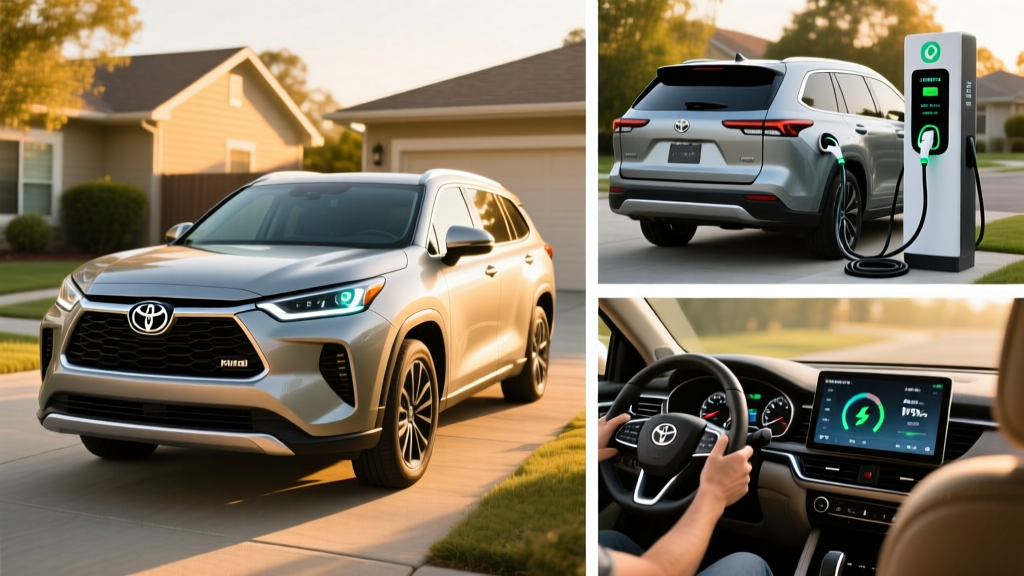
If you need three rows of seating but dread the fuel bill that usually comes with a midsize SUV, the Toyota Highlander Hybrid occupies a narrow and increasingly popular lane. It's a full hybrid (HEV) — no plug required — that squeezes family-SUV utility into fuel consumption that rivals some compact sedans. For 2026, the Highlander Hybrid continues with the proven 2.5-liter four-cylinder hybrid powertrain, delivering an EPA-estimated 35 MPG combined across most trims.
But EPA stickers only tell part of the story. This guide breaks down the real-world MPG you can actually expect, how the Highlander Hybrid compares to plug-in hybrid alternatives, what the battery warranty actually covers, and whether this HEV or a full EV makes more financial sense for your household.
Toyota Highlander Hybrid MPG: EPA Estimates and Real-World Numbers
The 2026 Toyota Highlander Hybrid carries over the powertrain architecture Toyota has refined across two decades of hybrid production. Here's how the EPA rates it across configurations:
| Drivetrain | City MPG | Highway MPG | Combined MPG |
|---|---|---|---|
| FWD (LE, XLE) | 36 | 35 | 36 |
| AWD (LE, XLE, Limited, Platinum) | 35 | 34 | 35 |
Source: fueleconomy.gov
Toyota hybrids consistently outperform their EPA city estimates in stop-and-go driving thanks to aggressive regenerative braking and electric-motor assist at low speeds. Owners on fueleconomy.gov's My MPG tracker frequently report 37-39 MPG in city-heavy commutes. Highway driving at sustained 75+ MPH tends to yield 30-32 MPG — aerodynamic drag hits a boxy three-row SUV harder than the EPA test cycle suggests. Expect a realistic blended average of 33-35 MPG for AWD models in mixed driving. Cold weather (below 30°F) can drop observed MPG by 3-5 MPG as the engine runs more frequently for cabin heat and battery conditioning.
Powertrain Specs: What's Under the Hood
The Highlander Hybrid pairs a 2.5-liter Atkinson-cycle four-cylinder engine with two front-mounted motor-generators and, on AWD trims, an independent rear electric motor. There's no mechanical driveshaft to the rear wheels — AWD is handled entirely by the electric motor, which engages when slip is detected or during hard acceleration.
| Engine | 2.5L 4-cylinder Atkinson cycle |
| Combined System Horsepower | 243 hp |
| Front Motor Output | 134 kW (180 hp) |
| Rear Motor Output (AWD) | 40 kW (54 hp) |
| Hybrid Battery | ~1.6 kWh (NiMH), sealed, self-charging |
| Transmission | eCVT (planetary gearset, no belt) |
| 0-60 MPH | ~7.8 seconds |
| Towing Capacity | 3,500 lbs (all trims) |
| Fuel Tank | 17.1 gallons |
| Total Driving Range (est.) | ~575-600 miles |
The key engineering detail here is the eCVT. Unlike a conventional belt-and-pulley CVT found in some competitors, Toyota's Hybrid Synergy Drive uses a planetary gearset that seamlessly blends engine and motor power. There are no belts to wear, no shift shock, and no rubber-band acceleration feel. It's one reason this powertrain has proven remarkably durable over millions of units deployed across the Toyota and Lexus lineup.
HEV vs. PHEV: Why the Highlander Hybrid Doesn't Plug In
A common point of confusion: some shoppers search for a "Highlander plug-in hybrid" or "Highlander Prime." As of 2026, Toyota does not offer a plug-in hybrid (PHEV) version of the Highlander. The Highlander is available only as a conventional hybrid (HEV).
Conventional Hybrid (HEV) vs. Plug-In Hybrid (PHEV): Key Differences
| Feature | HEV (Highlander Hybrid) | PHEV (e.g., RAV4 Prime) |
|---|---|---|
| Plugs in? | No — charges via engine and regen | Yes — Level 1 or Level 2 |
| Battery Size | ~1.6 kWh (small) | 14-18 kWh (typical) |
| Electric-Only Range | Less than 1 mile at low speed | 25-42 miles typical |
| Gas Engine | Always available, seamlessly blends | Activates after EV range depleted |
| Federal Tax Credit (§30D) | Not eligible | Up to $7,500 (if eligible) |
| Home Charging Needed? | No | Recommended for full benefit |
If plug-in capability is a priority, Toyota's closest PHEV offering in the SUV segment is the RAV4 Prime, which delivers 42 miles of electric-only range and 302 combined horsepower. However, the RAV4 Prime is a compact two-row SUV — it doesn't offer the third row or the cargo volume of the Highlander. Buyers who need three rows and want a PHEV must look to competitors like the Kia Sorento Plug-In Hybrid (32 miles EV range, EPA-estimated) or the Jeep Grand Cherokee 4xe.
Pricing, Trims, and Tax Credit Eligibility
The 2026 Toyota Highlander Hybrid is offered across four trims, all sharing the same 243-hp hybrid powertrain:
| Trim | Drivetrain | Starting MSRP |
|---|---|---|
| LE | FWD | $41,815 |
| LE | AWD | $43,415 |
| XLE | AWD | $46,015 |
| Limited | AWD | $50,415 |
| Platinum | AWD | $54,065 |
Prices include destination charge. Source: Toyota.com
Federal Tax Credit Status
The Highlander Hybrid is a conventional HEV, not a plug-in vehicle. Under IRS §30D rules, the Highlander Hybrid does not qualify for the federal plug-in electric vehicle tax credit (up to $7,500). That credit is reserved for battery electric vehicles (BEVs) and plug-in hybrids (PHEVs) with battery capacity of at least 7 kWh that meet critical-mineral and battery-component sourcing requirements, MSRP caps ($80,000 for SUVs), and buyer income limits.
Some states offer separate incentives for conventional hybrids, but these are increasingly rare as policy focus has shifted to plug-in vehicles. Check your state's energy office or the DOE's Alternative Fuels Data Center for any local hybrid incentives that may apply.
Battery Warranty, Lifespan, and Replacement Cost
Hybrid battery longevity remains the single most common concern among first-time hybrid buyers. Here's what Toyota provides:
Toyota Hybrid Battery Warranty
- Coverage: 10 years / 150,000 miles (whichever comes first)
- Applies to: Hybrid battery pack, hybrid control module, inverter
- Transferable: Yes — warranty follows the vehicle to subsequent owners
- Capacity threshold: Toyota warrants against defects and abnormal loss of capacity; there is no published minimum State of Health percentage, but significant degradation that impairs function is covered
How Long Do Highlander Hybrid Batteries Actually Last?
Toyota's hybrid battery packs — particularly the nickel-metal hydride (NiMH) units used in the Highlander — have an exceptional longevity record. Unlike the large NMC or LFP packs in full EVs that endure deep charge/discharge cycles, the Highlander's small ~1.6 kWh battery operates in a narrow state-of-charge window (roughly 40-80%). The hybrid control system never lets the battery fully charge or fully deplete, which dramatically reduces degradation.
Real-world data from fleet operators, taxi services, and long-term owners consistently shows Toyota hybrid batteries lasting 150,000-200,000+ miles before any meaningful capacity loss. Many first-generation Prius packs (2001-2003) exceeded 200,000 miles on the original battery.
Replacement Cost If Out of Warranty
If a hybrid battery does fail outside the warranty window, replacement costs for the Highlander Hybrid typically range from $3,000 to $5,000 for a new OEM pack, including labor. Refurbished or reconditioned packs from third-party suppliers can reduce this to $1,500-$2,500. Individual module replacement (only the failed cells) is sometimes possible for $500-$1,000 at specialized hybrid repair shops. For context, this is far less than the $10,000-$20,000+ replacement costs associated with large EV traction batteries.
Highlander Hybrid vs. Full EV vs. Gas: Which Fits Your Life?
Choosing between a conventional hybrid, a full battery electric vehicle, and a gas-only SUV comes down to three practical variables: your daily mileage, your access to charging, and your willingness to adapt your routine.
Decision Framework: Highlander Hybrid vs. Alternatives
Choose the Highlander Hybrid (HEV) if:
- You drive 30-60 miles per day in mixed city/highway conditions
- You cannot install a home charger (apartment, street parking, no garage)
- You take regular road trips exceeding 300 miles and don't want to plan around charging stops
- You need three rows but want fuel costs well below a gas-only SUV
- You want zero behavior change — fill up at any gas station, never think about charging
Choose a full EV (e.g., Kia EV9, Tesla Model X) if:
- You can install a Level 2 home charger and wake up to a "full tank" daily
- Your daily driving is under 250 miles round-trip
- You want the lowest per-mile fuel cost and minimal maintenance
- You qualify for the §30D federal tax credit (up to $7,500) and/or state EV rebates
- You're comfortable planning DC fast-charging stops on longer road trips
Choose a PHEV (e.g., Sorento PHEV, Grand Cherokee 4xe) if:
- You can charge at home AND want electric-only commuting for 25-40 miles
- You want a gas-engine safety net for longer weekend trips
- You need three rows and want some federal tax credit benefit
- You're willing to manage two "fueling" routines (plugging in nightly + occasional gas fill-ups)
Annual Fuel Cost Comparison
To make this concrete, here's a rough annual fuel cost comparison assuming 15,000 miles/year and $3.50/gallon regular unleaded:
| Vehicle Type | Combined MPG / MPGe | Est. Annual Fuel Cost |
|---|---|---|
| Highlander Hybrid (AWD) | 35 MPG | $1,500 |
| Highlander Gas (2.4T, AWD) | 24 MPG | $2,188 |
| Kia EV9 (BEV, home charging) | 89 MPGe | $650-$850 (electricity) |
The Highlander Hybrid saves roughly $688/year versus its gas-only counterpart. Over a 5-year ownership period, that's approximately $3,440 in fuel savings — which largely offsets the typical $1,500-$2,500 hybrid premium over the gas model at purchase.
Pros and Cons at a Glance
Pros
- 35 MPG combined in a three-row AWD SUV — best-in-class efficiency
- No plug-in required; zero change to refueling habits
- Proven, durable hybrid powertrain with 10-year/150k-mile battery warranty
- 3,500-lb towing capacity (adequate for small boats, trailers)
- Strong resale value — Toyota hybrids hold value exceptionally well
- Smooth, quiet low-speed electric operation in city driving
Cons
- No PHEV variant available — no electric-only commuting range
- 243 hp is adequate but not quick; highway merging requires planning when loaded
- No federal tax credit eligibility
- Third row is tight for adults on longer trips
- Highway MPG drops noticeably above 75 MPH (expect ~30-32)
- Infotainment and software feel a generation behind some competitors
Frequently Asked Questions
How many MPG does the Toyota Highlander Hybrid get?
The EPA rates the 2026 Highlander Hybrid at 35 MPG combined (35 city / 34 highway) for AWD trims and 36 combined (36 city / 35 highway) for FWD. Real-world city driving often yields 37-39 MPG due to regenerative braking, while sustained highway driving at 75+ MPH typically returns 30-32 MPG.
Does the Highlander Hybrid need to be plugged in?
No. The Highlander Hybrid is a conventional hybrid (HEV). Its small battery recharges through regenerative braking and the gasoline engine. You never plug it in — you simply refuel at any gas station as you would with a traditional vehicle.
Is there a plug-in hybrid (PHEV) version of the Highlander?
Not as of 2026. Toyota has not announced a Highlander PHEV. If you need a three-row plug-in hybrid SUV, consider the Kia Sorento PHEV (32 miles EV range) or the Jeep Grand Cherokee 4xe (25 miles EV range).
How long does the Highlander Hybrid battery last, and what does replacement cost?
Toyota warranties the hybrid battery for 10 years / 150,000 miles. Real-world data shows these NiMH packs frequently last 150,000-200,000+ miles. Out-of-warranty replacement costs $3,000-$5,000 for a new OEM pack, or $1,500-$2,500 for a refurbished unit.
Does the Highlander Hybrid qualify for a federal tax credit?
No. The IRS §30D federal tax credit applies only to plug-in electric vehicles (BEVs and PHEVs) with at least 7 kWh of battery capacity that meet sourcing, MSRP, and income requirements. The Highlander Hybrid, as a conventional HEV, does not qualify. Check your state's incentives at the DOE Alternative Fuels Data Center for any local hybrid benefits.
Is the Highlander Hybrid good for towing?
The Highlander Hybrid is rated to tow up to 3,500 pounds across all trims. This is sufficient for a small utility trailer, a pair of personal watercraft, or a light pop-up camper. Expect MPG to drop significantly (to roughly 20-25 MPG) while towing at highway speeds.
How does the Highlander Hybrid perform in cold weather?
Like all hybrids, the Highlander's fuel economy drops in cold weather (below 30°F) by roughly 3-5 MPG. The gasoline engine runs more frequently to provide cabin heat and to keep the hybrid battery within its optimal temperature range. This is less severe than the range loss experienced by full EVs in winter (which can lose 20-30% of range), but it's a measurable effect.