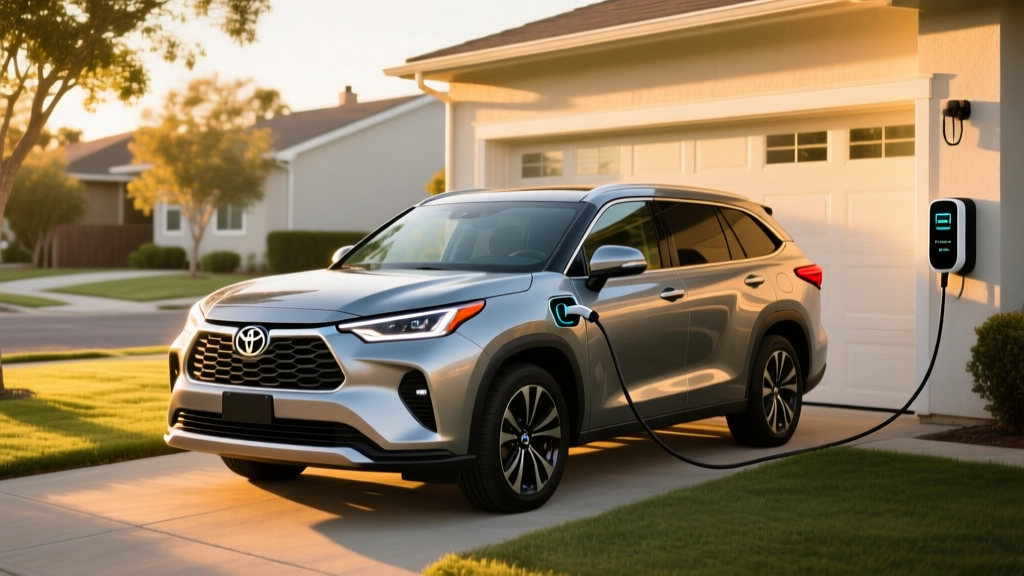
Three-row SUVs are rarely fuel sippers, but the Toyota Highlander Hybrid has spent the last several model years proving that a family hauler doesn't need to punish you at the pump. For the 2026 model year, the Highlander Hybrid carries forward the proven 2.5-liter four-cylinder hybrid powertrain that made it one of the most fuel-efficient vehicles in its class — a segment where competitors like the Kia Sorento Hybrid and Hyundai Santa Fe Hybrid are nipping at its heels.
This guide breaks down everything a prospective buyer needs to know: EPA MPG versus real-world results, the hybrid powertrain's engineering, long-term battery reliability, pricing across trims, and the critical question of whether the Highlander Hybrid is the right electrified choice for your family — or whether a plug-in hybrid or full EV makes more sense.
EPA Fuel Economy vs. Real-World MPG: What You'll Actually See
The 2026 Toyota Highlander Hybrid carries EPA estimates that have remained remarkably consistent since the current generation's refresh. Here's the official breakdown from fueleconomy.gov:
| Drivetrain | City MPG | Highway MPG | Combined MPG |
|---|---|---|---|
| FWD (LE trim) | 36 | 35 | 36 |
| AWD (LE, XLE, Limited, Platinum) | 35 | 34 | 35 |
The Hybrid Powertrain: 243 Horsepower, Zero Plugs Required
The Highlander Hybrid is a conventional hybrid electric vehicle (HEV). It does not plug in. It does not have a large battery you charge from a wall outlet. Instead, it uses a compact nickel-metal hydride (NiMH) traction battery that charges exclusively through regenerative braking and the gasoline engine. If you're looking for a plug-in experience, you'll want to look at the Toyota RAV4 Prime or the Highlander's platform-mate, the Grand Highlander Hybrid — but the standard Highlander Hybrid remains a no-plug, no-compromise setup.
| Specification | Detail |
|---|---|
| Engine | 2.5L inline-4 Atkinson-cycle |
| Electric Motors | 2 front (AWD: +1 rear motor) |
| Combined Net Horsepower | 243 hp |
| Transmission | eCVT (electronically controlled) |
| Drivetrain Options | FWD or electronic AWD |
| Traction Battery | NiMH, ~1.9 kWh (sealed, self-charging) |
| 0–60 MPH | ~7.8 seconds (AWD) |
| Towing Capacity | 3,500 lbs (AWD) |
| Fuel Tank | 17.1 gallons |
| Total Driving Range | ~595–615 miles |
The electronic AWD system deserves specific mention. Unlike mechanical AWD with a driveshaft, the Highlander Hybrid's rear axle is powered entirely by an independent electric motor. It engages on-demand during acceleration and slippery conditions, then disconnects to minimize drag. This contributes to the minimal 1-MPG penalty versus FWD — a trade-off most buyers in snow-belt states will gladly accept.
Highlander Hybrid vs. Plug-In Hybrids and Full EVs: Which Fits Your Life?
The three-row electrified SUV market now spans three distinct architectures. Understanding the difference is essential before you visit a dealer.
| Factor | HEV (Highlander Hybrid) | PHEV (e.g., Grand Highlander Hybrid MAX)* | BEV (e.g., Kia EV9) |
|---|---|---|---|
| Plugs In? | No | Yes | Yes |
| Electric-Only Range | None (EV assist only) | ~30–35 miles (typical) | 250–300+ miles |
| Home Charging Needed? | No | Recommended (Level 2) | Essential (Level 2) |
| Fuel Cost (per mile) | ~$0.10–$0.12 | ~$0.04 electric / $0.11 gas | ~$0.03–$0.06 |
| Upfront Price Premium | Low (~$2K over gas) | Medium (~$5–8K) | High (~$15–25K) |
| Tax Credit Eligibility | None (federal §30D) | Varies by model/sourcing | Up to $7,500 (§30D) |
| Best For | No home charger, long trips | Short commute + road trips | Home charger, mostly local |
*Note: As of the 2026 model year, Toyota does not offer a plug-in hybrid (PHEV) variant of the standard Highlander. The Grand Highlander Hybrid is a conventional HEV. Buyers seeking Toyota PHEV capability in a larger vehicle should watch for future announcements or consider the RAV4 Prime for smaller families.
- You don't have access to home Level 2 charging (apartment, street parking, no garage)
- You regularly take road trips exceeding 300 miles and don't want to plan around DC fast chargers
- You want meaningful fuel savings over a gas-only three-row SUV without changing your habits at all
- Your budget is under $50,000 and you want proven long-term reliability
- You have a garage with a 240V outlet and a commute under 35 miles (PHEV covers your daily driving on electricity)
- You want the lowest per-mile operating cost and qualify for the federal §30D tax credit (BEV)
- You want one-pedal driving, instant torque, and zero tailpipe emissions in your daily routine
Battery Longevity, Warranty, and Replacement Costs
Hybrid battery anxiety is the single most common concern we hear from first-time hybrid buyers. Here's what the data actually shows.
Toyota warranties the Highlander Hybrid's traction battery and all hybrid-system components for 10 years or 150,000 miles, whichever comes first. This applies in all 50 states and is among the most comprehensive hybrid warranties in the industry. The battery itself is a compact NiMH pack — not the large, expensive lithium-ion packs found in full EVs.
Traction Battery: 10 years / 150,000 miles
Hybrid System Components (inverter, motors, control modules): 10 years / 150,000 miles
Powertrain (engine, eCVT): 5 years / 60,000 miles
Basic Bumper-to-Bumper: 3 years / 36,000 miles
Toyota's hybrid battery track record is exceptional. The Prius, which has used a similar NiMH architecture for over two decades, routinely sees original batteries lasting 200,000+ miles. The Highlander Hybrid's battery is smaller, less stressed, and benefits from the same thermal management philosophy.
If replacement is eventually needed outside warranty, a new OEM hybrid battery for the Highlander Hybrid typically costs between $2,000 and $4,000 including labor — a fraction of the $10,000–$20,000+ replacement costs associated with full EV battery packs. Third-party refurbished NiMH packs are also available for $1,200–$2,000. This is a key ownership-cost advantage of the conventional hybrid architecture.
Pricing, Trims, and Tax Credit Eligibility
The 2026 Toyota Highlander Hybrid is available across four trims. Pricing below reflects base MSRP before destination charges:
| Trim | Drivetrain | Base MSRP (est.) | Key Features |
|---|---|---|---|
| LE | FWD or AWD | ~$41,000–$42,500 | Toyota Safety Sense 3.0, 8" touchscreen, tri-zone climate |
| XLE | AWD | ~$45,000–$46,500 | SofTex seats, power liftgate, 20" wheels, wireless CarPlay |
| Limited | AWD | ~$49,500–$51,000 | Leather, 12.3" display, panoramic roof, JBL audio |
| Platinum | AWD | ~$53,000–$54,500 | Head-up display, 360° camera, ventilated 2nd row |
Federal Tax Credit: The Hard Truth for HEV Buyers
The Highlander Hybrid is a conventional hybrid (HEV). Under current IRS §30D rules, conventional hybrids do not qualify for the federal clean vehicle tax credit. The §30D credit of up to $7,500 is reserved for plug-in electric vehicles (BEVs and PHEVs) that meet battery-sourcing, critical-mineral, MSRP cap, and buyer income requirements.
Some states offer their own hybrid incentives — for example, certain utility rebates or state-level clean-vehicle programs may include HEVs. Check your state's energy office or utility provider for local programs. But at the federal level, the Highlander Hybrid's value proposition rests on its fuel savings and lower total cost of ownership, not tax incentives.
Five-Year Fuel Savings vs. Gas-Only Highlander
The gas-only 2026 Highlander (turbocharged 2.4L four-cylinder) returns an EPA-estimated 24 MPG combined. At 15,000 miles per year and $3.50/gallon regular unleaded:
| Metric | Hybrid (35 MPG) | Gas (24 MPG) | Difference |
|---|---|---|---|
| Annual Fuel Cost | $1,500 | $2,188 | $688/year |
| 5-Year Fuel Cost | $7,500 | $10,938 | $3,438 saved |
| CO₂ Emissions (5 yr) | ~19.7 tons | ~28.7 tons | ~9 tons less |
That ~$3,400 in fuel savings over five years effectively closes most of the price gap between the Highlander Hybrid and its gas-only counterpart. Factor in typically stronger resale value for Toyota hybrids, and the hybrid almost always wins the total-cost equation.
Reliability and Safety: What the Data Shows
Toyota's hybrid systems are among the most battle-tested in the automotive industry. The Highlander Hybrid's eCVT has no conventional belts, clutches, or torque converter — it's a planetary gearset with fewer moving parts than a traditional automatic transmission. This simplicity translates directly to long-term reliability.
The NHTSA and IIHS have historically rated the Highlander platform well, with Toyota Safety Sense (TSS 3.0) providing standard automatic emergency braking, adaptive cruise control, lane-keeping assist, and road-sign recognition. Note: these are SAE Level 2 driver-assistance features — the driver must remain attentive and keep hands on the wheel at all times. This is not autonomous driving.
Common owner-reported strengths include smooth powertrain operation, quiet cabin at cruising speeds, and predictable brake feel (a frequent weak point in earlier hybrid generations). Criticisms center on the third-row being tight for adults, infotainment responsiveness lagging behind rivals, and the 243-hp output feeling adequate rather than quick when fully loaded with passengers and cargo.
- 36 MPG combined in a 3-row SUV — class-leading
- 10-year / 150K-mile hybrid battery warranty
- No plug-in required — zero lifestyle change
- Proven reliability, strong resale value
- ~600-mile total range between fill-ups
- Standard Toyota Safety Sense 3.0
- No federal tax credit (HEV, not PHEV/BEV)
- Third row is tight for adults on long trips
- 243 hp is adequate, not quick (7.8s 0–60)
- No PHEV variant available for electric commute
- Infotainment UI trails Korean competitors
- ~$41K starting price is steep vs. gas-only base
Who Should Buy the Highlander Hybrid — and Who Shouldn't
The Highlander Hybrid occupies a very specific sweet spot: families who need three rows, drive 12,000–20,000 miles per year, lack home charging infrastructure, and want to minimize fuel costs without range anxiety or charging logistics. If that describes you, it's arguably the best vehicle in its class.
If you have a garage, a sub-35-mile commute, and access to a Level 2 charger, a PHEV like the Chrysler Pacifica Hybrid or a three-row BEV like the Kia EV9 could save you significantly more on fuel while offering electric-only daily driving. And if you rarely use the third row, the Toyota RAV4 Hybrid (39 MPG combined, ~$32,000) delivers even better efficiency in a smaller package.
Frequently Asked Questions
How many MPG does the Toyota Highlander Hybrid get?
The 2026 Highlander Hybrid is EPA-rated at 36 MPG combined (36 city / 35 highway) with FWD and 35 MPG combined (35 city / 34 highway) with AWD. Real-world results typically range from 33–37 MPG depending on driving conditions, with city driving often exceeding the EPA estimate.
Does the Toyota Highlander Hybrid need to be plugged in?
No. The Highlander Hybrid is a conventional hybrid (HEV). Its small traction battery charges through regenerative braking and the gasoline engine. You never plug it in — you simply fill it with regular unleaded gasoline like any other car.
Is there a plug-in hybrid (PHEV) version of the Highlander?
As of the 2026 model year, Toyota does not offer a plug-in hybrid Highlander. The Highlander Hybrid is exclusively a conventional HEV. Buyers seeking a Toyota PHEV with more space should monitor Toyota's announcements or consider the RAV4 Prime for smaller families.
How long will the Highlander Hybrid battery last, and what does replacement cost?
Toyota warranties the hybrid battery for 10 years or 150,000 miles. Based on Toyota's extensive hybrid track record (particularly with NiMH packs), original batteries commonly last 200,000+ miles. If replacement is needed out of warranty, expect $2,000–$4,000 for a new OEM battery, or $1,200–$2,000 for a refurbished unit.
Does the Highlander Hybrid qualify for any tax credit?
No. Under current IRS §30D rules, conventional hybrids (HEVs) are not eligible for the federal clean vehicle tax credit. Only plug-in electric vehicles (BEVs and qualifying PHEVs) are eligible. Check your state and local utility for any regional hybrid incentives.
How does the Highlander Hybrid compare to the Grand Highlander Hybrid?
The Grand Highlander is a larger vehicle built on an extended platform, offering more third-row and cargo space. Its hybrid powertrain delivers similar MPG (approximately 34–36 combined depending on trim and drivetrain). If third-row comfort is a priority, the Grand Highlander is worth the ~$2,000–$3,000 premium. If you want maximum fuel efficiency and a lower starting price, the standard Highlander Hybrid is the better pick.