The 2026 Highlander Hybrid at a Glance
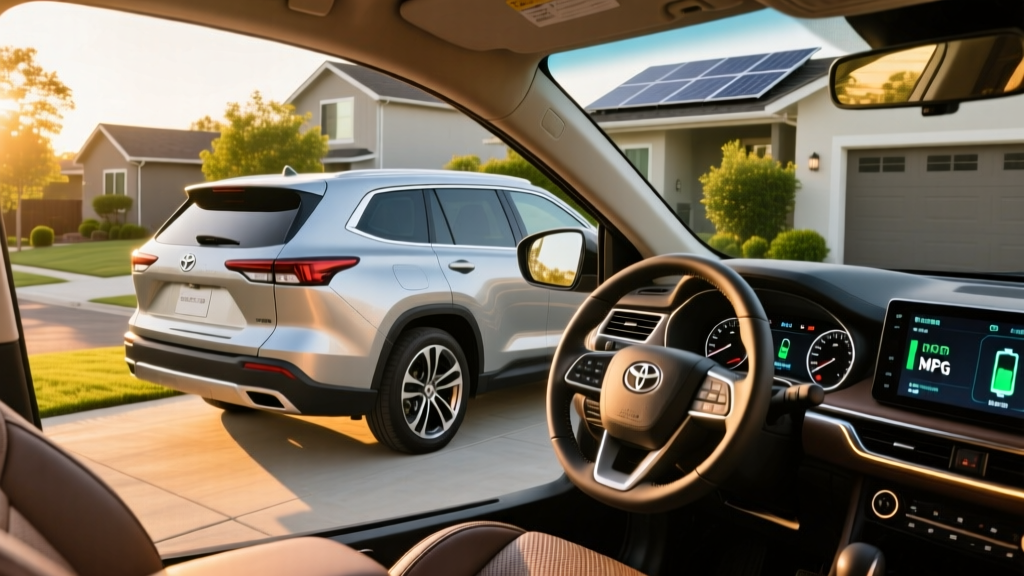
The Toyota Highlander Hybrid occupies a narrow but important lane: a three-row, eight-seat family hauler that achieves mid-30s MPG without ever plugging in. For 2026, Toyota carries forward the proven 2.5-liter four-cylinder hybrid powertrain introduced with the fourth-generation platform, now paired with the updated Toyota Audio Multimedia system and Toyota Safety Sense 3.0 across all trims.
This is a conventional hybrid electric vehicle (HEV) — not a plug-in hybrid (PHEV). You never plug it in. The 1.6 kWh nickel-metal hydride (NiMH) traction battery recharges exclusively through regenerative braking and the gasoline engine. If you need electric-only driving or a federal tax credit, you'll want to look at the RAV4 Prime PHEV or a full battery-electric vehicle instead.
| Specification | Value |
|---|---|
| Powertrain | 2.5L inline-4 + 2 electric motors (AWD: 3 motors) |
| Combined Horsepower | 243 hp |
| Drivetrain | FWD standard; electronic AWD (AWD-i) available |
| EPA MPG (FWD) | 36 city / 35 highway / 36 combined |
| EPA MPG (AWD) | 35 city / 34 highway / 35 combined |
| Traction Battery | 1.6 kWh NiMH (self-charging, no plug) |
| Seating | 8 passengers (bench 2nd row) or 7 (captain's chairs) |
| Cargo Volume | 16.1 cu ft (behind 3rd row) / 84.3 cu ft (max) |
| Towing Capacity | 3,500 lbs (with tow package) |
| 0–60 mph | ~7.9 seconds |
| Base MSRP (LE FWD) | $42,320 |
| Battery Warranty | 10 years / 150,000 miles |
Fuel Economy: EPA Ratings vs. Real-World MPG
The headline number is 36 MPG combined for front-wheel-drive models, according to fueleconomy.gov. AWD drops that to 35 MPG combined — a negligible 1 MPG penalty for all-weather traction.
| Drivetrain | City MPG | Highway MPG | Combined MPG | Annual Fuel Cost* |
|---|---|---|---|---|
| FWD | 36 | 35 | 36 | ~$1,750 |
| AWD-i | 35 | 34 | 35 | ~$1,800 |
*Based on 15,000 miles/year at $3.50/gallon regular unleaded. Actual costs vary by region and driving habits.
Real-World MPG: What Owners Actually See
Toyota's hybrid system excels in stop-and-go city driving where regenerative braking recovers energy constantly. Expect to meet or slightly exceed the EPA city rating of 36 MPG in suburban and urban commuting. Highway driving at 75+ mph, however, typically yields 30–33 MPG — the boxy three-row crossover shape creates aerodynamic drag that the hybrid system can't fully offset at sustained speed.
On a loaded family road trip with roof cargo, AWD engaged, and mountain elevation changes, plan for 28–31 MPG. Cold weather (below 30°F) typically reduces hybrid efficiency by 5–10% due to increased engine runtime for cabin heat and reduced battery efficiency. Overall, most owners report 32–35 MPG in mixed driving — a realistic expectation that still represents a 40–50% improvement over the gas-only Highlander's 24 MPG combined.
HEV vs. PHEV: Why the Highlander Hybrid Doesn't Plug In
This distinction trips up many shoppers. The Highlander Hybrid is a conventional hybrid (HEV), meaning:
- You never plug it in. There is no charge port.
- The 1.6 kWh battery is tiny compared to a PHEV (18+ kWh) or BEV (75+ kWh).
- Electric-only driving is limited to brief low-speed maneuvers — typically under 1 mile at parking-lot speeds.
- All energy ultimately comes from gasoline; the hybrid system simply uses it more efficiently.
| Factor | HEV (Highlander Hybrid) | PHEV (e.g., RAV4 Prime) | BEV (e.g., Kia EV9) |
|---|---|---|---|
| Plug in required? | No | Yes (optional — runs as HEV if not plugged in) | Yes (mandatory) |
| Electric-only range | ~0.5 mi at low speed | 35–42 mi | 250–310 mi |
| Federal tax credit | None | Up to $7,500 (§30D) | Up to $7,500 (§30D) |
| Home charging needed | No | Recommended (Level 2) | Essential (Level 2) |
| 3-row seating | Yes (8 seats) | No (RAV4 is 5-seat) | Limited options (EV9, Ioniq 9) |
| Mixed MPG / MPGe | 35–36 MPG | 94 MPGe (elec) / 38 MPG (gas) | 85–95 MPGe |
The critical tradeoff: if you need three rows and plug-in electric range, your options are extremely limited in 2026. The Chrysler Pacifica Hybrid PHEV minivan offers 32 miles electric-only but sacrifices some cargo flexibility. The Kia EV9 BEV provides three rows and ~270 miles of range but starts near $55,000 and requires home charging. For most three-row buyers without home charging access, the Highlander Hybrid remains the pragmatic choice.
Powertrain Deep Dive: 243 HP, Three Motors, and How It Works
The Highlander Hybrid pairs a 2.5-liter Atkinson-cycle four-cylinder engine (186 hp, 186 lb-ft) with Toyota's Hybrid Synergy Drive system. In FWD models, two motor-generators sit in the transaxle: MG1 handles engine starting and battery charging, while MG2 (118 hp, 149 lb-ft) drives the front wheels. Combined system output is 243 horsepower.
AWD-i models add a third electric motor (40 hp, 89 lb-ft) on the rear axle, activated automatically when the system detects front-wheel slip or during hard acceleration. There is no mechanical driveshaft connecting the front and rear — the rear motor engages and disengages electronically, which improves efficiency but means AWD is best suited for light snow and wet roads rather than serious off-road use.
Driving Impressions
The 2.5L four-cylinder can sound coarse under hard acceleration, a tradeoff of the Atkinson cycle's efficiency-optimized design. At cruising speeds, the cabin is quiet and the transition between electric and gas power is nearly seamless. The 0–60 mph time of approximately 7.9 seconds is adequate for merging and passing but won't feel sporty. The continuously variable transmission (eCVT) eliminates shift shock but produces the characteristic "drone" under sustained heavy throttle — something Toyota has worked to mitigate with stepped gear ratios in the software.
Pricing, Trims, and Tax Credit Reality
The 2026 Highlander Hybrid lineup spans four trims. All prices below include the $1,395 destination charge:
| Trim | FWD MSRP | AWD MSRP | Key Features |
|---|---|---|---|
| LE | $42,320 | $43,920 | TSS 3.0, 8" touchscreen, 8 seats |
| XLE | $46,370 | $47,970 | SofTex seats, sunroof, 2nd-row captain's chairs |
| Limited | $50,670 | $52,270 | Leather, 12.3" screen, JBL audio, 360° camera |
| Platinum | $54,070 | $55,670 | Panoramic roof, head-up display, ventilated seats |
Federal Tax Credit: Does It Qualify?
No. The Highlander Hybrid does not qualify for the federal §30D Clean Vehicle Credit. Under current IRS rules, the §30D credit of up to $7,500 applies only to plug-in electric vehicles — battery-electric vehicles (BEVs) and plug-in hybrids (PHEVs) with a minimum battery capacity of 7 kWh. The Highlander Hybrid's 1.6 kWh NiMH battery falls far below this threshold.
What about state incentives? Some states offer hybrid-specific rebates or HOV lane access, but these vary by jurisdiction and change frequently. Check your state's energy office or DMV website for current programs. Most state incentives also prioritize plug-in vehicles.
Battery Longevity, Warranty, and Replacement Costs
Hybrid battery anxiety is the most common concern we hear from prospective buyers. Here's what the data shows:
Toyota Hybrid Battery Warranty
- Coverage: 10 years or 150,000 miles (whichever comes first)
- What's covered: Hybrid battery, hybrid control module, inverter, and related hybrid-system components
- Threshold: Toyota warrants the battery against failure and abnormal capacity loss; there is no published minimum State of Health percentage, but dealerships test capacity during warranty claims
- Transferability: Warranty transfers to subsequent owners automatically
How Long Do Highlander Hybrid Batteries Last?
Toyota's NiMH hybrid batteries have an excellent longevity track record. The Highlander Hybrid's 1.6 kWh pack operates within a narrow state-of-charge window (roughly 40–80%), which dramatically reduces stress compared to a BEV battery that cycles between 10–90% or wider. Based on data from Toyota's third-generation Highlander Hybrid (2020–2023 model years) and the broader Toyota hybrid fleet (over 20 million hybrids sold globally), most hybrid batteries last well beyond 150,000 miles without replacement.
That said, batteries do degrade gradually. Owners at 150,000–200,000 miles may notice slightly reduced electric-only assist and marginally lower MPG — typically a 2–5% loss rather than a dramatic failure. Complete failure before 150,000 miles is uncommon but does occur; the warranty covers it.
Battery Replacement Cost
If your hybrid battery fails out of warranty, replacement costs break down as follows:
- OEM new battery from Toyota: $3,000–$4,500 (parts) + $500–$1,000 (labor) = $3,500–$5,500 total
- Remanufactured/refurbished battery: $2,000–$3,000 installed
- Individual module replacement: Some independent hybrid specialists can replace failed modules within the pack for $500–$1,500, extending battery life at lower cost
For context, this is comparable to a major transmission repair on a conventional vehicle — not a trivial cost, but not a vehicle-totaling expense either.
Reliability, Safety, and Ownership Costs
Toyota's hybrid powertrain is one of the most proven in the industry. The eCVT transaxle has no traditional gears or clutch packs to wear out, and regenerative braking significantly reduces brake pad wear — many owners report 60,000–80,000 miles on original brake pads. NHTSA and IIHS safety ratings should be checked closer to the model year's release for the most current crash-test data.
Five-Year Cost of Ownership Estimate
| Category | Estimated Cost |
|---|---|
| Purchase Price (MSRP) | $47,970 |
| Fuel (75,000 mi at 35 MPG, $3.50/gal) | $7,500 |
| Insurance (national avg) | $9,500 |
| Maintenance (oil, tires, brakes) | $3,200 |
| Estimated Depreciation (5 yr) | $18,000 |
| Total 5-Year Cost | ~$86,170 |
Compared to the gas-only Highlander (24 MPG combined), the hybrid saves approximately $3,200 in fuel costs over five years / 75,000 miles. The hybrid's $2,000–$3,000 price premium over the gas model is typically recovered within 3–4 years of average driving.
Pros
- 36 MPG combined in a three-row, 8-seat crossover
- No plug-in charging required — works with any lifestyle
- Proven Toyota hybrid reliability with 10-year battery warranty
- Strong resale value and low depreciation
- Standard AWD-i option for all-weather traction
- 3,500-lb towing capacity covers most family trailers
Cons
- No federal tax credit (HEV, not PHEV/BEV)
- Four-cylinder engine sounds strained under hard acceleration
- Third-row space is tight for adults on long trips
- Cargo space behind 3rd row (16.1 cu ft) is modest for the class
- No electric-only driving range to speak of
- Platinum trim pushes past $55,000
Who Should Buy the Highlander Hybrid — And Who Shouldn't
Choose the Highlander Hybrid If:
- You need three rows and 8-passenger seating regularly
- You don't have access to home or workplace charging (apartment, street parking)
- Your daily driving is suburban/city with frequent stops (where hybrids shine)
- You want maximum fuel efficiency without changing your fueling habits
- You plan to keep the vehicle 8–10+ years (warranty coverage and proven longevity)
Look Elsewhere If:
- You want electric-only driving for a short commute — consider the RAV4 Prime PHEV (42 mi EV range) or a BEV
- You need the federal $7,500 tax credit to make the math work — only PHEVs and BEVs qualify
- You prioritize acceleration and driving engagement — the 4-cylinder hybrid drone won't satisfy
- You regularly tow more than 3,500 lbs — the gas Highlander V6 or a truck-based SUV offers more capacity
- Third-row adults are frequent passengers — the Kia Telluride or Hyundai Palisade offer more room (though neither offers a hybrid)
Frequently Asked Questions
How many MPG does the 2026 Highlander Hybrid actually get?
The EPA rates it at 36 city / 35 highway / 36 combined (FWD) and 35/34/35 (AWD). In real-world mixed driving, expect 32–35 MPG. City-heavy commuters often match or exceed the EPA city rating, while sustained highway driving at 75+ mph typically yields 30–33 MPG.
Does the Highlander Hybrid need to be plugged in?
No. It is a conventional hybrid (HEV), not a plug-in hybrid. The battery charges through regenerative braking and the gasoline engine. There is no charge port on the vehicle.
How far can the Highlander Hybrid drive on electric power alone?
Less than one mile, and only at low parking-lot speeds (under 25 mph). The 1.6 kWh battery is far too small for meaningful electric-only range. If you want 30+ miles of electric driving, you need a PHEV like the RAV4 Prime or a full BEV.
Is the Highlander Hybrid reliable? What does a battery replacement cost?
Toyota's hybrid system is among the most reliable powertrains in the industry, backed by a 10-year / 150,000-mile hybrid battery warranty. Most batteries last well beyond 150,000 miles. Out-of-warranty replacement costs $3,500–$5,500 for a new OEM battery, or $2,000–$3,000 for a remanufactured unit.
Does the Highlander Hybrid qualify for a tax credit?
No federal tax credit is available. The IRS §30D Clean Vehicle Credit applies only to plug-in vehicles (PHEVs and BEVs) with batteries of at least 7 kWh. The Highlander Hybrid's 1.6 kWh battery does not qualify. Some states may offer minor hybrid incentives — check your local energy office.
How does the Highlander Hybrid compare to the gas-only Highlander on fuel costs?
The gas-only Highlander AWD achieves 24 MPG combined. At 15,000 miles per year and $3.50/gallon, the gas model costs approximately $2,188 annually in fuel. The hybrid AWD at 35 MPG costs about $1,500 — a savings of roughly $688 per year, or $3,440 over five years.
Is the Highlander Hybrid good for towing?
It's rated for 3,500 lbs with the factory tow package, which covers small travel trailers, utility trailers, and a pair of personal watercraft. Towing will reduce fuel economy to roughly 22–26 MPG depending on trailer weight and terrain. If you regularly tow 5,000+ lbs, you'll need a larger SUV or truck.
Hybrid vs. PHEV vs. full EV — which is right for my family?
If you have home Level 2 charging and your daily commute is under 40 miles, a PHEV or BEV offers lower running costs and potential tax credits. If you lack reliable charging access, drive long distances frequently, or simply don't want to think about charging, the Highlander Hybrid delivers strong efficiency with zero lifestyle changes. The deciding factor is usually charging access, not the vehicle itself.