Quick Verdict: The Three-Row Efficiency Benchmark
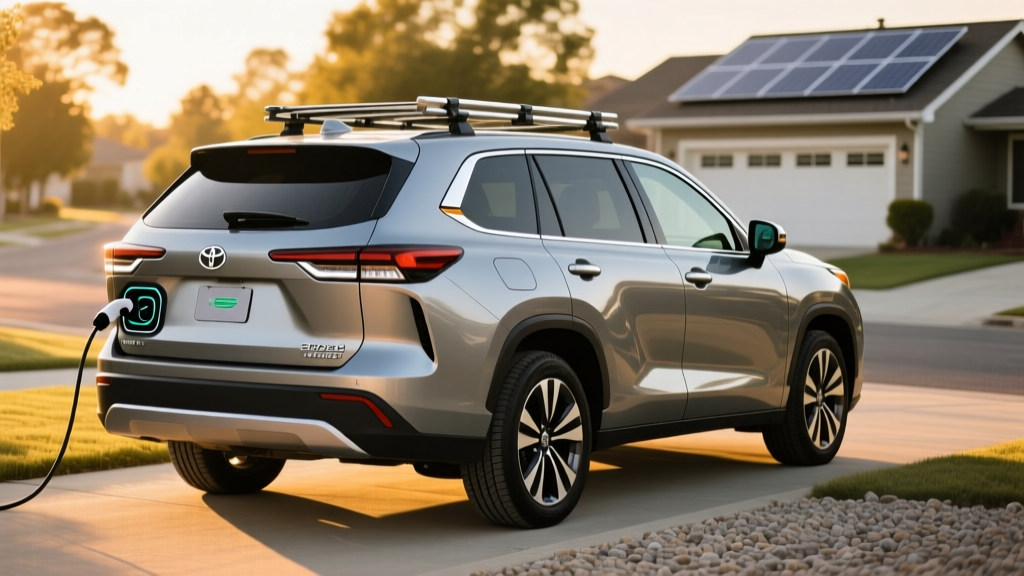
If you need three rows of seating but refuse to pay the fuel penalty that typically comes with a midsize SUV, the 2026 Toyota Highlander Hybrid remains the default answer. With an EPA-estimated 36 MPG combined, it sips fuel at a rate that embarrasses many compact crossovers — let alone a 4,600-pound family hauler. Unlike plug-in hybrids, the Highlander Hybrid is a conventional self-charging hybrid (HEV): no plug, no charging anxiety, no range limitations. You fuel it like any other vehicle and let Toyota's series-parallel hybrid system handle the rest.
This guide covers the 2026 Highlander Hybrid's real-world fuel economy, powertrain engineering, battery longevity, tax-credit eligibility, and how it stacks up against PHEV and full-electric alternatives for family buyers.
HEV vs. PHEV: What the Highlander Hybrid Actually Is
Before examining the numbers, it's essential to clarify what the Highlander Hybrid is — and what it is not. Toyota offers the Highlander Hybrid exclusively as a conventional hybrid electric vehicle (HEV). There is no plug-in hybrid (PHEV) variant of the Highlander as of the 2026 model year. Toyota does offer a PHEV in the RAV4 Prime and the Prius Prime, but the Highlander lineup stops at HEV.
| Feature | Highlander Hybrid (HEV) | Typical PHEV SUV (e.g., RAV4 Prime) |
|---|---|---|
| Plug-in charging required? | No — regenerative braking + engine charges battery | Yes — plug in for electric-only range |
| Electric-only range | ~1 mile at very low speeds | 35–42 miles (model dependent) |
| Battery size | 1.87 kWh (nickel-metal hydride) | 18.1 kWh (lithium-ion) |
| Federal tax credit | Not eligible (§30D requires plug-in) | Up to $7,500 if sourcing/income rules met |
| Home charging equipment | None needed | Level 2 (240V) recommended |
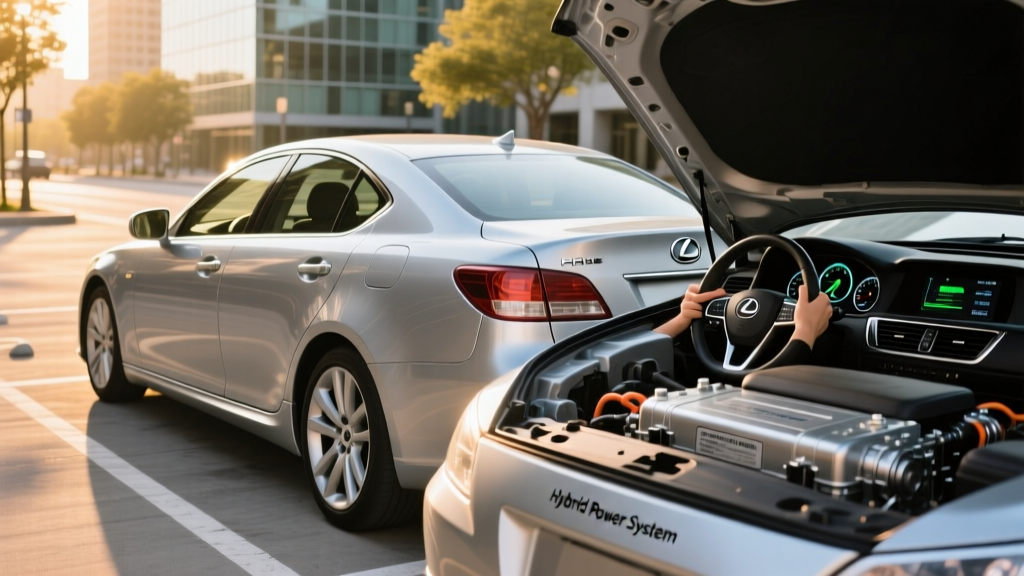
The Highlander Hybrid's 1.87 kWh battery is small by design. It functions as a buffer — capturing energy from regenerative braking and engine excess, then deploying it to assist acceleration or enable brief low-speed electric movement. You never think about it; the system manages charge automatically.
Fuel Economy: EPA Estimates and Real-World MPG
The headline number is what draws buyers in, but real-world results tell the full story. Here's the official EPA breakdown for the 2026 Highlander Hybrid, courtesy of fueleconomy.gov:
| Drivetrain | City MPG | Highway MPG | Combined MPG |
|---|---|---|---|
| FWD (LE, XLE, Limited) | 36 | 35 | 36 |
| AWD (all trims) | 35 | 35 | 35 |
Real-World MPG: What Owners Actually See
Hybrids often exceed their EPA city estimates because stop-and-go driving maximizes regenerative braking and electric-motor assist. On the highway, the advantage narrows — the gasoline engine does most of the work at sustained speeds.
- City/suburban driving: Expect 34–38 MPG. In moderate traffic with frequent stops, owners regularly report hitting or exceeding the 36 MPG city sticker.
- Highway cruising (70–75 mph): Expect 30–33 MPG. Aerodynamic drag on a boxy three-row SUV limits hybrid advantage at speed.
- Cold weather (below 32°F): Expect a 10–15% drop, landing around 30–32 MPG combined. The engine runs more frequently to heat the cabin and bring the catalytic converter to operating temperature.
- Towing: The Highlander Hybrid is rated for 3,500 lbs. When towing near capacity, fuel economy drops to approximately 18–22 MPG.
For a family driving 15,000 miles per year at 35 MPG combined, that's roughly 429 gallons annually. At $3.50/gallon, fuel cost is approximately $1,500/year. A comparable non-hybrid midsize SUV averaging 23 MPG combined would consume 652 gallons — roughly $2,280/year. The hybrid saves about $780 annually in fuel.
Powertrain: How Toyota's Hybrid System Powers a 4,600-lb SUV
| Engine | 2.5L inline-4, Atkinson cycle |
| Engine output | 186 hp / 186 lb-ft torque |
| Electric motors | Front: 134 kW (180 hp); Rear (AWD): 40 kW (54 hp) |
| Net combined system output | 243 hp |
| Transmission | eCVT (planetary gearset, no fixed gears) |
| Hybrid battery | 1.87 kWh, nickel-metal hydride (NiMH) |
| 0–60 mph | ~7.8 seconds |
| Towing capacity | 3,500 lbs |
| Curb weight | ~4,500–4,700 lbs (trim dependent) |
Toyota's Hybrid Synergy Drive uses a planetary gearset — marketed as an eCVT — to seamlessly blend power from the gasoline engine and electric motors. There are no traditional gear shifts. The result is smooth, linear acceleration, though the engine note under hard acceleration can drone at high RPM. The 243 net horsepower is adequate for merging and passing, but this is an efficiency-first powertrain, not a performance one.
The AWD system uses a dedicated rear electric motor rather than a mechanical driveshaft. This means the rear axle engages only when the system detects slip or when additional traction is needed, reducing parasitic loss compared to a conventional AWD setup.
Battery Longevity, Warranty, and Replacement Cost
Hybrid battery anxiety is the most common concern among first-time hybrid buyers. Here's what the data shows:
- Coverage: 10 years / 150,000 miles (whichever comes first)
- What's covered: Battery capacity loss below a specified threshold, defects, and failure
- Transferable: Yes — warranty transfers to subsequent owners
Real-World Battery Degradation
Toyota's NiMH hybrid batteries are among the most proven in the industry. The Prius, which shares similar hybrid architecture, has demonstrated battery longevity exceeding 200,000 miles in numerous fleet and owner reports. The Highlander Hybrid's battery is relatively small (1.87 kWh) and is never fully charged or fully depleted — the system maintains a state-of-charge window between roughly 40% and 80%. This shallow cycling dramatically extends cell life.
Based on long-term ownership data across Toyota's hybrid lineup:
- Years 1–5: Negligible capacity loss; no measurable impact on fuel economy
- Years 5–10: Minor degradation (2–5%); most owners notice no difference
- Years 10–15: Some units may require replacement, but many original batteries remain functional beyond 200,000 miles
Battery Replacement Cost
If the hybrid battery does fail outside warranty, replacement costs for the Highlander Hybrid typically range from $2,000 to $4,000 for a new OEM unit, including labor. Refurbished or aftermarket units can reduce this to $1,200–$2,500. Given the 10-year/150,000-mile warranty and the proven longevity of Toyota's NiMH packs, out-of-pocket replacement during typical ownership is uncommon.
Pricing, Trims, and Tax Credit Eligibility
| Trim | Drivetrain | MSRP (est.) |
|---|---|---|
| LE | FWD | $42,820 |
| LE | AWD | $44,420 |
| XLE | FWD | $46,420 |
| XLE | AWD | $48,020 |
| Limited | AWD | $52,675 |
| Platinum | AWD | $55,075 |
Federal Tax Credit: Not Eligible
The Highlander Hybrid does not qualify for the IRS §30D Clean Vehicle Credit. Under current IRS rules, the §30D credit applies only to plug-in electric vehicles (BEVs and PHEVs) with a battery capacity of at least 7 kWh that can be recharged from an external power source. Because the Highlander Hybrid is a conventional HEV with a 1.87 kWh battery and no plug, it is ineligible regardless of buyer income or MSRP.
Some states offer separate incentives for conventional hybrids, but these are increasingly rare as incentive programs shift toward plug-in vehicles. Check your state's energy or environmental agency for current programs.
Highlander Hybrid vs. PHEV vs. Full EV: Which Fits Your Family?
The three-row family vehicle market now spans conventional hybrids, plug-in hybrids, and full battery-electric vehicles. Here's a decision framework based on real ownership scenarios:
Choose the Highlander Hybrid (HEV) if:
- You cannot charge at home (apartment, street parking, no garage)
- You want three rows with zero behavioral change from a gas car
- You drive 12,000–18,000 miles/year and want low fuel cost without plug-in logistics
- You frequently take road trips exceeding 400 miles
- You value Toyota's long-term reliability track record
Consider a PHEV or full EV instead if:
- You can install a Level 2 home charger and want electric-only daily driving
- Your daily commute is under 35 miles (a PHEV covers this on electricity alone)
- You want access to the $7,500 federal tax credit (PHEV or BEV only)
- You prioritize maximum acceleration and instant torque (BEV advantage)
- Three rows are optional — many BEV SUVs offer two rows with a small third-row option
Notable alternatives: The Kia Sorento Hybrid (34 MPG combined, lower starting price) is the closest competitor. The Toyota Grand Highlander Hybrid offers more third-row space and cargo room with a slightly lower EPA rating of 34 MPG combined. For plug-in buyers, the Mazda CX-90 PHEV offers 26 miles of electric-only range and three rows, though at a higher price and with tax-credit sourcing caveats.
Reliability, Safety, and Ownership Costs
Toyota consistently ranks at or near the top of long-term reliability surveys, and the Highlander Hybrid benefits from one of the most mature hybrid powertrains in production. The eCVT has no clutch packs, belts, or traditional wear components — it's a planetary gearset with minimal moving parts. Brake wear is significantly reduced thanks to regenerative braking; many owners report original brake pads lasting 80,000–100,000 miles.
Safety Ratings
The 2026 Highlander comes standard with Toyota Safety Sense 3.0, which includes adaptive cruise control, lane-tracing assist, automatic emergency braking with pedestrian detection, and blind-spot monitoring. The Highlander has earned the IIHS Top Safety Pick designation in recent model years and a 5-Star overall rating from NHTSA.
5-Year Estimated Ownership Costs
| Purchase price (MSRP) | $48,020 |
| Fuel (75,000 mi ÷ 35 MPG × $3.50/gal) | $7,500 |
| Insurance (national avg. midsize SUV) | $9,500 |
| Maintenance (hybrid — reduced brake wear) | $2,800 |
| Estimated depreciation (5-yr) | $18,000 |
| 5-year total (est.) | ~$85,820 |
Compared to a non-hybrid midsize SUV averaging 23 MPG, the Highlander Hybrid saves approximately $3,900 in fuel over five years, partially offsetting its higher purchase price.
Frequently Asked Questions
How many MPG does the Highlander Hybrid get?
The 2026 Toyota Highlander Hybrid is EPA-rated at 36 MPG city / 35 MPG highway / 36 MPG combined for FWD trims, and 35/35/35 for AWD trims. Real-world results typically match or slightly exceed the city estimate in stop-and-go driving, while highway driving at 70+ mph yields 30–33 MPG.
Does the Highlander Hybrid need to be plugged in?
No. The Highlander Hybrid is a conventional self-charging hybrid (HEV). Its small battery is charged entirely by the gasoline engine and regenerative braking. There is no plug, no charging cable, and no home charging equipment required.
Is the Highlander Hybrid available as a plug-in hybrid (PHEV)?
No. As of the 2026 model year, Toyota does not offer a plug-in hybrid version of the Highlander. If you want a Toyota PHEV with SUV utility, the RAV4 Prime (42 miles electric-only) is the closest option, though it has only two rows of seating.
Does the Highlander Hybrid qualify for any tax credit?
No. The federal §30D Clean Vehicle Credit requires a plug-in vehicle with a battery of at least 7 kWh. The Highlander Hybrid's 1.87 kWh battery and lack of a plug make it ineligible. Some states may offer minor hybrid incentives — check your state's energy office for details.
How long will the Highlander Hybrid battery last?
Toyota's hybrid batteries are designed for the life of the vehicle. The battery is covered by a 10-year / 150,000-mile warranty. Real-world data from Toyota's hybrid lineup shows many original batteries functioning well past 200,000 miles with minimal degradation, thanks to shallow charge-discharge cycling.
What does it cost to replace the hybrid battery?
Out-of-warranty replacement for the Highlander Hybrid battery typically costs $2,000–$4,000 for a new OEM unit, or $1,200–$2,500 for a refurbished unit. Given the 10-year warranty and proven longevity, most owners will never need to replace the battery.
Is the Highlander Hybrid good for towing?
The Highlander Hybrid is rated to tow 3,500 lbs — sufficient for a small boat, light utility trailer, or a pair of personal watercraft. Expect fuel economy to drop to 18–22 MPG when towing near maximum capacity. For heavier towing needs, a body-on-frame SUV remains the better tool.
How does the Highlander Hybrid compare to the Grand Highlander Hybrid?
The Grand Highlander Hybrid offers more third-row legroom (33.5" vs. 27.7") and greater cargo space, but its EPA rating is slightly lower at 34 MPG combined. If maximum passenger and cargo space is the priority, the Grand Highlander is the better fit. If fuel economy is paramount and the third row is for occasional use, the standard Highlander Hybrid wins.