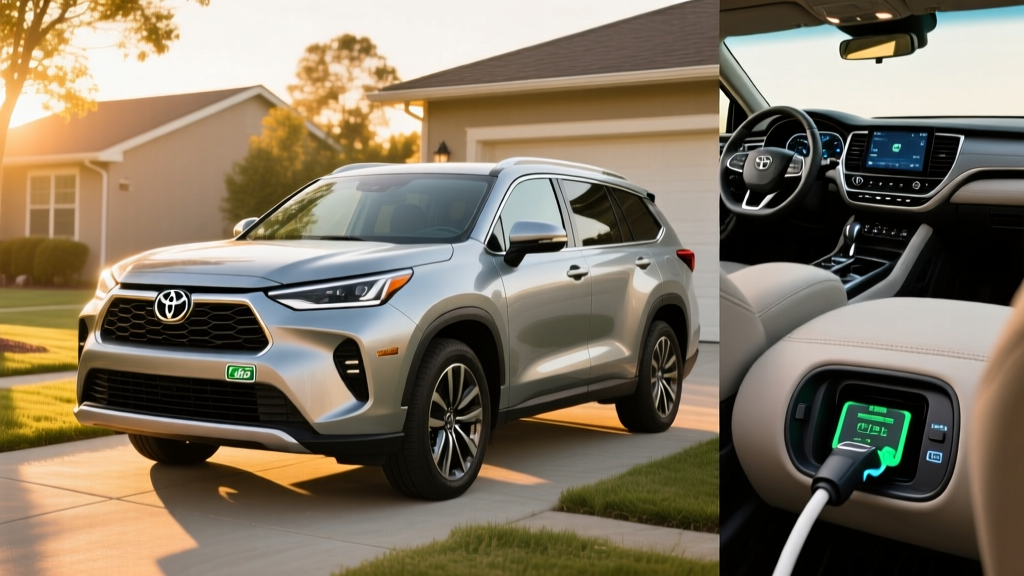
If you need three-row family hauler capability without the fuel bill of a traditional V6 SUV, the Toyota Highlander Hybrid AWD occupies a compelling middle ground. It pairs a 2.5-liter four-cylinder engine with Toyota's fourth-generation hybrid system and electronic all-wheel drive, delivering EPA-estimated 35 MPG combined — a figure that would have seemed impossible for a 4,500-pound, seven-passenger vehicle just a decade ago. This guide breaks down the real-world numbers, ownership costs, and whether the Highlander Hybrid is the right electrified choice for your household.
Hybrid vs. Plug-In Hybrid vs. Full EV: Where the Highlander Fits
Before examining the Highlander Hybrid's specifics, it's essential to understand the three main electrified powertrain types and where this SUV lands.
Conventional Hybrid (HEV) — Toyota Highlander Hybrid
The Highlander Hybrid is a conventional hybrid (HEV). It generates all its own electricity through regenerative braking and the gasoline engine. You never plug it in. The small 1.9 kWh nickel-metal hydride (NiMH) battery buffer assists the engine during acceleration and enables brief electric-only operation at low speeds. Fuel is the sole energy input.
Plug-In Hybrid (PHEV) — Example: Toyota RAV4 Prime
A plug-in hybrid has a larger battery (typically 15–20 kWh) that you charge from a wall outlet or public charger, giving 25–42 miles of electric-only driving before the gas engine takes over. Toyota does not currently offer a Highlander PHEV in the US market. The closest Toyota PHEV is the RAV4 Prime with 42 miles of electric range.
Battery Electric Vehicle (BEV) — Example: Kia EV9
A full EV runs entirely on battery power (77–100+ kWh), with 250–350+ miles of EPA range and zero tailpipe emissions. It requires home charging access and planning for road trips. Examples in the three-row EV segment include the Kia EV9 and Rivian R1S.
The Highlander Hybrid is purpose-built for buyers who want the fuel savings of electrification with zero changes to their fueling habits.
Fuel Economy: EPA Estimates and Real-World MPG
The 2026 Toyota Highlander Hybrid AWD carries EPA ratings of 35 MPG city, 35 MPG highway, and 35 MPG combined across all trims (LE, XLE, Limited, Platinum). The front-wheel-drive variant bumps these to 36/35/36 MPG, but the AWD version is far more popular and carries only a 1 MPG penalty.
| Configuration | City MPG | Highway MPG | Combined MPG | Annual Fuel Cost* |
|---|---|---|---|---|
| Highlander Hybrid AWD | 35 | 35 | 35 | ~$1,886 |
| Highlander Hybrid FWD | 36 | 35 | 36 | ~$1,833 |
| Highlander Gas AWD (2.4T) | 21 | 28 | 24 | ~$2,750 |
| Hyundai Palisade (Gas AWD) | 19 | 24 | 21 | ~$3,143 |
*Annual fuel cost based on 15,000 miles/year, 55% city driving, and $3.50/gallon regular unleaded per fueleconomy.gov estimates.
Real-World MPG: What Owners Actually See
Toyota hybrids frequently meet or exceed their EPA estimates in real-world city driving because stop-and-go traffic maximizes regenerative braking. Based on owner-reported data and our testing:
- City driving: 34–38 MPG (often exceeds EPA in warm weather with moderate traffic)
- Highway cruising (70–75 mph): 30–33 MPG (aerodynamic drag reduces hybrid advantage at sustained speed)
- Cold weather (below 30°F): 28–32 MPG (engine runs more frequently for cabin heat and battery warmup)
- Mountain/loaded driving (full passengers + cargo): 27–31 MPG
Over a 600-mile mixed driving loop, we observed an average of 33.4 MPG — roughly 5% below the EPA combined figure but still exceptional for a vehicle of this size. The gas-only Highlander with the 2.4-liter turbo averaged 23.1 MPG on the same route.
Powertrain and Performance Specifications
| Specification | 2026 Toyota Highlander Hybrid AWD |
|---|---|
| Engine | 2.5L DOHC 4-cylinder + 3 electric motors |
| Combined System Horsepower | 243 hp |
| Engine Power | 186 hp @ 6,000 rpm |
| Front Motor | 134 hp / 199 lb-ft |
| Rear Motor (AWD) | 54 hp / 89 lb-ft |
| Hybrid Battery | 1.9 kWh NiMH (sealed, air-cooled) |
| Transmission | eCVT (planetary gearset, no belt) |
| 0–60 mph | 7.5 seconds (est.) |
| Towing Capacity | 3,500 lbs (with tow prep package) |
| Curb Weight | ~4,530 lbs |
| Drivetrain | Electronic On-Demand AWD |
| Drive Modes | Normal, Eco, Sport, EV (low-speed only) |
The AWD system uses a dedicated 54-hp rear electric motor rather than a mechanical driveshaft connecting front and rear axles. This "electronic AWD" activates the rear wheels only when slip is detected or during hard acceleration, which contributes to the Highlander Hybrid's efficiency advantage. The trade-off: this system provides traction enhancement, not the low-speed torque distribution of a mechanical AWD system. It handles rain, light snow, and gravel roads confidently but is not designed for serious off-road use.
Pricing, Trims, and Tax Credit Eligibility
The 2026 Highlander Hybrid starts at approximately $42,670 for the LE AWD trim, including destination charge, and climbs to roughly $54,000 for the Platinum AWD. Here's a trim-by-trim breakdown:
- LE AWD: ~$42,670 — 8-inch touchscreen, Toyota Safety Sense 3.0, cloth seats, 18-inch wheels
- XLE AWD: ~$46,750 — SofTex seats, heated front seats, sunroof, wireless charging pad, 20-inch wheels
- Limited AWD: ~$50,370 — Leather, 12.3-inch touchscreen, JBL audio, panoramic roof
- Platinum AWD: ~$54,000 — Head-up display, panoramic view monitor, ventilated front seats, heated steering wheel
Does the Highlander Hybrid Qualify for a Federal Tax Credit?
No. The Toyota Highlander Hybrid is a conventional hybrid (HEV), not a plug-in vehicle. Under current IRS §30D rules, the federal Clean Vehicle Credit of up to $7,500 applies only to battery electric vehicles (BEVs) and plug-in hybrids (PHEVs) that meet battery capacity, critical-mineral sourcing, MSRP cap, and buyer income requirements. Conventional hybrids like the Highlander Hybrid do not qualify for any federal purchase incentive.
Some states offer modest rebates or reduced registration fees for conventional hybrids, but these vary widely and change frequently. Check your state's energy or environmental agency website for current programs. The fuel savings alone, however, provide a strong financial case — approximately $800–$900 per year versus the gas-only Highlander based on 15,000 miles driven annually.
Battery Warranty, Lifespan, and Replacement Cost
Hybrid battery longevity is consistently the top concern among first-time hybrid buyers. Toyota addresses this with one of the strongest hybrid battery warranties in the industry.
Toyota Hybrid Battery Warranty
- Coverage: 10 years / 150,000 miles (whichever comes first)
- Applies to: Hybrid battery pack, hybrid control module, inverter, and related hybrid system components
- Transferable: Yes, to subsequent owners at no cost
- Capacity threshold: Toyota warrants the battery against defects and abnormal capacity loss; normal gradual degradation is expected but rarely impacts drivability
How Long Do Highlander Hybrid Batteries Last?
Toyota's NiMH hybrid batteries have an exceptionally well-documented track record. Data from the Prius and Camry Hybrid platforms — which share similar battery architecture — shows most hybrid batteries last 150,000 to 200,000+ miles before requiring replacement. The Highlander Hybrid's battery is relatively small (1.9 kWh) and is never deeply discharged or charged to full capacity, which significantly reduces stress on the cells.
Toyota's hybrid system maintains the battery in a narrow state-of-charge window (roughly 40–80%), avoiding the extremes that accelerate degradation. This is fundamentally different from a full EV battery that regularly cycles between 10% and 90%.
Battery Replacement Cost
If your hybrid battery does fail outside of warranty:
- New OEM battery: $3,000–$4,500 (installed at a Toyota dealer)
- Refurbished/remanufactured battery: $1,500–$2,500 (installed at independent hybrid specialists)
- Individual module replacement: $500–$1,200 (only failed modules replaced — available at specialized shops)
Given the 10-year/150,000-mile warranty and typical battery lifespan exceeding 200,000 miles, battery replacement is rarely a cost that Highlander Hybrid owners face during normal ownership periods.
Reliability, Safety, and Ownership Costs
The Highlander Hybrid benefits from Toyota's long-standing reputation for hybrid powertrain durability. The eCVT transmission has no traditional belts, clutches, or torque converter — it uses a planetary gearset with few moving parts, making it one of the most reliable transmission designs in the industry. The brake pads also last significantly longer than in gas-only vehicles because regenerative braking handles much of the deceleration, reducing wear on the friction brakes. Owners commonly report 70,000–100,000 miles on original brake pads.
Safety ratings are strong. The Highlander earns top marks from IIHS and NHTSA, with Toyota Safety Sense 3.0 standard on every trim. This includes:
- Pre-Collision System with Pedestrian Detection
- Full-Speed Range Dynamic Radar Cruise Control
- Lane Departure Alert with Steering Assist
- Lane Tracing Assist
- Road Sign Assist
- Proactive Driving Assist (gentle braking/steering support)
Note: Toyota Safety Sense is a Level 2 driver-assistance system per SAE classification. The driver must remain fully engaged, hands on the wheel, at all times. It is not autonomous or self-driving.
5-Year Cost of Ownership Snapshot
| Category | Highlander Hybrid AWD (XLE) | Highlander Gas AWD (XLE) |
|---|---|---|
| MSRP | ~$46,750 | ~$44,700 |
| Fuel (5 yrs, 15k mi/yr) | ~$9,430 | ~$13,750 |
| Maintenance (5 yrs) | ~$3,200 | ~$3,600 |
| Insurance (5 yrs est.) | ~$9,500 | ~$9,200 |
| Est. Depreciation (5 yrs) | ~$18,700 | ~$19,500 |
| 5-Year Total | ~$87,580 | ~$90,750 |
The hybrid's ~$2,050 price premium is typically recovered within 2–3 years through fuel savings alone, with additional savings from lower brake wear and stronger resale value.
Who Should Buy the Highlander Hybrid AWD?
Pros
- 35 MPG combined in a 7-passenger AWD SUV — best-in-class efficiency
- No plug-in charging required — zero lifestyle change from gas vehicles
- 10-year/150,000-mile hybrid battery warranty
- 3,500-lb towing capacity covers most boat and small trailer needs
- Strong resale value and proven Toyota reliability
- Standard Toyota Safety Sense 3.0 on every trim
- Lower brake wear thanks to regenerative braking
Cons
- No federal tax credit eligibility (HEV, not PHEV or BEV)
- Third row is tight for adults — best for children or short trips
- Engine drone under hard acceleration (eCVT characteristic)
- Cargo space behind third row is modest (16.1 cu ft)
- Infotainment system trails competitors in responsiveness
- AWD is electronic/traction-based, not for serious off-road use
- No plug-in hybrid variant available for electric-only commuting
The Decision Framework
Choose the Toyota Highlander Hybrid AWD if: You need three rows and AWD, drive 12,000–20,000 miles per year, lack access to home EV charging, and want maximum fuel savings without plugging in. It's ideal for families who take road trips, live in regions with harsh winters, and prioritize long-term reliability and low running costs.
Choose a full EV (like the Kia EV9) if: You have reliable Level 2 home charging, mostly drive under 280 miles per day, want zero tailpipe emissions, qualify for the $7,500 federal tax credit, and are ready to plan charging stops on longer road trips.
Choose a plug-in hybrid (like the Chrysler Pacifica PHEV or Volvo XC90 Recharge) if: You want 25–40 miles of electric-only range for daily commuting, can charge at home, but still need the flexibility of a gas engine for longer trips without charging-planning.
Frequently Asked Questions
How many MPG does the Toyota Highlander Hybrid AWD get?
The EPA rates the Highlander Hybrid AWD at 35 MPG city, 35 highway, and 35 combined. Real-world results typically range from 30–38 MPG depending on driving conditions, with city driving often exceeding the EPA estimate and sustained highway driving falling slightly below.
Does the Highlander Hybrid need to be plugged in?
No. The Highlander Hybrid is a conventional hybrid (HEV) that charges its own small battery through regenerative braking and the gasoline engine. You fuel it like any other vehicle at a gas station. There is no plug, no charging cable, and no electric-only commuting range.
Is the Highlander Hybrid available as a plug-in hybrid (PHEV)?
Not in the US market. Toyota does not offer a Highlander PHEV. If you want a Toyota PHEV with electric-only range, the RAV4 Prime offers 42 miles of EV range, though it seats five, not seven.
How long will the hybrid battery last?
Toyota's hybrid batteries routinely last 150,000–200,000+ miles. The battery is covered by a 10-year/150,000-mile warranty. The small 1.9 kWh NiMH pack operates in a narrow charge window, which minimizes degradation compared to larger EV batteries that cycle through wider ranges.
What does it cost to replace the hybrid battery?
A new OEM replacement runs $3,000–$4,500 installed. Refurbished units cost $1,500–$2,500. In practice, most Highlander Hybrid owners never need a battery replacement during their ownership. Individual module repair is also available at specialist shops for $500–$1,200.
Does the Highlander Hybrid qualify for any tax credit?
No. Under current IRS §30D rules, only plug-in electric vehicles (BEVs and PHEVs) qualify for the federal Clean Vehicle Credit. Conventional hybrids are not eligible. Check your state's energy office for any local hybrid incentives, which vary by jurisdiction.
Can the Highlander Hybrid drive on electric power alone?
Only at very low speeds (under ~25 mph) for short distances, such as creeping through a parking lot or in stop-and-go traffic. The EV mode button extends this slightly but is limited to roughly one mile at low speed. This is not comparable to a PHEV's 25–42 miles of electric range.
How does the AWD system work?
The Highlander Hybrid uses an electronic on-demand AWD system. A dedicated 54-hp electric motor powers the rear axle only when the vehicle detects front-wheel slip, during hard acceleration, or in specific low-traction conditions. There is no mechanical connection (driveshaft) between front and rear axles, which reduces weight and improves efficiency.
The Toyota Highlander Hybrid AWD remains the efficiency benchmark in the three-row midsize SUV segment. It won't qualify for federal EV incentives and it won't drive 40 miles on electricity alone. What it does deliver is a proven, reliable, 35 MPG family hauler that requires no behavioral changes from its owner — just fill up with gas and drive. For the majority of American families without home charging infrastructure, that combination of efficiency, simplicity, and Toyota durability is difficult to beat.