Quick Verdict: The Family Hybrid That Just Works
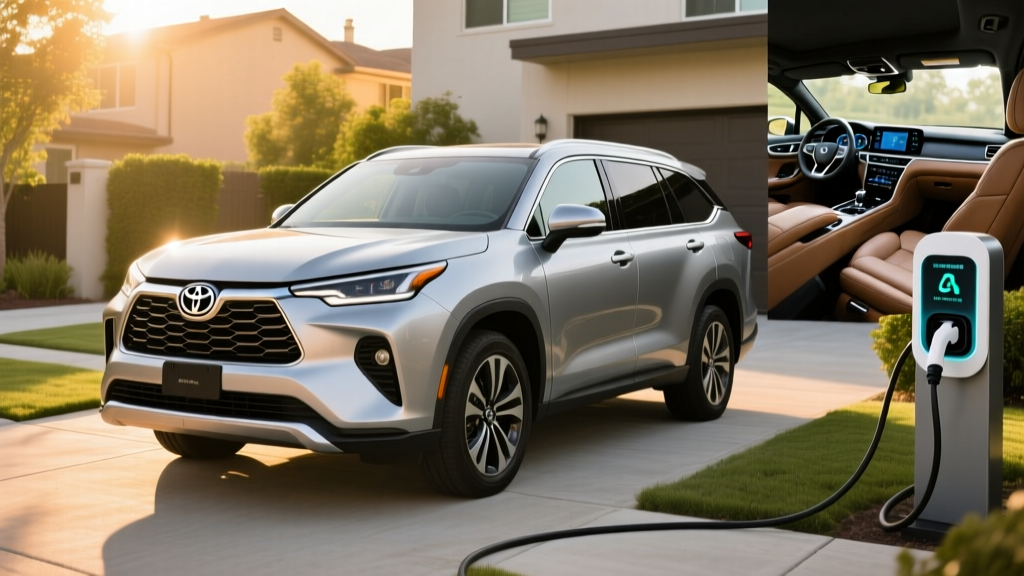
If you need three rows, all-wheel drive, and fuel economy that embarrasses sedans a decade old, the Toyota Highlander Hybrid remains the default answer. The 2026 Highlander Hybrid 7 seater pairs a 2.5-liter four-cylinder with a hybrid electric powertrain to deliver an EPA-estimated 35 MPG combined — a figure that holds remarkably steady in real-world driving. No plug required, no range anxiety, and a hybrid battery backed by a 10-year/150,000-mile warranty.
But is it the right electrified vehicle for your family, or should you look at a plug-in hybrid (PHEV) or a full battery-electric SUV instead? This guide breaks down every number that matters.
HEV vs PHEV: What the Highlander Hybrid Actually Is
Important distinction: The Toyota Highlander Hybrid is a conventional hybrid (HEV). It does not plug in. Toyota does not currently offer a plug-in hybrid (PHEV) variant of the Highlander. The hybrid system recovers energy through regenerative braking and the gasoline engine to charge its small nickel-metal-hydride (NiMH) battery pack — typically around 1.6 kWh of usable capacity. You simply fuel up with gasoline and drive.
This matters because buyers sometimes confuse the Highlander Hybrid with plug-in models like the Toyota RAV4 Prime. Here's how the two electrification approaches differ in practice:
| Feature | Highlander Hybrid (HEV) | Typical PHEV (e.g., RAV4 Prime) | Battery Electric (e.g., Kia EV9) |
|---|---|---|---|
| Plugs in? | No | Yes (Level 1/2) | Yes (Level 1/2/DC) |
| Electric-only range | ~1 mile at low speed | 30–42 miles | 230–300+ miles |
| Gasoline engine | Yes (primary) | Yes (backup) | None |
| Federal tax credit (§30D) | Not eligible | Up to $7,500 (if eligible) | Up to $7,500 (if eligible) |
| Home charging needed | No | Recommended | Essential |
Fuel Economy: EPA Ratings vs Real-World MPG
The 2026 Highlander Hybrid with all-wheel drive (AWD) carries these EPA estimates, per fueleconomy.gov:
| Drivetrain | City | Highway | Combined |
|---|---|---|---|
| AWD (all trims) | 35 MPG | 34 MPG | 35 MPG |
Note that the front-wheel-drive configuration was discontinued after earlier model years; all 2026 Highlander Hybrids are AWD.
Real-World MPG: What Owners Actually See
Toyota's hybrid system excels in city and suburban driving, where regenerative braking and electric-motor assist do the heavy lifting. Many owners report matching or slightly exceeding the EPA city figure in stop-and-go traffic — 36–38 MPG is common on commutes under 45 mph.
Highway driving tells a different story. At sustained 75–80 mph, expect 30–32 MPG. The Highlander's 4,500-pound curb weight and boxy aerodynamics work against it on long interstate runs. In cold weather (below 30°F), the engine runs more frequently to maintain cabin heat, dropping observed economy to roughly 28–31 MPG combined until the powertrain warms up.
Real-world fuel economy range: Expect 32–37 MPG combined in mixed driving. City-heavy commuters may see 36+ MPG; highway-dominant road trippers should plan for 30–32 MPG. With the 17.9-gallon fuel tank, total range is approximately 565–630 miles per fill-up.
Powertrain and Performance Specs
| Specification | 2026 Highlander Hybrid |
|---|---|
| Engine | 2.5L inline-4 DOHC |
| Electric motors | Front motor + rear motor (AWD) |
| Combined net horsepower | 243 hp |
| 0–60 mph | ~7.8 seconds |
| Transmission | eCVT (planetary gearset) |
| Drivetrain | Electronic AWD (eAWD) |
| Towing capacity | 3,500 lbs |
| Curb weight | ~4,515 lbs |
| Seating | 7 passengers (2-3-2) or 8 (2-3-3, select trims) |
| Cargo (behind 3rd row) | 16.1 cu ft |
| Cargo (max, seats folded) | 84.3 cu ft |
The hybrid powertrain uses Toyota's fourth-generation Hybrid System (THS IV). The rear axle is driven exclusively by an independent electric motor — there is no mechanical driveshaft connecting the front and rear wheels. This "eAWD" system engages the rear motor on demand during acceleration, low-traction starts, and cornering, then decouples to save fuel during cruising.
Acceleration is adequate for merging and passing but not quick. The eCVT delivers smooth, linear power without the rubber-band feel of older CVTs. The trade-off is a droning engine note under hard acceleration, as the engine holds at a fixed RPM while the electric motors modulate vehicle speed.
Pricing, Trims, and Tax Credit Eligibility
| Trim | MSRP (est.) | Key Features |
|---|---|---|
| LE | $42,120 | Toyota Safety Sense 3.0, 8" touchscreen, wireless CarPlay/Android Auto |
| XLE | $45,570 | SofTex seats, power liftgate, 2nd-row captain's chairs available |
| Limited | $49,870 | Leather, 12.3" display, panoramic roof, JBL audio |
| Platinum | $53,120 | Head-up display, 360° camera, heated/ventilated 2nd row |
Federal Tax Credit: The Bad News
The Highlander Hybrid does NOT qualify for the federal §30D Clean Vehicle Credit. Under current IRS rules, only plug-in electric vehicles (PHEVs and BEVs) with sufficient battery capacity are eligible. Conventional hybrids like the Highlander Hybrid are excluded from the $7,500 credit — and from the $4,000 used-EV credit as well.
Some states offer their own hybrid incentives (e.g., California's Clean Fuel Reward program has historically included HEVs at reduced amounts). Check your state's energy or DMV website for current programs.
This is a meaningful disadvantage versus PHEV competitors like the Chrysler Pacifica Hybrid or the Toyota Grand Highlander Hybrid (if a PHEV variant becomes available). A family choosing a qualifying PHEV could effectively reduce their purchase price by $7,500 through the point-of-sale credit transfer — savings the Highlander Hybrid cannot match at the dealership.
Battery Warranty, Reliability, and Replacement Cost
Hybrid battery warranty: 10 years or 150,000 miles (whichever comes first), per Toyota's standard hybrid battery coverage. This applies in all 50 states. The warranty guarantees the battery will retain sufficient capacity to operate the hybrid system — Toyota will repair or replace it if it fails within the coverage period.
How Long Do Toyota Hybrid Batteries Actually Last?
Toyota's hybrid battery track record is among the best in the industry. The NiMH packs used in the Highlander Hybrid are far less energy-dense than the lithium-ion packs in full EVs, but they are also subjected to a much shallower depth of discharge — the system rarely uses more than 40–60% of the pack's total capacity. This gentle cycling dramatically extends lifespan.
Based on long-term fleet data and owner reports, Toyota hybrid batteries commonly last 150,000–200,000+ miles before any capacity-related service is needed. Failures within the 10-year warranty period are uncommon but do occur; Toyota dealers handle replacements under warranty at no cost.
Out-of-Warranty Replacement Cost
If the hybrid battery fails after the warranty expires, replacement costs typically range from $3,000 to $5,000 including parts and labor at a Toyota dealer. Independent hybrid specialists may offer refurbished pack installations for $2,000–$3,500. This is substantially less than a full EV battery replacement ($10,000–$20,000+) because the Highlander's hybrid pack is small and modular.
Overall Reliability
Toyota consistently ranks at or near the top in IIHS safety ratings and long-term dependability studies. The Highlander Hybrid carries a Top Safety Pick designation, and the hybrid powertrain has fewer wear components than a conventional gasoline drivetrain — no traditional starter motor, no alternator, no accessory belt, and regenerative braking significantly extends brake pad life (many owners report 80,000+ miles on original pads).
Who Should Choose the Highlander Hybrid?
Choose the Highlander Hybrid if:
- You need 7 seats and AWD but can't charge at home
- Your daily driving is city/suburban-heavy (maximizes hybrid MPG advantage)
- You want proven long-term reliability with minimal maintenance
- You take frequent road trips and don't want to plan around charging stations
- You value strong resale value — Toyota hybrids hold value exceptionally well
Look elsewhere if:
- You want electric-only commuting (consider a PHEV like the Chrysler Pacifica Hybrid)
- You want the $7,500 federal tax credit (requires a PHEV or BEV)
- You prioritize quick acceleration (a BEV like the Kia EV9 delivers 0–60 in ~5 seconds)
- You mostly drive highway miles (the MPG advantage narrows vs. efficient gas SUVs)
- You need more than 16 cu ft of cargo behind the third row regularly
Hybrid vs PHEV vs EV: Which Fits Your Family?
| Factor | Highlander Hybrid (HEV) | PHEV SUV (e.g., Pacifica Hybrid) | Full EV (e.g., Kia EV9) |
|---|---|---|---|
| Purchase price | $42,120–$53,120 | $49,000–$58,000 | $54,900–$73,900 |
| After max tax credit | No credit | ~$41,500–$50,500 | ~$47,400–$66,400 |
| Fuel/energy cost per mile | ~$0.11 (at $3.50/gal) | ~$0.05 electric / $0.11 gas | ~$0.04–$0.06 (home charging) |
| Home charging required | No | Recommended (Level 2) | Yes (Level 2 strongly recommended) |
| Road-trip convenience | Excellent (gas stations) | Good (gas backup) | Requires DC fast-charge planning |
| Third row available | Yes (7 or 8 seats) | Yes (minivan, 7 seats) | Yes (EV9, 6–7 seats) |
The decision framework: If you have no access to home or workplace charging, the Highlander Hybrid is the pragmatic choice — it requires zero infrastructure investment and delivers meaningful fuel savings over a gas-only Highlander (24 MPG combined). If you can install a Level 2 charger and most of your daily driving falls under 35 miles, a PHEV lets you commute on electricity while keeping the gas engine for road trips. If you're ready for full electrification and have reliable charging, a three-row BEV like the Kia EV9 offers the lowest per-mile cost and the smoothest driving experience — at a higher upfront price.
Frequently Asked Questions
How many MPG does the Toyota Highlander Hybrid get?
The 2026 Highlander Hybrid AWD is EPA-rated at 35 MPG city, 34 MPG highway, and 35 MPG combined. In real-world driving, expect 32–37 MPG combined depending on your driving mix. City-heavy routes favor the hybrid system; sustained highway speeds above 75 mph reduce economy to roughly 30–32 MPG.
Does the Highlander Hybrid need to be plugged in?
No. The Highlander Hybrid is a conventional hybrid (HEV), not a plug-in hybrid (PHEV). The battery charges through regenerative braking and the gasoline engine. You never plug it in — just fill up at any gas station.
Is there a plug-in hybrid (PHEV) version of the Highlander?
As of the 2026 model year, Toyota does not offer a PHEV Highlander. The larger Grand Highlander also does not currently have a PHEV variant. If you want a Toyota PHEV with three rows, you would need to look outside the Toyota lineup (e.g., Chrysler Pacifica Hybrid) or wait for potential future model announcements.
Does the Toyota Highlander Hybrid qualify for any tax credit?
No. Under the IRS §30D Clean Vehicle Credit rules, only plug-in electric vehicles (PHEVs and BEVs) qualify for the federal tax credit of up to $7,500. Conventional hybrids are not eligible. Some state-level programs may offer smaller rebates for hybrid vehicles — check your state's clean energy or DMV website.
How long does the Highlander Hybrid battery last, and what does replacement cost?
Toyota's hybrid battery is warranted for 10 years or 150,000 miles. Based on long-term data, these NiMH packs commonly last 150,000–200,000+ miles. If replacement is needed out of warranty, expect $3,000–$5,000 at a dealer, or $2,000–$3,500 from an independent hybrid specialist.
Can the Highlander Hybrid tow?
Yes. The 2026 Highlander Hybrid is rated to tow up to 3,500 pounds when properly equipped — sufficient for a small boat, utility trailer, or a pair of jet skis. This is 1,500 pounds less than the non-hybrid Highlander's 5,000-pound rating, so heavy-towing buyers should note the difference.
Is the Highlander Hybrid good in snow?
The eAWD system provides confident traction in light to moderate snow and ice. The rear electric motor engages automatically when front-wheel slip is detected. However, this is not a dedicated off-road or severe-winter system — ground clearance is 8.0 inches, and winter tires make a far greater difference than the AWD system alone.