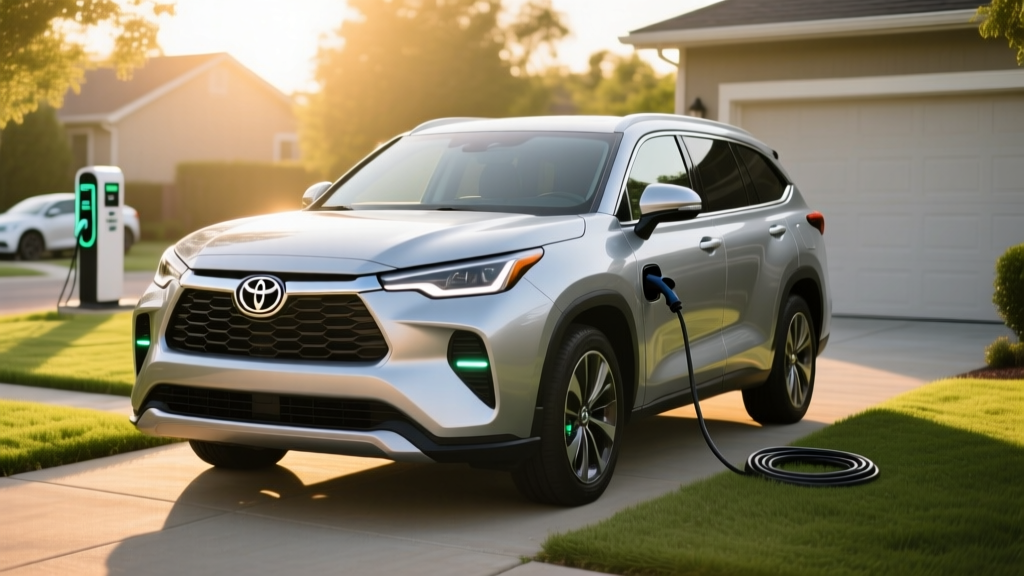
The 2024 Toyota Highlander Hybrid occupies a narrow but valuable niche: a three-row family hauler that sips fuel like a compact sedan without asking you to plug in, change your driving habits, or worry about charging infrastructure. With an EPA-rated 35 MPG combined and standard all-wheel drive, it remains one of the most efficient vehicles in its class. But is a conventional hybrid (HEV) the right call in 2026, or should you be looking at a plug-in hybrid or full EV instead?
This guide breaks down the 2024 Highlander Hybrid's powertrain, real-world efficiency, battery longevity, pricing, and tax-credit reality — then helps you decide whether it beats a PHEV or BEV for your specific driving pattern.
HEV vs PHEV: What the Highlander Hybrid Actually Is
Conventional Hybrid (HEV): The Toyota Highlander Hybrid is a self-charging hybrid. It uses a small battery pack (1.6 kWh, nickel-metal hydride) that recharges through regenerative braking and the gasoline engine. You never plug it in. It cannot drive on electric power alone for meaningful distances — the electric motors assist the gas engine and enable brief low-speed EV-mode crawling, but there is no plug, no electric-only range to speak of, and no eligibility for the federal EV tax credit.
Plug-In Hybrid (PHEV): A PHEV like the Toyota RAV4 Prime carries a much larger battery (18.1 kWh), offers 42 miles of electric-only driving, and can be plugged into a Level 2 home charger. PHEVs qualify for the §30D federal tax credit (up to $7,500, subject to sourcing, income, and MSRP rules). Toyota does not currently offer a Highlander PHEV in the US market.
Battery Electric (BEV): A full EV like the Kia EV9 offers 270+ miles of range, zero tailpipe emissions, and lower per-mile fuel costs — but requires charging infrastructure and carries a higher purchase price.
The Highlander Hybrid is firmly an HEV. If you're shopping for a three-row plug-in hybrid, you'll need to look at competitors like the Chrysler Pacifica Hybrid (PHEV minivan) or wait for future Toyota product updates.
Powertrain and Performance Specs
| Specification | 2024 Toyota Highlander Hybrid |
|---|---|
| Powertrain | 2.5L 4-cylinder + 2 electric motors (AWD-i) |
| Combined Horsepower | 243 hp (net system) |
| Gas Engine | 184 hp @ 6,000 rpm / 175 lb-ft torque |
| Front Electric Motor | 134 hp / 199 lb-ft |
| Rear Electric Motor | 54 hp / 89 lb-ft |
| Transmission | eCVT (planetary gearset, not belt-driven) |
| Battery | 1.6 kWh NiMH (sealed, self-charging) |
| Drivetrain | Electronic AWD (AWD-i), standard on all trims |
| 0-60 mph | ~7.8 seconds |
| Towing Capacity | 3,500 lbs |
| Seating | 7 or 8 passengers (trim-dependent) |
| Cargo (behind 3rd row) | 16.1 cu ft |
| Cargo (max, seats folded) | 84.3 cu ft |
The Highlander Hybrid pairs Toyota's proven 2.5-liter Dynamic Force engine with a front and rear electric motor. The rear motor provides electronic all-wheel drive without a mechanical driveshaft — it engages automatically when the system detects slip or during hard acceleration. The eCVT is a planetary gearset, not a traditional belt-and-pulley CVT, which contributes to the powertrain's reputation for durability.
At 243 net horsepower, the Highlander Hybrid is adequate rather than quick. Highway merging and passing are confident, but don't expect the low-end punch of a turbocharged rival like the Hyundai Santa Fe Hybrid. The tradeoff is exceptional smoothness and efficiency.
Fuel Economy: EPA Ratings and Real-World MPG
| Driving Condition | EPA Estimate | Real-World Expectation |
|---|---|---|
| City | 35 MPG | 34-38 MPG (hybrids often exceed EPA in city) |
| Highway | 35 MPG | 30-33 MPG (highway favors gas-only drivetrains) |
| Combined | 35 MPG | 32-36 MPG depending on driving mix |
| Cold Weather (below 32°F) | — | 28-32 MPG (engine runs more for cabin heat) |
According to fueleconomy.gov, the 2024 Highlander Hybrid AWD earns 35 MPG across the board — city, highway, and combined. This flat profile is typical of Toyota's hybrid system: the electric motors handle low-speed and stop-and-go driving (where gas engines are least efficient), while the engine takes over at highway speeds.
Real-world nuance: In city-heavy commuting with frequent stops, owners regularly report 36-38 MPG — the hybrid system shines here, recapturing energy through regenerative braking and running the engine less. On sustained highway drives at 75+ mph, expect the number to drop to 30-33 MPG. Cold weather further reduces efficiency because the gas engine must run more frequently to provide cabin heat (the Highlander Hybrid does not use a heat pump, which is a BEV feature).
For context, the non-hybrid 2024 Highlander with the 2.4L turbo engine rates at 24 MPG combined. The hybrid saves roughly 11 MPG — about 130 gallons per year at 15,000 miles, or approximately $450-$550 annually at current fuel prices.
Trim Levels, Pricing, and Tax Credit Reality
The 2024 Toyota Highlander Hybrid is offered in five trims. AWD-i is standard on every hybrid trim — there is no FWD-only hybrid option.
| Trim | MSRP (incl. destination) | Key Features |
|---|---|---|
| LE | $40,720 | 8" touchscreen, Toyota Safety Sense 2.5+, 8 seats |
| XLE | $43,770 | SofTex seats, power liftgate, sunroof, 7 seats |
| XLE Bronze | $45,070 | Unique bronze exterior accents, bronze interior stitching |
| Limited | $48,470 | Leather, 12.3" touchscreen, JBL audio, panoramic roof |
| Platinum | $51,420 | Head-up display, 360° camera, panoramic moonroof, ventilated seats |
Does the 2024 Highlander Hybrid Qualify for a Federal Tax Credit?
No. The Highlander Hybrid is a conventional HEV — it has no plug and does not meet the definition of a "clean vehicle" under IRS §30D rules. The federal clean vehicle credit (up to $7,500) is available only for plug-in vehicles: BEVs and PHEVs with at least 7 kWh of battery capacity. The Highlander Hybrid's 1.6 kWh pack does not qualify.
Some states offer modest rebates for conventional hybrids, but these are uncommon and vary by jurisdiction. Check your state energy office or AFDC state incentives database for current local programs.
Without a federal credit, the Highlander Hybrid's value proposition rests on fuel savings and lower total cost of ownership rather than upfront incentives. Compared to the non-hybrid Highlander (which starts around $39,000), the hybrid carries roughly a $1,700 premium at the LE trim — a premium you'll typically recoup through fuel savings within 3-4 years at average mileage.
Battery Longevity, Warranty, and Replacement Cost
Hybrid battery anxiety is the top concern for first-time hybrid buyers. Here's what the data shows:
| Battery Factor | 2024 Highlander Hybrid Detail |
|---|---|
| Battery Chemistry | Nickel-Metal Hydride (NiMH) |
| Battery Capacity | 1.6 kWh |
| Hybrid Battery Warranty | 10 years / 150,000 miles (whichever comes first) |
| Powertrain Warranty | 5 years / 60,000 miles |
| Basic Warranty | 3 years / 36,000 miles |
| Expected Battery Lifespan | 150,000-200,000+ miles (based on fleet data) |
| Replacement Cost (out of warranty) | $2,000-$4,000 (remanufactured or new) |
Toyota's hybrid battery warranty covers 10 years or 150,000 miles — one of the longest in the industry. In practice, Toyota's NiMH hybrid batteries have demonstrated exceptional longevity. Taxi fleets running Toyota Camry and Prius hybrids have routinely exceeded 300,000 miles on the original battery pack. The Highlander Hybrid uses the same proven architecture.
If replacement is needed out of warranty, a remanufactured NiMH pack typically costs $2,000-$3,000 installed; a new OEM pack runs closer to $3,500-$4,000. Independent hybrid specialists in most metro areas can perform the swap in 2-3 hours. This is a fraction of what a BEV traction battery replacement would cost ($10,000-$20,000+), and the Highlander's small 1.6 kWh pack is inherently less expensive.
Key reliability note: Toyota ranked in the top 5 brands in both Consumer Reports reliability surveys and J.D. Power dependability studies for 2024-2025. The hybrid system adds complexity (two electric motors, inverter, planetary gearset) but eliminates other failure points — there is no traditional starter motor, no alternator, no accessory belt, and the eCVT has no clutch packs or torque converter to wear out.
Highlander Hybrid vs PHEV vs EV: Which Fits You?
Choose the Highlander Hybrid (HEV) if:
- You want three rows and AWD without plugging in or changing habits
- You drive 12,000-18,000 miles/year in a mixed city/highway pattern
- You lack access to home or workplace Level 2 charging
- You want Toyota's proven reliability and low maintenance costs
- You tow occasionally (3,500-lb capacity)
- Your budget is $40,000-$52,000
Choose a PHEV (e.g., Chrysler Pacifica Hybrid) if:
- You have home Level 2 charging and a short commute (<30 miles)
- You want electric-only daily driving with gas-engine flexibility for road trips
- You want to claim the §30D federal tax credit (up to $7,500)
- You can accept minivan packaging for maximum interior space
Choose a Full EV (e.g., Kia EV9, Rivian R1S) if:
- You have reliable home charging and your daily driving is under 250 miles
- You want the lowest per-mile energy cost and zero tailpipe emissions
- You're willing to plan charging stops on road trips
- You want instant torque, one-pedal driving, and minimal maintenance
- You can absorb a higher purchase price ($55,000-$80,000+)
The Highlander Hybrid's ideal buyer is a family that values simplicity: no charging cables, no range planning, no app management. You fill up at any gas station and drive. The 35 MPG combined rating keeps fuel costs moderate, and the AWD system handles snow and rain without the weight penalty of a large battery pack.
If you have Level 2 charging at home and a commute under 30 miles, a PHEV gives you the best of both worlds — electric daily driving with gas flexibility. But Toyota doesn't make a Highlander PHEV, so you'd need to cross-shop other brands or vehicle classes.
Pros and Cons at a Glance
Pros
- 35 MPG combined — best-in-class for a 3-row SUV
- Standard AWD on every hybrid trim
- 10-year / 150,000-mile hybrid battery warranty
- Proven, low-maintenance powertrain (no starter, alternator, or belts)
- 3,500-lb towing capacity
- Strong resale value and reliability track record
- No charging infrastructure required
Cons
- No plug-in (PHEV) variant available — no electric-only range
- No federal tax credit eligibility
- Modest 243 hp — adequate but not quick for the class
- Third row is tight for adults on longer trips
- 16.1 cu ft cargo behind 3rd row is limited vs minivan rivals
- Infotainment and driver-assist tech lag behind Hyundai/Kia offerings
- Highway MPG drops noticeably at sustained 75+ mph speeds
Frequently Asked Questions
How many MPG does the 2024 Toyota Highlander Hybrid get?
The EPA rates the 2024 Highlander Hybrid AWD at 35 MPG city, 35 MPG highway, and 35 MPG combined. In real-world driving, city-heavy commuters often see 36-38 MPG thanks to regenerative braking, while sustained highway driving at higher speeds typically yields 30-33 MPG. Cold weather further reduces efficiency to roughly 28-32 MPG due to increased engine runtime for cabin heating.
Does the Highlander Hybrid have an electric-only mode or plug-in option?
No. The Highlander Hybrid is a conventional HEV with a 1.6 kWh battery. It has a brief EV mode for low-speed parking-lot maneuvers (under ~1 mile at very low speed), but it cannot sustain electric-only driving and has no charging port. Toyota does not offer a Highlander PHEV in the US market.
Is the Toyota Highlander Hybrid reliable?
Yes. Toyota's hybrid powertrain is among the most proven in the industry, with the same architecture used in millions of Prius, Camry Hybrid, and RAV4 Hybrid vehicles worldwide. The 2024 Highlander Hybrid carries a 10-year/150,000-mile hybrid battery warranty. Independent reliability surveys from Consumer Reports and J.D. Power consistently rank Toyota near the top. The eCVT transmission has no wearable clutch packs, and the system eliminates the starter motor and alternator.
What does a Highlander Hybrid battery replacement cost?
Out of warranty, a replacement NiMH hybrid battery pack costs approximately $2,000-$4,000 depending on whether you choose a remanufactured or new OEM unit. Given the 10-year/150,000-mile warranty coverage and the demonstrated longevity of Toyota's NiMH packs (many exceeding 200,000 miles), most owners will never face this expense.
Does the 2024 Highlander Hybrid qualify for any tax credit?
No federal tax credit is available. The IRS §30D clean vehicle credit applies only to plug-in vehicles (BEVs and PHEVs) with a battery capacity of at least 7 kWh. The Highlander Hybrid's 1.6 kWh pack does not qualify. Some states may offer minor hybrid incentives — check your state's energy office or the AFDC database for current programs.
How does the Highlander Hybrid compare to a full EV like the Kia EV9?
The EV9 offers 270-304 miles of electric range, 215-379 hp, and lower per-mile energy costs (~$0.04-$0.06/mile vs ~$0.13-$0.15/mile for the hybrid at current gas prices). However, the EV9 starts around $55,000, requires home charging infrastructure, and demands route planning on long road trips. The Highlander Hybrid costs less upfront, needs no charging setup, and fills up in 5 minutes anywhere — making it the pragmatic choice for families without reliable charging access or those who frequently drive 300+ miles between stops.