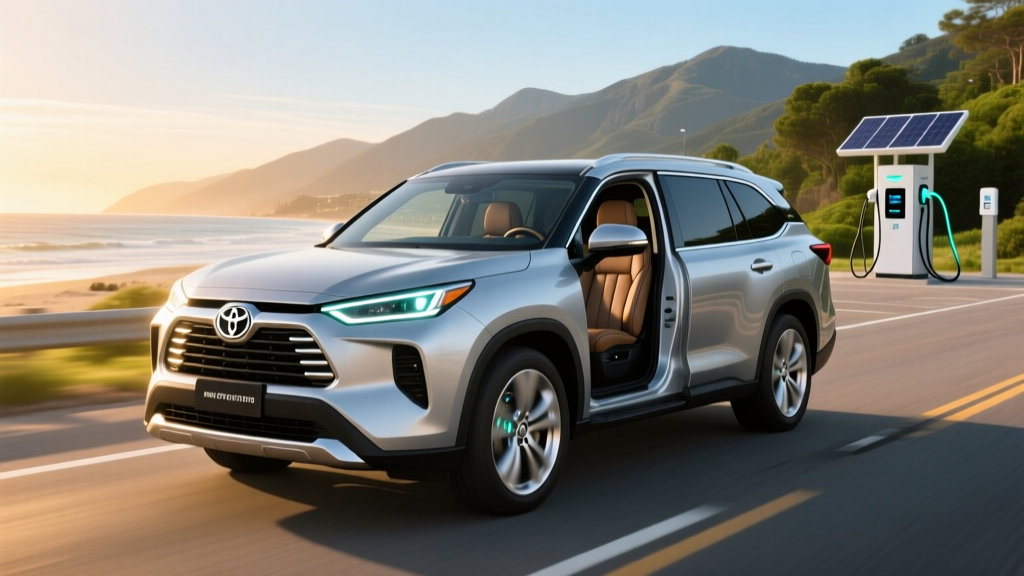
The Toyota Grand Highlander Limited Hybrid occupies a specific niche: a three-row family hauler that prioritizes fuel efficiency without requiring a plug. For buyers who want the cargo space and seating of a full-size SUV but can't accommodate a full EV charging routine, this conventional hybrid (HEV) offers a compelling middle ground. The Limited trim sits near the top of the lineup, adding premium features while retaining the hybrid powertrain's core efficiency advantage.
This guide breaks down the Grand Highlander Hybrid's fuel economy, powertrain details, real-world ownership expectations, and how it compares to plug-in hybrids and full EVs in the three-row segment.
Fuel Economy: EPA Ratings and Real-World MPG
The Grand Highlander Hybrid's headline number is its EPA-estimated 36 MPG combined. This figure applies to both front-wheel drive and all-wheel drive configurations, which is unusual — many competitors see a 1-2 MPG penalty when adding AWD. Here's the full breakdown:
| Drivetrain | City MPG | Highway MPG | Combined MPG |
|---|---|---|---|
| FWD | 37 | 34 | 36 |
| AWD (AWD-i) | 36 | 34 | 35 |
Source: EPA fueleconomy.gov
HEV vs PHEV: Why the Grand Highlander Hybrid Doesn't Plug In
The Grand Highlander Hybrid is a conventional hybrid electric vehicle (HEV), not a plug-in hybrid (PHEV). This distinction matters for ownership expectations:
| Feature | Grand Highlander Hybrid (HEV) | Typical 3-Row PHEV (e.g., Mazda CX-90 PHEV) |
|---|---|---|
| Plug-in charging required? | No — self-charging via engine and regen | Yes — requires Level 1 or Level 2 charging |
| Electric-only range | ~1 mile at low speeds | 25-30 miles |
| Battery size | 1.8 kWh (nominal) | 17-18 kWh usable |
| Federal tax credit (§30D) | Not eligible | Up to $7,500 (with sourcing/income requirements) |
| Total range | ~542 miles | ~450 miles (gas + electric) |
| Best for | No home charging access; long highway trips | Home charging available; short daily commutes |
The HEV approach means zero lifestyle change: you fuel up at gas stations as normal, and the hybrid system handles energy recapture automatically. The tradeoff is that you won't drive meaningful distances on electric power alone, and you won't qualify for federal EV tax credits.
Powertrain: 245 HP With Seamless Electric Assist
The Grand Highlander Hybrid uses Toyota's proven Hybrid Synergy Drive system, pairing a 2.5-liter inline-four engine with front and rear electric motors:
| Component | Specification |
|---|---|
| Engine | 2.5L DOHC 4-cylinder, 186 HP / 173 lb-ft |
| Front electric motor | Permanent magnet synchronous, 134 HP |
| Rear electric motor (AWD-i) | 54 HP (AWD models only) |
| Combined net horsepower | 245 HP |
| Transmission | eCVT (planetary gearset, no fixed gears) |
| 0-60 MPH | ~7.8 seconds (FWD), ~7.5 seconds (AWD) |
| Towing capacity | 3,500 lbs (with towing package) |
| Fuel tank | 17.1 gallons |
The eCVT isn't a traditional belt-and-cone CVT — it's a power-split device that blends engine and motor output seamlessly. Acceleration is linear and adequate for merging, though the four-cylinder engine becomes audible under hard acceleration. The rear motor on AWD models provides traction without a mechanical driveshaft, reducing weight and drivetrain losses.
Pricing: 2026 Limited Hybrid MSRP and Tax Credit Reality
The Limited trim sits between the XLE and Platinum in the Grand Highlander Hybrid lineup. Pricing reflects its premium positioning:
| Configuration | MSRP |
|---|---|
| Limited FWD | $51,490 |
| Limited AWD | $52,290 |
Prices exclude destination charge (~$1,395) and dealer-installed options.
For context, competing three-row PHEVs like the Mazda CX-90 PHEV (starting ~$51,000) may qualify for partial or full federal credits depending on battery sourcing compliance and buyer income limits. The Grand Highlander Hybrid's value proposition rests on lower purchase price, no charging infrastructure requirement, and Toyota's reliability reputation rather than tax incentive offset.
Battery Warranty, Lifespan, and Replacement Cost
Toyota's nickel-metal hydride (NiMH) and lithium-ion hybrid batteries have demonstrated strong longevity in the field. The Prius and Camry Hybrid have shown batteries lasting 150,000-200,000+ miles with gradual capacity loss. The Grand Highlander's relatively small 1.8 kWh battery experiences shallow charge/discharge cycles, which reduces stress compared to full EV batteries that cycle through deeper ranges daily.
Replacement cost: If the hybrid battery fails outside warranty, expect $3,000-$4,500 for a new OEM replacement including labor. Third-party refurbishers offer reconditioned batteries for $1,500-$2,500. Given the 10-year/150,000-mile warranty and Toyota's track record, most original owners will never face this expense.
Who Should Choose the Grand Highlander Hybrid vs Alternatives
The Grand Highlander Limited Hybrid serves a specific buyer profile. Here's a decision framework:
- You lack access to home or workplace charging (apartment, street parking)
- Your typical trips exceed 300+ miles where EV charging stops add time
- You prioritize proven reliability and resale value over maximum efficiency
- You need three rows and cargo space without minivan styling
- You want lower fuel costs without lifestyle changes (no plug-in routine)
- You have Level 2 charging at home and a commute under 30 miles
- You want electric-only driving for daily errands with gas backup for road trips
- You may qualify for federal/state PHEV tax credits that offset higher purchase price
- You have reliable home charging and your trips rarely exceed 250 miles
- You want to eliminate gas purchases entirely and minimize maintenance
- You qualify for the full $7,500 federal tax credit and state incentives
Pros and Cons: Grand Highlander Limited Hybrid at a Glance
- 36 MPG combined in a 3-row SUV (class-leading)
- No plug-in charging required
- 542-mile total range reduces fuel stops
- 10-year/150,000-mile hybrid battery warranty
- Smooth, quiet operation in city driving
- Strong Toyota reliability and resale value
- No federal tax credit eligibility
- Four-cylinder engine audible under hard acceleration
- Highway MPG drops to 30-32 in real-world 75+ MPH driving
- Limited trim exceeds $52,000 with AWD
- No electric-only driving beyond low-speed creep
- Towing limited to 3,500 lbs (less than V6 competitors)
Frequently Asked Questions
How many MPG does the Toyota Grand Highlander Limited Hybrid get in real driving?
Expect 33-36 MPG in mixed suburban driving, with city-heavy routes potentially reaching 37-38 MPG thanks to regenerative braking. Highway-only trips at 75+ MPH typically yield 30-32 MPG. Cold weather (below 40°F) reduces efficiency by 5-10%.
Can I plug in the Grand Highlander Hybrid to charge?
No. This is a conventional hybrid (HEV), not a plug-in hybrid (PHEV). The battery charges automatically through the gasoline engine and regenerative braking. There is no charging port.
Does the Grand Highlander Hybrid qualify for any federal tax credit?
No. The IRS §30D Clean Vehicle Credit applies only to plug-in electric vehicles (BEVs and PHEVs). Conventional hybrids are excluded. Check your state's energy office for any state-level hybrid incentives.
How long will the hybrid battery last, and what does replacement cost?
Toyota warrants the hybrid battery for 10 years or 150,000 miles. Real-world data from Toyota's hybrid lineup shows batteries lasting 150,000-200,000+ miles with gradual capacity loss. Out-of-warranty replacement costs $3,000-$4,500 for a new OEM battery.
Is the Grand Highlander Hybrid good for long road trips?
Yes. With a 17.1-gallon tank and 36 MPG combined, you can expect 542+ miles between fill-ups — fewer stops than most gas-only SUVs. Highway comfort is strong, though the four-cylinder engine drones under sustained hill climbing.
How does the Grand Highlander Hybrid compare to the standard Grand Highlander (non-hybrid)?
The standard 2.4L turbocharged Grand Highlander produces 265 HP and achieves 24 MPG combined — a 12 MPG penalty. The hybrid trades 20 HP for 50% better fuel economy. Acceleration is comparable (7.8s vs 7.5s 0-60), but the hybrid's eCVT delivers smoother city driving.