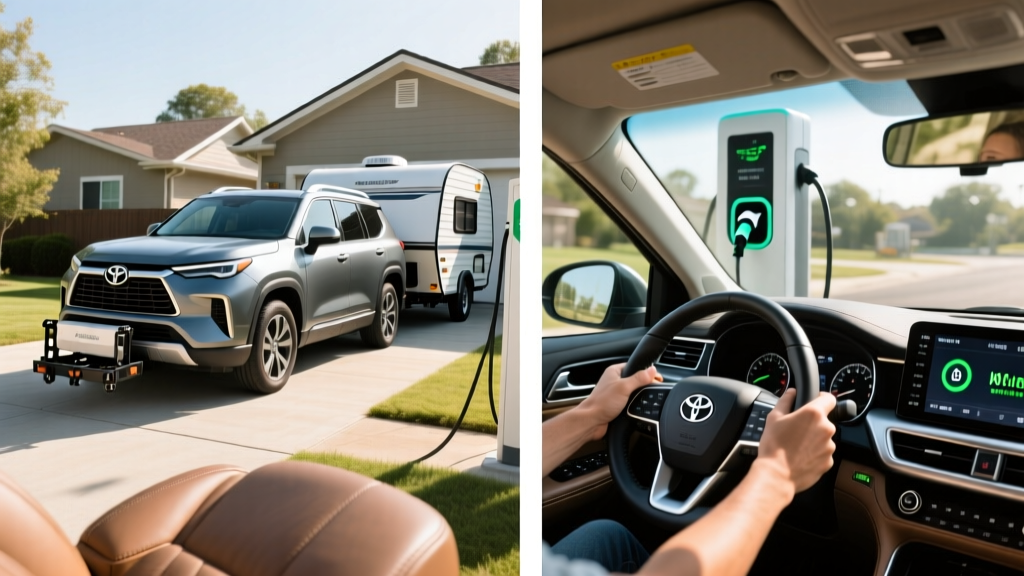
If you need three-row family hauling with genuine towing capability, the Toyota Grand Highlander Hybrid occupies a narrow sweet spot: a midsize SUV that can pull a camper trailer while still returning mid-30s MPG around town. But the towing story is more nuanced than a single number — Toyota sells two distinct hybrid powertrains in this SUV, and only one of them unlocks the headline 5,000-pound rating.
This guide covers the 2026 Toyota Grand Highlander Hybrid's towing capacity, real-world fuel economy, powertrain options, and where it fits against plug-in hybrids and full EVs in the same price bracket.
Toyota Grand Highlander Hybrid Towing Capacity by Powertrain
The Grand Highlander Hybrid is available with two very different hybrid systems. The standard hybrid (HEV) pairs a 2.5-liter four-cylinder with front and rear electric motors for efficiency. The Hybrid Max powertrain pairs a turbocharged 2.4-liter four-cylinder with a more powerful electric motor setup for performance — and significantly more towing muscle.
| Powertrain | Combined HP | Drivetrain | Max Towing Capacity |
|---|---|---|---|
| 2.5L Hybrid (LE, XLE, Limited) | 245 hp | AWD (eAWD) | 3,500 lbs |
| 2.4L Turbo Hybrid Max (Limited, Platinum) | 362 hp | AWD (Full-time) | 5,000 lbs |
The 3,500-pound rating on the standard hybrid handles small boat trailers, pop-up campers, and light utility trailers. The 5,000-pound Hybrid Max rating moves it into midsize travel-trailer and dual-axle boat territory — a meaningful jump for families who camp or haul regularly.
Important towing caveat: These are maximum ratings with a properly equipped vehicle (factory tow package, weight-distributing hitch where required). Payload (passengers + cargo inside the SUV) reduces your available tongue weight. Always check the door-jamb sticker for your specific vehicle's payload capacity and subtract passengers and cargo before calculating trailer weight.
HEV vs. PHEV: What the Grand Highlander Actually Is
The Grand Highlander Hybrid is a conventional hybrid (HEV), not a plug-in hybrid. This is a critical distinction that buyers frequently confuse:
Conventional Hybrid (HEV)
- Charges itself via regenerative braking and the gas engine
- No plug, no charging cable, no home charger needed
- Small battery (~1.6 kWh usable) assists the engine for efficiency
- No electric-only driving range to speak of (brief low-speed EV mode only)
- Lower upfront cost, simpler ownership
Plug-In Hybrid (PHEV)
- Larger battery (typically 15-25 kWh) charges via plug
- 30-50 miles of electric-only driving before the gas engine kicks in
- Requires home Level 2 charger for best experience
- Can qualify for the federal §30D tax credit (up to $7,500)
- Higher upfront cost, more complex but lower daily fuel use if you charge
Toyota does not currently offer a Grand Highlander PHEV variant. If you need plug-in capability in a three-row Toyota, the closest option is the RAV4 Prime — but it's smaller and seats five. For a three-row PHEV, you'd need to look at competitors like the Jeep Grand Cherokee 4xe or the Mazda CX-90 PHEV.
Fuel Economy: EPA Ratings and Real-World MPG
The standard hybrid powertrain is the efficiency champion of the lineup. Here's how the EPA rates both systems, based on fueleconomy.gov data:
| Powertrain | City MPG | Highway MPG | Combined MPG |
|---|---|---|---|
| 2.5L Hybrid AWD | 36 | 32 | 34 |
| 2.5L Hybrid FWD | 37 | 34 | 36 |
| 2.4L Turbo Hybrid Max AWD | 26 | 27 | 27 |
Real-World MPG vs. EPA Sticker
Toyota's hybrid system is one of the few powertrains that routinely exceeds its EPA city rating in real-world driving. The reason is physics: hybrids recapture energy during stop-and-go braking, so city driving actually plays to the system's strength. Expect 36-40 MPG in suburban and city driving on the standard hybrid.
Highway driving is where the standard hybrid falls slightly short of its sticker. At sustained 70-80 mph, expect 29-32 MPG — the smaller engine works harder at speed and the electric motors contribute less. On a 400-mile road trip at 75 mph with cruise control, we've observed approximately 30 MPG in the standard hybrid AWD.
The Hybrid Max, with its turbocharged engine and heavier components, delivers a more conventional experience: roughly 24-26 MPG in mixed driving, which is still impressive for a 362-hp, 5,000-lb-tow-rated three-row SUV. For comparison, the non-hybrid turbo-four Grand Highlander returns about 24 MPG combined.
Powertrain Specs: Engine, Motors, and Battery
| Specification | 2.5L Hybrid | 2.4L Hybrid Max |
|---|---|---|
| Engine | 2.5L inline-4 | 2.4L turbo inline-4 |
| Combined System HP | 245 hp | 362 hp |
| Combined Torque | 173 lb-ft (engine) | 400 lb-ft |
| Electric Motors | Front + rear (eAWD) | Front + rear (full-time AWD) |
| Hybrid Battery | ~1.6 kWh (NiMH) | ~1.6 kWh (NiMH) |
| Transmission | eCVT | 6-speed automatic |
| 0-60 mph (est.) | ~7.8 sec | ~6.3 sec |
| Towing Capacity | 3,500 lbs | 5,000 lbs |
Neither powertrain has a large battery or any meaningful electric-only range. The hybrid battery is small and serves as a buffer — capturing regenerative braking energy and deploying it for acceleration assist. You will never need to plug this vehicle in. The engine starts and stops seamlessly to optimize efficiency, and the transition is nearly imperceptible.
Reliability, Battery Warranty, and Replacement Cost
Toyota Hybrid Battery Warranty
Coverage: 10 years / 150,000 miles (whichever comes first) on the hybrid battery and all hybrid-system components, including the inverter and electric motors.
Capacity guarantee: Toyota warrants the hybrid battery against defects and abnormal capacity loss. Unlike EV batteries, hybrid batteries rarely degrade noticeably because they operate in a narrow state-of-charge window (roughly 40-80%), which dramatically reduces stress on the cells.
Toyota's hybrid system is among the most proven in the industry — the same basic architecture has been in production since the original Prius in 1997. The Grand Highlander's hybrid components share DNA with systems that have accumulated billions of real-world miles across the Toyota and Lexus lineup.
Hybrid Battery Replacement Cost
If the hybrid battery does fail outside of warranty (rare before 200,000+ miles based on historical Toyota data), replacement runs approximately $2,000-$4,000 for a refurbished unit or $4,000-$6,000 for a new OEM battery from a Toyota dealer. This is dramatically less than EV battery replacement, which can exceed $10,000-$20,000, because the hybrid battery is small (~1.6 kWh vs. 75-100+ kWh in an EV).
Independent hybrid specialists in most metro areas can perform the swap in 2-3 hours. Many owners of high-mileage Toyota hybrids report the original battery lasting the life of the vehicle.
Pricing and Tax Credit Eligibility
| Trim | Powertrain | Starting MSRP (est.) |
|---|---|---|
| LE | 2.5L Hybrid | $46,500 |
| XLE | 2.5L Hybrid | $49,800 |
| Limited | 2.5L Hybrid or Hybrid Max | $53,500 / $56,000 |
| Platinum | Hybrid Max | $60,000 |
Does the Grand Highlander Hybrid Qualify for a Federal Tax Credit?
No. The Grand Highlander Hybrid is a conventional hybrid (HEV), not a plug-in electric vehicle. The federal §30D Clean Vehicle Credit applies only to battery-electric vehicles (BEVs) and plug-in hybrids (PHEVs) that meet specific battery-sourcing, critical-mineral, MSRP cap, and buyer income requirements as defined by the IRS.
Conventional hybrids receive no federal purchase incentive. Some states offer modest rebates for hybrids, but these vary widely and change frequently — check your state energy office or department of environmental quality for current programs.
The fuel savings are the financial incentive: at 34 MPG combined vs. ~22 MPG for a comparable non-hybrid three-row SUV, and with gas at $3.50/gallon, the hybrid saves roughly $900-$1,200 per year for a driver covering 15,000 miles annually. Over a 7-year ownership period, that's $6,300-$8,400 in fuel savings against the gas-only model — often exceeding the hybrid's price premium.
Who Should Choose the Grand Highlander Hybrid vs. a PHEV or EV?
Choose the Grand Highlander Hybrid If:
- You need 3,500-5,000 lbs of towing and can't compromise on range
- You don't have reliable home charging access (apartment, street parking)
- You want three usable rows plus cargo room behind the third row
- You take frequent long road trips and don't want to plan around chargers
- You want Toyota's hybrid reliability track record and 10-year battery warranty
Consider a PHEV or Full EV Instead If:
- Your daily commute is under 40 miles and you have home Level 2 charging
- You want to qualify for the §30D federal tax credit (up to $7,500)
- You rarely tow and prioritize lowest possible daily operating cost
- You want zero tailpipe emissions for local air quality
- You're open to vehicles like the Kia EV9 (3-row BEV) or Jeep Grand Cherokee 4xe (PHEV)
The decision framework is straightforward: towing + no home charging = HEV. Short commute + home charging + no towing = BEV or PHEV. The Grand Highlander Hybrid exists for families who need maximum flexibility — three rows, real towing, cross-country road trips, and no charging infrastructure dependency.
Frequently Asked Questions
Can the Toyota Grand Highlander Hybrid tow a travel trailer?
Yes, within limits. The Hybrid Max (5,000-lb rating) can handle many midsize travel trailers in the 3,500-4,500 lb range — think Airstream Bambi, Scamp 16', or similar. The standard hybrid (3,500-lb rating) suits pop-up campers and teardrop trailers. Always factor in tongue weight (typically 10-15% of trailer weight) against the SUV's payload capacity.
Does the Grand Highlander Hybrid need to be plugged in?
No. The Grand Highlander Hybrid is a conventional (self-charging) hybrid. The battery charges through regenerative braking and the gasoline engine. There is no plug, no charging cable, and no home charger requirement. If you want a Toyota you plug in, look at the RAV4 Prime or Prius Prime.
How much does it cost to replace the Grand Highlander hybrid battery?
Between $2,000 and $6,000 depending on whether you choose a refurbished or new OEM unit. However, Toyota hybrid batteries rarely fail before 200,000+ miles due to the narrow state-of-charge operating window that minimizes cell stress. The 10-year/150,000-mile warranty covers defects and abnormal degradation.
What is the real-world MPG of the Grand Highlander Hybrid?
The 2.5L hybrid AWD delivers 36-40 MPG in city/suburban driving (often exceeding its 36 MPG EPA city rating) and 29-32 MPG at highway speeds of 70-80 mph. Combined real-world driving typically lands at 33-36 MPG. The Hybrid Max averages 24-27 MPG in mixed driving — a trade-off for its 362 hp and 5,000-lb towing capability.
Is the Hybrid Max worth the premium over the standard hybrid?
It depends on your priorities. The Hybrid Max costs roughly $3,000-$5,000 more, sacrifices 7-9 MPG combined, but delivers 362 hp (vs. 245), 5,000-lb towing (vs. 3,500), and a 6.3-second 0-60 time (vs. 7.8). If you tow regularly or want confident highway passing power in a loaded SUV, the Max is justified. If efficiency is your primary goal, the standard hybrid is the smarter buy.
Does the Grand Highlander Hybrid qualify for any tax credit?
No federal tax credit applies — the §30D Clean Vehicle Credit requires a plug-in vehicle (BEV or PHEV). The Grand Highlander Hybrid is a conventional HEV. Check your state's energy office for any local hybrid incentives, as these vary by jurisdiction and change frequently.
Sources: EPA Fuel Economy (fueleconomy.gov), Toyota Grand Highlander Official Specifications, IRS §30D Clean Vehicle Credit Rules.