Quick Verdict: The Grand Highlander Hybrid Is a Tow-Capable Family Hauler
The 2025 Toyota Grand Highlander Hybrid occupies a specific niche: a three-row SUV that delivers genuine towing utility without the fuel penalty of a body-on-frame truck. With a maximum towing capacity of 5,000 pounds on Hybrid MAX trims and 36 MPG combined on the standard hybrid powertrain, it threads a needle that few competitors can match. But buyers need to understand which powertrain delivers which capability — because the standard hybrid and the Hybrid MAX are fundamentally different beasts when it comes to pulling a trailer.
This guide breaks down the exact towing figures, real-world fuel economy, powertrain mechanics, and ownership costs you need to make an informed decision. We'll also clarify where this hybrid fits against plug-in hybrids and full EVs for families who need both efficiency and utility.
2025 Grand Highlander Hybrid Towing Capacity by Trim and Powertrain
Toyota offers the Grand Highlander Hybrid with two distinct powertrains, and towing capacity differs significantly between them. This is the single most important distinction to understand before you configure your build.
| Powertrain | Available Trims | Combined HP | Max Towing Capacity | Drivetrain |
|---|---|---|---|---|
| Hybrid (standard) | Limited, Platinum | 245 hp | 3,500 lbs | AWD (electronic) |
| Hybrid MAX | Limited, Platinum | 362 hp | 5,000 lbs | AWD (direct) |
The standard hybrid uses Toyota's familiar series-parallel hybrid system with a 2.5-liter four-cylinder engine and electric motors, optimized for efficiency. The Hybrid MAX pairs a turbocharged 2.4-liter four-cylinder with a more powerful electric motor and a six-speed automatic transmission — trading some fuel economy for substantially more torque and a 43% increase in towing capacity.
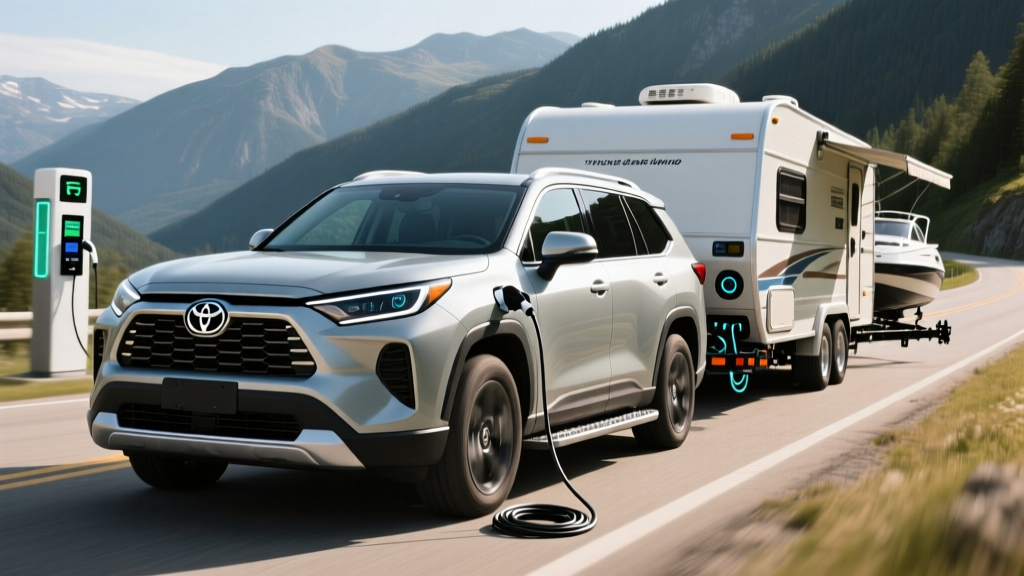
For context, 5,000 pounds covers most aluminum-hull boats on trailers, small travel trailers (think Airstream Bambi or similar), a pair of personal watercraft, or a utility trailer loaded with landscaping materials. It won't pull a large fifth-wheel or a horse trailer — for that, you'd still need a truck. But for the weekend-warrior use case, 5,000 lbs is genuinely practical.
Fuel Economy: EPA Ratings and Real-World MPG
Towing capacity means little if you're visiting the pump every 200 miles. Here's where the Grand Highlander Hybrid earns its keep.
| Powertrain | City MPG | Highway MPG | Combined MPG | Fuel Tank | Est. Total Range |
|---|---|---|---|---|---|
| Hybrid (AWD) | 35 | 34 | 35 | 17.9 gal | ~625 mi |
| Hybrid MAX (AWD) | 26 | 27 | 27 | 17.9 gal | ~480 mi |
Source: fueleconomy.gov
Real-World MPG: What to Actually Expect
The standard hybrid's 35 MPG combined is a strong EPA figure, and real-world results generally align with it — with a caveat. Toyota's hybrid system excels in city and suburban driving, where regenerative braking and electric-motor assist do the heavy lifting. In stop-and-go traffic, some drivers report exceeding 37 MPG. On sustained highway trips at 75+ mph, expect closer to 31-33 MPG as the gas engine carries more of the load.
The Hybrid MAX's 27 MPG combined reflects its performance orientation. The turbocharged engine and heavier drivetrain components cost you roughly 8 MPG versus the standard hybrid. If towing is your priority, that trade-off is worthwhile. If you rarely tow and commute daily, the standard hybrid is the smarter financial choice — the fuel savings compound quickly over 15,000 miles per year.
When towing near max capacity: Expect fuel economy to drop to 15-18 MPG on the Hybrid MAX and 18-22 MPG on the standard hybrid, depending on trailer weight, aerodynamics, terrain, and speed. This is physics, not a flaw — any vehicle towing 4,000+ pounds will see similar drops.
Powertrain Deep Dive: How Each Hybrid System Works
Standard Hybrid (245 HP)
The conventional hybrid pairs a 2.5-liter Atkinson-cycle four-cylinder engine (186 hp on its own) with front and rear electric motors through Toyota's fourth-generation hybrid system. The rear motor provides electronic AWD — there's no mechanical driveshaft to the rear wheels. Total system output is 245 horsepower. The hybrid battery is a 1.87 kWh (gross) nickel-metal hydride pack, charged entirely through regenerative braking and engine operation. You never plug it in.
This is a self-charging hybrid (HEV) — not a plug-in hybrid (PHEV). It has no electric-only driving range to speak of (roughly 0.5-1 mile at very low speeds), but the electric motors assist constantly to reduce fuel consumption.
Hybrid MAX (362 HP)
The Hybrid MAX swaps in a turbocharged 2.4-liter four-cylinder (271 hp) and pairs it with a 54-hp electric motor integrated into a six-speed automatic transmission. Unlike the standard hybrid's CVT, the MAX uses fixed gears, which delivers more direct power delivery and better towing performance. Total system output is 362 horsepower and 400 lb-ft of torque. The AWD system here is a direct-torque mechanical setup with a rear electric motor, providing more robust traction when pulling heavy loads.
The hybrid battery in the MAX is a lithium-ion pack (approximately 1.8 kWh usable). Like the standard hybrid, it charges through regen and engine operation — no plug required.
HEV vs. PHEV vs. EV: Which Powertrain Fits Your Family?
The Grand Highlander is available only as a conventional hybrid (HEV) — there is no plug-in hybrid (PHEV) or fully electric version in the 2025 lineup. Here's how to think about that in context:
Choose the Hybrid (HEV) If:
- You don't have reliable access to home or workplace charging
- You want maximum simplicity — no charging cables, no range planning
- You drive 15,000+ miles per year and want consistent 30+ MPG
- You need 5,000-lb towing capacity (Hybrid MAX) without a truck
- You want Toyota's long-proven hybrid reliability track record
Consider a PHEV (like the Toyota RAV4 Prime) If:
- You can install a Level 2 home charger
- Most daily driving is under 40 miles (you'd rarely use gas)
- You want some electric-only driving but need gas flexibility for road trips
- You're willing to sacrifice some cargo/passenger space vs. the Grand Highlander
Consider a Full EV (like the Kia EV9 or Rivian R1S) If:
- You have Level 2 home charging and access to DC fast charging
- You want zero tailpipe emissions and minimal maintenance
- You're comfortable with range planning on long road trips
- You can absorb higher upfront cost (partially offset by the §30D federal tax credit)
The Grand Highlander Hybrid's advantage is that it requires zero behavioral change from a gas-car owner. You fuel up at any gas station, never think about charging, and still get mid-30s MPG in daily driving. For families who tow occasionally and commute daily without home charging infrastructure, this is the pragmatic choice.
Pricing, Trims, and Tax Credit Eligibility
| Trim | Powertrain | MSRP (approx.) | Federal Tax Credit |
|---|---|---|---|
| Limited | Standard Hybrid | $49,690 | Not eligible |
| Platinum | Standard Hybrid | $53,120 | Not eligible |
| Limited | Hybrid MAX | $53,420 | Not eligible |
| Platinum | Hybrid MAX | $58,175 | Not eligible |
Federal tax credit status: The Grand Highlander Hybrid does not qualify for the IRS §30D federal clean vehicle tax credit (up to $7,500). That credit applies only to plug-in electric vehicles — battery-electric vehicles (BEVs) and plug-in hybrids (PHEVs) with a minimum battery capacity of 7 kWh. Since the Grand Highlander Hybrid is a conventional (self-charging) hybrid with a battery well under 2 kWh, it falls outside the credit's scope entirely. See current eligibility rules at IRS.gov.
Some states and local utilities offer rebates for conventional hybrids, though these are increasingly rare as incentive programs shift toward plug-in vehicles. Check your state energy office or utility provider for current programs — amounts vary by jurisdiction.
The total cost advantage of the Grand Highlander Hybrid comes from fuel savings, not upfront incentives. At 35 MPG combined versus a comparable gas-only three-row SUV at ~23 MPG, you'd save approximately $700-$900 per year in fuel costs (at 15,000 miles/year and $3.50/gallon). Over a 7-year ownership period, that's $4,900-$6,300 in fuel savings.
Battery Warranty, Reliability, and Replacement Cost
Toyota Hybrid Battery Warranty
Coverage: 10 years / 150,000 miles (whichever comes first)
What's covered: Defects and capacity loss below a defined threshold on the hybrid battery pack
Transferable: Yes — warranty transfers to subsequent owners
Toyota's hybrid battery warranty is among the strongest in the industry, and the company's track record backs it up. The Prius, Camry Hybrid, and Highlander Hybrid have demonstrated that Toyota's hybrid battery packs routinely last 150,000-200,000+ miles before requiring replacement. The nickel-metal hydride pack in the standard hybrid is particularly robust — NiMH chemistry is less prone to degradation than some lithium-ion formulations, though it's heavier and less energy-dense.
Replacement cost if out of warranty: A Toyota hybrid battery replacement for the Grand Highlander would likely fall in the $3,000-$5,000 range (parts and labor) based on current Highlander Hybrid pricing. This is a fraction of full EV battery replacement costs. Independent hybrid-battery refurbishers also offer reconditioned packs for $1,500-$2,500 if you're outside warranty coverage.
Source: Toyota Owner's Warranty Information
Overall reliability: Toyota's hybrid systems have two decades of real-world validation. The Grand Highlander uses proven components from the Toyota hybrid parts bin, which is a strong reliability indicator. The primary risk areas are the same as any modern vehicle — electronics, infotainment, and turbocharger longevity on the Hybrid MAX (turbo systems add complexity versus the naturally aspirated standard hybrid).
Towing Practicality: What 5,000 Pounds Actually Gets You
Let's ground the towing spec in real-world scenarios. Here's what the Hybrid MAX can handle at or near its 5,000-lb rating:
- Small travel trailers: Airstream Bambi (2,900 lbs), Scamp 16' (2,200-2,600 lbs), or similar
- Boats: 18-20 ft aluminum or fiberglass hulls on single-axle trailers (2,500-4,000 lbs total)
- Utility trailers: Loaded 6x12 utility trailers with equipment or materials
- Personal watercraft: Two PWCs on a dual trailer (~2,500 lbs)
- Small campers: Pop-up campers and teardrop trailers (1,500-3,500 lbs)
What it can't tow: Large travel trailers (25+ ft), fifth wheels, horse trailers, or any load exceeding 5,000 lbs total (trailer + cargo). For those, you need a truck-rated vehicle like the Ford F-150 or Toyota Tundra.
Towing equipment: The Grand Highlander Hybrid MAX comes with a factory-installed tow hitch receiver and integrated trailer wiring harness on trims equipped with the tow package. Toyota's trailer sway control is included, which uses selective braking to stabilize a swaying trailer — a meaningful safety feature when towing near the capacity limit.
Pros and Cons: The Honest Assessment
Pros
- 35 MPG combined on standard hybrid is exceptional for a 3-row SUV
- 5,000-lb towing on Hybrid MAX covers most recreational trailers
- Genuine third-row space for adults (unlike many midsize competitors)
- Toyota hybrid reliability with 10-year/150,000-mile battery warranty
- No charging infrastructure needed — works for apartment/condo dwellers
- Smooth, quiet hybrid operation in daily driving
Cons
- No federal tax credit eligibility (conventional hybrid)
- Hybrid MAX trades significant fuel economy for towing power
- 3,500-lb limit on standard hybrid is modest for the class
- Premium pricing — starts near $50K, Platinum MAX exceeds $58K
- CVT in standard hybrid can drone under hard acceleration or when towing
- No plug-in hybrid option available (Toyota doesn't offer a Grand Highlander PHEV)
Frequently Asked Questions
How many MPG does the 2025 Grand Highlander Hybrid get?
The standard hybrid AWD achieves an EPA-estimated 35 city / 34 highway / 35 combined MPG. The Hybrid MAX AWD is rated at 26 city / 27 highway / 27 combined. Real-world results generally track the EPA figures, with the standard hybrid sometimes exceeding its rating in city driving thanks to regenerative braking.
Can the Grand Highlander Hybrid tow a camper?
Yes, within limits. The Hybrid MAX (5,000-lb capacity) can tow small travel trailers, pop-up campers, and teardrop trailers. The standard hybrid (3,500-lb capacity) handles lighter pop-ups and teardrops. Always verify your specific trailer's gross vehicle weight rating (GVWR) including cargo, water, and propane.
Does the Grand Highlander Hybrid qualify for any tax credit?
No. The federal §30D clean vehicle credit applies only to plug-in vehicles (BEVs and PHEVs). As a conventional self-charging hybrid, the Grand Highlander Hybrid is not eligible. Some state or utility rebates may apply — check your local programs.
Is the hybrid battery reliable and what does replacement cost?
Toyota's hybrid batteries are among the most proven in the industry, with many lasting 150,000-200,000+ miles. The warranty covers 10 years/150,000 miles. Out-of-pocket replacement costs approximately $3,000-$5,000, with refurbished options available for less.
What's the difference between the standard hybrid and Hybrid MAX?
The standard hybrid (245 hp, 35 MPG, 3,500-lb towing) uses a 2.5L engine with a CVT and electronic AWD, optimized for fuel efficiency. The Hybrid MAX (362 hp, 27 MPG, 5,000-lb towing) uses a turbocharged 2.4L with a 6-speed automatic and more robust AWD, optimized for power and towing. Choose based on whether fuel savings or towing capacity is your priority.
Does the Grand Highlander Hybrid need to be plugged in?
No. Both the standard hybrid and Hybrid MAX are conventional (self-charging) hybrids. The hybrid battery charges through regenerative braking and the gasoline engine. You never plug the vehicle in — just fuel it at any gas station.
Hybrid vs. PHEV vs. EV — which should I buy?
Choose the Grand Highlander Hybrid if you need three rows, towing capability, and excellent fuel economy without changing your refueling habits. Choose a PHEV if you have home charging and want electric-only commuting with gas backup for trips. Choose a full EV if you have charging access, want zero tailpipe emissions, and are comfortable with range planning. The Grand Highlander Hybrid is the lowest-friction option — it works exactly like a gas car but sips fuel.