Quick Verdict: Towing, Efficiency, and the Hybrid MAX Sweet Spot
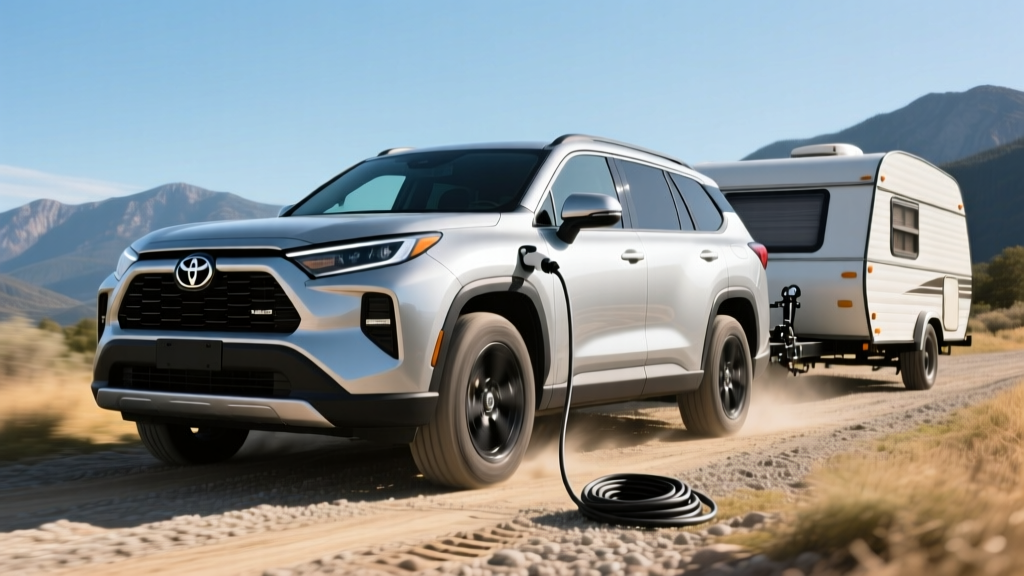
The 2026 Toyota Grand Highlander Hybrid occupies a narrow but compelling lane: three-row family hauler with genuine tow capability and fuel economy that embarrasses its V6 gas competitors. The headline number buyers search for — Toyota Grand Highlander Hybrid tow capacity — splits into two tiers. The standard hybrid powertrain (LE, XLE, Limited) is rated for 3,500 pounds. Step up to the Hybrid MAX performance variant (Limited and Platinum trims) and that figure jumps to 5,000 pounds, enough for a loaded pop-up camper, a pair of jet skis, or a 16-foot aluminum boat on a single-axle trailer.
But towing is only one axis of the purchase decision. The standard hybrid returns up to 36 MPG combined, while the Hybrid MAX sacrifices about 2 MPG for an extra 117 horsepower and a 1,500-pound tow bump. Below, we dissect the powertrain specs, real-world efficiency, battery longevity, pricing, and whether this three-row hybrid makes more sense than a full EV or a conventional gas SUV for your household.
HEV vs PHEV: Where the Grand Highlander Sits
A common point of confusion at the dealership: the Grand Highlander Hybrid is a conventional hybrid (HEV), not a plug-in hybrid (PHEV). Toyota does not currently offer a plug-in version of the Grand Highlander in the U.S. market. Here is what that distinction means in practice:
| Feature | HEV (Grand Highlander Hybrid) | PHEV (e.g., RAV4 Prime-style) | BEV (e.g., Kia EV9) |
|---|---|---|---|
| Plug-in charging required? | No — regenerative braking and engine recharge the battery | Yes — for electric-only range | Yes — sole energy source |
| Electric-only range | ~1 mile at very low speeds | Typically 30–42 miles | 230–310+ miles |
| Battery size | ~1.5–2.0 kWh (small buffer) | ~18–22 kWh usable | 77–100+ kWh |
| Gas engine? | Yes, primary power + charging | Yes, kicks in above EV range | None |
| Home charger needed? | No | Recommended (Level 2) | Essential (Level 2) |
| Federal tax credit (§30D)? | No — HEVs are not eligible | Yes, if sourcing/income/MSRP rules met | Yes, if sourcing/income/MSRP rules met |
The practical takeaway: if you want to drive on grid electricity for your daily commute and only use gas on road trips, the Grand Highlander Hybrid won't do that. It operates as a self-charging system — the gasoline engine and regenerative braking handle all battery charging. If plug-in electric range is a priority, you'd need to look at vehicles like the Toyota RAV4 Prime, the Chrysler Pacifica PHEV, or a fully electric three-row SUV like the Kia EV9.
Powertrain Breakdown: Standard Hybrid vs Hybrid MAX
Toyota offers two distinct hybrid powertrains in the 2026 Grand Highlander, and the differences go well from horsepower all the way to the transmission type.
| Spec | Standard Hybrid (LE/XLE/Limited) | Hybrid MAX (Limited/Platinum) |
|---|---|---|
| Engine | 2.5L 4-cylinder + 2 electric motors | 2.4L turbo 4-cylinder + electric motor |
| Combined horsepower | 245 hp | 362 hp |
| Combined torque | 173 lb-ft (engine) + motor torque | 400 lb-ft combined |
| Transmission | eCVT (planetary gearset) | 6-speed automatic |
| Drivetrain | AWD (electronic rear motor) or FWD | AWD standard |
| 0–60 mph (est.) | ~7.6 seconds | ~6.3 seconds |
| Tow capacity | 3,500 lbs | 5,000 lbs |
| EPA combined MPG | 36 (FWD) / 34 (AWD) | 27 (AWD) |
| Starting MSRP (2026) | ~$42,990 (LE FWD) | ~$54,590 (Limited AWD) |
The standard hybrid uses Toyota's well-proven eCVT architecture — a planetary gearset that blends engine and electric motor output seamlessly. There are no fixed gear shifts; the system continuously adjusts the ratio. It's extremely smooth in city driving but can produce the characteristic "motorboat" drone under hard acceleration or when towing uphill.
The Hybrid MAX swaps the eCVT for a conventional 6-speed automatic and pairs a turbocharged 2.4-liter engine with a more powerful electric motor sandwiched between the engine and transmission. The result is dramatically more torque (400 lb-ft), a more traditional driving feel with distinct gear shifts, and the structural confidence to tow 5,000 pounds. The trade-off is fuel economy: 27 MPG combined vs. 34–36 MPG for the standard hybrid.
Real-World MPG: EPA Sticker vs What You'll Actually See
Hybrid efficiency behaves differently than gas-car efficiency, and the EPA test cycle actually underestimates city MPG for hybrids while potentially overestimating highway numbers. Here's the full EPA breakdown from fueleconomy.gov paired with real-world expectations:
| Powertrain | EPA City | EPA Highway | EPA Combined | Real-World Expectation |
|---|---|---|---|---|
| Standard Hybrid FWD | 37 | 34 | 36 | 33–38 city; 30–33 highway |
| Standard Hybrid AWD | 35 | 33 | 34 | 31–36 city; 29–32 highway |
| Hybrid MAX AWD | 26 | 27 | 27 | 24–27 city; 25–28 highway |
Why hybrids beat EPA in the city: Regenerative braking recaptures energy at every stoplight, and the engine shuts off entirely when the vehicle is stationary or coasting. In stop-and-go traffic, a hybrid's advantage over a gas-only SUV can stretch to 40% or more. On sustained highway climbs at 75+ mph, the advantage narrows because the engine runs continuously and aerodynamic drag dominates.
Towing MPG reality: When hitched to a 3,500-pound trailer (standard hybrid) or a 5,000-pound load (Hybrid MAX), expect fuel economy to drop to roughly 16–20 MPG depending on trailer aerodynamics, terrain, and speed. This is still competitive with or better than most body-on-frame SUVs towing equivalent loads, but it's a significant hit from the unloaded sticker number.
Fuel cost context: At $3.50/gallon and 15,000 miles/year, the standard hybrid AWD (34 MPG combined) costs approximately $1,544 annually in fuel. A comparable gas-only three-row SUV averaging 22 MPG combined would cost $2,386 — a difference of about $842/year, or $4,210 over five years. Source: fueleconomy.gov calculator.
Toyota Grand Highlander Hybrid Tow Capacity: What You Can Actually Pull
The tow rating is only useful if you understand what fits within it. Toyota requires the factory tow package (included on Hybrid MAX trims, available on standard hybrid trims) and a weight-distribution hitch for trailers approaching the maximum rating.
3,500 lbs (Standard Hybrid):
- Pop-up camper or teardrop trailer (1,500–3,000 lbs loaded)
- Small utility trailer with ATV or motorcycle (1,000–2,500 lbs)
- Single jet ski on a trailer (~1,500 lbs)
- Light aluminum boat, 14–16 ft, with trailer (~2,500–3,200 lbs)
5,000 lbs (Hybrid MAX):
- Hard-sided travel trailer, 16–19 ft (3,500–4,800 lbs loaded)
- Larger aluminum or fiberglass boat, 17–20 ft, with trailer (3,500–4,800 lbs)
- Two jet skis on a dual trailer (~3,000 lbs)
- Horse trailer, single-horse, unloaded (~2,800–3,500 lbs)
- Enclosed cargo trailer, 6x12, loaded for moving (~3,500–4,500 lbs)
Remember that tow capacity must account for passengers and cargo inside the SUV. The Grand Highlander's Gross Combined Weight Rating (GCWR) caps the total weight of vehicle + passengers + cargo + trailer. A fully loaded cabin with six passengers and luggage can eat 500–800 pounds from your available tow margin. Always weigh your loaded trailer at a certified scale before a long trip.
Battery Longevity, Warranty, and Replacement Cost
Hybrid battery anxiety remains the single most common objection from first-time hybrid buyers. Here's what the data says for Toyota's hybrid systems:
2026 Toyota Hybrid Battery Warranty: 10 years / 150,000 miles (whichever comes first) in all 50 states. This covers the hybrid traction battery against defects and excessive capacity loss. California and states adopting CARB emissions rules may offer extended coverage under emissions warranty provisions. Source: Toyota Owner's Warranty Guide.
Real-world lifespan data: Toyota's hybrid battery packs — particularly the nickel-metal hydride (NiMH) units used in earlier generations and the lithium-ion packs in current models — have demonstrated exceptional longevity. Fleet data and owner reports consistently show Toyota hybrid batteries lasting 150,000–200,000+ miles with minimal degradation. The Highlander Hybrid, in production since 2006, has a deep track record; many first-generation units are still on their original battery packs past 200,000 miles.
Replacement cost if out of warranty: A new OEM hybrid battery pack for the Grand Highlander runs approximately $3,000–$4,500 including labor at a Toyota dealer. Refurbished or reconditioned packs from independent hybrid specialists typically cost $1,500–$2,500 installed. Individual module replacement (only the degraded cells) can drop the cost to $800–$1,500 at a specialist shop. These figures are substantially lower than EV battery replacements, which can exceed $10,000–$15,000, because hybrid packs are small (1.5–2.0 kWh vs. 75–100 kWh in a BEV).
Degradation behavior: Unlike an EV battery where degradation directly reduces your driving range, a hybrid battery's small size means moderate degradation is largely invisible to the driver. The system simply relies slightly more on the gasoline engine. You might notice a 1–2 MPG drop over 100,000+ miles — not a catastrophic range loss.
Pricing, Trims, and Tax Credit Eligibility
The 2026 Grand Highlander Hybrid lineup spans five trims. Here's the pricing structure and what you get at each level:
| Trim | Powertrain | MSRP (approx.) | Tow Capacity | Key Features |
|---|---|---|---|---|
| LE | Standard Hybrid | $42,990 (FWD) / $44,590 (AWD) | 3,500 lbs | Toyota Safety Sense 3.0, 12.3" touchscreen, tri-zone climate |
| XLE | Standard Hybrid | $46,590 (AWD) | 3,500 lbs | SofTex seats, power liftgate, wireless CarPlay/Android Auto |
| Limited | Standard Hybrid or MAX | $51,590 (Hybrid) / $54,590 (MAX) | 3,500 / 5,000 lbs | Leather, panoramic roof, 360° camera, JBL audio |
| Platinum | Hybrid MAX | $58,990 | 5,000 lbs | Head-up display, ventilated 2nd row, digital rearview mirror |
Federal Tax Credit: Does the Grand Highlander Hybrid Qualify?
No. The Grand Highlander Hybrid does not qualify for the federal §30D Clean Vehicle Credit. Under current IRS rules, the §30D credit (up to $7,500) applies only to plug-in electric vehicles — battery-electric (BEV) and plug-in hybrid (PHEV) models that meet battery sourcing, critical minerals, MSRP cap, and buyer income requirements. Conventional hybrids (HEVs) that cannot be plugged in are categorically excluded.
Some states offer their own incentives for hybrid purchases, though these are less common than EV rebates. Check your state's energy or environmental agency for current programs. Toyota's own incentives page occasionally lists manufacturer rebates on hybrid models.
Who Should Choose This Hybrid vs a Full EV or Gas SUV
Choose the Grand Highlander Hybrid if:
- You need three rows and tow capability but want to avoid $5/gallon fuel pain
- You can't install a home Level 2 charger (apartment, street parking, no garage)
- You regularly drive in stop-and-go city traffic where hybrid efficiency peaks
- You want Toyota's proven hybrid reliability without EV charging-infrastructure risk
- Your towing needs fall in the 3,500–5,000 lb range (campers, boats, utility trailers)
Choose a full EV three-row SUV (Kia EV9, Rivian R1S) if:
- You have reliable home Level 2 charging and want zero tailpipe emissions
- Your daily driving is under 250 miles and you rarely tow over 3,500 lbs
- You want to qualify for the $7,500 federal tax credit (point-of-sale eligible)
- You prioritize instant torque, one-pedal driving, and minimal maintenance
Choose a conventional gas SUV (Grand Highlander gas, Mazda CX-90) if:
- Your budget is strictly under $40,000 and you don't drive enough to recoup the hybrid premium
- You tow over 5,000 lbs regularly (consider a body-on-frame SUV like the Tahoe)
- You drive predominantly highway miles at 75+ mph where the hybrid advantage narrows
Pros
- 36 MPG combined (FWD) in a 200-inch three-row SUV
- 5,000-lb tow rating on Hybrid MAX — class-leading for hybrid crossovers
- Genuine third-row adult space with usable cargo behind it
- 10-year/150,000-mile hybrid battery warranty
- No home charger or plug-in infrastructure needed
- Toyota Safety Sense 3.0 standard on all trims
Cons
- No federal tax credit — HEV excluded from §30D
- Hybrid MAX fuel economy drops to 27 MPG combined
- eCVT drone under heavy acceleration (standard hybrid)
- No plug-in hybrid variant available for electric-only commuting
- Premium trims push past $58,000 — enters luxury SUV territory
- Towing MPG drops sharply to 16–20 MPG under load
Frequently Asked Questions
How many MPG does the Toyota Grand Highlander Hybrid get?
The EPA rates the 2026 Grand Highlander Hybrid at 37 city / 34 highway / 36 combined (FWD) and 35 city / 33 highway / 34 combined (AWD). The Hybrid MAX variant is rated at 26 city / 27 highway / 27 combined. In real-world city driving, owners often exceed the EPA city estimate by 1–3 MPG thanks to regenerative braking; highway fuel economy tends to align closely with the sticker number.
Can the Grand Highlander Hybrid tow a camper trailer?
Yes. The standard hybrid tows up to 3,500 lbs — enough for most teardrop and pop-up campers. The Hybrid MAX tows up to 5,000 lbs, which covers many hard-sided travel trailers in the 16–19 foot range. Always account for passengers and cargo when calculating your available tow margin, and use a weight-distribution hitch for trailers near the maximum rating.
Is the Grand Highlander Hybrid reliable, and what does battery replacement cost?
Toyota's hybrid system has an exceptional reliability track record spanning two decades. The hybrid battery is warrantied for 10 years / 150,000 miles. Out-of-warranty replacement costs approximately $3,000–$4,500 for a new OEM pack, or $1,500–$2,500 for a refurbished unit. Many Toyota hybrid batteries last 200,000+ miles with minimal degradation.
Does the Grand Highlander Hybrid qualify for any federal tax credit?
No. The §30D Clean Vehicle Credit applies only to plug-in vehicles (BEVs and PHEVs). Conventional hybrids that cannot be plugged in are not eligible. Some states may offer separate hybrid incentives — check your state's energy agency for current programs.
Is the Grand Highlander Hybrid a plug-in hybrid?
No. It is a conventional self-charging hybrid (HEV). You never plug it in. The battery recharges through regenerative braking and the gasoline engine. Toyota does not currently offer a plug-in hybrid (PHEV) version of the Grand Highlander.
What's the difference between the standard hybrid and Hybrid MAX?
The standard hybrid (245 hp, eCVT) prioritizes fuel efficiency at 34–36 MPG combined with a 3,500-lb tow rating. The Hybrid MAX (362 hp, turbo + 6-speed automatic) prioritizes performance and towing at 27 MPG combined with a 5,000-lb tow rating. The MAX costs roughly $5,000–$8,000 more depending on trim.
How does the Grand Highlander Hybrid compare to the regular Highlander Hybrid for towing?
The regular Highlander Hybrid is rated for 3,500 lbs across all trims and offers no higher-tow variant. The Grand Highlander Hybrid matches that with its standard powertrain but adds the Hybrid MAX option at 5,000 lbs — a significant advantage for buyers who need more tow capacity without stepping up to a body-on-frame SUV.