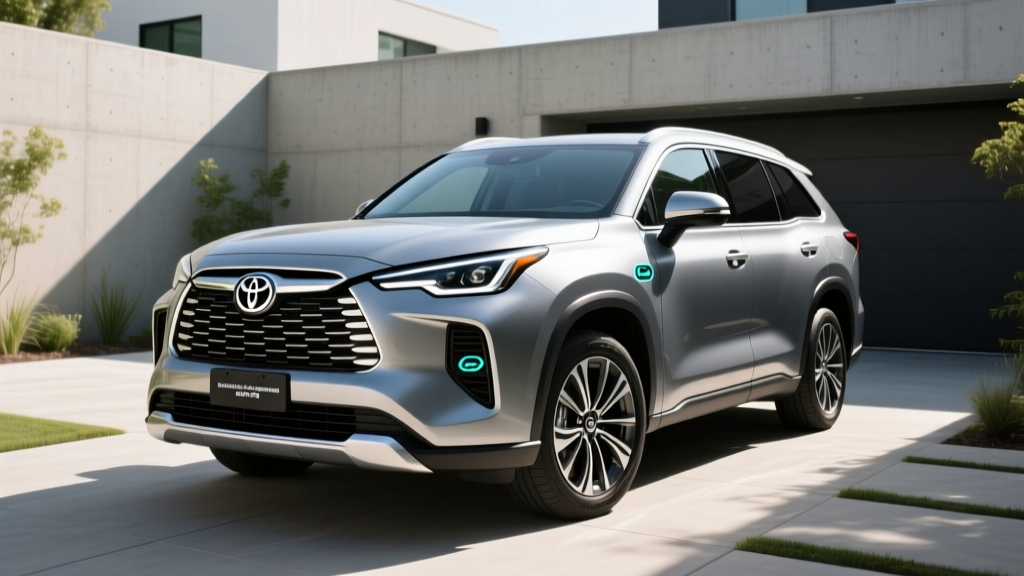
The 2026 Toyota Grand Highlander Hybrid occupies a narrow but highly desirable lane: three-row SUV space for seven or eight passengers without the fuel-cost penalty of a traditional gas V6. With EPA ratings reaching 36 MPG combined and a proven hybrid powertrain, it targets families who want the cargo room of a full-size SUV but refuse to spend $4,000+ annually at the pump. This guide covers every trim, both hybrid powertrains, real-world efficiency expectations, battery longevity, and whether a conventional hybrid (HEV) or a full EV makes more sense for your household.
HEV vs PHEV: What the Grand Highlander Hybrid Actually Is
Conventional Hybrid (HEV): The Grand Highlander Hybrid is a self-charging hybrid. It pairs a 2.5-liter four-cylinder engine with electric motors and a small nickel-metal hydride (NiMH) battery pack. You never plug it in — the battery recharges through regenerative braking and the gas engine. There is no electric-only driving mode of meaningful distance.
Plug-in Hybrid (PHEV): As of the 2026 model year, Toyota does not offer a Grand Highlander Hybrid Prime (PHEV variant). If you need plug-in electric-only range in a Toyota three-row SUV, the closest alternative is the Highlander Hybrid (also HEV-only) or stepping to a full EV like the upcoming Toyota bZ large SUV. Buyers searching for a PHEV three-row should also consider the Kia Sorento PHEV or Jeep Grand Cherokee 4xe.
This distinction matters because conventional hybrids like the Grand Highlander Hybrid do not qualify for the federal §30D clean vehicle tax credit. That credit, worth up to $7,500, applies only to plug-in vehicles with sufficient battery capacity and compliant sourcing. We cover pricing implications below.
Fuel Economy: EPA MPG and Real-World Expectations
The Grand Highlander Hybrid comes in two distinct powertrain flavors, and the efficiency gap between them is significant.
| Powertrain | Drivetrain | City MPG | Highway MPG | Combined MPG |
|---|---|---|---|---|
| 2.5L Hybrid (LE, XLE) | FWD | 37 | 34 | 36 |
| 2.5L Hybrid (LE, XLE) | AWD (AWD-i) | 36 | 32 | 34 |
| Hybrid MAX (Limited, Platinum) | AWD | 27 | 28 | 27 |
Source: EPA Fuel Economy
Powertrain Specs: Standard Hybrid vs Hybrid MAX
| Specification | 2.5L Hybrid | Hybrid MAX |
|---|---|---|
| Engine | 2.5L inline-4 | 2.4L turbo inline-4 |
| Combined Horsepower | 245 hp | 362 hp |
| Combined Torque | 173 lb-ft (engine) | 400 lb-ft |
| Electric Motors | Front + rear (AWD-i) | Front + rear |
| Transmission | eCVT | 6-speed automatic |
| 0–60 MPH | ~7.8 sec | ~5.8 sec |
| Towing Capacity | 3,500 lbs | 5,000 lbs |
| Drivetrain | FWD or AWD | AWD only |
The standard 2.5L hybrid prioritizes efficiency. Its eCVT (electronically controlled continuously variable transmission) keeps the engine in its most efficient RPM range, which makes acceleration smooth but unhurried. The AWD-i system uses a dedicated rear electric motor rather than a mechanical driveshaft — there's no physical connection between the front and rear axles.
The Hybrid MAX is Toyota's performance-oriented hybrid. It swaps the eCVT for a traditional 6-speed automatic and pairs a turbocharged 2.4L engine with more powerful electric motors. The result is 362 hp and a 0–60 time near 5.8 seconds, but efficiency drops to 27 MPG combined. Think of it as the option for buyers who want hybrid smoothness and AWD traction without sacrificing passing power or the 5,000-lb towing rating.
Pricing by Trim and Tax Credit Eligibility
For the 2026 model year, the Grand Highlander Hybrid is offered across four trims:
| Trim | Powertrain | MSRP (approx.) | Seating |
|---|---|---|---|
| LE | 2.5L Hybrid | $46,500 | 8 (bench 2nd row) |
| XLE | 2.5L Hybrid | $49,800 | 7 or 8 |
| Limited | Hybrid MAX | $56,500 | 7 (captain's chairs) |
| Platinum | Hybrid MAX | $61,000 | 7 |
Pricing reflects estimated 2026 MSRP including destination. Verify current pricing at Toyota's official site.
Battery Warranty, Longevity, and Replacement Cost
Toyota's hybrid battery track record is among the best in the industry. The NiMH packs used in the 2.5L hybrid system have demonstrated minimal degradation in long-term fleet data — many Prius and Highlander Hybrid owners report 150,000+ miles with no battery replacement needed. The Hybrid MAX uses a lithium-ion pack, which Toyota has also warrantied for the same 10-year/150,000-mile period.
If replacement is needed out of warranty, a Toyota hybrid battery typically costs $3,000–$5,000 including labor at a dealership, though refurbished units are available for $1,500–$2,500. For context, that's roughly the cost of a single major transmission repair on a conventional vehicle — and hybrid battery failures remain rare within the first decade of ownership.
Grand Highlander Hybrid vs Full EV vs Gas: Which Fits You?
Choose the Grand Highlander Hybrid if:
- You regularly carry 6–8 passengers and need 97+ cu ft of cargo space
- You want 34–36 MPG without changing your refueling habits (no plug needed)
- You take frequent road trips where charging infrastructure is uncertain
- You tow up to 5,000 lbs (Hybrid MAX trims)
- You plan to keep the vehicle 8–10+ years (warranty-backed reliability)
Choose a full EV (e.g., Kia EV9, Tesla Model X) if:
- You have reliable home Level 2 charging
- Your daily driving is under 250 miles
- You want to eliminate gas expenses entirely and qualify for the $7,500 federal credit
- You prioritize instant torque and near-silent operation
Choose a conventional gas SUV if:
- Upfront purchase price is the primary constraint (gas models start ~$5,000 lower)
- You drive fewer than 8,000 miles per year (hybrid fuel savings won't offset the premium)
- You prefer maximum towing capacity (some gas V6 competitors tow 6,000+ lbs)
The fuel-cost math is straightforward. At $3.50/gallon and 15,000 miles/year, the standard hybrid at 36 MPG costs roughly $1,458/year in fuel. A comparable gas-only three-row SUV averaging 22 MPG would cost $2,386/year. That's ~$928 in annual savings, meaning the hybrid's price premium pays for itself in approximately 4–5 years — and the savings compound for as long as you own the vehicle.
Pros and Cons at a Glance
Pros
- Class-leading 36 MPG combined in a 3-row SUV
- 10-year/150,000-mile hybrid battery warranty
- No plug-in charging required — refuel like any gas car
- Hybrid MAX offers 362 hp and 5,000-lb towing
- Strong Toyota reliability and resale value
- Spacious third row fits adults comfortably
Cons
- No PHEV option — cannot drive on electric-only power
- No federal tax credit eligibility
- Standard hybrid acceleration is modest (7.8 sec 0–60)
- Hybrid MAX drops to 27 MPG (efficiency trade-off for power)
- Hybrid trims carry a ~$3,000–$5,000 premium over gas equivalents
- No DC fast charging (not applicable for HEV)
Frequently Asked Questions
How many MPG does the Toyota Grand Highlander Hybrid get?
The 2026 Grand Highlander Hybrid with the 2.5L powertrain and FWD earns an EPA-estimated 37 city / 34 highway / 36 combined MPG. With AWD (AWD-i), it drops slightly to 36/32/34 MPG. The performance-oriented Hybrid MAX AWD rates at 27/28/27 MPG.
Does the Grand Highlander Hybrid need to be plugged in?
No. It is a conventional hybrid (HEV), meaning the battery recharges through regenerative braking and the gasoline engine. You never plug it in — you refuel at any gas station as usual.
Is there a plug-in hybrid (PHEV) Grand Highlander?
Not for 2026. Toyota has not announced a Grand Highlander Hybrid Prime or any PHEV variant. If electric-only range is a priority, consider the Kia Sorento PHEV (32 miles electric) or wait for Toyota's future PHEV three-row announcements.
Does the Grand Highlander Hybrid qualify for a federal tax credit?
No. The IRS §30D Clean Vehicle Credit requires a plug-in electric vehicle. As a conventional hybrid, the Grand Highlander Hybrid does not qualify. Some state or utility programs may offer smaller incentives for hybrids — check your local programs.
How reliable is the hybrid battery and what does replacement cost?
Toyota's hybrid batteries are covered by a 10-year/150,000-mile warranty. Real-world data from Toyota's hybrid fleet shows most batteries last well beyond 150,000 miles. Out-of-warranty replacement typically costs $3,000–$5,000 at a dealer, with refurbished options available for less.
Can the Grand Highlander Hybrid tow?
Yes. The standard 2.5L Hybrid tows up to 3,500 lbs. The Hybrid MAX (Limited and Platinum trims) tows up to 5,000 lbs — competitive with many V6 gas SUVs in this segment.
How does real-world MPG compare to the EPA sticker?
City driving often matches or slightly exceeds EPA estimates thanks to Toyota's regenerative braking system. Highway driving at sustained speeds above 70 MPH typically returns 1–3 MPG below the sticker. Cold weather (under 30°F) reduces efficiency by 5–10% due to increased engine operation for cabin heating.