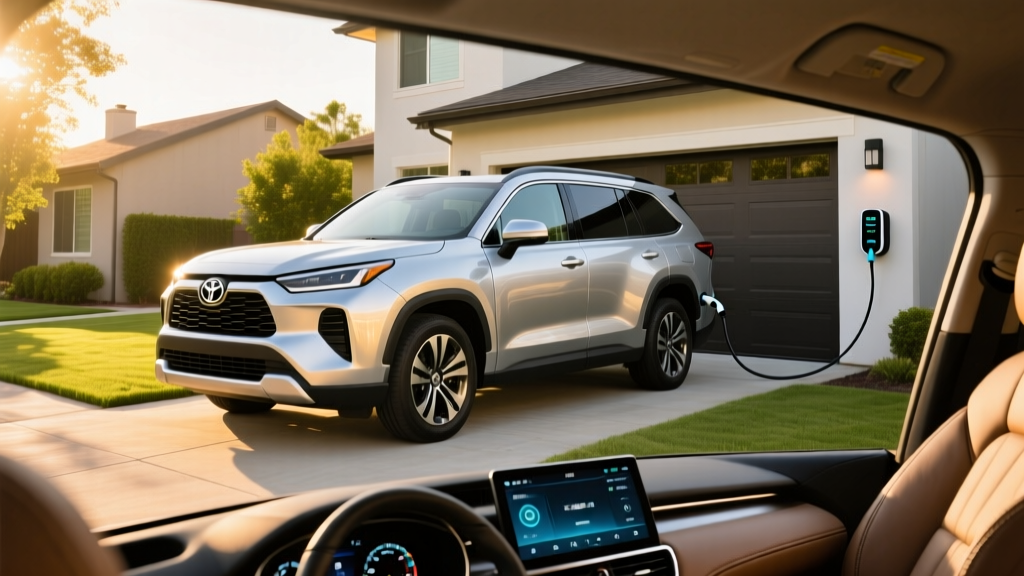
The 2024 Toyota Grand Highlander Hybrid Max occupies a rare niche: a three-row family hauler that pairs a turbocharged engine with electric motors for genuine performance without sacrificing fuel economy. Unlike the standard Grand Highlander Hybrid—which prioritizes maximum efficiency with a naturally aspirated 2.5-liter four-cylinder—the Hybrid Max swaps in a 2.4-liter turbocharged four-cylinder paired to a more powerful electric motor system, producing a combined 362 horsepower and an EPA-estimated 27 MPG combined. For buyers who want three-row utility, all-wheel drive, and tow capability without going full EV or settling for a thirsty V6, this powertrain demands a closer look.
HEV vs. PHEV: Where the Hybrid Max Fits
Before diving into specs, it's critical to understand what the Hybrid Max is—and isn't. This is a conventional hybrid (HEV), not a plug-in hybrid (PHEV). You never plug it in. The 1.8 kWh nickel-metal hydride (NiMH) traction battery charges exclusively through regenerative braking and the gasoline engine. There is no electric-only driving range to speak of—the electric motor assists the gas engine during acceleration and low-speed maneuvers, but the vehicle cannot operate in pure EV mode for any meaningful distance.
- HEV (Hybrid Max): No plug. ~1.8 kWh battery. Electric motor assists gas engine. 27 MPG combined. Zero electric-only range.
- PHEV (e.g., Toyota RAV4 Prime): Plugs in. ~18 kWh battery. 35-42 miles electric-only before gas engine engages. Qualifies for partial §30D tax credit.
- BEV (e.g., Tesla Model X, Kia EV9): Plugs in. 75-100+ kWh battery. 250-330+ miles all-electric. Full §30D credit eligibility (if sourcing/income rules met).
Toyota does not currently offer a plug-in hybrid version of the Grand Highlander. If you need electric-only commuting range for school runs or grocery trips, you'd need to look at a smaller PHEV like the RAV4 Prime or consider a full BEV three-row SUV such as the Kia EV9.
Fuel Economy: EPA Ratings and Real-World MPG
The Hybrid Max's headline efficiency figure is 27 MPG combined, but the city/highway split tells a more nuanced story about how this powertrain actually behaves.
| Metric | EPA Rating | Real-World Expectation |
|---|---|---|
| City MPG | 26 | 27–29 (hybrids excel in stop-and-go) |
| Highway MPG | 27 | 24–26 (turbo + AWD drivetrain losses) |
| Combined MPG | 27 | 25–28 depending on driving mix |
| Fuel Tank Capacity | 17.9 gal | ~450–480 miles total range |
| Towing Capacity | 5,000 lbs | Expect 16–19 MPG while towing |
Source: EPA Fuel Economy
The real-world dynamic is typical of performance-oriented hybrids: city driving lets the regenerative braking system recapture energy at every stoplight, often pushing actual city MPG slightly above the EPA sticker. Highway cruising at 75-80 MPH, however, works against the turbo hybrid's efficiency advantage—the engine carries more of the load without regenerative assist, and the AWD system's mechanical drag reduces economy. Owners who do mostly suburban and city driving will likely see 28-29 MPG; heavy highway commuters should budget for 24-25 MPG.
Compare this to the non-hybrid Grand Highlander's turbo 2.4-liter (26 MPG combined) and the standard Hybrid's 2.5-liter system (36 MPG combined with FWD, 34 with AWD). The Hybrid Max gives up 7-9 MPG to the standard Hybrid in exchange for 120 additional horsepower and a 5,000-lb tow rating versus 3,500 lbs.
Powertrain and Performance Specs
| Specification | 2024 Grand Highlander Hybrid Max |
|---|---|
| Engine | 2.4L turbocharged 4-cylinder |
| Engine Output | 265 hp / 310 lb-ft torque |
| Electric Motor | Front + rear eAxle motors |
| Combined System Output | 362 hp / 400 lb-ft torque |
| 0-60 MPH | ~5.9 seconds (est.) |
| Drivetrain | Electronic AWD (standard on Hybrid Max) |
| Transmission | 6-speed automatic |
| Traction Battery | 1.8 kWh NiMH |
| Max Towing | 5,000 lbs |
| Cargo Volume (behind 3rd / 2nd / 1st) | 20.6 / 57.9 / 97.5 cu ft |
The Hybrid Max uses Toyota's Hybrid MAX powertrain architecture, which differs fundamentally from the standard Toyota Hybrid System. Where the regular hybrid uses an eCVT (planetary gearset), the Hybrid Max routes power through a conventional 6-speed automatic transmission. This gives it more traditional shift feel and better high-speed passing response, at the cost of some low-speed efficiency. The rear eAxle motor provides electronic all-wheel drive with no mechanical driveshaft—improving packaging and reducing weight versus a traditional AWD system.
The 362-hp combined output makes this the quickest Grand Highlander variant by a significant margin. For context, the standard 2.4L turbo (non-hybrid) produces 265 hp alone, and the standard 2.5L Hybrid makes 245 hp. The Hybrid Max's 400 lb-ft of torque is particularly useful for merging and towing, where the electric motor's instant torque fill eliminates the turbo lag inherent to the gas-only powertrain.
Pricing, Trims, and Tax Credit Eligibility
The Hybrid Max is available exclusively on higher trims, which pushes its entry price well above the base Grand Highlander.
| Trim | MSRP | Key Features |
|---|---|---|
| Limited | $54,040 | Leather, panoramic roof, 12.3" display |
| Platinum | $58,175 | Head-up display, 360° camera, ventilated 2nd row |
Prices include destination charge. Source: Toyota
The 2024 Grand Highlander Hybrid Max does not qualify for the IRS §30D Clean Vehicle Credit. This credit applies only to plug-in electric vehicles (PHEVs and BEVs) with batteries of at least 7 kWh and specific critical-mineral and battery-component sourcing requirements. Conventional hybrids (HEVs) like the Hybrid Max are excluded regardless of price or efficiency. Some states may offer minor rebates for hybrid purchases—check your state's energy office or IRS §30D guidelines for current rules.
Battery Warranty, Reliability, and Replacement Costs
- Hybrid Battery Warranty: 10 years / 150,000 miles (whichever comes first), transferable to subsequent owners
- Hybrid System Components Warranty: 8 years / 100,000 miles (covers inverter, eAxle motors, control modules)
- Battery Chemistry: Nickel-Metal Hydride (NiMH) — proven technology with decades of Toyota deployment
- Estimated Out-of-Warranty Replacement: $3,000–$5,000 (dealer), $2,000–$3,500 (independent hybrid specialist)
Toyota's hybrid reliability record is among the strongest in the industry. The Prius, Camry Hybrid, and RAV4 Hybrid have demonstrated hybrid battery lifespans routinely exceeding 150,000-200,000 miles with minimal degradation. The NiMH chemistry used in the Hybrid Max is less energy-dense than lithium-ion but significantly more tolerant of temperature extremes and deep cycling—making it a pragmatic choice for a vehicle designed for 15+ years of family duty.
The 1.8 kWh battery in the Hybrid Max is small by EV standards, but it's also doing far less work. It's never deeply discharged (the system maintains a state-of-charge buffer between roughly 40-80%), never fast-charged, and never exposed to the thermal stress of DC fast charging. This gentle operating profile is why Toyota hybrid batteries routinely outlast their warranty periods. The 10-year/150,000-mile warranty is also transferable, which supports resale value—a meaningful factor for a $54,000+ family SUV.
Should a replacement become necessary out of warranty, Toyota's hybrid battery ecosystem is mature. Dealership replacement runs $3,000-$5,000 including labor, while reconditioned units from independent hybrid specialists can be had for $2,000-$3,500. Individual module replacement (rather than the full pack) is sometimes possible for $500-$1,500 if only specific cells have degraded.
Hybrid Max vs. Standard Hybrid vs. Gas vs. EV: Which Powertrain Fits You?
- You tow a boat, trailer, or camper (5,000-lb capacity vs. 3,500 for the standard Hybrid)
- You want quick passing power and confident highway merging (362 hp, ~5.9s 0-60)
- You live in a region with cold winters where EV range loss is a concern
- You don't have access to home or workplace charging
- Three rows and 97.5 cu ft of max cargo space are non-negotiable
- Maximum fuel economy is your priority (saves ~$400-600/year in fuel vs. Hybrid Max)
- You don't need to tow more than 3,500 lbs
- You want a lower entry price (starts ~$40,000 on lower trims)
- You have reliable Level 2 home charging
- Your daily driving is under 250 miles and you can plan road trips around DC fast chargers
- You want to qualify for the $7,500 federal tax credit (subject to §30D sourcing/income/MSRP rules)
- You want near-zero maintenance (no oil changes, no transmission fluid, minimal brake wear)
Real-World Ownership: What to Expect
Beyond the spec sheet, a few practical realities shape the Hybrid Max ownership experience:
Fuel cost vs. EV: At 27 MPG combined and $3.50/gallon regular unleaded, the Hybrid Max costs roughly $0.13 per mile in fuel. A comparable three-row EV like the Kia EV9 (89 MPGe, $0.14/kWh national average) costs about $0.05 per mile. Over 15,000 miles annually, that's an ~$1,200/year fuel savings for the EV—but the EV carries a higher purchase price and requires home charging infrastructure ($500-$2,000 for Level 2 installation).
Cold-weather behavior: Unlike EVs, which can lose 20-30% of range in sub-freezing temperatures, the Hybrid Max's fuel economy drops only modestly in winter—typically 1-3 MPG due to cold-start enrichment and increased engine load from heating. The engine's waste heat warms the cabin quickly, a genuine advantage over EVs that must use battery energy for resistive or heat-pump heating.
Maintenance: Toyota recommends oil changes every 10,000 miles, transmission fluid inspection at 60,000 miles, and standard brake/coolant service. The regenerative braking system significantly extends brake pad life—many Toyota hybrid owners report 60,000-80,000 miles on original pads. Annual maintenance costs typically run $400-$700, far below a comparable turbo V6 SUV but above a BEV.
Pros and Cons
- 362 hp with 27 MPG — rare performance/efficiency balance
- 5,000-lb towing (best in hybrid three-row class)
- AWD standard; no FWD option reduces complexity
- Proven Toyota hybrid reliability; 10-yr/150k battery warranty
- No plug-in required; works with any gas station
- 97.5 cu ft max cargo with three usable rows
- Starts at $54,040 — no budget-friendly trim available
- 7-9 MPG less than standard Grand Highlander Hybrid
- No federal tax credit eligibility (HEV exclusion)
- Highway MPG can dip to 24-25 at sustained 75+ MPH
- 1.8 kWh battery means no meaningful EV-mode driving
- Premium feel but not premium badge — resale may lag luxury competitors
Frequently Asked Questions
How many MPG does the 2024 Grand Highlander Hybrid Max get?
The EPA rates it at 26 city / 27 highway / 27 combined. Real-world results vary: city-heavy drivers often see 28-29 MPG thanks to regenerative braking, while sustained highway driving at higher speeds can drop economy to 24-25 MPG. Towing reduces economy to approximately 16-19 MPG.
Does the Hybrid Max have electric-only driving range?
No. This is a conventional hybrid (HEV), not a plug-in hybrid. The 1.8 kWh battery is too small for meaningful electric-only operation, and there is no plug. The electric motor assists the gas engine but cannot propel the vehicle independently for more than brief low-speed maneuvers.
Is the Hybrid Max reliable, and what does battery replacement cost?
Toyota's hybrid systems have an exceptional reliability track record spanning 25+ years since the original Prius. The hybrid battery is warrantied for 10 years/150,000 miles. Out-of-warranty replacement costs $3,000-$5,000 at a dealer or $2,000-$3,500 through an independent hybrid specialist. Many Toyota hybrid batteries exceed 200,000 miles without replacement.
Does the Grand Highlander Hybrid Max qualify for any tax credit?
No. The federal §30D Clean Vehicle Credit applies only to plug-in vehicles (PHEVs and BEVs). Conventional hybrids are excluded. Some states offer minor hybrid purchase incentives—check your state energy office for current programs.
How does the Hybrid Max compare to the standard Grand Highlander Hybrid?
The standard Hybrid uses a 2.5L four-cylinder (245 hp combined) and achieves 36 MPG combined with FWD. The Hybrid Max uses a 2.4L turbo (362 hp combined) with standard AWD and gets 27 MPG. The Max tows 5,000 lbs vs. 3,500 lbs for the standard Hybrid, but costs roughly $10,000-$14,000 more and sacrifices 9 MPG. Choose the Max for towing and performance; choose the standard Hybrid for efficiency and value.
What is the total driving range on a full tank?
With a 17.9-gallon fuel tank and 27 MPG combined, expect approximately 450-480 miles of total range. Highway-heavy driving may reduce this to ~420 miles; city-heavy driving could stretch it past 500 miles.