Why the Grand Highlander Hybrid Dominates Three-Row Lease Searches
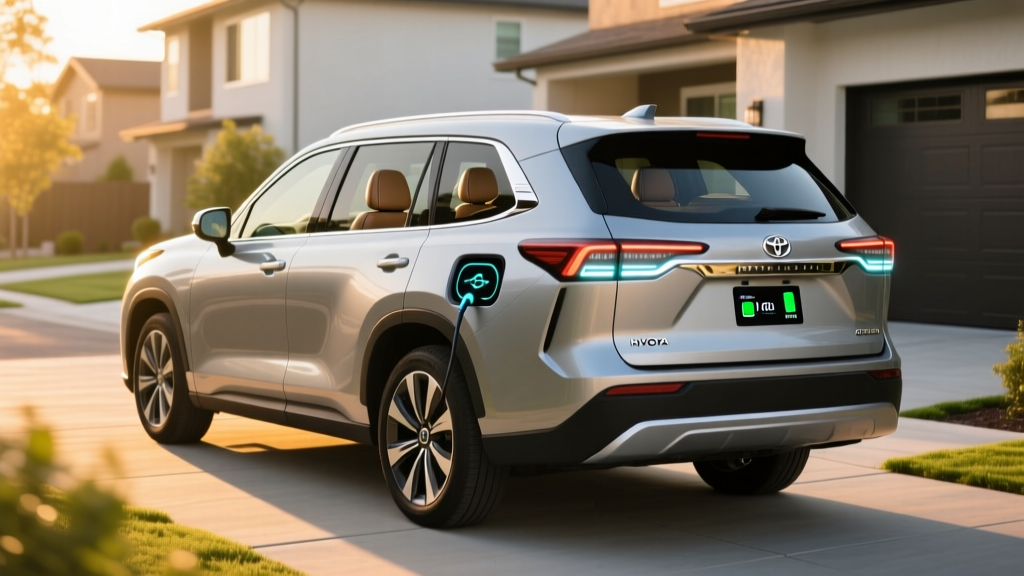
Search volume for Toyota Grand Highlander Hybrid lease deals has surged as families realize this is one of the few three-row SUVs that returns over 30 MPG combined without a charging cord. For 2026, Toyota offers the Grand Highlander in two distinct electrified flavors: the conventional Hybrid (HEV) and the Hybrid MAX performance variant. There is no plug-in hybrid (PHEV) version of the Grand Highlander — a critical distinction that shapes both the lease economics and daily ownership experience.
Leasing a Grand Highlander Hybrid makes particular sense right now. Toyota's residual values on large SUVs remain strong, money factors on hybrid trims are competitive, and you avoid the long-term battery degradation question entirely by cycling into a new vehicle every 36 months. Here's everything you need to evaluate before signing.
HEV vs. PHEV: What the Grand Highlander Actually Is
Conventional Hybrid (HEV): The Grand Highlander Hybrid uses Toyota's fifth-generation hybrid system. A small battery (approximately 1.6 kWh usable) charges through regenerative braking and the gasoline engine. You never plug it in. It operates as a gas vehicle that happens to be extremely efficient.
Plug-in Hybrid (PHEV): The Grand Highlander does NOT come in a PHEV variant for 2026. If you need plug-in electric-only range in a three-row Toyota, the closest option remains the RAV4 Prime (compact, two-row) or stepping to a different brand entirely. Toyota has not announced a Grand Highlander PHEV or Prime variant as of the 2026 model year.
Hybrid MAX: This is Toyota's performance-oriented hybrid variant — still a conventional HEV (no plug), but with a turbocharged 2.4L engine and more powerful electric motors for higher output. It sacrifices some fuel economy for acceleration and towing capability.
Fuel Economy: EPA MPG and Real-World Expectations
According to fueleconomy.gov, the 2026 Toyota Grand Highlander Hybrid achieves the following EPA estimates depending on drivetrain:
| Powertrain | City MPG | Highway MPG | Combined MPG | Drivetrain |
|---|---|---|---|---|
| Hybrid (standard) | 36 | 32 | 34 | FWD |
| Hybrid (standard) | 35 | 33 | 34 | AWD (eAWD) |
| Hybrid MAX | 27 | 28 | 27 | AWD |
Real-world MPG reality check: Toyota's hybrid system excels in stop-and-go city driving, where the electric motor handles low-speed propulsion and the engine operates in its most efficient range. Many owners report exceeding the EPA city estimate by 1-3 MPG in suburban driving. Highway efficiency at sustained 75+ MPH speeds tends to run 1-2 MPG below the sticker, as with most large vehicles. In cold weather (below 30°F), expect a 5-10% reduction in fuel economy as the engine runs more frequently to provide cabin heat and maintain battery temperature.
For context, the non-hybrid gas-only Grand Highlander with the turbo 2.4L engine achieves 24 MPG combined — meaning the standard Hybrid saves roughly 10 MPG, or about $400-$550 annually in fuel at 15,000 miles/year and $3.40/gallon.
Powertrain Specs: Horsepower, Towing, and Drivetrain
| Specification | Grand Highlander Hybrid | Grand Highlander Hybrid MAX |
|---|---|---|
| Engine | 2.5L 4-cyl + 3 electric motors | 2.4L turbo 4-cyl + electric motors |
| Combined Horsepower | 245 hp | 362 hp |
| Combined Torque | 173 lb-ft (engine) + motor torque | 400 lb-ft |
| 0-60 mph (est.) | ~7.8 sec | ~5.9 sec |
| Drivetrain | FWD or eAWD | AWD (standard) |
| Max Towing Capacity | 3,500 lbs (eAWD) | 5,000 lbs |
| Transmission | eCVT | 6-speed automatic |
| Seating | 7 or 8 passengers | 7 passengers |
The standard Hybrid's eAWD system uses a dedicated rear electric motor rather than a mechanical driveshaft, providing on-demand rear traction without the efficiency penalty of a traditional AWD system. The Hybrid MAX uses a conventional AWD system with a mechanical rear driveshaft, necessary to handle its significantly higher torque output and 5,000-lb towing rating.
Lease Pricing: What to Expect in 2026
Toyota Grand Highlander Hybrid lease deals vary by region, dealer, and trim, but here's the current pricing landscape for the 2026 model year:
| Trim Level | MSRP (approx.) | Typical Lease Range (36 mo / 12k mi) |
|---|---|---|
| XLE Hybrid | $47,200 | $520–$580/mo |
| Limited Hybrid | $52,500 | $580–$650/mo |
| Platinum Hybrid MAX | $59,800 | $680–$760/mo |
Lease deal variables that move the needle:
- Money factor: Toyota Financial Services typically offers competitive hybrid money factors (the lease equivalent of an interest rate). Ask the dealer to disclose the base money factor — anything above 0.00250 (equivalent to ~6% APR) on a Toyota hybrid lease in 2026 warrants negotiation.
- Residual value: Toyota SUVs hold value well. The Grand Highlander Hybrid typically residuals at 56-60% on a 36-month lease, keeping monthly payments manageable relative to the MSRP.
- Dealer markup: Some dealers add market adjustments above MSRP on hybrid trims due to demand. This inflates the capitalized cost and your monthly payment. Push for MSRP or below on the cap cost.
- Lease cash: Toyota occasionally offers lease cash incentives on specific trims. Check Toyota's national offers page and ask your dealer about unadvertised regional incentives.
Tax Credit Eligibility: Does the Grand Highlander Hybrid Qualify?
Federal §30D Tax Credit: The Grand Highlander Hybrid (both standard and MAX) does NOT qualify for the federal §30D new clean vehicle tax credit. Per IRS rules, the §30D credit applies only to plug-in electric vehicles (BEVs and PHEVs) with a battery capacity of at least 7 kWh. The Grand Highlander Hybrid's ~1.6 kWh battery and lack of plug-in capability disqualify it entirely.
State incentives: A handful of states offer rebates or tax credits for conventional hybrids, but these are uncommon and typically small ($500-$1,500). Check your state's energy or environmental agency website for current programs. Most state incentives have shifted exclusively to plug-in vehicles.
The absence of a federal tax credit is the primary financial trade-off versus a plug-in competitor. However, the lower purchase price, no charging infrastructure requirement, and proven hybrid reliability often offset this for buyers who lack home charging access.
Battery Warranty, Lifespan, and Replacement Cost
Battery longevity is the single most common concern among first-time hybrid buyers. Here's what Toyota provides:
| Coverage | Term |
|---|---|
| Hybrid Battery Warranty | 10 years / 150,000 miles (whichever comes first) |
| Hybrid System Components | 8 years / 100,000 miles |
| Basic Vehicle Warranty | 3 years / 36,000 miles |
| Powertrain Warranty | 5 years / 60,000 miles |
Real-world battery lifespan: Toyota's hybrid battery packs — now using bipolar nickel-metal hydride (NiMH) in the fifth-generation system — have an exceptional track record. Data from Prius fleets and Highlander Hybrids shows most original hybrid batteries lasting 150,000-200,000+ miles before significant degradation. The Grand Highlander's relatively small battery undergoes shallow charge/discharge cycles (typically staying between 40-80% state of charge), which dramatically extends cycle life.
Replacement cost if needed: A replacement hybrid battery for the Grand Highlander runs approximately $3,000-$4,500 installed at a Toyota dealer, depending on the specific pack and labor rates. Third-party refurbished options may be available for $1,500-$2,500 as the platform ages. Given the 10-year/150,000-mile warranty, most lessees will never encounter this cost, and most original owners will sell before it becomes relevant.
Grand Highlander Hybrid vs. EV vs. Gas: Which Fits You?
Choose the Grand Highlander Hybrid If:
- You want three-row seating with 30+ MPG and no charging hassle
- You don't have reliable home or workplace charging access
- You take frequent long road trips where DC charging infrastructure is sparse
- You want Toyota's proven hybrid reliability and strong resale value
- You lease and prefer not to manage long-term battery risk
Consider a Full EV (BEV) Instead If:
- You have Level 2 home charging and a daily commute under 60 miles
- You want the $7,500 federal tax credit (income and sourcing rules apply)
- You prioritize instant torque, quiet operation, and zero tailpipe emissions
- You're open to vehicles like the Kia EV9 (3-row BEV, 270+ mi range) or Rivian R1S
- Your electricity rate is low enough to make per-mile fuel cost dramatically cheaper
The Grand Highlander Hybrid occupies a specific and valuable niche: maximum flexibility with minimum behavioral change. You fuel it like a gas car, maintain it like a gas car (with less brake wear thanks to regenerative braking), and simply enjoy dramatically lower fuel consumption. For families without charging infrastructure or those in apartment/condo situations, it remains the pragmatic three-row choice.
Reliability Ratings and Safety
Toyota's hybrid powertrain is among the most proven in the industry, with over 25 years of continuous production since the original Prius. The Grand Highlander carries forward this lineage with the fifth-generation hybrid system, which has been in production across multiple Toyota models since 2023.
Safety-wise, the Grand Highlander earned strong marks from the IIHS and comes standard with Toyota Safety Sense 3.0, which includes adaptive cruise control, lane-keeping assist, automatic emergency braking with pedestrian detection, and blind-spot monitoring. These are SAE Level 1-2 driver-assistance features — the driver must remain engaged and hands-on at all times.
FAQ: Toyota Grand Highlander Hybrid
How many MPG does the Grand Highlander Hybrid get?
The 2026 Grand Highlander Hybrid with eAWD achieves an EPA-estimated 35 city / 33 highway / 34 combined MPG. The FWD variant rates 36/32/34. Real-world city driving often exceeds EPA estimates by 1-3 MPG, while sustained highway speeds above 75 MPH may reduce efficiency slightly. The Hybrid MAX variant rates 27 MPG combined.
Does the Grand Highlander Hybrid need to be plugged in?
No. The Grand Highlander Hybrid is a conventional hybrid (HEV). Its battery charges exclusively through regenerative braking and the gasoline engine. You fuel it with regular unleaded gasoline and never need a charging cable. There is no PHEV or plug-in variant available for 2026.
Is the Grand Highlander Hybrid reliable, and what does battery replacement cost?
Toyota's hybrid systems have a 25+ year track record of exceptional reliability. The hybrid battery is warranted for 10 years/150,000 miles. Real-world data shows most Toyota hybrid batteries lasting 150,000-200,000+ miles. If replacement is needed, expect $3,000-$4,500 at a dealer. Most lessees will never face this cost.
Does the Grand Highlander Hybrid qualify for any federal tax credit?
No. The federal §30D clean vehicle tax credit requires plug-in capability and a minimum 7 kWh battery. The Grand Highlander Hybrid's ~1.6 kWh non-plug-in system does not qualify. No significant state hybrid incentives exist in most jurisdictions as of 2026.
Can I tow with the Grand Highlander Hybrid?
Yes. The standard Hybrid with eAWD is rated for 3,500 lbs of towing — sufficient for a small boat, utility trailer, or light camper. The Hybrid MAX increases this to 5,000 lbs, making it competitive with body-on-frame SUVs for mid-size trailer duty.
How does the Hybrid MAX differ from the standard Hybrid?
The Hybrid MAX pairs a turbocharged 2.4L engine with electric motors for 362 combined horsepower and 400 lb-ft of torque, compared to 245 hp in the standard Hybrid. It uses a 6-speed automatic instead of an eCVT and achieves 27 MPG combined vs. 34 MPG. It's the choice for buyers prioritizing acceleration and 5,000-lb towing over maximum efficiency.
What should I negotiate on a Grand Highlander Hybrid lease?
Focus on three numbers: the capitalized cost (push for MSRP or below — refuse dealer markups), the money factor (ask for the base rate from Toyota Financial Services), and any available lease cash or loyalty incentives. Avoid negotiating the residual value — it's set by the manufacturer and non-negotiable.