Quick Verdict: The Family Hauler That Sips Fuel
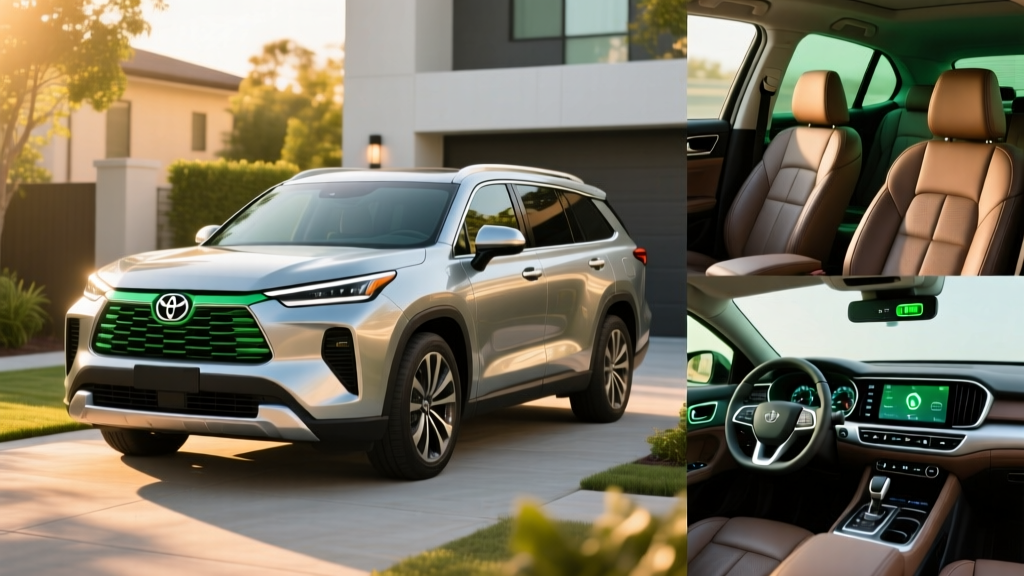
If you need three usable rows of seating but refuse to accept the fuel bills that typically come with a large SUV, the Toyota Grand Highlander Hybrid is one of the most compelling options on the market. Unlike its V6-only predecessor, this hybrid powertrain squeezes legitimate three-row comfort into a package that returns mid-30s MPG in combined driving — a figure that would have seemed impossible for a vehicle this size just five years ago.
For 2026, the Grand Highlander Hybrid remains a conventional hybrid electric vehicle (HEV), meaning it charges its own battery through regenerative braking and the gasoline engine. You never plug it in. Toyota also offers a Hybrid MAX performance variant for buyers who prioritize acceleration over maximum efficiency. There is no plug-in hybrid (PHEV) version of the Grand Highlander, which is an important distinction for shoppers cross-referencing Toyota's broader hybrid lineup.
HEV vs. PHEV: What the Grand Highlander Hybrid Actually Is
Conventional Hybrid (HEV) — Grand Highlander Hybrid
- No plug required. The battery recharges via regenerative braking and the gas engine.
- Small battery (~1.6 kWh usable) — assists the engine but cannot drive on electric power alone for meaningful distances.
- No federal tax credit under IRS §30D, which applies only to plug-in vehicles with ≥7 kWh battery capacity.
- Lower upfront cost than comparable PHEVs; simpler ownership with no charging infrastructure needed.
Plug-In Hybrid (PHEV) — Not Available for Grand Highlander
- Requires plugging in to access 20-40 miles of electric-only range.
- Larger battery (typically 13-20 kWh) and eligibility for up to $7,500 federal tax credit if sourcing and income rules are met.
- Toyota's RAV4 Prime and Prius Prime are PHEVs; the Grand Highlander is not.
This distinction matters because many shoppers searching for a "Toyota Grand Highlander hybrid" assume a plug-in option exists. It does not — at least not as of the 2026 model year. If plug-in capability is a dealbreaker, you would need to look at the RAV4 Prime (smaller, two-row) or consider competitors like the Chrysler Pacifica PHEV minivan.
Fuel Economy: EPA Ratings and Real-World MPG
The Grand Highlander Hybrid comes in two distinct powertrain flavors, and their efficiency profiles differ significantly.
| Powertrain | City MPG | Highway MPG | Combined MPG | Est. Total Range |
|---|---|---|---|---|
| Hybrid (FWD) | 36 | 32 | 34 | ~620 mi |
| Hybrid (AWD) | 36 | 32 | 34 | ~620 mi |
| Hybrid MAX (AWD) | 26 | 27 | 27 | ~490 mi |
Source: EPA fueleconomy.gov
Real-World MPG: What to Actually Expect
Toyota's hybrid system excels in stop-and-go city driving, where regenerative braking recaptures energy that a conventional vehicle would waste as heat. In real-world use:
- City driving: Many owners report 36-38 MPG — sometimes exceeding the EPA city estimate. This is the hybrid sweet spot.
- Highway cruising (70-75 mph): Expect 29-32 MPG. Aerodynamic drag dominates at highway speeds, and the hybrid system provides less benefit.
- Cold weather (below 30°F): Plan for a 10-15% reduction. The engine runs more frequently to provide cabin heat, and battery efficiency drops in cold temperatures.
- Mountain/towing: With a 3,500-lb tow rating (Hybrid MAX: 5,000 lbs), loaded mountain driving can drop MPG into the low-to-mid 20s.
Bottom line: if your commute is mostly suburban or urban, the standard Hybrid will likely meet or beat its EPA numbers. If you primarily drive highway miles, the gap between the Hybrid and Hybrid MAX narrows considerably.
Powertrain Specs: Engine, Motors, and Horsepower
| Specification | Hybrid (Standard) | Hybrid MAX |
|---|---|---|
| Engine | 2.5L 4-cylinder | 2.4L turbo 4-cylinder |
| Combined System HP | 245 hp | 362 hp |
| Combined Torque | 173 lb-ft (engine) | 400 lb-ft |
| 0-60 mph (est.) | ~7.8 sec | ~5.6 sec |
| Drivetrain | FWD or AWD (eAxle rear motor) | AWD (standard) |
| Transmission | eCVT | 6-speed automatic |
| Hybrid Battery | ~1.6 kWh (NiMH) | ~1.6 kWh (NiMH) |
| Towing Capacity | 3,500 lbs | 5,000 lbs |
| Fuel Tank | 17.9 gal | 17.9 gal |
The standard Hybrid uses Toyota's well-proven fourth-generation hybrid system: a 2.5-liter Atkinson-cycle four-cylinder paired with front and (on AWD models) rear electric motors. The eCVT is not a traditional belt-and-pulley CVT — it uses a planetary gearset that's remarkably durable and smooth, with no belts to wear.
The Hybrid MAX swaps efficiency for performance, pairing a turbocharged 2.4-liter with a more powerful electric motor and a conventional 6-speed automatic. It's the enthusiast's choice in this segment, but the ~7 MPG combined penalty is substantial over a 15,000-mile year.
Pricing, Trims, and Tax Credit Eligibility
| Trim | Powertrain | MSRP (2026 est.) |
|---|---|---|
| XLE FWD | Hybrid | ~$47,500 |
| XLE AWD | Hybrid | ~$49,100 |
| Limited AWD | Hybrid | ~$53,500 |
| Limited AWD | Hybrid MAX | ~$55,200 |
| Platinum AWD | Hybrid MAX | ~$59,500 |
Federal Tax Credit: Not Eligible
Because the Grand Highlander Hybrid is a conventional HEV (not a plug-in), it does not qualify for the IRS §30D Clean Vehicle Credit. That credit requires a battery capacity of at least 7 kWh and the ability to charge from an external power source — criteria only PHEVs and BEVs meet.
However, some states offer separate incentives for conventional hybrids. Check your state's energy office or the Alternative Fuels Data Center for current local programs. These are typically modest ($250-$1,000) compared to the federal PHEV/EV credit.
Battery Warranty, Reliability, and Replacement Cost
Toyota Hybrid Battery Warranty
- Coverage: 10 years / 150,000 miles (whichever comes first), transferable to subsequent owners
- What's covered: Hybrid battery pack, hybrid control module, and related hybrid system components
- Capacity threshold: Toyota warrants against defects and abnormal loss of capacity — not a specific percentage floor like BEV warranties
Toyota's hybrid battery track record is among the best in the industry. The Prius, now in its fifth generation, has demonstrated that Toyota's hybrid battery management — which keeps the battery in a narrow state-of-charge window (roughly 40-80%) — dramatically extends cell life. Many first-generation Prius batteries lasted well beyond 200,000 miles before needing replacement.
What Does Hybrid Battery Replacement Cost?
If your Grand Highlander Hybrid's battery fails outside the warranty window, expect these approximate costs:
- New OEM battery from Toyota: $2,500 - $4,000 (parts) + $500 - $800 labor
- Refurbished/remanufactured battery: $1,500 - $2,500 installed
- Individual cell module replacement: Some independent hybrid specialists can replace only the degraded modules for $500 - $1,200
For context, this is a fraction of what a full BEV battery replacement costs ($8,000-$20,000+), because the Grand Highlander's hybrid battery is small (~1.6 kWh) and uses proven nickel-metal hydride (NiMH) chemistry rather than a large lithium-ion pack.
Long-Term Reliability Outlook
The Grand Highlander Hybrid uses the same fundamental hybrid architecture that Toyota has refined over 25+ years and tens of millions of vehicles worldwide. The eCVT transmission has no friction bands or clutches to wear, and the electric motors are essentially maintenance-free. The primary long-term wear items are the same as any vehicle: suspension components, brakes (which last longer thanks to regenerative braking), and the 12V auxiliary battery.
According to NHTSA, check for any active recalls or technical service bulletins before purchasing, as is wise with any vehicle.
Hybrid vs. PHEV vs. Full EV: Which Powertrain Fits You?
Choose the Grand Highlander Hybrid (HEV) If:
- You don't have access to home or workplace charging (no garage, apartment living, street parking)
- You want three rows with maximum fuel efficiency and zero behavior change
- You regularly take long road trips and don't want to plan around charging stops
- You want lower upfront cost than a PHEV or BEV of similar size
- Your annual mileage is moderate (10,000-15,000 mi) — the fuel savings vs. gas-only are meaningful but not transformative
Consider a PHEV (Different Model) If:
- You can install a Level 2 charger at home and your daily commute is under 30-40 miles
- You want to drive on electricity most days but keep gas flexibility for road trips
- You qualify for the §30D federal tax credit (up to $7,500, subject to income and sourcing rules — see IRS.gov)
- Two rows are sufficient (RAV4 Prime) or you'll consider a minivan (Pacifica PHEV)
Consider a Full EV (BEV) If:
- You have reliable home Level 2 charging and want the lowest per-mile "fuel" cost
- Your daily driving is predictable and within 250-300 miles
- You want to eliminate oil changes, spark plugs, and emissions system maintenance
- Three-row BEV options like the Kia EV9 or Tesla Model X fit your budget ($55,000-$80,000+)
Who Should Buy the Toyota Grand Highlander Hybrid?
The Grand Highlander Hybrid occupies a specific and popular niche: families who need genuine third-row space (adults can ride back there on shorter trips, and children/teens are comfortable for longer hauls) but want to avoid the fuel cost penalty of a traditional three-row SUV.
Pros
- 34 MPG combined is exceptional for a 3-row SUV
- Third row fits adults — not just a penalty seat
- Proven Toyota hybrid reliability with 10yr/150k battery warranty
- No charging infrastructure required
- ~620 miles of total range eliminates road-trip range anxiety
- Strong resale value (Toyota hybrid brand equity)
- Standard Toyota Safety Sense 3.0 (adaptive cruise, lane keep, auto emergency braking)
Cons
- No plug-in hybrid option for electric-only commuting
- No federal tax credit eligibility
- Standard Hybrid's 245 hp feels adequate but not quick for a vehicle this size
- Hybrid MAX sacrifices ~7 MPG for performance
- Starting MSRP near $47,500 is steep vs. non-hybrid competitors
- Third-row cargo space behind seats is limited (~22 cu ft) vs. minivans
- Dealer markups on hybrid trims remain common in high-demand markets
Frequently Asked Questions
How many MPG does the Toyota Grand Highlander Hybrid get?
The standard Grand Highlander Hybrid (FWD or AWD) earns an EPA-estimated 36 city / 32 highway / 34 combined MPG. The performance-oriented Hybrid MAX drops to 26 city / 27 highway / 27 combined. In real-world suburban driving, many owners of the standard Hybrid report matching or slightly exceeding the 34 MPG combined figure, while highway-heavy commutes typically yield 29-32 MPG.
Does the Grand Highlander Hybrid need to be plugged in?
No. The Grand Highlander Hybrid is a conventional hybrid (HEV). Its small battery recharges automatically through regenerative braking and the gasoline engine. You fuel it exactly like a regular gas vehicle — just with significantly better fuel economy.
Is there a plug-in hybrid (PHEV) version of the Grand Highlander?
Not as of the 2026 model year. Toyota offers PHEV versions of the RAV4 (RAV4 Prime, ~42 miles electric-only) and Prius (Prius Prime, ~44 miles electric-only), but neither offers three rows. If a three-row PHEV is essential, the Chrysler Pacifica PHEV (32 miles electric-only) is currently the closest option in the family-vehicle segment.
How long will the Grand Highlander Hybrid battery last?
Toyota warrants the hybrid battery for 10 years or 150,000 miles. Based on decades of real-world data from millions of Toyota hybrids on the road, the battery commonly lasts well beyond the warranty period — many reaching 200,000+ miles before significant degradation. Toyota's battery management system keeps the cells in a conservative state-of-charge window, which is the primary reason for this longevity.
What does it cost to replace the hybrid battery?
A new OEM hybrid battery from Toyota runs approximately $2,500-$4,000 for the part, plus $500-$800 in labor, totaling roughly $3,000-$4,800. Refurbished batteries are available for $1,500-$2,500 installed, and some independent specialists can replace individual degraded cell modules for $500-$1,200. These costs are far lower than full EV battery replacements due to the small ~1.6 kWh battery size.
Does the Grand Highlander Hybrid qualify for any tax credits?
The Grand Highlander Hybrid does not qualify for the federal §30D Clean Vehicle Credit, which requires plug-in capability and a minimum 7 kWh battery. Some states may offer smaller incentives for conventional hybrids — check the Alternative Fuels Data Center for your state's current programs. Consult a tax professional for personalized eligibility guidance.
How does the Grand Highlander Hybrid compare to a full EV three-row SUV?
Compared to three-row BEVs like the Kia EV9 (EPA 279-304 mi range, $54,900+) or Tesla Model X (EPA 311-335 mi, $79,990+), the Grand Highlander Hybrid costs significantly less upfront and eliminates charging logistics entirely. However, BEVs offer lower per-mile energy costs (roughly $0.04-$0.06/mi on home electricity vs. $0.10-$0.14/mi on gas at 34 MPG), instant torque, and eligibility for the $7,500 federal credit (if sourcing rules are met). For high-mileage drivers with home charging, a BEV may have a lower 5-year total cost of ownership despite the higher sticker price.
Is the Hybrid MAX worth the extra cost and lower MPG?
The Hybrid MAX's 362 hp and 5.6-second 0-60 time make it genuinely quick for a three-row SUV, and the 5,000-lb tow rating is a meaningful upgrade. However, the ~7 MPG penalty costs roughly $400-$600 more per year in fuel (at 15,000 miles/year and $3.50/gallon). Unless you regularly tow or find the standard Hybrid underpowered during highway merging, the standard Hybrid is the smarter financial choice for most families.
Final Word: A Pragmatic Three-Row Choice
The Toyota Grand Highlander Hybrid won't qualify for federal tax credits, won't drive on electricity alone, and won't win any drag races in standard form. What it does is deliver three-row family transportation at 34 MPG combined with the reliability backing of Toyota's most proven technology. For families who can't charge at home, who take frequent road trips, or who simply don't want to change their refueling habits, it's one of the most rational vehicles in its class. The math is straightforward: at 15,000 miles per year and $3.50/gallon, the Grand Highlander Hybrid saves roughly $900-$1,100 annually in fuel compared to a gas-only three-row SUV getting 22 MPG combined — enough to offset a meaningful portion of its premium over a non-hybrid competitor within a few years of ownership.