Quick Verdict: Who the Grand Highlander Hybrid Is For
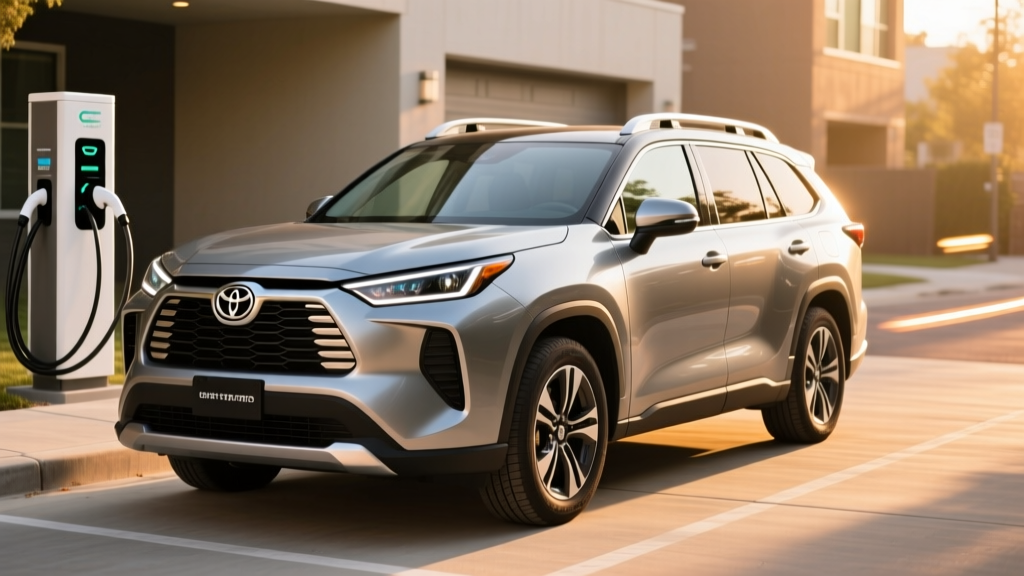
The 2025 Toyota Grand Highlander Hybrid is a three-row, eight-passenger SUV that prioritizes fuel economy without sacrificing cargo space or towing capability. It's not a plug-in hybrid — it never needs to be plugged in — and it doesn't qualify for the federal §30D EV tax credit. But for families who want to cut fuel costs by roughly 40% compared to a gas-only three-row SUV without changing their fueling habits, this is one of the strongest options in the segment.
Available in two distinct powertrains — the efficiency-focused standard Hybrid and the performance-oriented Hybrid MAX — the Grand Highlander Hybrid starts at approximately $41,490 and tops out near $55,000. Below, we break down every number that matters: real MPG, powertrain specs, battery longevity, warranty coverage, and how it stacks up against a PHEV or full EV for your specific driving pattern.
| Specification | Standard Hybrid (XLE/Limited) | Hybrid MAX (Limited/Platinum) |
|---|---|---|
| Powertrain | 2.5L 4-cyl + 2 electric motors (AWD) or 1 motor (FWD) | 2.4L turbo 4-cyl + electric motor |
| Combined Horsepower | 245 hp | 362 hp |
| 0-60 mph | ~7.8 sec | ~6.3 sec |
| EPA City / Hwy / Combined | 37 / 34 / 36 MPG (FWD) · 35 / 33 / 35 MPG (AWD) | 27 / 28 / 27 MPG |
| Drivetrain | FWD or AWD (eAWD) | AWD (standard) |
| Max Towing | 3,500 lbs | 5,000 lbs |
| Fuel Tank | 17.1 gal | 17.1 gal |
| Total Range (est.) | ~615 miles (FWD) | ~462 miles |
| Base MSRP | ~$41,490 (XLE FWD) | ~$53,170 (Limited) |
| Federal Tax Credit | Not eligible (§30D is BEV/PHEV only) | Not eligible |
| Battery Warranty | 10 yr / 150,000 mi | 10 yr / 150,000 mi |
Hybrid vs Plug-In Hybrid: What You Need to Know
One of the most common questions we field from three-row SUV shoppers: is the Grand Highlander Hybrid a plug-in? The answer is no. Toyota offers two distinct hybrid architectures, and the distinction matters for your daily routine and your wallet.
| Factor | HEV (Grand Highlander Hybrid) | PHEV (e.g., Mazda CX-90 PHEV) | BEV (e.g., Kia EV9) |
|---|---|---|---|
| Plugs in? | No — regenerative braking charges the battery | Yes — 120V or 240V | Yes — 120V, 240V, or DC fast |
| Electric-only range | None (motor assists engine) | ~26 miles (varies by model) | 240-370+ miles (EPA) |
| Fuel/energy cost per mile | ~$0.10-$0.12 (at $3.50/gal) | ~$0.04 electric / $0.11 gas | ~$0.04-$0.06 (home charging) |
| Home charging install needed? | No | Recommended (Level 2) | Essential (Level 2) |
| Federal tax credit (§30D) | No | Up to $7,500 (if eligible) | Up to $7,500 (if eligible) |
| Best for | No plug access, long road trips, simplicity | Short commute + plug access + road trips | Home charging, daily driving, lowest running cost |
The Grand Highlander Hybrid operates as a conventional HEV. A small nickel-metal hydride (NiMH) traction battery captures energy from regenerative braking and engine excess to power the electric motor, which assists the gasoline engine during acceleration and at low speeds. You never plug it in, and there is no electric-only driving mode. This makes it ideal for buyers who lack access to a garage or driveway outlet but still want meaningful fuel savings.
Fuel Economy: EPA Ratings and Real-World MPG
According to EPA data on fueleconomy.gov, the 2025 Grand Highlander Hybrid delivers class-leading efficiency for a three-row SUV:
| Powertrain / Drivetrain | City MPG | Highway MPG | Combined MPG | Annual Fuel Cost (est.)* |
|---|---|---|---|---|
| Standard Hybrid FWD | 37 | 34 | 36 | ~$1,550 |
| Standard Hybrid AWD | 35 | 33 | 35 | ~$1,600 |
| Hybrid MAX AWD | 27 | 28 | 27 | ~$2,100 |
*Based on 15,000 mi/yr, $3.50/gal regular unleaded. Your costs will vary.
Real-World MPG: What to Actually Expect
Toyota's hybrid system excels in stop-and-go city driving, where the electric motor handles more of the load. In real-world driving, owners frequently report matching or slightly exceeding the EPA city rating — 37-39 MPG in suburban and urban conditions is common based on aggregated owner data.
Highway driving is where the physics works against you. At sustained 75-80 mph speeds, expect the FWD Hybrid to deliver roughly 30-32 MPG rather than the EPA-rated 34. Cold weather (below 35°F) reduces MPG by approximately 8-12% due to increased engine idling for cabin heat and reduced battery efficiency. If your commute is mostly highway, budget for ~32 MPG combined rather than the sticker's 36.
The Hybrid MAX trades efficiency for power. Its 27 MPG combined rating is honest — expect 25-27 MPG in mixed driving, dropping to 22-24 on extended highway trips at speed. For context, the gas-only Grand Highlander (2.4L turbo, non-hybrid) earns an EPA 24 MPG combined, so even the MAX saves you roughly 12% over the purely combustion version.
Powertrain Deep Dive: Two Very Different Driving Experiences
The standard Hybrid pairs a 2.5-liter naturally aspirated four-cylinder engine with two electric motors (AWD) or one (FWD). Combined output is 245 horsepower. The eAWD system uses a rear-mounted electric motor to send torque to the rear wheels when needed — there is no mechanical driveshaft. This setup is smooth, quiet, and calibrated for efficiency over urgency. Passing on a two-lane highway is adequate but not thrilling; plan your merges accordingly.
The Hybrid MAX is a fundamentally different animal. It combines a 2.4-liter turbocharged four-cylinder with a more powerful electric motor for 362 combined horsepower and 400 lb-ft of torque. A six-speed automatic transmission replaces the standard Hybrid's eCVT, delivering more direct, traditional shift feel. The result: a 0-60 mph time of approximately 6.3 seconds — quick for a 4,900-pound SUV — and a 5,000-pound towing capacity that matches many body-on-frame competitors.
The trade-off is fuel economy (27 vs 36 MPG combined) and a price premium of roughly $11,000-$12,000. If you tow a boat or camper and want hybrid efficiency, the MAX is the only option in this segment that delivers both.
Battery Warranty, Lifespan, and Replacement Cost
Toyota Hybrid Battery Warranty (2025 models): 10 years or 150,000 miles, whichever comes first. This covers the hybrid traction battery against defects and excessive capacity loss. Toyota defines coverage as the battery retaining sufficient capacity for the hybrid system to function as designed.
Toyota's hybrid battery track record is among the best in the industry. The Grand Highlander Hybrid uses a nickel-metal hydride (NiMH) battery pack — a mature, proven chemistry that Toyota has refined over two decades of Prius, Camry Hybrid, and Highlander Hybrid production. Real-world data from earlier Toyota hybrid models shows these batteries routinely lasting 150,000-200,000+ miles with minimal degradation.
NiMH chemistry is less energy-dense than the lithium-ion packs in BEVs and PHEVs, but it is extremely tolerant of the shallow charge-discharge cycles that characterize hybrid operation. The battery in a conventional HEV never fully charges or fully discharges — the system keeps it in a narrow state-of-charge window (roughly 40-80%) to maximize longevity.
If Replacement Is Needed
Should the hybrid battery fail outside warranty, replacement costs for a Toyota hybrid battery pack typically range from $2,000 to $4,000 including labor at a dealership. Third-party reconditioned or refurbished packs are available for $1,000-$2,500. For context, this is dramatically less than a BEV traction battery replacement ($8,000-$20,000+), and the likelihood of needing one within the first 15 years of ownership is low based on historical failure rates.
The 12-volt auxiliary battery (which powers electronics, not the drivetrain) is a separate maintenance item and typically costs $200-$350 to replace every 4-6 years — the same as any conventional vehicle.
Pricing, Trims, and Tax Credit Reality
The 2025 Grand Highlander Hybrid is offered across multiple trims. Pricing is approximate and excludes destination charges (~$1,450):
- XLE FWD: ~$41,490
- XLE AWD: ~$42,490
- Limited AWD (standard Hybrid): ~$47,590
- Nightshade AWD (standard Hybrid): ~$47,590
- Limited (Hybrid MAX): ~$53,170
- Platinum (Hybrid MAX): ~$55,150
Federal Tax Credit: Not Eligible
The Grand Highlander Hybrid does not qualify for the federal §30D Clean Vehicle Credit. Per current IRS rules, the §30D credit applies only to battery electric vehicles (BEVs) and plug-in hybrids (PHEVs) that meet battery capacity, MSRP, buyer income, and critical-mineral/battery-sourcing thresholds. Conventional hybrids (HEVs) that cannot be plugged in are excluded entirely.
Some states offer separate incentives for hybrid purchases, though these are less common and typically smaller than EV credits. Check your state's energy or environmental agency for current programs.
Total Cost of Ownership: Hybrid vs Gas vs EV
Fuel savings are the Grand Highlander Hybrid's strongest financial argument. Here's a simplified 5-year comparison assuming 15,000 miles/year and $3.50/gallon gasoline:
| Vehicle | Combined MPG | Gallons Used | Total Fuel Cost | Savings vs Gas-Only |
|---|---|---|---|---|
| Grand Highlander Gas (2.4T AWD) | 24 | 3,125 | ~$10,940 | — |
| Grand Highlander Hybrid AWD | 35 | 2,143 | ~$7,500 | ~$3,440 |
| Grand Highlander Hybrid MAX | 27 | 2,778 | ~$9,720 | ~$1,220 |
| Kia EV9 (BEV, home charging) | ~88 MPGe | — | ~$3,750 (electric) | ~$7,190 |
The standard Hybrid saves roughly $3,400 over the gas model across five years. That doesn't fully offset the Hybrid's ~$3,500-$4,000 price premium over the equivalent gas trim, but it nearly does — and the gap closes further if gas prices rise. The Hybrid MAX saves about $1,200 but costs roughly $11,000 more than the gas Limited, making its value proposition about performance and towing, not economy.
A comparable BEV like the Kia EV9 saves significantly more on fuel but costs more upfront, requires home charging infrastructure ($500-$2,000 install), and may not fit your road-trip patterns. See the HEV vs PHEV vs BEV comparison table above for a decision framework.
Reliability and Safety
Toyota's hybrid powertrains have consistently earned above-average reliability ratings across Consumer Reports and J.D. Power surveys. The Grand Highlander specifically shares its hybrid architecture with the well-proven Highlander Hybrid and Sienna, both of which have accumulated years of real-world durability data.
The NHTSA and IIHS are the authoritative sources for crash-test ratings. Check both for the latest scores, as the Grand Highlander is a relatively new nameplate and testing timelines vary. Toyota Safety Sense 3.0 is standard across all trims, including pre-collision braking, lane departure alert, adaptive cruise control, and road sign assist.
Who Should Choose the Grand Highlander Hybrid?
Choose the Grand Highlander Hybrid if:
- You need three rows and want the best fuel economy in the segment
- You don't have access to a garage or outlet for plug-in charging
- You take frequent road trips and don't want to plan around charging stops
- You want proven, low-risk hybrid technology with a 10-year battery warranty
- You tow up to 3,500 lbs (standard Hybrid) or 5,000 lbs (Hybrid MAX)
Consider a PHEV (e.g., Mazda CX-90 PHEV, Jeep Grand Cherokee 4xe) if:
- Your daily commute is under 30 miles and you can charge at home
- You want electric-only daily driving with gas-engine backup for road trips
- You may qualify for the $7,500 federal tax credit (income and sourcing rules apply)
Consider a BEV (e.g., Kia EV9, Tesla Model X) if:
- You have reliable home Level 2 charging
- You want the lowest possible per-mile energy cost
- Your road trips are under 300 miles or you're comfortable with DC fast-charging stops
- You want to qualify for federal and state EV incentives
Pros
- Best-in-class 36 MPG combined (FWD) for a true three-row SUV
- No plug-in required — zero lifestyle change from gas
- 10-year / 150,000-mile hybrid battery warranty
- Proven Toyota hybrid reliability with decades of data
- Hybrid MAX offers 362 hp and 5,000-lb towing
- Spacious third row and 97.5 cu ft max cargo volume
Cons
- No federal tax credit eligibility
- Standard Hybrid (245 hp) feels leisurely for highway merging
- Highway MPG drops to ~30-32 at sustained 75+ mph
- Hybrid MAX fuel economy (27 MPG) only modestly better than gas
- No PHEV variant available — can't drive on electric only
- Hybrid premium adds $3,500+ over gas trims
Frequently Asked Questions
How many MPG does the 2025 Toyota Grand Highlander Hybrid get?
The standard Hybrid achieves an EPA-rated 36 MPG combined (37 city / 34 highway) in FWD and 35 MPG combined (35 city / 33 highway) in AWD. The Hybrid MAX earns 27 MPG combined (27 city / 28 highway). In real-world driving, city MPG often matches or slightly exceeds the EPA rating, while sustained highway driving at 75+ mph typically yields 30-32 MPG for the standard Hybrid.
Is the Grand Highlander Hybrid a plug-in?
No. It is a conventional hybrid (HEV), not a plug-in hybrid (PHEV). The battery charges itself through regenerative braking and the gasoline engine. You never need to plug it in, and there is no electric-only driving mode. Toyota currently does not offer a Grand Highlander PHEV variant.
Does the Grand Highlander Hybrid qualify for any tax credit?
No. The federal §30D Clean Vehicle Credit applies only to battery electric vehicles (BEVs) and plug-in hybrids (PHEVs) that meet specific battery sourcing, MSRP cap, and buyer income requirements. Conventional hybrids are not eligible. Some states may offer small hybrid incentives — check your state's energy agency for current programs.
How long will the hybrid battery last and what does replacement cost?
Toyota covers the hybrid battery for 10 years or 150,000 miles. Based on historical data from Toyota's NiMH hybrid batteries (Prius, Camry, Highlander), these packs routinely last 150,000-200,000+ miles. If replacement is needed outside warranty, expect to pay $2,000-$4,000 at a dealership or $1,000-$2,500 for a refurbished unit. This is far less than a BEV battery replacement.
How does the Grand Highlander Hybrid compare to a full EV for a family?
The Hybrid wins on convenience — no charging infrastructure needed, no range planning for road trips, and lower upfront cost. A BEV like the Kia EV9 wins on running cost (~$0.04-$0.06/mile vs ~$0.10-$0.12/mile for the Hybrid), qualifies for the $7,500 federal credit (if eligible), and produces zero tailpipe emissions. If you can install a Level 2 home charger and your road trips are typically under 300 miles, a BEV saves more long-term. If you lack home charging or regularly drive 400+ mile routes, the Hybrid is the more practical choice.
Is the Hybrid MAX worth the price premium?
Only if you need the 5,000-pound towing capacity or value the 362-hp acceleration (6.3 seconds to 60 mph). The standard Hybrid saves significantly more fuel and costs $11,000+ less. For daily family hauling without towing, the standard Hybrid is the rational financial choice.