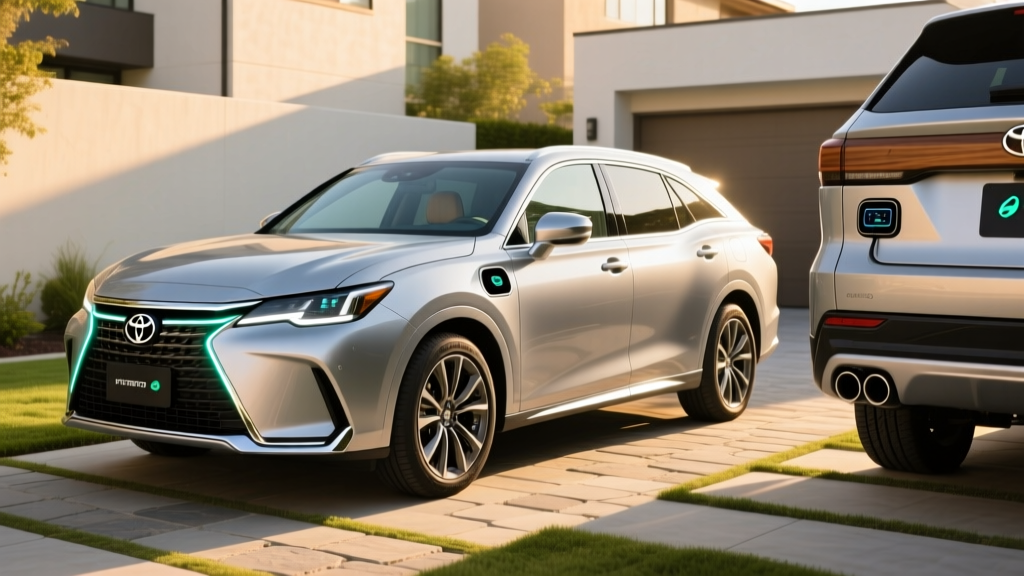
The Toyota Crown Signia occupies a specific niche that's getting crowded: the midsize hybrid-only crossover. For 2026, Toyota continues to position it as a premium wagon-SUV hybrid aimed squarely at buyers leaving the RAV4 or Venza behind who want more refinement without stepping into full EV territory. If you've been searching for the Toyota Crown Signia hybrid SUV, this guide breaks down exactly what you're getting — real MPG, powertrain details, ownership costs, and whether it beats a PHEV or full EV for your commute.
What Is the Toyota Crown Signia? HEV vs PHEV Clarified
The Crown Signia is a conventional hybrid electric vehicle (HEV). It does not plug in. There is no PHEV variant for 2026. This matters because buyers often confuse Toyota's hybrid lineup — here's the distinction:
| Feature | HEV (Crown Signia) | PHEV (e.g., RAV4 Prime) |
|---|---|---|
| Plugs in to charge? | No — charges via regenerative braking and engine | Yes — Level 1/Level 2 charging |
| Electric-only range | None (EV mode limited to ~1 mile at low speed) | Typically 25–42 miles |
| Battery size | ~1.6 kWh (small buffer) | 18–22 kWh usable |
| Federal tax credit (§30D) | Not eligible | Up to $7,500 (subject to sourcing/income rules) |
| Home charging install needed? | No | Yes, recommended for daily EV driving |
The Crown Signia's hybrid system is self-charging. You fill it with gas and drive — the electric motors assist the gasoline engine and recover energy during braking. If you need 30+ miles of pure electric commuting before the engine fires, you'd need to look at a PHEV like the RAV4 Prime or a full EV.
Fuel Economy: EPA MPG and Real-World Expectations
Toyota rates the 2026 Crown Signia with its standard all-wheel-drive hybrid powertrain at the following EPA figures:
| Driving Cycle | EPA MPG |
|---|---|
| City | 39 MPG |
| Highway | 37 MPG |
| Combined | 38 MPG |
Source: fueleconomy.gov
Real-World MPG: What Owners Actually See
Toyota's hybrid synergy drive tends to deliver close to — and sometimes above — EPA city estimates because low-speed stop-and-go driving maximizes regenerative braking and electric motor assist. In mixed suburban commuting, expect 37–41 MPG. On sustained highway trips at 75+ mph, efficiency drops to roughly 33–36 MPG as the gasoline engine carries more load and aerodynamic drag increases.
In cold weather (below 30°F), expect a 5–10% reduction in observed fuel economy as the engine runs longer to heat the cabin and bring the catalytic converter to operating temperature. This is normal hybrid behavior and far less dramatic than the 20–30% range loss a full EV experiences in winter.
Powertrain and Performance Specs
| Specification | 2026 Crown Signia |
|---|---|
| Powertrain type | 2.5L 4-cylinder hybrid (HEV) |
| Combined system horsepower | 240 hp |
| Drivetrain | Electronic AWD (eAWD) with rear electric motor |
| Transmission | eCVT (planetary gearset, no fixed gears) |
| 0–60 mph | ~7.1 seconds |
| Towing capacity | Not rated for towing |
| Hybrid battery type | Lithium-ion, ~1.6 kWh |
| EPA combined fuel economy | 38 MPG |
| Fuel tank capacity | 14.5 gallons |
| Total estimated range | ~550 miles |
| Base MSRP (XLE AWD) | $44,990 |
| Limited AWD MSRP | $49,490 |
The 240-hp combined output comes from the 2.5-liter Atkinson-cycle four-cylinder paired with front and rear electric motors. The rear motor provides electronic AWD — there's no mechanical driveshaft to the rear wheels. This system is proven across Toyota's lineup (Highlander Hybrid, Camry AWD) and prioritizes seamless efficiency over sporty engagement. The eCVT means no shift shock, but it also means the engine drones under hard acceleration. This is a cruiser, not a performance SUV.
Hybrid Battery Warranty and Longevity
Toyota Hybrid Battery Warranty: 10 years / 150,000 miles (whichever comes first), covering capacity below 70% of original. This applies to all 2026 Toyota hybrids including the Crown Signia. The hybrid system components (inverter, electric motors, control module) carry the same 10-year/150,000-mile coverage.
What Does a Hybrid Battery Replacement Cost?
Toyota hybrid battery replacements outside of warranty typically run $3,000–$5,000 for a new OEM pack. However, real-world data from Toyota's hybrid fleet (over 20 million hybrids sold globally) shows that hybrid batteries rarely fail catastrophically. Individual cell modules can be replaced for $500–$1,200 at specialized hybrid shops. The small 1.6 kWh battery in the Crown Signia is under far less stress than a full EV's 75+ kWh pack — it never fully depletes, never charges to true 100%, and operates in a narrow state-of-charge window that maximizes longevity.
For context, Consumer Reports and iSeeCars data consistently rank Toyota hybrids among the lowest long-term maintenance cost vehicles. The hybrid system eliminates the traditional starter motor and alternator (the motor-generators handle both functions), reducing potential failure points.
Pricing, Trims, and Tax Credit Eligibility
The 2026 Crown Signia is available in two trims, both with AWD:
- XLE: $44,990 MSRP — includes 12.3-inch infotainment, heated front seats, power liftgate, Toyota Safety Sense 3.0
- Limited: $49,490 MSRP — adds panoramic fixed glass roof, ventilated front seats, leather-trimmed interior, premium JBL audio, 360-degree camera
Does the Crown Signia Qualify for a Federal Tax Credit?
No. Under current IRS §30D rules, the Clean Vehicle Credit applies only to plug-in electric vehicles (BEVs and PHEVs) with a minimum battery capacity of 7 kWh. The Crown Signia's ~1.6 kWh hybrid battery does not qualify. It is also not eligible for the §25D used EV credit or the §45W commercial credit.
Some states offer their own hybrid incentives, though these have become rare as programs shift toward plug-in vehicles. Check your state's energy office or department of environmental quality for current programs. The Crown Signia's value proposition rests on fuel savings and low maintenance, not tax incentives.
Crown Signia vs PHEV vs Full EV: Which Fits You?
This is the decision that matters most. Here's a practical framework:
Choose the Crown Signia (HEV) if:
- You don't have reliable access to home or workplace charging
- You want zero behavior change — just fill up with gas and drive
- Your daily commute is under 40 miles but you take frequent 300+ mile road trips
- You want AWD traction without EV range-loss concerns in winter
- You plan to keep the vehicle 8+ years and value Toyota's reliability track record
Choose a PHEV (e.g., Toyota RAV4 Prime, Hyundai Tucson PHEV) if:
- You can install a Level 2 home charger and your daily commute is under 35 miles
- You want to drive mostly on electricity Monday–Friday but need gas flexibility for weekend trips
- You want the $7,500 federal tax credit (verify IRS eligibility — income caps, MSRP caps, and battery sourcing rules apply)
Choose a full EV (e.g., Tesla Model Y, Hyundai Ioniq 5) if:
- You have home Level 2 charging and your daily driving is under 250 miles
- You want the lowest per-mile fuel cost (electricity at $0.14/kWh ≈ $0.04/mile vs. gas at $3.50/gal ≈ $0.13/mile for the Signia)
- You want zero tailpipe emissions and qualify for federal + state EV incentives
5-Year Ownership Cost Snapshot
Here's what 5 years / 75,000 miles looks like for the Crown Signia compared to a non-hybrid midsize SUV averaging 25 MPG:
| Cost Factor | Crown Signia (38 MPG) | Gas SUV (25 MPG) |
|---|---|---|
| Fuel cost (75,000 mi at $3.50/gal) | $6,908 | $10,500 |
| Estimated maintenance (5 yr) | $2,800 | $3,600 |
| Insurance (avg 5 yr) | $9,500 | $8,800 |
| Depreciation (est. 5 yr) | $18,000 | $16,500 |
| Total 5-yr operating cost | $37,208 | $39,400 |
The Crown Signia saves roughly $3,500 in fuel over five years but costs slightly more upfront and carries marginally higher insurance premiums. The real savings compound over 8–10 years of ownership as the hybrid system's lower brake wear (regenerative braking extends pad life 2–3x) and elimination of starter/alternator replacements add up.
Pros and Cons
Pros
- 38 MPG combined is excellent for a midsize AWD crossover
- Standard AWD with no fuel economy penalty vs FWD
- Premium interior at a mainstream price point
- 10-year/150,000-mile hybrid battery warranty
- No charging infrastructure needed
- Toyota Safety Sense 3.0 standard on all trims
- Proven hybrid powertrain with 20+ year track record
Cons
- No PHEV or EV variant available
- Not eligible for federal tax credits
- CVT drone under hard acceleration
- No third-row seating
- Only two trim levels — limited customization
- Not rated for towing
- Cargo space trails boxier midsize SUV competitors
Frequently Asked Questions
How many MPG does the Toyota Crown Signia hybrid get?
The EPA rates the 2026 Crown Signia at 39 MPG city, 37 MPG highway, and 38 MPG combined. Real-world city driving often yields 39–41 MPG thanks to regenerative braking, while sustained highway driving at 75+ mph drops to 33–36 MPG.
Does the Crown Signia need to be plugged in?
No. The Crown Signia is a conventional hybrid (HEV). Its small battery charges entirely through regenerative braking and the gasoline engine. You never plug it in.
Is the Toyota Crown Signia hybrid reliable?
Toyota's hybrid powertrain is among the most proven in the industry, with over two decades of real-world deployment across millions of vehicles. The hybrid battery carries a 10-year/150,000-mile warranty. Third-party reliability data from Consumer Reports consistently ranks Toyota hybrids at or near the top for long-term dependability.
What does a Crown Signia hybrid battery replacement cost?
Out of warranty, a full OEM hybrid battery replacement runs approximately $3,000–$5,000. However, individual cell module replacement is available for $500–$1,200 at hybrid specialists. Catastrophic hybrid battery failure is rare in Toyota's system given the narrow state-of-charge operating window.
Does the Crown Signia qualify for any tax credit?
No. The federal §30D Clean Vehicle Credit requires a minimum 7 kWh battery and plug-in capability. The Crown Signia's ~1.6 kWh self-charging hybrid system does not qualify. Check your state's energy office for any local hybrid incentives, though most have shifted to plug-in vehicles.
How does the Crown Signia compare to the RAV4 Hybrid?
The RAV4 Hybrid offers similar fuel economy (39 MPG combined) at a lower starting price (~$34,000) but with a less premium interior, more road noise, and a more utilitarian design. The Crown Signia trades cargo versatility and affordability for a quieter cabin, more refined ride, and wagon-like styling.
Is the Crown Signia good in snow?
Yes. The electronic AWD system engages the rear electric motor automatically when front-wheel slip is detected. Combined with Toyota Safety Sense 3.0 (which includes traction and stability control), the Crown Signia performs competently in snow. Winter fuel economy drops roughly 5–10%, which is far less than the 20–30% range loss a battery EV experiences in cold weather.