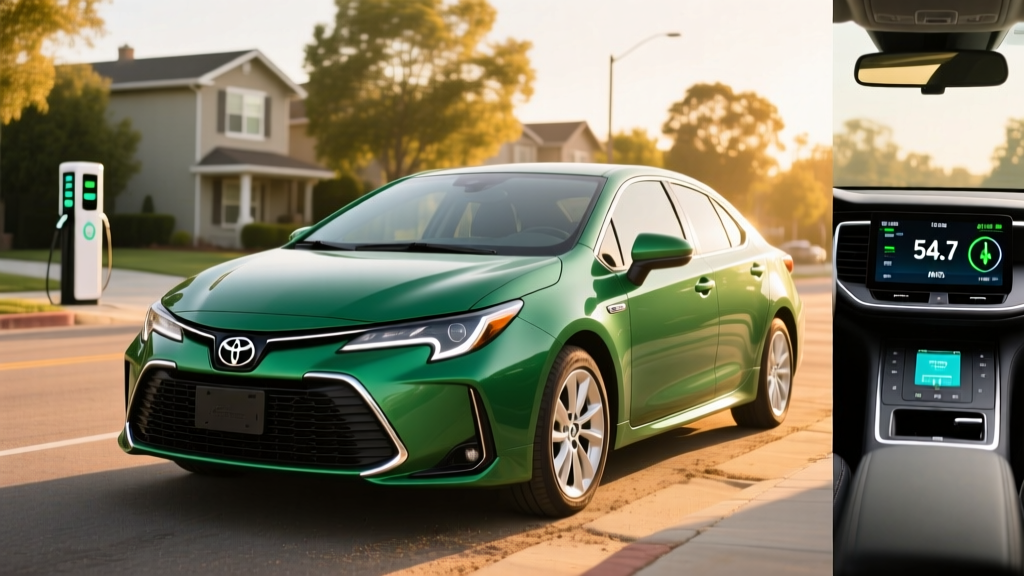
The Toyota Corolla SE Hybrid occupies a specific niche in 2026's electrified-vehicle landscape: it's a sport-tuned conventional hybrid (HEV) that delivers crossover buyers a sub-$26,000 entry point into 50 MPG territory without ever needing to plug in. For shoppers cross-shopping between a gas-only Corolla, a plug-in hybrid like the Prius Prime, and full battery-electric vehicles, the SE Hybrid trim warrants a precise look at what you actually get for the money — and where its limits lie.
This guide breaks down the 2026 Corolla SE Hybrid's powertrain, real-world fuel economy versus EPA estimates, battery longevity data, and how it fits into the broader HEV vs. PHEV vs. EV decision.
2026 Toyota Corolla SE Hybrid: Powertrain & Core Specs
The Corolla SE Hybrid pairs Toyota's fifth-generation hybrid system with a sport-oriented suspension tune, paddle shifters, and a 1.8-liter Atkinson-cycle four-cylinder engine. Unlike the LE Hybrid (which is FWD-only), the SE Hybrid comes standard with Electronic On-Demand All-Wheel Drive, adding a rear-mounted electric motor for traction in rain and light snow.
| Spec | Value |
|---|---|
| Engine | 1.8L 4-cyl Atkinson-cycle + 2 electric motors (front) + 1 rear motor (AWD) |
| Combined Net Horsepower | 138 hp |
| Transmission | Electronically controlled CVT (eCVT) |
| Drivetrain | Electronic On-Demand AWD (standard on SE Hybrid) |
| Hybrid Battery | ~1.3 kWh lithium-ion (self-charging, no plug) |
| EPA Fuel Economy | 50 city / 43 highway / 47 combined MPG |
| Fuel Tank Capacity | 11.4 gallons |
| Total Driving Range | ~535 miles (EPA est.) |
| 0–60 mph | ~9.2 seconds (est.) |
| Base MSRP (SE Hybrid) | $25,950 + $1,095 destination |
| Federal Tax Credit | Not eligible (§30D requires plug-in capability) |
A critical distinction: the Corolla SE Hybrid is a conventional hybrid (HEV), not a plug-in hybrid. Its small ~1.3 kWh battery recharges exclusively through regenerative braking and the gasoline engine. You never plug it in. This means no electric-only driving range to speak of — the electric motors assist the engine and enable brief low-speed EV-mode crawling, but the gas engine is always the primary energy source.
EPA MPG vs. Real-World Fuel Economy
Toyota's EPA-rated 47 MPG combined is the headline number, but hybrid fuel economy behaves differently than most buyers expect — particularly in how city and highway figures invert compared to gas-only cars.
| Driving Condition | EPA Estimate | Real-World Expectation |
|---|---|---|
| City | 50 MPG | 48–53 MPG (hybrids excel here; regen braking recovers energy) |
| Highway | 43 MPG | 40–45 MPG (aerodynamic drag dominates; less regen opportunity) |
| Combined | 47 MPG | 44–50 MPG depending on driving mix |
| Cold Weather (below 32°F) | N/A | 38–43 MPG (engine runs more for cabin heat, battery less efficient) |
Why does city MPG beat highway? In stop-and-go driving, regenerative braking captures kinetic energy that a gas car wastes as brake heat, and the electric motor handles low-speed acceleration where gas engines are least efficient. On sustained highway runs above 65 mph, the Corolla SE Hybrid operates predominantly on its gasoline engine, and aerodynamic drag erodes efficiency just as it does in any vehicle.
In real-world driving, owners with heavy city commutes and moderate highway use routinely report 48–52 MPG on forums and fuel-tracking apps. Drivers whose routes are 80%+ highway should budget for 42–45 MPG. Cold climates introduce a meaningful penalty: below freezing, the engine must run more frequently to generate cabin heat (since there's no large battery to power a heat pump as in a full EV), dropping observed economy into the high 30s to low 40s.
HEV vs. PHEV vs. EV: Which Corolla Electrified Option Fits?
Toyota offers the Corolla exclusively as a conventional hybrid in the US market — there is no Corolla PHEV. However, shoppers cross-shopping electrified compacts need to understand the landscape:
| Vehicle | Type | Combined MPG / MPGe | Electric-Only Range | Plug Required? | Starting MSRP |
|---|---|---|---|---|---|
| Toyota Corolla SE Hybrid | HEV | 47 MPG | None (EV-mode assist only) | No | $25,950 |
| Toyota Prius Prime | PHEV | 52 MPG / 127 MPGe | ~44 miles | Yes (Level 1/2) | $33,450 |
| Hyundai Elantra Hybrid | HEV | 54 MPG | None | No | $26,500 |
| Chevrolet Bolt EV | BEV | 120 MPGe | ~259 miles | Yes (Level 1/2/DC) | $28,900 |
Choose the Corolla SE Hybrid if: You want maximum fuel efficiency with zero lifestyle change — no charging setup, no plug-in routine, no range planning. You drive 12,000–15,000 miles/year in mixed city/highway conditions and want AWD for weather without paying an SUV premium.
Consider a PHEV (like the Prius Prime) if: You have reliable home charging (Level 2 preferred), your daily commute is under 40 miles round-trip, and you want to drive mostly on electricity during the week while retaining gas-engine flexibility for road trips. PHEVs qualify for the federal §30D tax credit (up to $3,750–$7,500 depending on battery sourcing and your income) — which the Corolla HEV does not.
Go full BEV if: You have home charging access, your daily driving is predictable, you want to eliminate gasoline entirely, and you're prepared for higher upfront cost offset by lower fuel and maintenance expenses over time.
Pricing, Tax Credits, and Total Cost of Ownership
The 2026 Corolla SE Hybrid starts at $25,950 MSRP plus $1,095 destination, putting it at approximately $27,045 before dealer fees, taxes, or options. Adding packages (like the SE Premium package with moonroof and upgraded infotainment) can push the out-the-door price toward $29,000–$30,500.
Federal Tax Credit: Not Eligible
Because the Corolla SE Hybrid is a conventional HEV that cannot be plugged in, it does not qualify for the IRS §30D Clean Vehicle Credit. That credit — which offers up to $7,500 for qualifying new plug-in vehicles — applies only to PHEVs and BEVs that meet battery-component and critical-mineral sourcing requirements, MSRP caps ($55,000 for sedans), and buyer income limits. See IRS §30D guidance for current rules.
Some states offer their own rebates for conventional hybrids, but these vary by jurisdiction and change frequently. Check your state's energy or environmental agency for current programs.
5-Year Cost Snapshot
Despite the lack of a federal credit, the Corolla SE Hybrid's low fuel cost creates meaningful savings versus a gas-only compact:
- Annual fuel cost (15,000 mi/yr at $3.40/gal, 47 MPG): ~$1,085
- Gas-only Corolla SE (34 MPG combined): ~$1,500/year
- Annual fuel savings: ~$415/year, or ~$2,075 over 5 years
- Maintenance: Hybrids typically cost slightly less to maintain than gas cars (regenerative braking reduces brake-pad wear; no conventional starter motor; fewer belt-driven accessories). Toyota's hybrid system has no timing belt — it uses a timing chain.
- Insurance: Comparable to the gas Corolla SE; no significant hybrid premium in most markets.
Battery Warranty, Lifespan, and Replacement Cost
Hybrid battery longevity remains the top concern for first-time hybrid buyers, and this is where Toyota's track record provides substantial reassurance.
Toyota Hybrid Battery Warranty
Toyota covers the 2026 Corolla SE Hybrid's battery with a 10-year / 150,000-mile warranty (whichever comes first). This applies in all 50 states. The warranty guarantees the battery against defects and excessive capacity loss. Toyota's hybrid battery warranty has been 10/150k since the 2020 model year — prior to that, it was 8 years/100,000 miles in most states and 10/150k only in CARB states.
Beyond warranty, real-world data from millions of Toyota hybrids on the road (the Prius has been sold in the US since 2000) shows that modern Toyota hybrid batteries routinely last 150,000–200,000+ miles before requiring replacement. Failures before 100,000 miles are uncommon in third-generation and later systems.
If replacement is eventually needed out of warranty:
- New OEM replacement battery: $2,000–$3,500 (parts + labor at a Toyota dealer)
- Refurbished/reconditioned battery: $1,000–$2,000 from independent hybrid specialists
- Individual module replacement: Some shops can replace only the degraded cell modules within the pack for $500–$1,200
The Corolla SE Hybrid's relatively small ~1.3 kWh battery pack is far less expensive to replace than a full EV's 60–80 kWh pack (which can cost $8,000–$18,000). This is a key ownership-cost advantage of conventional hybrids.
Reliability & Safety Ratings
Toyota's hybrid powertrain is among the most proven in the automotive industry. The Corolla Hybrid shares its core hybrid architecture with the Prius, which has accumulated billions of real-world miles globally. NHTSA crash-test ratings for the Corolla platform historically rate well, and the Corolla comes standard with Toyota Safety Sense 3.0 (TSS 3.0), which includes:
- Pre-Collision System with Pedestrian Detection
- Full-Speed Range Dynamic Radar Cruise Control
- Lane Departure Alert with Steering Assist
- Lane Tracing Assist
- Automatic High Beams
- Road Sign Assist
Important SAE-level note: Toyota Safety Sense is a Level 1–2 driver-assistance system. It does not drive the car autonomously. You must keep your hands on the wheel and your attention on the road at all times. Lane Tracing Assist provides steering centering support, not autonomous lane changes or navigation-based driving.
SE Hybrid Trim: What the Sport Tuning Actually Gets You
The "SE" designation on the Corolla Hybrid isn't merely an appearance package. Compared to the LE Hybrid, the SE Hybrid includes:
- Sport-tuned suspension: Firmer damping and revised spring rates for sharper turn-in. The ride is noticeably firmer than the LE — a trade-off buyers should test-drive on rough roads.
- 18-inch graphite-colored alloy wheels: Styled for the SE, wrapped in all-season tires. The larger wheel diameter slightly reduces ride comfort compared to the LE's 16-inch wheels but improves steering response.
- Paddle shifters: Simulated 6-speed manual shift feel via the eCVT. This doesn't change actual gear ratios (an eCVT has no fixed gears) but provides a more engaging driving feel.
- Electronic On-Demand AWD: Standard on SE Hybrid, adding a rear electric motor that engages during acceleration and low-traction conditions.
- Sport driving mode: Adjusts throttle response and steering weight.
- Exterior: Color-keyed rear spoiler, sport mesh grille, LED accent lighting.
The performance envelope remains modest — 138 combined horsepower yields a 0–60 mph time around 9.2 seconds. This is adequate for highway merging and city driving but won't satisfy anyone looking for a genuinely quick compact. The SE Hybrid's sport character is about handling engagement and driver involvement, not straight-line speed.
Pros
- 47 MPG combined EPA — real-world city driving often exceeds 50 MPG
- Standard AWD at a sub-$27K starting price
- 10-year / 150,000-mile hybrid battery warranty
- No plug-in required — zero lifestyle adjustment
- Sport-tuned suspension and paddle shifters add engagement
- Proven Toyota hybrid reliability with low maintenance costs
- TSS 3.0 safety suite standard across all trims
Cons
- No federal tax credit (HEV, not PHEV or BEV)
- ~9.2-second 0–60 — modest acceleration
- Small rear seat and trunk compared to compact SUVs
- Firmer ride from sport suspension may not suit all buyers
- Highway MPG drops to 43 (city-biased efficiency)
- Cold-weather MPG penalty more noticeable than in gas-only cars
- No DC fast charging or meaningful electric-only range
Frequently Asked Questions
How many MPG does the Toyota Corolla SE Hybrid get?
The 2026 Corolla SE Hybrid is EPA-rated at 50 city / 43 highway / 47 combined MPG. In real-world driving, city-heavy commuters often see 48–53 MPG thanks to regenerative braking, while highway-dominant drivers should expect 40–45 MPG. Cold weather (below freezing) can reduce economy to the high 30s or low 40s.
Does the Corolla SE Hybrid need to be plugged in?
No. The Corolla SE Hybrid is a conventional hybrid (HEV). Its small lithium-ion battery charges entirely through regenerative braking and the gasoline engine. There is no plug, no charging cable, and no electric-only driving range. You simply fill it with gasoline like any other car.
How far can the Corolla SE Hybrid go on electric only?
Effectively zero miles. The hybrid system can operate in EV mode at very low speeds (parking lots, brief stop-and-go) for short distances under a mile, but the gas engine is always the primary power source. If electric-only driving is a priority, look at a PHEV like the Toyota Prius Prime (~44 miles electric-only) or a full BEV.
Is the Toyota Corolla Hybrid reliable, and what does battery replacement cost?
Toyota's hybrid system is one of the most proven powertrains in the industry, with over two decades of real-world data from millions of vehicles. The hybrid battery is warranted for 10 years / 150,000 miles. Real-world battery lifespan typically reaches 150,000–200,000+ miles. If replacement is needed out of warranty, expect $2,000–$3,500 for a new OEM battery or $1,000–$2,000 for a refurbished unit.
Does the Corolla SE Hybrid qualify for any tax credit?
No federal tax credit. The IRS §30D Clean Vehicle Credit requires plug-in capability (PHEV or BEV), so conventional hybrids like the Corolla SE Hybrid are ineligible. Some states offer separate hybrid incentives, but these vary widely. Check your state's energy office or consult a tax professional for current local programs. See IRS guidance on clean vehicle credits.
Hybrid vs. PHEV vs. full EV — which should I choose?
Choose the Corolla SE Hybrid (HEV) if you want fuel savings with zero charging infrastructure — ideal for apartment dwellers, frequent road-trippers, or anyone who doesn't want to change their fueling routine. Choose a PHEV if you have home charging and a short commute (under 40 miles) and want to drive mostly on electricity while keeping gas flexibility. Choose a full BEV if you have reliable charging access, want to eliminate gas entirely, and are ready for a higher upfront cost offset by long-term fuel and maintenance savings.
How does the SE Hybrid compare to the Corolla LE Hybrid?
Both share the same 138 hp hybrid powertrain and similar EPA fuel economy. The SE Hybrid adds sport-tuned suspension, 18-inch wheels, paddle shifters, a rear spoiler, and standard AWD (the LE Hybrid is FWD-only). The trade-off is a slightly firmer ride and a ~$1,500 price premium over the LE Hybrid. Fuel economy is nearly identical between the two trims.
Sources: EPA Fuel Economy (fueleconomy.gov), Toyota Corolla Hybrid Official Specs, IRS §30D Clean Vehicle Credit. All specs reflect 2026 model year data available at time of publication. Tax credit rules are subject to change; consult a tax professional for eligibility.