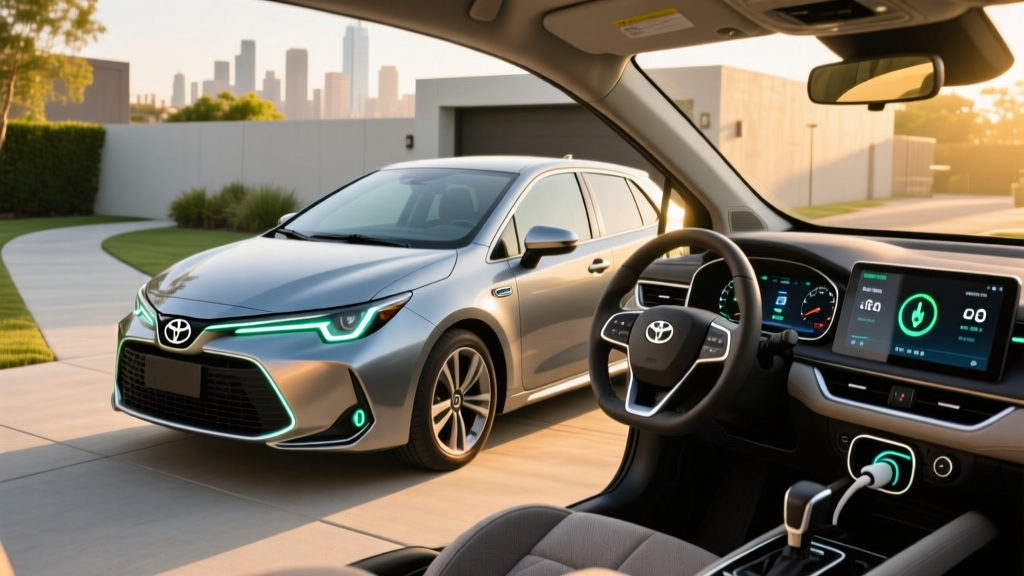
If you want hybrid efficiency without committing to a plug-in lifestyle or paying an EV premium, the Toyota Corolla Hatchback Hybrid occupies a compelling middle ground. For 2026, Toyota continues to offer its fifth-generation hybrid system in the compact hatchback, delivering an EPA-estimated 50 MPG combined with no charging cords, no range anxiety, and a starting MSRP that undercuts most competitors. But how does that sticker MPG translate to real-world driving, and does the math still work against full EVs and plug-in hybrids?
We break down every number that matters — fuel economy, powertrain output, battery warranty, ownership cost, and tax credit eligibility — so you can decide whether the Corolla Hatchback Hybrid is the right electrified vehicle for your commute, budget, and charging access.
Fuel Economy: EPA Numbers vs. Real-World MPG
The headline figure for the 2026 Toyota Corolla Hatchback Hybrid is its EPA-rated fuel economy, which remains one of the best in the compact hatchback segment. Here is the official breakdown from fueleconomy.gov:
| Metric | SE Hybrid (FWD) | XSE Hybrid (FWD) |
|---|---|---|
| City MPG | 53 | 50 |
| Highway MPG | 46 | 44 |
| Combined MPG | 50 | 47 |
| Annual Fuel Cost* | ~$1,050 | ~$1,150 |
| Gallons per 15,000 mi | ~300 | ~319 |
*Based on 15,000 miles/year at $3.50/gallon regular unleaded. Actual costs vary by region and driving habits.
Hybrid vs. Plug-In Hybrid: What the Corolla Hatchback Actually Is
Before going further, it is critical to understand what you are — and are not — getting. The 2026 Corolla Hatchback Hybrid is a conventional hybrid electric vehicle (HEV), not a plug-in hybrid (PHEV). This distinction affects everything from daily driving to tax credit eligibility.
HEV (This Car)
- No plug — charges itself via regenerative braking and engine power
- Small battery (~1.3 kWh) — electric-only driving limited to low-speed, short bursts
- Cannot drive on electricity alone at highway speeds
- No federal tax credit under §30D
- Lower purchase price; no charging infrastructure needed
PHEV (e.g., Prius Prime)
- Plug-in capable — larger battery (~13.6 kWh) charges from a wall outlet or public charger
- 25–44 miles of electric-only range before the gas engine engages
- Can operate as a full EV for short commutes
- May qualify for up to $7,500 federal tax credit (subject to §30D rules)
- Higher purchase price; benefits most from home charging access
The Corolla Hatchback Hybrid does not have a plug. You fuel it like any gas car, and the hybrid system manages energy recovery automatically. If you want electric-only commuting, you would need to look at the Toyota Prius Prime (PHEV) or a full battery-electric vehicle (BEV).
Powertrain and Performance Specs
Toyota's fifth-generation hybrid powertrain pairs a 1.8-liter four-cylinder Atkinson-cycle engine with two motor-generators and a lithium-ion hybrid battery. The result is smooth, adequate acceleration with exceptional efficiency.
| Specification | Detail |
|---|---|
| Engine | 1.8L 4-cylinder Atkinson-cycle |
| Engine Horsepower | 96 hp @ 5,200 rpm |
| Electric Motor Output | 83 hp / 105 lb-ft torque |
| Net Combined System Horsepower | 138 hp |
| Transmission | Electronically controlled CVT (eCVT) |
| Drivetrain | Front-wheel drive (FWD) |
| Hybrid Battery Type | Lithium-ion |
| Hybrid Battery Capacity | ~1.3 kWh (not plug-in) |
| 0–60 MPH (est.) | ~9.2 seconds |
| Fuel Tank Capacity | 11.4 gallons |
| Total Driving Range (est.) | ~570 miles (combined) |
| Cargo Volume (rear seats up) | 17.8 cu ft |
| Cargo Volume (rear seats folded) | ~47 cu ft |
The 138 net horsepower is a meaningful step up from earlier-generation Corolla hybrids, which felt underpowered on highway merges. The 2026 model handles freeway on-ramps competently, though it is not a sporty car by any measure. The eCVT operates smoothly without the rubber-band sensation that older CVTs produced, and the transition between electric and gasoline power is nearly imperceptible in normal driving.
One limitation worth noting: Toyota does not offer all-wheel drive on the Corolla Hatchback Hybrid. If AWD is a priority, the Prius AWD-e or Corolla Cross Hybrid (which uses a rear electric motor for AWD) are alternatives in the Toyota lineup.
Pricing, Trims, and Tax Credit Eligibility
The 2026 Corolla Hatchback Hybrid is available in SE and XSE trims. Pricing is competitive against other compact hybrids and significantly lower than comparable EVs.
| Trim | MSRP (incl. destination) | Key Features |
|---|---|---|
| SE Hybrid | $24,995 | 16" alloy wheels, 8" touchscreen, wireless Apple CarPlay/Android Auto, Toyota Safety Sense 3.0 |
| XSE Hybrid | $27,495 | 18" alloy wheels, SofTex seats, heated front seats, 7" digital cluster, ambient lighting |
Even without a tax credit, the Corolla Hatchback Hybrid's low MSRP and strong fuel economy produce a compelling total cost of ownership. At 50 MPG combined and $3.50/gallon gas, you would spend roughly $1,050/year on fuel — compared to approximately $1,875/year for a 28 MPG combined gas-only compact hatchback. That is roughly $825 in annual fuel savings, or about $4,125 over five years, which offsets much of the hybrid's price premium over a non-hybrid equivalent.
Battery Warranty, Lifespan, and Replacement Cost
Hybrid battery longevity is the single most common concern among first-time hybrid buyers. Toyota has refined its hybrid battery technology over 25+ years (since the original 1997 Prius), and the data on long-term durability is reassuring.
- Hybrid Battery: 10 years / 150,000 miles (whichever comes first), transferable to subsequent owners
- Hybrid System Components: 8 years / 100,000 miles (inverters, control modules, motor-generators)
- Basic New Vehicle: 3 years / 36,000 miles
- Powertrain: 5 years / 60,000 miles
Coverage applies to defects and capacity loss that impairs vehicle operation. Toyota covers the full battery assembly under warranty, not just individual cells.
Real-world lifespan: Based on fleet data and owner reports across multiple Toyota hybrid generations, most lithium-ion hybrid batteries last 150,000–200,000+ miles before significant degradation. Because the Corolla Hatchback Hybrid's battery is small (~1.3 kWh) and the hybrid system never fully charges or fully depletes it (operating roughly between 40% and 80% state of charge), the battery experiences relatively gentle cycling stress compared to a full EV battery.
Replacement cost if out of warranty: A new OEM Toyota hybrid battery assembly for the Corolla Hybrid typically runs $2,500–$4,000 including parts and labor at a dealership. Third-party refurbished or reconditioned batteries are available for $1,500–$2,500. Individual cell replacement (if only a few cells fail) can cost $500–$1,500 at specialized hybrid repair shops. For context, this is dramatically less than EV battery replacement ($8,000–$20,000+), and most Corolla Hybrid owners will sell the vehicle before the battery requires replacement.
Toyota Safety Sense 3.0 and Driver Assistance
Every 2026 Corolla Hatchback Hybrid comes standard with Toyota Safety Sense 3.0 (TSS 3.0), which includes:
- Pre-Collision System with Pedestrian Detection
- Full-Speed Range Dynamic Radar Cruise Control
- Lane Departure Alert with Steering Assist
- Lane Tracing Assist
- Automatic High Beams
- Road Sign Assist
- Proactive Driving Assist (gentle braking/steering support in certain scenarios)
The system performs well in its class, with smooth lane-centering and adaptive cruise control that avoids the abrupt braking common in some competitors. It is not as feature-rich as Toyota's higher-tier Traffic Jam Assist (available on some models), but for highway commuting and long road trips, TSS 3.0 reduces fatigue meaningfully.
Who Should Buy the Corolla Hatchback Hybrid (and Who Shouldn't)
Choose the Corolla Hatchback Hybrid if:
- You want maximum MPG without plugging in or changing your fueling habits
- You lack access to home or workplace charging (apartment, street parking, no garage outlet)
- Your commute involves heavy stop-and-go city traffic where hybrids shine
- You want a low purchase price (~$25K) and low annual fuel cost (~$1,050/year)
- You plan to keep the car 8–10+ years and want Toyota's long-term reliability track record
- You drive 12,000–15,000+ miles per year (higher mileage = faster payback on the hybrid premium)
Look elsewhere (EV or PHEV) if:
- You have home charging and want to eliminate gas entirely for daily commuting → consider a BEV (Chevrolet Equinox EV, Hyundai Ioniq 5, Tesla Model 3)
- You want 25–44 miles of electric-only range for short commutes but gas flexibility for road trips → consider the Toyota Prius Prime (PHEV)
- You need AWD for snow-belt climates → consider the Corolla Cross Hybrid or Prius AWD-e
- You want sporty driving dynamics → the Corolla Hybrid prioritizes efficiency over performance
Pros
- 50 MPG combined EPA — among the best in any compact car
- No plug required — zero lifestyle change from a gas car
- Low starting MSRP ($24,995) for a hybrid hatchback
- 10-year/150,000-mile hybrid battery warranty
- Strong cargo utility (17.8 cu ft) for the class
- TSS 3.0 standard on all trims
- Proven Toyota hybrid reliability
Cons
- No federal tax credit (HEV, not PHEV/BEV)
- No AWD option
- 9.2-second 0–60 time — adequate but not quick
- Highway MPG drops at sustained 75+ MPH speeds
- Rear seat legroom is tight for taller passengers
- No DC fast charging capability (not applicable — no plug)
- XSE trim's 18" wheels slightly reduce fuel economy
Corolla Hatchback Hybrid vs. Alternatives: Quick Comparison
| Vehicle | Type | EPA Combined MPG | EV-Only Range | Starting MSRP | Federal Tax Credit |
|---|---|---|---|---|---|
| Toyota Corolla Hatchback Hybrid | HEV | 50 | N/A | $24,995 | None |
| Toyota Prius (HEV) | HEV | 57 | N/A | $28,545 | None |
| Toyota Prius Prime | PHEV | 52 (gas) / 127 MPGe | 44 mi | $33,445 | Up to $7,500* |
| Hyundai Elantra Hybrid | HEV | 54 | N/A | $26,250 | None |
*Prius Prime eligibility for the §30D credit depends on buyer income, battery critical-mineral sourcing, and MSRP caps. Verify current eligibility at fueleconomy.gov.
The Corolla Hatchback Hybrid trades the Prius's slightly higher MPG and more modern interior for a lower price, a more conventional hatchback design, and a more engaging (if modest) driving feel. The Prius Prime offers electric-only commuting but costs nearly $9,000 more before any tax credit.
Frequently Asked Questions
How many MPG does the Toyota Corolla Hatchback Hybrid get?
The EPA rates the 2026 Corolla Hatchback Hybrid SE at 53 city / 46 highway / 50 combined MPG. The XSE trim is rated slightly lower at 50/44/47 due to larger 18-inch wheels and tires. In real-world city driving, many owners report matching or exceeding the EPA city figure, while sustained highway driving at high speeds typically yields 40–46 MPG combined.
Does the Corolla Hatchback Hybrid need to be plugged in?
No. The Corolla Hatchback Hybrid is a conventional HEV. It charges its small lithium-ion battery through regenerative braking and the gasoline engine. You fuel it exclusively at a gas station, just like a non-hybrid car. There is no plug, no charging port, and no electric-only driving mode at highway speeds.
How far can it go on electric only?
Not far, and not at meaningful speeds. The hybrid system can propel the car on electric power alone at very low speeds (typically under 25 MPH) for roughly 1 mile or less, such as creeping through a parking lot or in heavy traffic. This is not a plug-in hybrid — it cannot sustain electric-only driving for a commute. If you need 25–44 miles of electric-only range, consider the Toyota Prius Prime PHEV.
Is the hybrid battery reliable, and what does replacement cost?
Toyota's hybrid batteries have an excellent longevity record spanning 25+ years of production. The 2026 Corolla Hatchback Hybrid battery is covered by a 10-year / 150,000-mile warranty. Real-world data suggests most Toyota hybrid batteries last 150,000–200,000+ miles. If replacement is needed out of warranty, expect $2,500–$4,000 for a new OEM battery, or $1,500–$2,500 for a refurbished unit.
Does the Corolla Hatchback Hybrid qualify for any tax credit?
No federal tax credit applies to conventional hybrids under the current IRS §30D rules, which are limited to plug-in electric vehicles (BEVs and PHEVs) meeting battery-sourcing and MSRP requirements. Some states and local utilities offer small rebates for hybrid purchases — check your state energy office. The lack of a federal credit is offset by the Corolla Hybrid's low $24,995 starting price and ~$825/year fuel savings versus a comparable gas-only hatchback.
Hybrid vs. PHEV vs. EV — which should I choose?
HEV (Corolla Hatchback Hybrid): Best if you have no home charging, want zero lifestyle change, drive high miles, and want the lowest purchase price. You get 50 MPG with no plug.
PHEV (Prius Prime): Best if you have home charging, a short commute (under 40 miles), and want to drive mostly on electricity day-to-day while keeping gas flexibility for road trips. Higher upfront cost, but potential $7,500 tax credit and near-zero gas use on daily drives.
BEV (e.g., Chevrolet Equinox EV): Best if you have reliable home charging, want zero tailpipe emissions, and your daily driving plus typical road trips fall within 250–350 miles of range. Lowest "fuel" cost per mile (electricity), lowest maintenance, but highest purchase price and dependence on charging infrastructure.
Is the Corolla Hatchback Hybrid available with AWD?
No. The 2026 Corolla Hatchback Hybrid is front-wheel drive only. If all-wheel drive is essential, look at the Toyota Corolla Cross Hybrid (compact SUV, AWD-i, ~42 MPG combined) or the Prius AWD-e (50 MPG combined, available on select trims).
The 2026 Toyota Corolla Hatchback Hybrid is not flashy, and it will not appear in any "most exciting EV" roundups. But as a practical, data-driven purchase for someone who wants to cut fuel costs by roughly 45% without changing their daily routine, it remains one of the most rational electrified vehicles on the market. At $24,995, 50 MPG, and a 10-year battery warranty, the math speaks for itself.