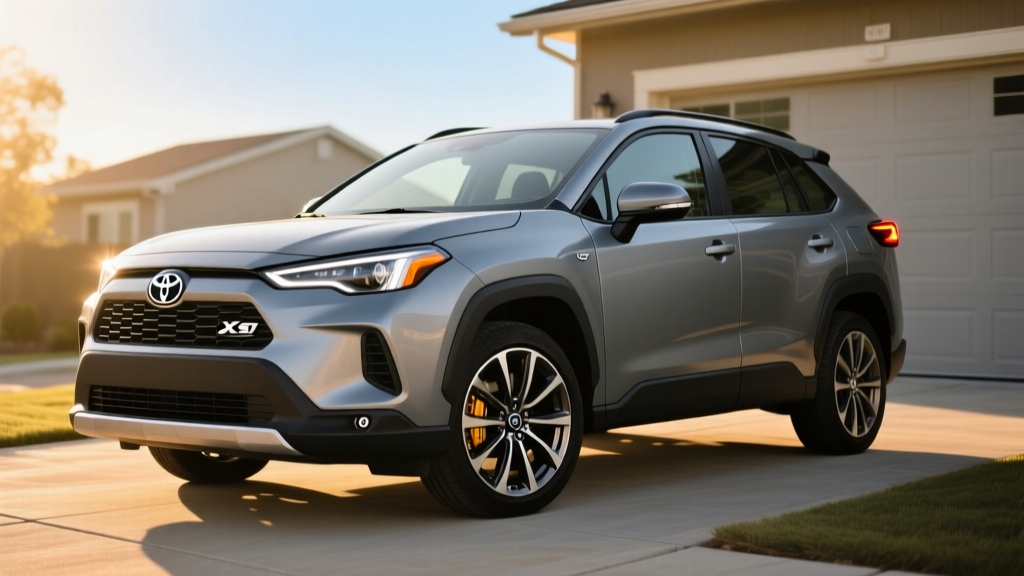
The compact crossover segment is crowded, but the Toyota Corolla Cross Hybrid XSE occupies a specific niche: all-wheel drive, strong city fuel economy, and Toyota's proven hybrid reliability — all without ever plugging in. For 2026, the XSE trim adds sport-tuned styling and upgraded interior tech to a powertrain that sips fuel in stop-and-go traffic while delivering confident acceleration when merging.
This guide breaks down every number that matters — EPA MPG, real-world fuel economy, powertrain specs, battery warranty, and whether this hybrid qualifies for federal tax credits — so you can decide if the Corolla Cross Hybrid XSE fits your commute, budget, and lifestyle.
HEV vs PHEV: What the Corolla Cross Hybrid Actually Is
Before examining the specs, it's essential to clarify what you're buying. The Corolla Cross Hybrid is a conventional hybrid electric vehicle (HEV). It does not have a plug. It charges its small battery through regenerative braking and the gasoline engine. You fuel it at a gas station exactly like a conventional car.
| Feature | HEV (Corolla Cross Hybrid) | PHEV (e.g., Toyota RAV4 Prime) | BEV (e.g., Tesla Model Y) |
|---|---|---|---|
| Plug-in charging | No — gas only | Yes — Level 1/2 AC | Yes — Level 1/2/DC fast |
| Electric-only range | ~1 mile at low speed | 35-42 miles typical | 250-330 miles typical |
| Battery size | ~1.3 kWh (buffer) | ~18 kWh usable | 60-82 kWh usable |
| Fueling | Gas station | Gas station + outlet/charger | Charger only |
| Federal tax credit (§30D) | Not eligible | Up to $7,500 (if eligible) | Up to $7,500 (if eligible) |
| Best for | No home charging access | Short commute + road trips | Home charging + daily driving |
Toyota does not currently offer a Corolla Cross plug-in hybrid. If you want electric-only commuting with a gas backup, the RAV4 Prime (PHEV) is the closest Toyota alternative, though it costs significantly more and sits in a larger vehicle class.
Fuel Economy: EPA Ratings and Real-World MPG
The 2026 Corolla Cross Hybrid comes exclusively with electronic all-wheel drive (AWD), which slightly reduces efficiency compared to a hypothetical FWD-only configuration but provides traction benefits in rain and snow. Here are the official EPA figures:
| Driving Cycle | EPA Rating (MPG) | Real-World Expectation |
|---|---|---|
| City | 45 MPG | 46-50 MPG (hybrids excel in stop-and-go) |
| Highway | 38 MPG | 35-38 MPG (aero drag hurts at 70+ mph) |
| Combined | 42 MPG | 40-44 MPG depending on driving mix |
Toyota's hybrid system uses the electric motor heavily at low speeds, where gasoline engines are least efficient. This is why the city MPG exceeds the highway rating — the opposite of most gas-only vehicles. In real-world driving, owners who do mostly urban and suburban commuting frequently report 44-48 MPG on forums and fuel-tracking apps. Highway-heavy road trippers should expect numbers closer to 36-38 MPG, especially at speeds above 70 mph or in mountainous terrain.
With a 10.6-gallon fuel tank, total range sits around 445 miles on the combined cycle, stretching past 475 miles in city-heavy driving. That eliminates range anxiety entirely — you simply refuel at any gas station in under five minutes.
Powertrain and Performance Specs
The Corolla Cross Hybrid pairs a 2.0-liter four-cylinder Atkinson-cycle engine with two motor-generators (one front, one rear) through Toyota's fifth-generation hybrid system. The rear motor provides electronic AWD without a mechanical driveshaft, reducing weight and packaging compromises.
| Specification | 2026 Corolla Cross Hybrid XSE |
|---|---|
| Combined net horsepower | 196 hp |
| Engine | 2.0L 4-cyl Atkinson-cycle (150 hp, 139 lb-ft) |
| Front electric motor | 83 kW (111 hp) |
| Rear electric motor | 30 kW (40 hp) — AWD |
| Transmission | eCVT (planetary gearset, no fixed gears) |
| Drivetrain | Electronic AWD (eAWD) |
| 0-60 mph | ~7.5 seconds (manufacturer est.) |
| Towing capacity | Not rated for towing |
| Hybrid battery | ~1.3 kWh lithium-ion (sealed, self-charging) |
| Fuel tank | 10.6 gallons (regular 87 octane) |
| Curb weight | ~3,310 lbs |
The 196 combined horsepower is generous for this segment. The electric motors deliver instant torque from a stop, making the Corolla Cross Hybrid feel quicker in city driving than the 0-60 time suggests. The eCVT operates smoothly without the rubber-band effect that older Toyota hybrids exhibited, and the engine engagement is noticeably quieter under acceleration than in the previous generation.
Pricing, Trims, and Tax Credit Eligibility
The 2026 Toyota Corolla Cross Hybrid is offered in three trims. The XSE sits at the top with sport-tuned exterior accents, SofTex-trimmed seats, a 12.3-inch infotainment display, wireless Apple CarPlay and Android Auto, and Toyota Safety Sense 3.0.
| Trim | MSRP (incl. destination) | Key Additions Over Base |
|---|---|---|
| S | ~$29,990 | Base hybrid with AWD, TSS 3.0, 8-inch display |
| SE | ~$31,490 | Sport styling, 12.3-inch display, heated front seats |
| XSE | ~$33,590 | SofTex seats, power liftgate, ambient lighting, paddle shifters |
Federal tax credit: The Corolla Cross Hybrid does not qualify for the IRS §30D Clean Vehicle Credit. That credit applies only to plug-in electric vehicles (BEVs and PHEVs) with sufficient battery capacity. Conventional hybrids like this one are ineligible regardless of buyer income or MSRP.
Some states and municipalities offer rebates or reduced registration fees for hybrids, but these vary widely. Check your state energy office or the Alternative Fuels Data Center for local incentive details. A few utility companies also offer rebates for purchasing any high-efficiency vehicle — worth investigating before you buy.
Battery Warranty, Reliability, and Replacement Cost
Hybrid battery longevity remains the top concern for first-time hybrid buyers. Toyota addresses this with one of the strongest hybrid battery warranties in the industry.
Toyota Hybrid Battery Warranty
- Coverage: 10 years / 150,000 miles (whichever comes first)
- Applies to: Hybrid battery pack, hybrid control module, inverter
- Transferable: Yes — transfers to subsequent owners automatically
- Capacity threshold: Warranty covers defects and significant capacity loss that impairs function
In practice, Toyota's hybrid batteries have demonstrated exceptional longevity. Taxi fleets running Toyota hybrids routinely exceed 300,000 miles on original battery packs. The Corolla Cross Hybrid's lithium-ion pack is smaller and less stressed than a PHEV or BEV battery — it never deep-cycles and is thermally managed by the vehicle's cooling system. Most owners will sell the vehicle long before the hybrid battery requires attention.
If replacement is eventually needed out of warranty, a refurbished Toyota hybrid battery for this generation typically costs $2,000-$3,500 installed at an independent hybrid specialist, or $4,000-$5,500 for a new OEM pack at a dealership. These figures are substantially lower than BEV battery replacements because the pack is small (~1.3 kWh) and modular.
Overall reliability ratings from Consumer Reports and J.D. Power consistently rank Toyota's hybrid powertrains among the most dependable in the industry. The eCVT has no clutch packs, belts, or traditional wear components — it's a planetary gearset with far fewer failure points than a conventional automatic or CVT.
Who Should Choose the Corolla Cross Hybrid XSE?
Choose This Hybrid If:
- You lack access to home or workplace charging (apartment, street parking)
- Your commute is city-heavy with frequent stop-and-go traffic
- You want AWD for weather without the fuel penalty of traditional AWD systems
- You plan to own the vehicle 8-10+ years and value long-term reliability
- You want lower fuel costs without changing your refueling habits
Consider a PHEV or BEV Instead If:
- You have home Level 2 charging and a short daily commute (PHEV or BEV saves more)
- You want to eliminate gasoline entirely (choose a BEV like the Hyundai Ioniq 5 or Tesla Model Y)
- You want federal tax credit eligibility (PHEV/BEV only under current §30D rules)
- You need more cargo space or towing capacity (RAV4 Hybrid or larger)
- You prioritize silent, electric-only driving for neighborhood trips
The Corolla Cross Hybrid XSE makes the strongest case for renters, condo dwellers, and anyone whose parking situation makes plug-in charging impractical. You get 42 MPG combined with zero behavior change — no apps, no charging cables, no trip planning. You also get Toyota's reliability track record and a vehicle that costs roughly $10,000 less than a comparable BEV crossover before incentives.
If you do have reliable home charging, a plug-in hybrid like the Toyota RAV4 Prime (42 miles electric-only, then 38 MPG hybrid) or a full BEV will deliver lower operating costs and may qualify for up to $7,500 in federal tax credits. The math depends on your electricity rate, commute distance, and whether you meet the IRS income and vehicle-sourcing requirements.
Corolla Cross Hybrid vs. the Competition
The compact hybrid crossover segment has grown. Here's how the XSE stacks up against its closest rivals:
| Model | Combined MPG | HP | AWD | Starting MSRP |
|---|---|---|---|---|
| Toyota Corolla Cross Hybrid XSE | 42 | 196 | Yes (eAWD) | ~$33,590 |
| Honda CR-V Hybrid Sport-L | 40 | 204 | Yes | ~$38,500 |
| Subaru Crosstrek Hybrid | 35 | 169 | Yes (symmetrical) | ~$34,000 |
| Kia Niro HEV (FWD only) | 49 | 139 | No | ~$28,500 |
The Corolla Cross Hybrid's combination of AWD, 196 hp, and 42 MPG combined is difficult to match. The Honda CR-V Hybrid offers more interior volume but costs roughly $5,000 more. The Kia Niro achieves higher MPG but lacks AWD entirely. The Subaru Crosstrek Hybrid provides superior off-road capability at the cost of fuel economy.
Ownership Costs: 5-Year Fuel Savings
To put the Corolla Cross Hybrid's efficiency in financial terms, compare five-year fuel costs against a typical gas-only compact AWD crossover averaging 28 MPG combined:
| Metric | Corolla Cross Hybrid (42 MPG) | Gas AWD Crossover (28 MPG) |
|---|---|---|
| Annual miles | 15,000 | 15,000 |
| Annual gallons used | 357 | 536 |
| Annual fuel cost ($3.50/gal) | $1,250 | $1,875 |
| 5-year fuel cost | $6,250 | $9,375 |
| 5-year savings | $3,125 saved with the hybrid | |
At current national average fuel prices, the hybrid saves roughly $625 per year. If gas prices rise to $4.00/gallon, savings increase to $3,570 over five years. The hybrid's fuel savings won't match the operating-cost advantage of a BEV charging on cheap residential electricity, but they require zero infrastructure investment and no change in daily routine.
Frequently Asked Questions
How many MPG does the Toyota Corolla Cross Hybrid get?
The EPA rates the 2026 Corolla Cross Hybrid at 45 city / 38 highway / 42 combined MPG. Real-world results typically range from 40-48 MPG depending on your driving mix. City-heavy commuters often exceed the EPA combined estimate because the hybrid system operates most efficiently at low speeds with frequent regenerative braking.
Does the Corolla Cross Hybrid need to be plugged in?
No. The Corolla Cross Hybrid is a conventional HEV — it charges its battery through regenerative braking and the gasoline engine. There is no plug, no charging cable, and no electric-only driving range to manage. You refuel at a gas station like any other vehicle.
Is the Corolla Cross Hybrid reliable, and what does battery replacement cost?
Toyota's hybrid powertrains are among the most reliable in the industry, backed by a 10-year/150,000-mile hybrid battery warranty. In the rare event of out-of-warranty failure, a replacement hybrid battery costs approximately $2,000-$3,500 (refurbished) or $4,000-$5,500 (new OEM). Most owners never need a replacement during the vehicle's life.
Does the Corolla Cross Hybrid qualify for a federal tax credit?
No. Under current IRS §30D rules, the federal Clean Vehicle Credit applies only to plug-in vehicles (BEVs and qualifying PHEVs). Conventional hybrids are not eligible. Some state or utility incentives may apply — check the Alternative Fuels Data Center for your area.
Hybrid vs PHEV vs EV — which should I choose?
Choose the Corolla Cross Hybrid (HEV) if you can't charge at home, want zero behavior change, and prioritize proven reliability at a moderate price. Choose a PHEV (like the RAV4 Prime) if you have home charging and a short commute but still want gas flexibility for road trips. Choose a BEV (like the Tesla Model Y or Hyundai Ioniq 5) if you have reliable home charging, want the lowest operating costs, and are ready to go fully electric. Each option has different infrastructure requirements and tax-credit implications.
How does AWD work on the Corolla Cross Hybrid?
The Corolla Cross Hybrid uses electronic AWD — a separate rear electric motor powers the rear wheels when the system detects slip or when extra traction is needed. There is no mechanical driveshaft connecting the front and rear axles. This approach reduces weight, improves packaging, and allows the rear motor to contribute to regenerative braking.
The 2026 Toyota Corolla Cross Hybrid XSE won't grab headlines the way a 300-mile BEV does. But for the millions of drivers who can't plug in at home, who face real winters, and who plan to keep their vehicles for a decade or more, it delivers exactly what matters: 42 MPG with AWD, Toyota's hybrid reliability, and a price that doesn't require a tax credit to justify. It's the pragmatic electrified choice for buyers who want efficiency without complication.