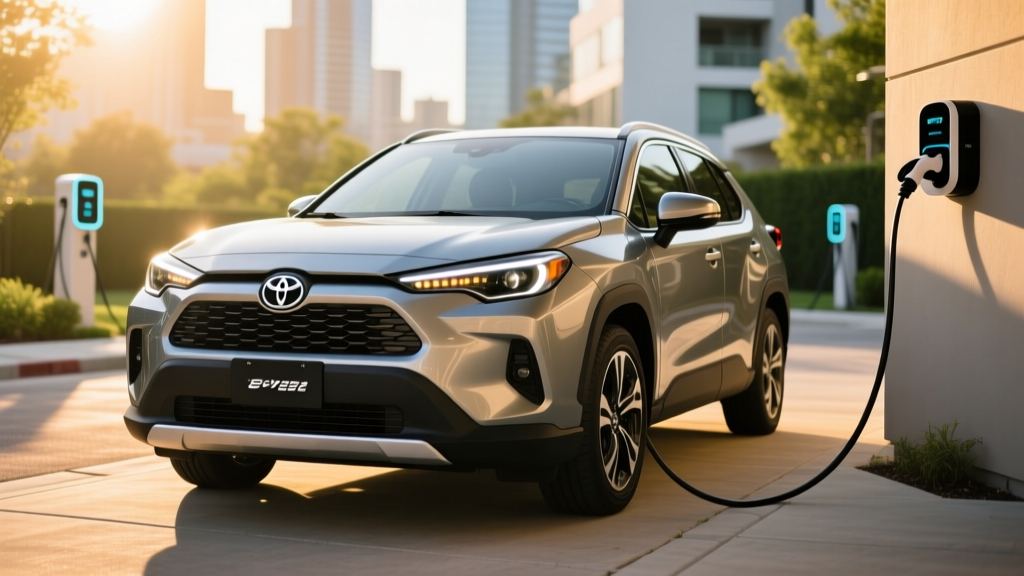
The Toyota Corolla Cross Hybrid occupies a specific niche: a compact crossover that pairs Toyota's fifth-generation hybrid system with standard all-wheel drive, without requiring a plug. The SE trim sits at the sport-oriented end of the lineup, adding visual and handling tweaks over the base S and mid-tier XSE. For 2026, the Corolla Cross Hybrid continues with the 2.0-liter four-cylinder hybrid powertrain rated at 196 combined horsepower — a meaningful step up from the 169 hp non-hybrid Corolla Cross.
This guide covers everything a buyer needs to evaluate the Corolla Cross Hybrid SE: EPA and real-world fuel economy, how the conventional hybrid (HEV) system differs from a plug-in hybrid (PHEV), battery longevity, pricing, and whether this crossover fits your driving pattern better than a full battery-electric vehicle (BEV).
HEV vs PHEV vs BEV: Where the Corolla Cross Hybrid Fits
A common source of confusion at the dealership is the difference between a conventional hybrid, a plug-in hybrid, and a full electric vehicle. The Corolla Cross Hybrid is a conventional hybrid (HEV). It has a small battery (approximately 1.0 kWh usable) that charges itself through regenerative braking and the gasoline engine. You never plug it in. You simply refuel at a gas station.
| Attribute | HEV (Corolla Cross Hybrid) | PHEV (e.g., RAV4 Prime) | BEV (e.g., bZ4X) |
|---|---|---|---|
| Plug-in required? | No | Yes (Level 1 or 2) | Yes (Level 2 or DC fast) |
| Battery size | ~1.0 kWh | 18.1 kWh (RAV4 Prime) | 71.4 kWh (bZ4X) |
| Electric-only range | ~1 mile at low speed | 42 miles (EPA) | 252 miles (EPA) |
| Fuel source | Gasoline only | Gasoline + electricity | Electricity only |
| Tailpipe emissions | Yes | Yes (when engine runs) | None |
| Federal tax credit | Not eligible | Varies by sourcing | Up to $7,500 (if eligible) |
The Corolla Cross Hybrid is not available as a plug-in hybrid. If you want electric-only commuting with a gas backup, Toyota's RAV4 Prime (PHEV) fills that role in the compact SUV segment — but it starts roughly $12,000 higher. If you want zero tailpipe emissions, the Toyota bZ4X is the brand's current BEV option. The Corolla Cross Hybrid sits in the practical middle: significantly better fuel economy than a gas-only car, zero lifestyle change required.
Powertrain: 196 HP With Standard AWD
The 2026 Corolla Cross Hybrid uses Toyota's fifth-generation hybrid system, pairing a 2.0-liter Dynamic Force four-cylinder engine with two electric motor-generators through an eCVT (electronically controlled continuously variable transmission). A third electric motor on the rear axle provides all-wheel drive — what Toyota calls "Electronic On-Demand AWD."
| Engine | 2.0L 4-cylinder Dynamic Force (Atkinson cycle) |
| Engine output | 150 hp / 139 lb-ft torque |
| Front electric motor | 83 kW (111 hp) |
| Rear electric motor (AWD) | 30 kW (41 hp) |
| Combined net horsepower | 196 hp |
| Transmission | eCVT |
| Drivetrain | Electronic On-Demand AWD (standard) |
| Hybrid battery | ~1.0 kWh, lithium-ion |
| 0–60 mph (est.) | ~7.5 seconds |
| Towing capacity | Not rated for towing |
The 196 hp combined output puts the Corolla Cross Hybrid ahead of competitors like the Honda HR-V (158 hp) and the non-hybrid Corolla Cross (169 hp). The eCVT delivers smooth, stepless acceleration with no shift shock. The rear motor engages automatically when the system detects front-wheel slip or during hard acceleration, but it can also provide mild torque-fill during normal driving to improve stability.
Fuel Economy: EPA Ratings and Real-World MPG
The EPA rates the 2026 Corolla Cross Hybrid at 46 MPG city / 39 MPG highway / 42 MPG combined. These figures apply across all trims, including the SE, since the powertrain and curb weight are essentially identical.
| Cycle | EPA Rating | Real-World Expectation |
|---|---|---|
| City | 46 MPG | 44–50 MPG (hybrids often beat EPA in city) |
| Highway | 39 MPG | 36–40 MPG (sustained 75+ mph reduces advantage) |
| Combined | 42 MPG | 40–44 MPG (typical mixed driving) |
Real-world context: Toyota's hybrid system excels in stop-and-go driving, where the electric motor handles low-speed movement and regenerative braking recaptures energy. In city driving, owners routinely report matching or slightly exceeding the 46 MPG EPA city figure — a rarity in the auto world. Highway driving is the relative weak point: at sustained speeds above 70 mph, aerodynamic drag dominates and the hybrid advantage narrows. Expect 36–39 MPG on a long interstate trip.
Cold weather reduces fuel economy by roughly 5–10% due to increased engine idle time for cabin heat and reduced battery efficiency. In sub-freezing conditions, expect the combined figure to dip to approximately 38–40 MPG. This is a smaller penalty than a BEV experiences in cold weather (typically 20–30% range loss), but it's measurable.
With the 10.6-gallon fuel tank, total range works out to roughly 445 miles combined — enough for most weekly commutes with a single fill-up.
Corolla Cross Hybrid SE Pricing and Tax Credit Status
The 2026 Corolla Cross Hybrid SE carries a starting MSRP of approximately $31,590 (including destination). The SE trim adds sport-tuned suspension tuning, a black roof, 18-inch alloy wheels, SofTex-trimmed seats, and Toyota's Smart Key system with push-button start.
| Trim | MSRP (incl. destination) | Key Additions |
|---|---|---|
| S (base hybrid) | ~$29,990 | Hybrid powertrain, AWD, TSS 3.0 |
| SE | ~$31,590 | Sport suspension, black roof, 18" wheels, SofTex |
| XSE | ~$33,490 | Wireless CarPlay, JBL audio, heated seats |
Federal Tax Credit Eligibility
The Corolla Cross Hybrid does not qualify for the federal §30D clean vehicle tax credit. That credit applies exclusively to plug-in electric vehicles (PHEVs and BEVs) with a minimum battery capacity of 7 kWh and specific critical-mineral and battery-component sourcing requirements, as outlined on IRS.gov. The Corolla Cross Hybrid's ~1.0 kWh battery is far below the 7 kWh threshold.
Some states and municipalities offer incentives for high-efficiency hybrids, but these vary widely and change frequently. Check your state's energy office or the DOE's alternative fuels incentive database for local programs. Do not rely on dealer claims about hybrid tax credits — verify against official sources.
Reliability and Hybrid Battery Warranty
Toyota's hybrid system has a two-decade track record dating to the 1997 Prius. The fifth-generation system in the Corolla Cross Hybrid uses fewer moving parts than a conventional automatic transmission (no torque converter, no discrete gears) and has proven durable in long-term fleet data.
Warranty Coverage
- Hybrid battery: 10 years / 150,000 miles (whichever comes first)
- Hybrid system components: 8 years / 100,000 miles
- Powertrain (engine, eCVT): 5 years / 60,000 miles
- Basic bumper-to-bumper: 3 years / 36,000 miles
- Complimentary maintenance: 2 years / 25,000 miles (ToyotaCare)
Battery replacement cost: If the hybrid battery fails outside warranty, replacement typically runs $2,000–$3,500 including labor at a Toyota dealer. Independent hybrid specialists can often perform the same job for $1,500–$2,500. Refurbished battery packs are available for approximately $1,000–$1,800. For context, Toyota's hybrid battery failure rate is low — most packs last well beyond 150,000 miles based on Prius fleet data.
The Corolla Cross Hybrid also benefits from Toyota Safety Sense 3.0 (TSS 3.0), which includes automatic emergency braking with pedestrian detection, lane-departure alert with steering assist, full-speed adaptive cruise control, lane-tracing assist, and automatic high beams. The IIHS has historically rated Toyota's Corolla-based platforms highly for crashworthiness.
Who Should Choose the Corolla Cross Hybrid SE?
Decision Framework
Choose the Corolla Cross Hybrid SE if:
- You drive 10,000–18,000 miles per year and want to minimize fuel cost without changing your refueling habits
- You lack access to home or workplace charging (apartment dwellers, street parkers)
- You want AWD for snow or rain but don't need a larger SUV
- You prioritize long-term reliability and low maintenance cost
- Your budget is $30,000–$35,000 and you want the best fuel economy in that range
Consider a PHEV (like the RAV4 Prime) instead if:
- You can charge at home and your commute is under 40 miles round-trip
- You want to drive on electricity most days but keep gas for road trips
- You want to potentially qualify for the federal tax credit
Consider a full BEV (like the Hyundai Kona Electric) instead if:
- You have reliable home Level 2 charging
- Your daily driving is under 200 miles and you rarely road-trip beyond charging-network coverage
- You want to eliminate tailpipe emissions and gas-station visits entirely
The Corolla Cross Hybrid SE makes the most financial sense for drivers who cover significant miles but cannot charge at home. At 42 MPG combined, annual fuel cost runs approximately $1,350–$1,550 (assuming 12,000 miles/year and $3.50/gallon regular). A comparable gas-only compact crossover averaging 28 MPG would cost roughly $2,100/year — a difference of about $600 annually in the hybrid's favor. Over a 10-year ownership period, that's approximately $6,000 in fuel savings, which more than offsets any initial price premium over the non-hybrid Corolla Cross.
The SE trim specifically appeals to buyers who want a slightly more aggressive appearance and firmer ride without stepping to the fully loaded XSE. The sport-tuned suspension is noticeable on winding roads but doesn't compromise daily comfort on rough pavement.
Pros
- 42 MPG combined — best-in-class for AWD compact crossovers
- 196 hp provides confident highway merging and passing
- Standard AWD with no fuel-economy penalty vs FWD
- 10-year/150,000-mile hybrid battery warranty
- Proven Toyota hybrid reliability
- No plug-in charging required
- TSS 3.0 safety suite standard on all trims
Cons
- No federal tax credit eligibility
- Highway MPG drops to ~36–38 at sustained 75+ mph
- Not rated for towing
- Cargo space (25.5 cu ft behind rear seats) trails some rivals
- eCVT drone under hard acceleration
- No spare tire (tire-inflator kit only)
Frequently Asked Questions
How many MPG does the Toyota Corolla Cross Hybrid get?
The EPA rates it at 46 MPG city, 39 MPG highway, and 42 MPG combined. In real-world driving, most owners see 40–44 MPG combined, with city driving sometimes exceeding the EPA figure and sustained highway driving falling slightly below.
Does the Corolla Cross Hybrid need to be plugged in?
No. It is a conventional hybrid (HEV). The battery charges through regenerative braking and the gasoline engine. You refuel at a gas station like any other car.
Is there a plug-in hybrid version of the Corolla Cross?
Toyota does not currently offer a Corolla Cross PHEV in the United States. The closest Toyota PHEV in size and segment is the RAV4 Prime, which offers 42 miles of electric-only range but starts around $43,000.
How long will the hybrid battery last?
Toyota warranties the hybrid battery for 10 years or 150,000 miles. Based on long-term Prius fleet data, most Toyota hybrid batteries last 150,000–200,000+ miles before significant degradation. Replacement cost, if needed out of warranty, is $2,000–$3,500 at a dealer.
Does the Corolla Cross Hybrid qualify for any tax credit?
It does not qualify for the federal §30D clean vehicle credit, which requires a minimum 7 kWh battery and plug-in capability. Some state or local utility incentives may apply to high-efficiency vehicles — check fueleconomy.gov and your state energy office for current programs.
Is the Corolla Cross Hybrid SE worth the upgrade over the S trim?
The SE adds approximately $1,600 over the base S trim and includes sport-tuned suspension, 18-inch wheels, a black roof, SofTex upholstery, and Smart Key. If you value the sportier appearance and slightly firmer ride, the premium is modest. If you're budget-focused, the S trim delivers identical fuel economy and powertrain performance.
How does the Corolla Cross Hybrid compare to a full EV for commuting?
For a 30-mile round-trip commute, a BEV saves approximately $800–$1,200/year in fuel vs. the Corolla Cross Hybrid (depending on local electricity rates). However, a BEV requires home charging access and a higher purchase price (typically $35,000–$45,000 before credits). The Corolla Cross Hybrid eliminates range anxiety and charging logistics while still cutting fuel cost roughly 35–40% vs. a gas-only crossover.
For the latest EPA figures, see the official Fuel Economy Guide. For current federal incentive rules, refer to IRS Publication on Clean Vehicle Credits.