The Toyota Corolla Cross Hybrid has carved out a unique position as one of the most fuel-efficient compact crossovers available without a plug. For buyers who want SUV utility and all-wheel drive without range anxiety or charging infrastructure concerns, it remains a compelling option in 2026. But how does its EPA-rated fuel economy translate to real-world driving? We break down every efficiency figure, ownership cost, and powertrain detail you need before signing the paperwork.
Toyota Corolla Cross Hybrid MPG: The Official EPA Numbers
The 2026 Toyota Corolla Cross Hybrid is rated by the EPA at 45 mpg city / 38 mpg highway / 42 mpg combined across all trims (S, SE, and XSE). These figures apply to the sole powertrain configuration: a 2.0-liter four-cylinder engine paired with Toyota's fifth-generation hybrid system and electronic on-demand all-wheel drive (AWD).
| Metric | EPA Rating |
|---|---|
| City MPG | 45 mpg |
| Highway MPG | 38 mpg |
| Combined MPG | 42 mpg |
| Annual Fuel Cost (est.) | ~$1,350 (15,000 mi/yr at $3.50/gal) |
| Fuel Tank Capacity | 10.6 gallons |
| Total Driving Range (est.) | ~445 miles |
Source: fueleconomy.gov
In mixed suburban and city driving, owners consistently report 43–47 mpg, often exceeding the EPA city rating thanks to aggressive regenerative braking and frequent electric-only operation at low speeds. On sustained highway trips at 75+ mph, expect 35–38 mpg — aerodynamic drag reduces hybrid advantage at higher speeds. In cold weather (below 30°F), short-trip city MPG can dip to 36–39 mpg as the engine runs longer to heat the cabin and warm the hybrid battery. Overall, most drivers land between 40–44 mpg combined in year-round use.
HEV vs. PHEV: The Corolla Cross Is a Conventional Hybrid
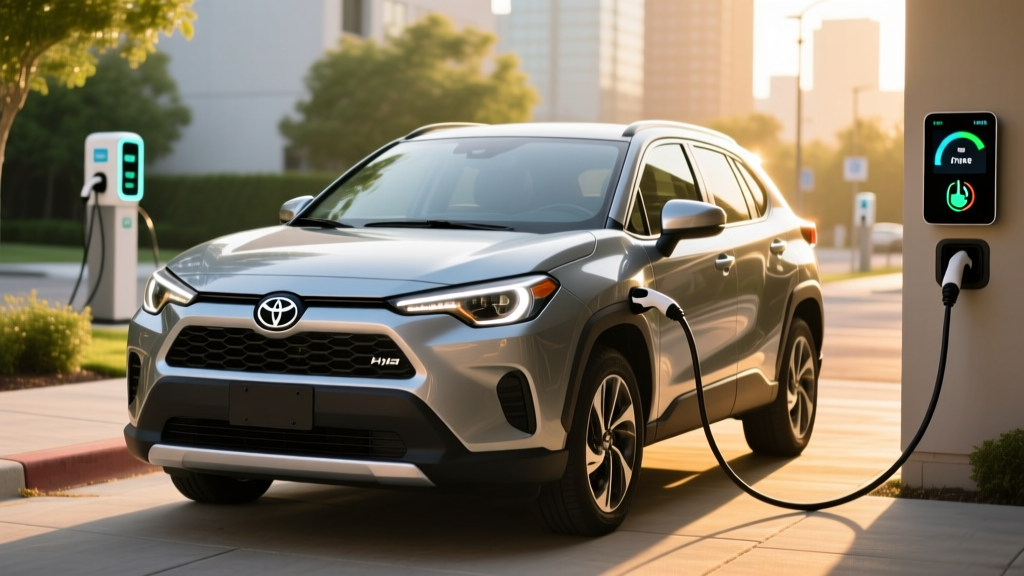
A critical distinction for shoppers: the Corolla Cross Hybrid is a conventional hybrid electric vehicle (HEV), not a plug-in hybrid (PHEV). It does not have a charging port, cannot be plugged in, and has no meaningful electric-only driving range. Instead, it generates all its electricity internally through regenerative braking and the gasoline engine.
| Feature | HEV (Corolla Cross Hybrid) | PHEV (e.g., Toyota RAV4 Prime) |
|---|---|---|
| Plug-in Charging | No — self-charging only | Yes — plug in to charge battery |
| Electric-Only Range | ~1 mile at very low speed | 35–42 miles (typical PHEV) |
| Battery Size | ~1.0 kWh (small buffer) | 13.6–18.1 kWh usable |
| Federal Tax Credit | Not eligible | Up to $7,500 (if eligible) |
| Best For | No home charging access; simplicity | Home charging + short daily commute |
If you have access to home or workplace Level 2 charging and a daily commute under 40 miles, a PHEV like the RAV4 Prime or a full BEV may save more fuel and qualify for federal incentives. If you park on the street, live in an apartment, or want zero charging hassle, the Corolla Cross HEV is the right call.
Powertrain and Performance Specs
The 2026 Corolla Cross Hybrid pairs a 2.0-liter Dynamic Force four-cylinder engine with three electric motor-generators — two on the front axle and one powering the rear wheels for electronic AWD. Combined system output is 196 horsepower.
| Specification | Value |
|---|---|
| Engine | 2.0L 4-cyl Atkinson-cycle |
| Combined System HP | 196 hp |
| Drivetrain | Electronic AWD (eAWD) |
| Transmission | eCVT (planetary gearset) |
| Hybrid Battery | ~1.0 kWh lithium-ion |
| 0–60 mph | ~7.5 seconds (est.) |
| Towing Capacity | Not rated for towing |
| Cargo Volume | 25.5 cu ft (rear seats up) |
| Curb Weight | ~3,370 lbs |
The eCVT isn't a traditional belt-driven CVT — it uses a planetary gearset to seamlessly blend engine and motor power. Acceleration is brisk for the class, with the electric motors providing instant torque off the line. The rear motor engages automatically when slippage is detected, making this a capable light-duty AWD system for rain and snow, though it's not designed for off-road use.
Pricing, Trims, and Tax Credit Eligibility
The 2026 Corolla Cross Hybrid is offered in three trims:
- S Hybrid: ~$30,050 MSRP (base, well-equipped)
- SE Hybrid: ~$32,500 MSRP (sport appearance, upgraded wheels)
- XSE Hybrid: ~$35,000 MSRP (premium interior, SofTex seats, JBL audio)
All prices include destination charge. These figures represent approximate 2026 model-year pricing; confirm with your local Toyota dealer for exact figures.
The Corolla Cross Hybrid does not qualify for the IRS §30D Clean Vehicle Credit. That credit applies only to plug-in electric vehicles (BEVs and PHEVs) with a minimum battery capacity of 7 kWh. As a conventional HEV with a ~1.0 kWh battery, it falls outside the program's scope. Some states and utilities offer modest rebates for high-MPG hybrids, but these vary by jurisdiction — check your state energy office or utility provider for current programs.
Source: IRS.gov — Clean Vehicle Credits
Reliability and Hybrid Battery Warranty
Toyota's hybrid powertrains are among the most proven in the industry, with over 25 years of continuous refinement since the original Prius. The Corolla Cross Hybrid uses Toyota's fifth-generation hybrid system, which has shown excellent durability in early field data.
- Hybrid Battery: 10 years / 150,000 miles (whichever comes first)
- Hybrid System Components: 8 years / 100,000 miles (inverter, motor-generators, control module)
- Powertrain Warranty: 5 years / 60,000 miles
- Basic Warranty: 3 years / 36,000 miles
Should the hybrid battery require replacement out of warranty, expect a cost of $2,500–$4,000 including labor at a Toyota dealer. However, Toyota hybrid batteries routinely last 150,000–200,000+ miles with normal use. Individual cell module replacement (rather than the full pack) is sometimes available for $500–$1,200 through independent hybrid specialists.
Toyota's hybrid system has no traditional starter motor, alternator, or accessory belt — all replaced by the motor-generators — which eliminates several common failure points found in conventional vehicles. The eCVT planetary gearset has proven exceptionally reliable with no scheduled fluid changes required under normal driving conditions.
Corolla Cross Hybrid vs. Competitors: MPG Comparison
| Model | City MPG | Highway MPG | Combined MPG | AWD | Base MSRP |
|---|---|---|---|---|---|
| Toyota Corolla Cross Hybrid | 45 | 38 | 42 | Standard | ~$30,050 |
| Honda HR-V (gas AWD) | 25 | 30 | 27 | Available | ~$27,500 |
| Subaru Crosstrek Hybrid (PHEV) | N/A | N/A | ~35 combined + 17 mi EV | Standard | ~$36,000 |
| Kia Niro Hybrid | 53 | 48 | 50 | No (FWD only) | ~$28,500 |
| Toyota RAV4 Hybrid | 41 | 38 | 39 | Standard | ~$33,500 |
The Corolla Cross Hybrid leads the AWD compact crossover segment in combined MPG. The Kia Niro Hybrid is more efficient overall, but it's front-wheel drive only and sits lower to the ground. The RAV4 Hybrid offers more interior space and towing capacity but returns 3 fewer combined mpg. If AWD and maximum fuel economy are both priorities, the Corolla Cross Hybrid has no direct rival.
Who Should Buy the Corolla Cross Hybrid?
- You want AWD capability with 40+ mpg combined
- You lack access to home or workplace charging (apartment, street parking)
- You want Toyota reliability with a 10-year hybrid battery warranty
- Your daily driving is a mix of city errands and suburban commuting
- You want a crossover profile without paying RAV4 prices
- You have Level 2 home charging and a commute under 35 miles (a PHEV could eliminate gas use entirely on weekdays)
- You want federal tax credit eligibility (up to $7,500 for qualifying BEVs/PHEVs)
- You drive mostly highway miles at 75+ mph (a diesel or efficient gas car may match hybrid highway MPG)
- You need towing capacity or maximum cargo volume (step up to the RAV4 Hybrid)
Ownership Costs: 5-Year Fuel Savings
Compared to the average compact gas AWD crossover returning 27 mpg combined, the Corolla Cross Hybrid's 42 mpg combined saves roughly 148 gallons per year at 15,000 miles driven annually. At $3.50 per gallon, that's approximately $520 per year or $2,600 over five years in fuel savings alone. Factor in Toyota's strong resale value retention and low maintenance costs (no timing belt, no traditional transmission fluid service, reduced brake wear from regenerative braking), and the total cost of ownership is among the lowest in the segment.
Frequently Asked Questions
How many MPG does the Toyota Corolla Cross Hybrid get in real-world driving?
The EPA rates it at 45 city / 38 highway / 42 combined. In real-world use, most owners report 40–44 mpg combined year-round, with city driving often exceeding 45 mpg and sustained highway driving at 75+ mph returning 35–38 mpg. Cold weather short trips can reduce city MPG to the mid-to-high 30s.
Does the Corolla Cross Hybrid need to be plugged in?
No. It is a conventional hybrid (HEV), not a plug-in hybrid. It charges its own small battery through regenerative braking and the gasoline engine. You simply fill it with gas like any other vehicle.
Does the Corolla Cross Hybrid qualify for any tax credit?
It does not qualify for the federal §30D Clean Vehicle Credit, which requires a minimum 7 kWh battery and plug-in capability. Some state or utility rebates for high-efficiency vehicles may apply — check local programs.
Is the hybrid battery reliable, and what does replacement cost?
Toyota's hybrid batteries are covered for 10 years / 150,000 miles and routinely last 150,000–200,000+ miles. Out-of-warranty replacement costs $2,500–$4,000 at a dealer, though independent hybrid shops can sometimes replace individual modules for $500–$1,200.
Hybrid vs. PHEV vs. EV — which is right for me?
Choose a conventional hybrid (HEV) like the Corolla Cross if you want simplicity and no charging. Choose a PHEV if you can charge at home and want electric-only commuting with gas backup. Choose a full EV (BEV) if you want maximum savings, zero tailpipe emissions, and have reliable charging access.
How does the Corolla Cross Hybrid AWD system work?
It uses an electronic on-demand AWD system with a dedicated rear electric motor. The rear motor engages automatically when the front wheels slip or during hard acceleration, providing traction without the mechanical drag and fuel economy penalty of a traditional AWD driveshaft.