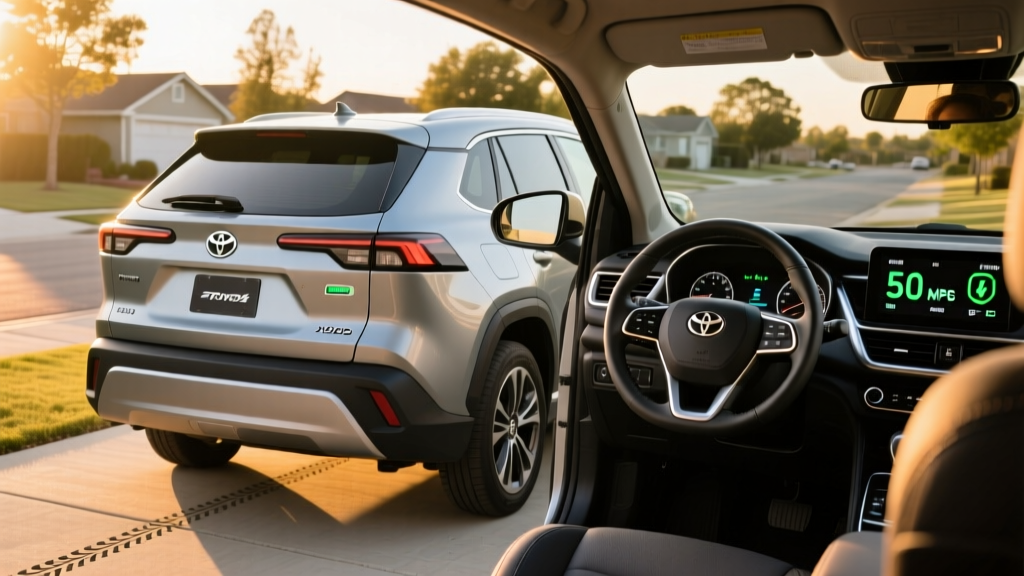
The compact crossover segment is packed with choices, but the 2024 Toyota Corolla Cross Hybrid occupies a specific niche: a practical all-wheel-drive runabout that sips fuel without requiring you to change a single habit. No plugs, no range math, no charging apps. You fill it at a gas station and drive. For buyers weighing the Toyota Corolla Cross Hybrid 2024 model year against gas-only rivals, full EVs, or plug-in hybrids, this guide breaks down exactly what you get — and what you give up.
Quick Verdict: Who Is the Corolla Cross Hybrid For?
The Corolla Cross Hybrid is a conventional hybrid electric vehicle (HEV), not a plug-in. It charges its own small battery through regenerative braking and the gasoline engine. If you want electric-only commuting, you need a PHEV or BEV. If you want dramatically lower fuel consumption with zero lifestyle changes, this is one of the most efficient AWD crossovers you can buy.
- HEV (this vehicle): No plug. Small battery (~1-2 kWh). Regenerates energy from braking. Cannot drive on electric power alone for meaningful distances. No federal tax credit.
- PHEV: Has a plug. Larger battery (typically 12-20 kWh). Can drive 20-40 miles on electricity alone before the gas engine kicks in. May qualify for federal or state incentives.
- BEV (full EV): No gas engine. Large battery (60-100+ kWh). Requires home or public charging. Eligible for up to $7,500 federal tax credit if requirements are met.
Fuel Economy: EPA Ratings vs. Real-World MPG
Every 2024 Corolla Cross Hybrid trim (S, SE, XSE, XLE) uses the same powertrain and carries identical EPA ratings. Here is the official data from fueleconomy.gov:
| Metric | MPG |
|---|---|
| City | 45 |
| Highway | 38 |
| Combined | 42 |
| Annual Fuel Cost (15,000 mi) | ~$1,550 |
Real-World MPG: What Owners Actually See
Toyota hybrids historically overperform their EPA city ratings in stop-and-go traffic because regenerative braking recovers energy that a gas car wastes as heat. In mixed suburban driving, owners on forums and testing outlets consistently report 40–46 MPG combined. On sustained highway trips at 75+ mph, expect the number to dip to 35–38 MPG — the small battery provides less assistance at constant high speeds, and aerodynamic drag dominates.
In cold weather (below 30°F), the engine runs more frequently to heat the cabin and maintain catalytic converter temperature. Expect a 5–10% reduction in fuel economy during winter months, bringing combined figures to roughly 38–40 MPG.
Powertrain and Performance Specs
The Corolla Cross Hybrid pairs a 2.0-liter four-cylinder engine with Toyota's fifth-generation hybrid system and standard electronic all-wheel drive (AWD). Here are the exact figures:
| Specification | Value |
|---|---|
| Combined Net Horsepower | 196 hp |
| Gas Engine | 2.0L 4-cyl, 150 hp / 139 lb-ft |
| Front Electric Motor | 83 kW (111 hp) |
| Rear Electric Motor (AWD) | 30 kW (41 hp) |
| Transmission | eCVT (planetary gearset) |
| 0–60 mph | ~7.5 seconds |
| Drivetrain | Electronic AWD (standard) |
| Hybrid Battery | ~1.3 kWh, Lithium-ion (sealed NiMH on some builds) |
| Towing Capacity | Not rated for towing |
The 196 hp figure represents combined system output — not the sum of the individual components. Toyota's hybrid synergy drive blends engine and motor power through the planetary eCVT, which has no fixed gear ratios and therefore no shift shock. Acceleration is linear and adequate for merging, though the engine drone under hard acceleration is a known characteristic of Toyota's eCVT design.
HEV vs. PHEV vs. EV: Which Powertrain Fits Your Life?
The decision between a conventional hybrid, plug-in hybrid, and full electric vehicle comes down to three questions: Can you charge at home? How far is your commute? And how much complexity are you willing to manage?
| Factor | HEV (Corolla Cross Hybrid) | PHEV (e.g., RAV4 Prime) | BEV (e.g., bZ4X) |
|---|---|---|---|
| Home Charging Needed? | No | Yes (Level 2 ideal) | Yes (Level 2 essential) |
| Electric-Only Range | ~1 mi (low-speed only) | 25–42 mi | 200–300+ mi |
| Fuel Cost per Mile | ~$0.10 | $0.04–0.10 | $0.03–0.05 |
| Federal Tax Credit | None | Up to $7,500 (if eligible) | Up to $7,500 (if eligible) |
| Road-Trip Simplicity | Gas and go | Gas and go | Route planning required |
| Best For | No home charging, mixed driving | Short commute + home charging | Home charging + daily driving |
Choose the Corolla Cross Hybrid if you rent or live in an apartment without charging access, you want AWD for snow and rain, and your priority is low fuel cost with zero behavior change. Look at a PHEV like the RAV4 Prime (42 miles electric-only) if you have a garage and a short commute — you may go months without buying gas. Consider a BEV if you can install a Level 2 charger at home and want the lowest per-mile cost and zero tailpipe emissions.
Pricing, Trims, and Tax Credit Eligibility
The 2024 Corolla Cross Hybrid is available in four trims. Pricing below reflects MSRP including destination charge, as listed by Toyota's official specifications:
| Trim | MSRP | Key Additions |
|---|---|---|
| S | $29,390 | 8" touchscreen, Toyota Safety Sense 3.0, AWD |
| SE | $30,490 | Sport-tuned suspension, SofTex seats, 18" wheels |
| XLE | $32,090 | Heated front seats, power liftgate, ambient lighting |
| XSE | $32,690 | Sport styling, JBL audio, 10" head-up display |
Does the Corolla Cross Hybrid Qualify for a Tax Credit?
No. The Corolla Cross Hybrid is a conventional HEV, which means it does not have a plug and does not meet the definition of a qualified plug-in electric vehicle under IRS §30D rules. The federal clean vehicle credit of up to $7,500 applies only to plug-in hybrids (PHEVs) and battery electric vehicles (BEVs) that meet battery-sourcing, MSRP, and buyer income requirements.
Some states offer their own rebates for hybrids, but these are uncommon and vary by jurisdiction. Check your state's energy office or department of environmental quality for current programs.
Battery Warranty, Reliability, and Replacement Cost
Hybrid battery longevity is consistently the top concern for first-time hybrid buyers. Toyota addresses this with one of the strongest warranties in the segment.
- Hybrid Battery: 10 years / 150,000 miles (whichever comes first)
- Hybrid System Components: 8 years / 100,000 miles
- Basic New Vehicle: 3 years / 36,000 miles
- Powertrain (engine, trans): 5 years / 60,000 miles
Coverage applies to the original owner and all subsequent owners. If the hybrid battery fails within the warranty window, Toyota replaces it at no cost.
Real-World Battery Lifespan
Toyota's hybrid battery packs are designed for the life of the vehicle. Data from Toyota Prius fleets — which use similar nickel-metal hydride and lithium-ion chemistries — shows typical capacity loss of less than 15% after 200,000 miles. Because the Corolla Cross Hybrid battery is small (~1.3 kWh) and is never deeply discharged (the system keeps it between roughly 40% and 80% state of charge), degradation stress is minimal.
Should a replacement be needed out of warranty, a refurbished hybrid battery for a Toyota compact hybrid typically costs $2,000–$3,500 installed. A new OEM battery from a Toyota dealer runs $3,500–$5,000 installed. These figures are dramatically lower than BEV battery replacements, which can exceed $15,000.
Overall Reliability
Toyota's hybrid powertrains have an exceptional reliability record spanning two decades. The eCVT has no belts, no clutch packs, and no friction bands — it is a simple planetary gearset with far fewer failure points than a conventional automatic or dual-clutch transmission. The IIHS rated the 2024 Corolla Cross as a Top Safety Pick+ when equipped with specific headlights, and standard Toyota Safety Sense 3.0 includes pre-collision braking, lane-departure alert, adaptive cruise control, and road-sign assist.
Pros and Cons at a Glance
- 42 MPG combined EPA — class-leading for AWD crossovers
- Standard AWD on every trim (no FWD-only base model)
- 196 hp provides confident merging power
- 10-year/150,000-mile hybrid battery warranty
- No plug required — zero lifestyle change from a gas car
- Toyota Safety Sense 3.0 standard across all trims
- Strong resale value (Toyota hybrid brand equity)
- No federal tax credit eligibility
- Cargo space is modest (~25 cu ft behind rear seats)
- Engine drone under hard acceleration (eCVT characteristic)
- Not rated for towing
- Rear seat legroom is tight for taller passengers
- Infotainment lacks wireless CarPlay on base S trim
- No plug-in option available for this model
Ownership Costs: 5-Year Comparison
Here is how the Corolla Cross Hybrid stacks up against its gas-only sibling and a comparable BEV over five years and 75,000 miles:
| Cost Factor | Corolla Cross Hybrid | Corolla Cross Gas (AWD) | Tesla Model Y (LR) |
|---|---|---|---|
| Purchase Price (base) | $29,390 | $24,990 | $44,990 |
| Federal Tax Credit | $0 | $0 | Up to $7,500* |
| Fuel / Energy (75k mi) | ~$7,750 | ~$10,500 | ~$2,625 |
| Maintenance (5 yr) | ~$2,500 | ~$3,200 | ~$1,500 |
| Net 5-Year Cost | ~$39,640 | ~$38,690 | ~$41,615 |
*Tesla Model Y tax credit eligibility depends on MSRP caps, buyer income, battery sourcing, and point-of-sale transfer rules under current IRS §30D guidelines. Verify eligibility with a tax professional. Fuel costs based on $3.50/gal regular and $0.14/kWh national average electricity.
The hybrid breaks even with the gas model within roughly 3–4 years through fuel savings, despite a ~$4,400 higher purchase price. Against a BEV, the hybrid avoids charging infrastructure concerns but cannot match the per-mile energy cost of home-charged electricity.
Frequently Asked Questions
How many MPG does the 2024 Toyota Corolla Cross Hybrid get?
The EPA rates it at 45 city / 38 highway / 42 combined MPG. Real-world testing and owner reports generally confirm 40–46 MPG combined in mixed driving, with highway-only trips yielding 35–38 MPG. Cold weather can reduce these figures by 5–10%.
Does the Corolla Cross Hybrid need to be plugged in?
No. It is a conventional hybrid (HEV), not a plug-in hybrid (PHEV). The battery charges itself through regenerative braking and the gasoline engine. You never plug it in — you simply fill the 10.6-gallon fuel tank at any gas station.
Can it drive on electric power alone?
Only at very low speeds (under ~25 mph) for extremely short distances, such as creeping through a parking lot. The battery is too small (~1.3 kWh) for meaningful electric-only driving. If electric-only commuting matters to you, look at a PHEV like the Toyota RAV4 Prime or a full BEV.
Is the hybrid battery reliable and what does replacement cost?
Toyota's hybrid batteries have an outstanding longevity record. The warranty covers 10 years / 150,000 miles. Out-of-warranty replacement runs $2,000–$5,000 depending on refurbished vs. new OEM. Most hybrid batteries last the life of the vehicle with minimal degradation because the system never deeply cycles them.
Does the 2024 Corolla Cross Hybrid qualify for any federal tax credit?
No. The IRS §30D clean vehicle credit applies only to plug-in electric vehicles (PHEVs and BEVs). Conventional hybrids like the Corolla Cross Hybrid are not eligible. Check your state's energy office for any local hybrid incentives, though these are rare.
How does the Corolla Cross Hybrid compare to the RAV4 Hybrid?
The RAV4 Hybrid is larger, more powerful (219 hp), offers more cargo space (37.6 cu ft vs. ~25 cu ft), and achieves a nearly identical 41 MPG combined. It also starts about $2,000 higher. If you need more room or plan to carry families regularly, the RAV4 Hybrid is the better fit. If you prioritize a smaller footprint, easier parking, and a slightly lower price, the Corolla Cross Hybrid wins.
Is AWD always engaged?
The electronic AWD system activates the rear motor automatically when the front wheels slip — in rain, snow, or gravel. Under normal dry-road cruising, the vehicle operates primarily in front-wheel drive for maximum efficiency. There is no driver-selectable AWD mode; the system manages torque distribution independently.