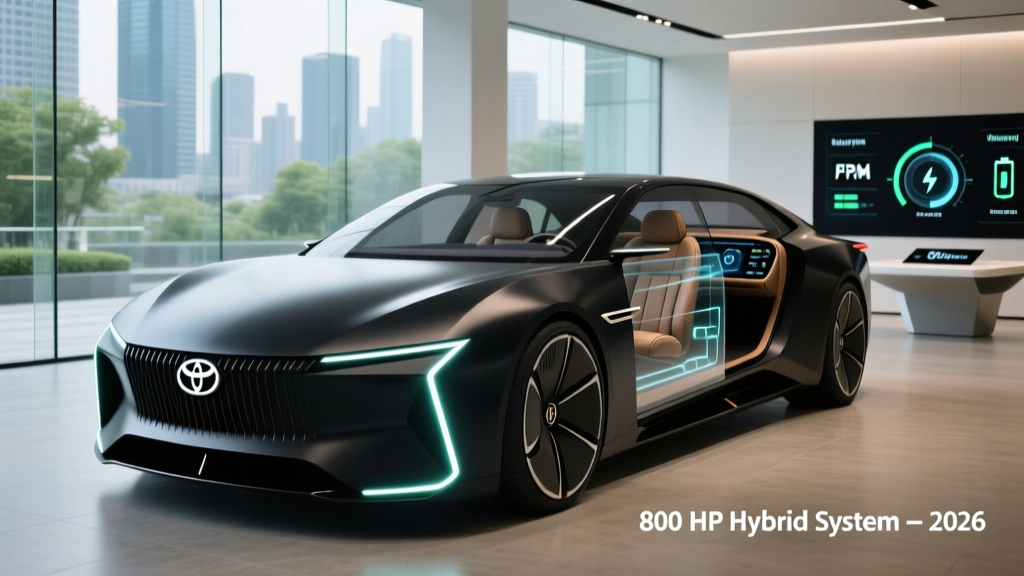
The Toyota Century has long occupied a singular place in the automotive world: a hand-built, chauffeur-oriented flagship sold almost exclusively in Japan, traditionally powered by a silky V12. With the current generation (G60) shifting to a V8 hybrid architecture, persistent rumors about a Toyota Century rumored 800-HP V12 hybrid powertrain have electrified enthusiast circles and luxury-car watchers alike. Here is everything verifiable about this speculated powertrain, separated from speculation — and what it would mean for buyers if Toyota green-lights production.
The Current Toyota Century: V8 Hybrid Baseline
Before evaluating the rumored V12, we need to anchor against the vehicle that actually exists. The current-generation Toyota Century sedan, introduced for the Japanese market, uses a 2.5-liter V6 hybrid system (not a V8 as some Western reports have suggested) paired with Toyota's THS II hybrid architecture. The Century SUV variant, unveiled in late 2023 and entering limited production, also uses a plug-in hybrid powertrain built around a 3.5-liter V6.
| Attribute | Century Sedan (G60) | Century SUV |
|---|---|---|
| Engine | 2.5L V6 (A25A-FXS) | 3.5L V6 (2GR-FXS) |
| Hybrid Type | HEV (conventional) | PHEV (plug-in) |
| Combined Output | ~231 hp | ~406 hp |
| Battery | ~1.6 kWh NiMH | ~18.1 kWh lithium-ion |
| Electric-Only Range | N/A (HEV) | ~43 miles (est.) |
| Drivetrain | RWD / e-Four AWD | AWD (E-Four) |
| Price (Japan) | ~¥25,000,000 (~$170,000 USD) | ~¥25,000,000 (~$170,000 USD) |
This baseline matters because any rumored 800-HP V12 hybrid would represent a roughly threefold increase in system output over the existing sedan — a move that would reposition the Century from a stately Japanese-market limousine into hyper-luxury performance territory occupied by the Rolls-Royce Spectre and Bentley Flying Spur Hybrid.
Unpacking the Rumored 800-HP V12 Hybrid Powertrain
The rumor of a Toyota Century with an 800-horsepower V12 hybrid powertrain appears to stem from a convergence of factors: Toyota's historical attachment to the V12 (the previous G50 generation used a 5.0L 1GZ-FE V12), patent filings related to multi-motor hybrid architectures, and speculative renderings from Japanese automotive media. As of early 2026, Toyota has not confirmed any V12 hybrid Century variant. What follows is an analysis of what such a powertrain would require and what precedent exists.
Engineering Plausibility
Toyota's last production V12, the 1GZ-FE, produced 276 hp (gentleman's agreement limited) from 5.0 liters. A modern twin-turbo V12 hybrid could plausibly reach 800 combined system horsepower — the internal combustion engine contributing perhaps 550–600 hp with two or three electric motors adding 200–250 hp. For comparison, Mercedes-AMG's M177 4.0L V8 hybrid in the S 63 E Performance produces 791 hp. The physics work.
However, Toyota has been systematically reducing cylinder count across its lineup for efficiency and packaging reasons. Introducing a brand-new V12 engine family — with all the tooling, emissions certification, and cost that entails — runs counter to the company's stated carbon-neutrality roadmap. A more likely path to 800 hp would be a twin-turbo V6 or V8 paired with a high-output plug-in hybrid system, similar to the approach taken by BMW in the XM Label Red (738 hp from a V8 PHEV).
HEV vs. PHEV: Which Would a V12 Century Use?
| Factor | Conventional Hybrid (HEV) | Plug-In Hybrid (PHEV) |
|---|---|---|
| Needs external charging? | No — regenerates via braking & engine | Yes — plugs into Level 1/2 charger |
| Battery size | Small (~1–2 kWh) | Larger (~15–25 kWh) |
| Electric-only driving | Very limited (~1 mi at low speed) | 20–50+ miles typical |
| Tax credit eligible? | No | Possibly, if criteria met |
| Best for | Drivers without home charging | Drivers with home/garage charging |
If Toyota does build an 800-hp Century, it would almost certainly be a PHEV to meet increasingly strict emissions standards in Japan and potentially Europe. A large battery pack (likely 20–30 kWh) would enable silent, zero-tailpipe-emission driving through urban areas — a fitting characteristic for a chauffeur-driven luxury car navigating Tokyo's streets.
Projected MPG, Range, and Efficiency
Because this vehicle does not officially exist, no EPA data is available. However, we can model expected efficiency based on comparable high-output luxury PHEVs currently on the market. Data sourced from fueleconomy.gov for reference vehicles:
| Vehicle | Combined MPG (gas) | MPGe (elec+gas) | EV Range | System HP |
|---|---|---|---|---|
| BMW XM Label Red | 14 MPG | 26 MPGe | 30 mi | 738 hp |
| Mercedes S 580e | 25 MPG | 54 MPGe | 46 mi | 503 hp |
| Bentley Flying Spur Hybrid | 19 MPG | — | 25 mi | 536 hp |
| Porsche Panamera Turbo S E-Hybrid | 22 MPG | 49 MPGe | 30 mi | 756 hp |
| Century V12 PHEV (projected) | ~15–18 MPG | ~30–38 MPGe | ~25–35 mi | ~800 hp |
A vehicle weighing likely over 5,500 lbs with 800 hp would not achieve Prius-level efficiency. Expect roughly 15–18 MPG combined on gasoline alone once the battery is depleted, with an MPGe rating in the low-to-mid 30s when factoring in electric driving. Real-world MPG for luxury PHEVs often falls below EPA estimates when drivers use full performance capability — but exceeds estimates in city driving where regenerative braking recovers significant energy.
Real-World vs. EPA Expectations
Hybrids and PHEVs typically exceed EPA city MPG because stop-and-go traffic maximizes regenerative braking and electric-motor usage. Highway driving, however, relies more heavily on the combustion engine, and a heavy V12 sedan would see significant efficiency drop-off above 70 mph. In cold weather (below freezing), expect a 15–25% reduction in electric-only range due to battery chemistry limitations and cabin heating demands.
Battery, Charging, and Powertrain Details
Based on the Century SUV's existing PHEV architecture and competitive benchmarks, a high-output Century PHEV would likely feature:
- Battery capacity: 20–30 kWh lithium-ion (likely NMC chemistry for energy density)
- Level 2 charging: ~6.6 kW onboard charger, 0–100% in approximately 3–5 hours
- DC fast charging: Unlikely for a luxury PHEV of this class — most competitors (BMW XM, Mercedes S 580e) do not include DC fast-charge capability, as the battery is small enough that Level 2 overnight charging suffices
- Regenerative braking: Multi-mode regen with paddle-selectable levels, recovering energy during deceleration to extend range and reduce brake wear
Hybrid Battery Warranty & Longevity
Toyota's hybrid battery warranty in the US market covers 10 years or 150,000 miles (whichever comes first) for models from 2020 onward. In Japan, warranty terms differ. Toyota hybrid batteries have demonstrated exceptional longevity — it is common for Prius and Camry Hybrid batteries to exceed 200,000 miles with minimal degradation. Replacement cost for a large luxury PHEV battery (20–30 kWh) would likely range from $8,000 to $15,000 out of warranty, though Toyota's track record suggests this is rarely needed within the vehicle's typical ownership lifecycle.
Pricing, Availability, and Tax Credit Eligibility
The current Toyota Century sedan is priced at approximately ¥25,000,000 in Japan, translating to roughly $170,000 USD at current exchange rates. An 800-HP V12 hybrid variant — if it were to exist — would command a substantial premium. Based on the pricing gap between standard and performance variants in the luxury segment, a reasonable estimate would be $250,000 to $350,000+ USD.
Federal Tax Credit: Does It Qualify?
Under the IRS §30D Clean Vehicle Credit rules current for 2026, a plug-in hybrid may qualify for up to $7,500 — but several constraints apply:
- MSRP cap: Sedars are capped at $55,000 MSRP. Trucks, SUVs, and vans are capped at $80,000. A $250,000+ Century would far exceed both caps and be categorically ineligible.
- Income cap: Modified AGI limits of $150,000 (single) / $300,000 (joint) apply.
- Battery sourcing: Critical minerals and battery components must meet phased-in domestic-content thresholds.
- Assembly: Final assembly must occur in North America. The Century is built in Japan.
Bottom line: Even if this vehicle existed and were sold in the US, it would qualify for zero federal tax credit due to its MSRP, Japanese assembly, and likely battery sourcing. This is a vehicle for buyers who are entirely credit-insensitive.
Who Should Consider This (Hypothetical) Vehicle?
Reasons to Want It
- Unmatched Toyota prestige — the Century is Japan's answer to Rolls-Royce
- V12 smoothness combined with hybrid torque for effortless acceleration
- Silent electric-only mode for urban chauffeur driving
- Hand-built craftsmanship, extreme attention to detail
- Toyota reliability reputation applied to ultra-luxury
Reasons to Hesitate
- Does not officially exist — purely speculative as of 2026
- Japan-market only (no LHD, no US homologation planned)
- Projected $250K–$350K+ price with no tax incentives
- Estimated 15–18 MPG combined is thirstier than most luxury PHEVs
- V12 is an endangered architecture; resale uncertainty long-term
- Competitors like Rolls-Royce Spectre (full EV) offer 264-mi range with zero tailpipe emissions
Hybrid vs. PHEV vs. Full EV: Which Fits the Ultra-Luxury Buyer?
For buyers in this rarefied price bracket considering electrified luxury:
- Choose a conventional hybrid (HEV) if you lack reliable home charging access, want zero lifestyle change, and prioritize unlimited range without plug-in logistics. The current Century sedan fits here.
- Choose a PHEV if you have a garage with a 240V outlet, want 25–45 miles of silent electric commuting, and need the security of a gas engine for long trips. The Century SUV and the rumored V12 variant fit here.
- Choose a full EV (BEV) if you want maximum performance, lowest operating cost, zero tailpipe emissions, and have reliable charging. The Rolls-Royce Spectre (264-mi EPA range, $420K+) or Lotus Eletre are benchmarks here.
Reliability and Long-Term Ownership
Toyota's hybrid systems are among the most proven in the automotive industry. The planetary-gear power-split device at the heart of THS has no clutch packs or belts to wear, and the electric motors have far fewer moving parts than a conventional transmission. The Century, as Toyota's flagship, receives the highest grade of component selection and assembly quality.
The primary long-term ownership risk for a hypothetical 800-hp V12 hybrid is not the hybrid system — it's the complexity of a twin-turbo V12 engine. Turbochargers, high-pressure fuel systems, and 12-cylinder valve trains all add maintenance burden compared to Toyota's simpler V6 and four-cylinder hybrid setups. Expect service intervals and costs closer to a Mercedes-AMG or BMW M than a Camry Hybrid.
For battery reliability specifically: Toyota's hybrid batteries have historically shown less than 10–15% capacity loss over 150,000 miles in real-world data from Prius fleets. A larger PHEV battery with active thermal management (expected in a vehicle at this price point) should perform at least as well.
Frequently Asked Questions
How many MPG would a Toyota Century 800-HP V12 hybrid get?
Based on comparable luxury PHEVs (BMW XM Label Red at 14 MPG combined, Porsche Panamera Turbo S E-Hybrid at 22 MPG), a Century V12 PHEV would likely achieve approximately 15–18 MPG combined on gasoline, with an MPGe rating in the 30–38 range when electric driving is included. Real-world city MPG may be higher due to regenerative braking; highway MPG will be lower.
How far could it drive on electric power alone?
Assuming a 20–30 kWh battery pack (consistent with luxury PHEV benchmarks), expect roughly 25–35 miles of electric-only range. This is sufficient for most urban chauffeur trips but not designed for long-distance electric driving. Cold weather would reduce this by 15–25%.
Is the Toyota Century V12 hybrid real or just a rumor?
As of early 2026, it remains a rumor. Toyota has not announced, confirmed, or teased an 800-HP V12 hybrid Century. The current production Century uses a V6 hybrid (sedan) or V6 plug-in hybrid (SUV). Enthusiast and media speculation about a V12 return is not backed by any official Toyota communication.
Is Toyota's hybrid system reliable, and what does battery replacement cost?
Toyota hybrid systems are among the most reliable in the industry, with batteries commonly exceeding 200,000 miles. US-market hybrid battery warranty is 10 years/150,000 miles. Out-of-warranty replacement for a large PHEV battery would likely cost $8,000–$15,000, though the need for replacement within normal ownership is statistically uncommon.
Would this vehicle qualify for any US tax credit?
No. Under current IRS §30D rules, the Century would fail multiple eligibility criteria: its MSRP would far exceed the $55,000 sedan / $80,000 SUV cap, it is assembled in Japan (not North America), and its battery sourcing likely does not meet domestic-content requirements. Even conventional hybrid tax credits for this vehicle class do not exist at the federal level.
Can I buy a Toyota Century in the United States?
The Century is not officially sold in the US market. It is built in right-hand drive for Japan. A small number have been imported under the 25-year rule (for older G50 models) or through grey-market channels, but there is no US-spec, left-hand-drive Century available from Toyota. The Century SUV has not been confirmed for US export either.
The Toyota Century rumored 800-HP V12 hybrid powertrain is an evocative idea — a fusion of old-world twelve-cylinder grandeur with modern electrified efficiency. Whether it becomes reality or remains an enthusiast fantasy, it highlights a genuine tension in the luxury auto industry: the emotional appeal of large, smooth engines versus the rational march toward electrification. For now, buyers seeking an electrified Toyota flagship can look to the existing Century SUV PHEV — a genuinely impressive vehicle that is real, available (in Japan), and represents Toyota's actual vision for ultra-luxury electrified motoring.