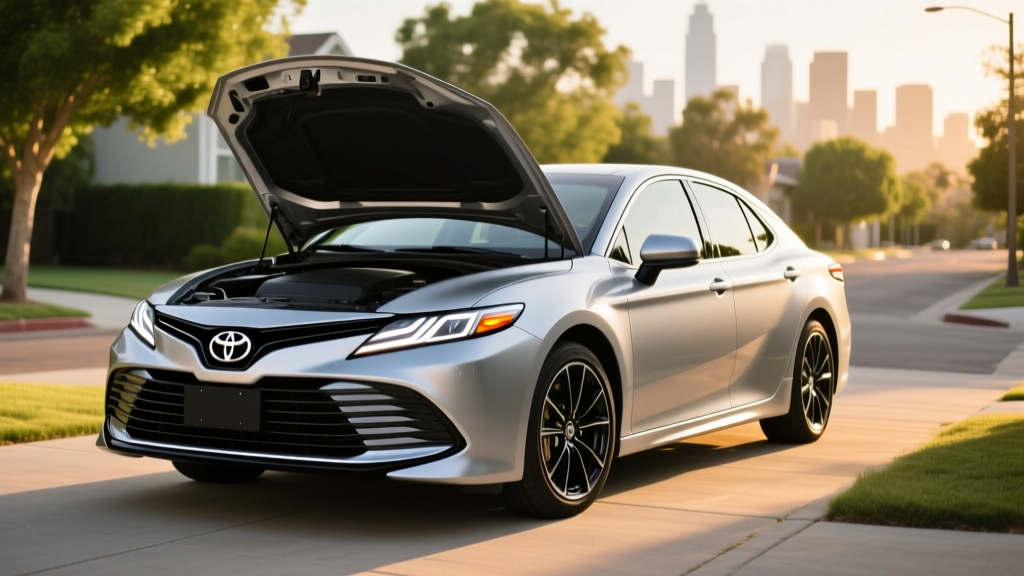
The Toyota Camry SE Hybrid occupies a specific lane in the midsize sedan market: sport-tuned suspension and aggressive styling wrapped around one of the most efficient powertrains Toyota has ever built. For the 2026 model year, the Camry lineup is hybrid-only — a decision that pays dividends at the pump without demanding you change how you drive or where you plug in. If you're researching the Toyota Camry SE Hybrid, you're likely weighing its real-world fuel economy against its sportier character and whether it makes more sense than a plug-in hybrid or full EV for your daily routine.
This guide covers the 2026 Camry SE Hybrid's EPA ratings versus real-world MPG, its fifth-generation hybrid powertrain, battery longevity and warranty, pricing across FWD and AWD configurations, and where it fits in the broader hybrid-vs-PHEV-vs-EV decision. All figures reflect current 2026 model-year specifications.
EPA Fuel Economy vs. Real-World MPG
The 2026 Camry SE Hybrid is available in both front-wheel drive (FWD) and electronic all-wheel drive (AWD) configurations, and the EPA numbers differ slightly between them. Here's the full breakdown from fueleconomy.gov:
| Configuration | City MPG | Highway MPG | Combined MPG |
|---|---|---|---|
| SE Hybrid FWD | 48 | 47 | 47 |
| SE Hybrid AWD | 46 | 46 | 46 |
Those numbers are exceptional for a midsize sedan with 225 combined horsepower. But the EPA sticker only tells part of the story.
Real-World MPG: What Owners Actually See
Toyota's hybrid system is at its best in stop-and-go city driving, where regenerative braking recaptures energy and the electric motor handles low-speed propulsion. Many Camry Hybrid owners report exceeding the EPA city estimate, with 50–53 MPG achievable on routes with frequent stops and moderate speeds.
Highway driving is a different calculus. At sustained 75–80 MPH, expect the SE Hybrid FWD to deliver approximately 40–44 MPG — below the EPA highway estimate. Aerodynamic drag and the gasoline engine doing more of the work at high speeds explain the shortfall. In cold weather (below 30°F), the engine runs more frequently to maintain cabin heat and battery temperature, which can drop combined real-world economy by 5–10 MPG on short trips.
EPA Combined: 47 MPG (FWD) / 46 MPG (AWD)
Expect in mixed real-world driving: 43–50 MPG depending on route mix, speed, and climate. City-heavy commuters will trend toward the high end; highway-dominant drivers toward the low end.
Fifth-Generation Hybrid Powertrain Specs
The 2026 Camry SE Hybrid uses Toyota's fifth-generation hybrid system, which pairs a 2.5-liter Dynamic Force inline-four engine with electric motors and a lithium-ion battery pack. Here's the complete powertrain breakdown:
| Specification | Detail |
|---|---|
| Engine | 2.5L inline-4 Dynamic Force (Atkinson cycle) |
| Engine Output | 184 HP / 163 lb-ft torque |
| Electric Motor (FWD) | 100 kW front motor |
| Electric Motor (AWD) | 100 kW front + 30 kW rear motor |
| Combined System Output | 225 HP (FWD) / 232 HP (AWD) |
| Hybrid Battery | Lithium-ion, ~1.6 kWh (self-charging HEV) |
| Transmission | eCVT (planetary gearset, no fixed gears) |
| 0–60 MPH | ~7.1 seconds (FWD) |
| Fuel Tank | 13.2 gallons |
| Total Driving Range | ~600–620 miles (FWD, EPA-based) |
| Drivetrain | FWD or electronic AWD (AWD adds rear motor) |
The SE trim specifically gets sport-tuned suspension with stiffer damping and a quicker steering ratio compared to the LE and XLE trims. It doesn't change the powertrain output, but it does make the Camry feel more responsive through corners — a meaningful distinction if you're choosing the SE over the softer-riding LE Hybrid.
HEV vs. PHEV: The Camry Is a Conventional Hybrid
A critical clarification: the 2026 Camry Hybrid is a conventional hybrid electric vehicle (HEV), not a plug-in hybrid (PHEV). You never plug it in. The battery recharges through regenerative braking and the gasoline engine. There is no electric-only driving mode beyond very low-speed maneuvers (typically under 25 MPH for short distances in EV mode).
- No plug-in required
- ~1.6 kWh battery (small)
- No electric-only highway range
- 47 MPG combined, always
- ~600+ mile total range
- No federal tax credit (§30D)
- Must plug in for EV range
- 14–18 kWh battery (large)
- 25–42 miles electric-only
- MPG after battery depletes: ~35–38
- 400–500 mile total range
- May qualify for $3,750–$7,500 credit
If you want electric-only commuting without range anxiety on road trips, a PHEV like the Toyota RAV4 Prime or a full BEV like the Tesla Model 3 might fit better. The Camry HEV's advantage is simplicity: it works like a gas car but sips fuel at roughly half the rate.
Pricing and Tax Credit Eligibility
The 2026 Camry SE Hybrid is positioned as the sport-oriented mid-tier trim. Here's the MSRP breakdown by configuration (destination charge included):
| Trim | MSRP | Federal Tax Credit |
|---|---|---|
| SE Hybrid FWD | $33,495 | Not eligible |
| SE Hybrid AWD | $34,995 | Not eligible |
Why the Camry Hybrid Doesn't Qualify for Federal Tax Credits
Under IRS §30D rules, the federal clean vehicle credit (up to $7,500) is available only for plug-in electric vehicles — battery electric vehicles (BEVs) and plug-in hybrids (PHEVs) with a minimum battery capacity of 7 kWh. The Camry Hybrid's ~1.6 kWh battery and lack of a charge port disqualify it entirely.
There is no federal tax credit for conventional hybrids in 2026. Some states and local utilities offer rebates for hybrid purchases, but these vary widely by jurisdiction. Check your state's energy office or utility provider for current programs.
Battery Longevity, Warranty, and Replacement Cost
Battery lifespan is consistently the top concern for hybrid buyers, and Toyota's track record here is among the best in the industry. The fifth-generation Camry Hybrid uses a lithium-ion pack that's smaller, lighter, and more durable than the nickel-metal hydride batteries in earlier generations.
10 years / 150,000 miles (whichever comes first) for the hybrid battery and all hybrid system components, including the inverter and electric motors. This applies nationwide for 2026 model-year vehicles.
Powertrain Warranty: 5 years / 60,000 miles
Basic Warranty: 3 years / 36,000 miles
How Long Does a Camry Hybrid Battery Actually Last?
Based on long-term fleet data from earlier Camry Hybrids and Prius models, Toyota's hybrid batteries routinely last 150,000–200,000+ miles before significant degradation. The battery management system keeps the state of charge within a narrow operating window (typically 40–80%), which dramatically reduces stress on the cells. Unlike a full EV battery that cycles through deep charge and discharge daily, the Camry's small HEV battery experiences shallow, frequent cycles — the least stressful usage pattern for lithium-ion chemistry.
If the battery does need replacement out of warranty, expect to pay approximately $2,500–$4,000 for a new OEM pack including labor at a Toyota dealer. Third-party remanufactured packs are available for $1,500–$2,500. Given the 10-year/150,000-mile warranty and the battery's demonstrated longevity, most original owners will never face this cost.
Reliability and Safety Ratings
Toyota consistently ranks at or near the top of long-term reliability surveys, and the Camry Hybrid benefits from a powertrain architecture that eliminates several common failure points: there's no traditional automatic transmission (the eCVT uses a simple planetary gearset with no clutches or bands to wear), no starter motor, no alternator, and the regenerative braking system significantly extends brake pad life.
The 2026 Camry comes standard with Toyota Safety Sense 3.0, which includes:
- Pre-Collision System with Pedestrian Detection
- Lane Departure Alert with Steering Assist
- Lane Tracing Assist (SAE Level 2 driver assist — requires hands on wheel)
- Dynamic Radar Cruise Control (full-speed adaptive)
- Road Sign Assist
- Automatic High Beams
- Proactive Driving Assist (gentle braking/steering support in specific scenarios)
The Camry has historically earned top marks from both NHTSA and IIHS. The SE trim's sport-tuned suspension doesn't compromise safety — it improves transient response during emergency maneuvers.
Ownership Economics: Camry HEV vs. Gas vs. EV
Let's put the Camry SE Hybrid's fuel savings into context with a 5-year ownership comparison. Assumptions: 15,000 miles/year, $3.40/gallon regular unleaded, $0.16/kWh electricity, no tax credits applied.
| Vehicle | Combined MPG / MPGe | Annual Fuel Cost | 5-Year Fuel Cost |
|---|---|---|---|
| Camry SE Hybrid (47 MPG) | 47 MPG | $1,085 | $5,425 |
| Typical Midsize Gas Sedan (30 MPG) | 30 MPG | $1,700 | $8,500 |
| Typical Midsize BEV (120 MPGe) | 120 MPGe | $560 | $2,800 |
The Camry Hybrid saves approximately $3,075 in fuel over 5 years compared to a comparable gas-only sedan. A full EV saves even more, but comes with a higher purchase price, charging infrastructure needs, and — depending on your state — higher registration fees and insurance premiums.
The Camry SE Hybrid's $33,495 MSRP is competitive with non-hybrid midsize sedans in the sport trim segment, meaning you're not paying a significant hybrid premium upfront. The fuel savings are essentially bonus value from day one.
Who Should Choose the Camry SE Hybrid?
- You want 45+ MPG without changing your fueling habits (no plugs, no apps, no charging networks)
- Your commute is city or suburban with frequent stops — this is where the hybrid system shines
- You want a 600+ mile driving range for road trips without planning charging stops
- You prefer Toyota's proven hybrid reliability and 10-year battery warranty
- You want sport-tuned handling (SE trim) without sacrificing efficiency
- You have home charging and a short commute (under 30 miles) — you could drive mostly on electricity
- You want to reduce gasoline use by 70–90% on daily drives
- You qualify for a federal or state PHEV tax credit that offsets the higher purchase price
- You have reliable home Level 2 charging
- Your daily driving is under 250 miles and you rarely take long road trips
- You want zero tailpipe emissions and the lowest per-mile fuel cost
- You want access to HOV lanes (available in some states for BEVs, not HEVs)
- 47 MPG combined is exceptional for a 225 HP midsize sedan
- No plug-in needed — zero lifestyle change from a gas car
- 600+ mile total range eliminates range anxiety entirely
- 10-year/150,000-mile hybrid battery warranty
- Sport-tuned suspension gives genuine handling edge over LE/XLE
- Toyota Safety Sense 3.0 standard on all trims
- Proven long-term reliability track record
- No federal tax credit eligibility (HEV, not PHEV/BEV)
- Highway MPG falls short of EPA estimate at 75+ MPH
- Cold weather reduces efficiency noticeably on short trips
- No electric-only driving mode for emissions-free short trips
- eCVT drone under hard acceleration (inherent to planetary gearset)
- AWD adds ~1 MPG penalty and $1,500 to price
Frequently Asked Questions
How many MPG does the 2026 Toyota Camry SE Hybrid get?
The Camry SE Hybrid FWD is EPA-rated at 48 city / 47 highway / 47 combined MPG. The AWD version rates 46/46/46. In real-world driving, city-heavy commuters often see 50+ MPG, while highway-dominant drivers at higher speeds should expect 40–44 MPG.
Is the Camry SE Hybrid a plug-in hybrid?
No. The Camry Hybrid is a conventional hybrid (HEV). It charges its own battery through regenerative braking and the gasoline engine. There is no plug, no charging cable, and no electric-only driving range to manage. If you want plug-in capability, look at the Toyota RAV4 Prime or Prius Prime.
Does the Camry Hybrid qualify for any federal tax credit?
No. Under current IRS §30D rules, the federal clean vehicle credit applies only to plug-in vehicles (BEVs and PHEVs) with a battery capacity of at least 7 kWh. The Camry Hybrid's ~1.6 kWh battery does not qualify. Some states or utilities may offer hybrid rebates — check locally.
How long will the Camry Hybrid battery last, and what does replacement cost?
Toyota's hybrid batteries are engineered for longevity, with real-world data showing 150,000–200,000+ miles of service life. The battery is covered by a 10-year/150,000-mile warranty. Out-of-warranty replacement costs approximately $2,500–$4,000 for an OEM pack. Most original owners will never need to replace it.
Is the Camry SE Hybrid reliable?
Toyota's hybrid powertrain is one of the most thoroughly proven in the automotive industry, with over 25 years of continuous refinement since the original Prius. The eCVT eliminates traditional transmission wear points, regenerative braking extends brake pad life, and Toyota consistently ranks at or near the top in J.D. Power and Consumer Reports reliability surveys. The Camry Hybrid is widely regarded as one of the most dependable vehicles in its class.
What's the difference between the Camry SE Hybrid and the LE Hybrid?
Both share the same 225 HP hybrid powertrain and similar EPA fuel economy (the LE rates slightly higher at 51/49/50 MPG due to lighter wheels and less aggressive tires). The SE adds sport-tuned suspension, a rear spoiler, 19-inch alloy wheels, paddle shifters, and a sport steering wheel. The trade-off is a slightly firmer ride and marginally lower EPA ratings.
Hybrid vs. PHEV vs. EV — which should I choose?
The right choice depends on your charging access and driving patterns. If you cannot charge at home and take frequent long trips, the Camry HEV is the pragmatic choice — maximum efficiency, zero infrastructure change. If you can charge at home and commute under 30 miles, a PHEV lets you drive mostly electric while keeping gas for road trips. If you have home charging, mostly drive under 250 miles daily, and want the lowest running costs, a full BEV delivers the best economics long-term — though at a higher upfront price.