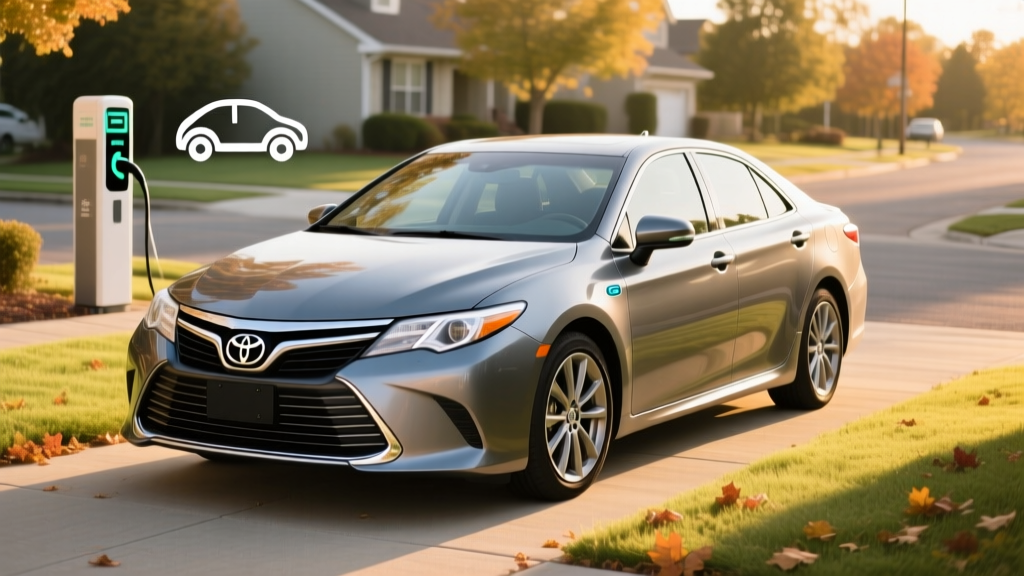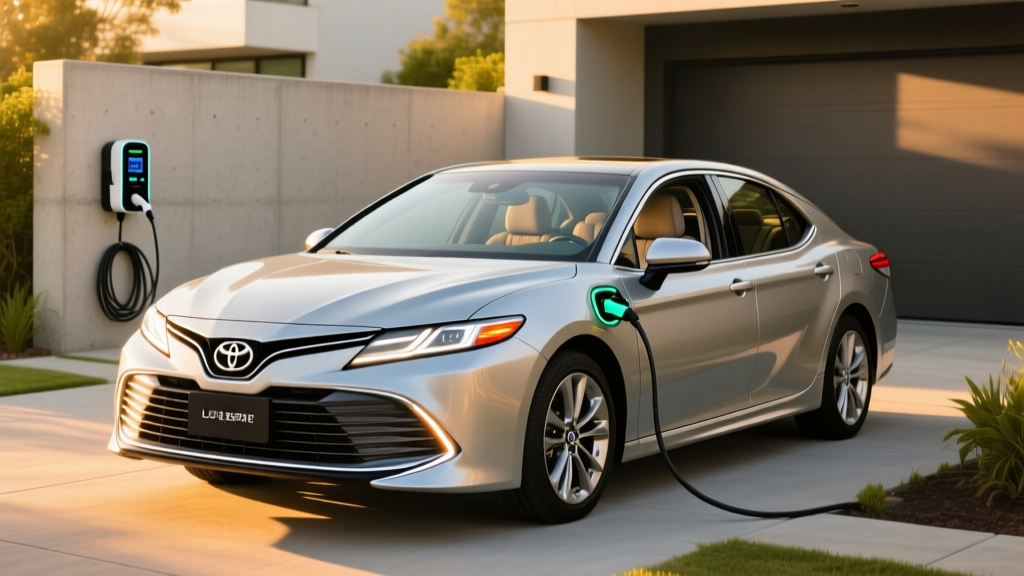
The 2026 Toyota Camry LE Hybrid sits at the intersection of practicality and efficiency that few midsize sedans can match. With the entire Camry lineup now hybrid-only for the current generation, the LE trim serves as the entry point to Toyota's fifth-generation hybrid system — delivering EPA-estimated fuel economy that routinely embarrasses vehicles costing twice as much at the pump. But sticker MPG is only the starting point. This guide breaks down the exact numbers, real-world expectations, battery longevity, and ownership economics you need before signing the paperwork.
2026 Camry LE Hybrid at a Glance: Key Specs
| Specification | 2026 Camry LE Hybrid (FWD) | 2026 Camry LE Hybrid (AWD) |
|---|---|---|
| Powertrain | 2.5L 4-cyl + electric motor | 2.5L 4-cyl + dual electric motors |
| Combined Horsepower | 225 hp | 232 hp |
| EPA City MPG | 51 | 47 |
| EPA Highway MPG | 49 | 46 |
| EPA Combined MPG | 50 | 46 |
| Fuel Tank Capacity | 13.2 gallons | 13.2 gallons |
| Estimated Total Range | ~660 miles | ~607 miles |
| 0–60 mph (est.) | ~7.2 seconds | ~6.9 seconds |
| Hybrid Battery | Lithium-ion, ~1.0 kWh (nominal) | Lithium-ion, ~1.0 kWh (nominal) |
| Drivetrain | Front-wheel drive | Electronic AWD |
| Starting MSRP | ~$29,995 | ~$31,395 |
| Hybrid Battery Warranty | 10 years / 150,000 miles | 10 years / 150,000 miles |
The Camry LE Hybrid is a conventional hybrid electric vehicle (HEV) — not a plug-in. It charges its own battery through regenerative braking and the gasoline engine. You never plug it in, and there is no electric-only driving mode of any meaningful distance. This distinction matters because buyers sometimes confuse HEVs with plug-in hybrids (PHEVs) like the now-discontinued Toyota Prius Prime or the RAV4 Prime, which offer 25–42 miles of electric-only range and require external charging.
Real-World MPG: What the Camry LE Hybrid Actually Delivers
The EPA rates the 2026 Camry LE Hybrid FWD at 51 city / 49 highway / 50 combined MPG. Those are exceptional numbers for a midsize sedan, but how do they translate to real-world driving?
EPA Combined: 50 MPG (FWD) / 46 MPG (AWD)
Real-World Expectation: Most drivers report 46–53 MPG in mixed driving. City-heavy routes often exceed the EPA city estimate because Toyota's hybrid system thrives in stop-and-go traffic where regenerative braking is constant. Highway-only driving at 75+ mph typically yields 42–46 MPG as aerodynamic drag reduces the hybrid system's advantage.
Cold-Weather Impact: Expect a 5–10% reduction in MPG during winter months (roughly 43–47 MPG combined FWD). The engine runs more frequently to generate cabin heat and keep the catalytic converter warm, reducing electric-motor duty cycles.
| Driving Scenario | FWD Expected MPG | AWD Expected MPG |
|---|---|---|
| City / stop-and-go | 49–54 | 45–50 |
| Suburban mixed | 48–52 | 44–48 |
| Highway (65 mph) | 46–49 | 43–46 |
| Highway (75+ mph) | 42–46 | 40–44 |
| Cold weather (mixed) | 43–47 | 40–44 |
The Camry Hybrid's city MPG advantage over its highway number is a hallmark of Toyota's series-parallel hybrid architecture. At low speeds, the electric motor handles most propulsion while the engine operates only at its most efficient RPM to generate electricity. On the highway, the gasoline engine does the heavy lifting directly, and the electric motor plays a supporting role.
Powertrain Deep Dive: Toyota's Fifth-Generation Hybrid System
The 2026 Camry LE Hybrid uses Toyota's fifth-generation hybrid synergy drive, which pairs a 2.5-liter Dynamic Force four-cylinder engine with one or two electric motors depending on drivetrain configuration.
- Gasoline Engine: 2.5L inline-4, Atkinson cycle, producing approximately 184 hp and 163 lb-ft of torque on its own
- Front Electric Motor: Integrated into the transaxle, contributing to a combined system output of 225 hp (FWD)
- Rear Electric Motor (AWD only): A separate rear-mounted motor provides electronic all-wheel drive by powering the rear axle when slip is detected, bumping combined output to 232 hp
- Transmission: Electronically controlled continuously variable transmission (eCVT) — a planetary gearset, not a belt-driven CVT
The eCVT deserves emphasis: unlike the rubber-belt CVTs found in some competitors, Toyota's planetary gearset has no belts or pulleys to wear. It is one of the most durable transmission designs in the industry and a significant factor in the Camry Hybrid's long-term reliability reputation.
The AWD system is not a mechanical all-wheel-drive setup with a driveshaft. Instead, the rear electric motor activates automatically when the front wheels lose traction — during rain, snow, or hard acceleration. It disengages during steady-state cruising to preserve fuel economy. This means the AWD Camry Hybrid sacrifices a few MPG compared to FWD but gains meaningful traction confidence in inclement weather without the parasitic losses of a traditional AWD system.
HEV vs. PHEV vs. Full EV: Which Powertrain Fits You?
| Factor | HEV (Camry Hybrid) | PHEV (e.g., RAV4 Prime) | Full EV (e.g., Tesla Model 3) |
|---|---|---|---|
| Plug-in charging required? | No | Yes (for EV range) | Yes (always) |
| Electric-only range | None (EV assists only) | 25–42 miles typical | 250–360+ miles |
| Total range | ~600–660 miles | ~400–500+ miles | 250–360+ miles |
| Home charging needed? | No | Recommended (Level 2) | Essential (Level 2) |
| Federal tax credit (§30D) | Not eligible | Up to $7,500 (if eligible) | Up to $7,500 (if eligible) |
| Best for | No home charging access; high-mileage drivers | Short commutes + road-trip flexibility | Home charging + mostly under 300 mi/day |
| Fuel/energy cost per mile | ~$0.07–0.09 | ~$0.03–0.05 (EV mode) | ~$0.03–0.05 |
The Camry LE Hybrid is the right choice if you cannot install a home charger (apartment living, street parking, no garage), drive high annual mileage where fuel savings compound quickly, or simply want maximum simplicity with zero behavior change from a gas car. You fuel up at any gas station, never think about charging, and still achieve roughly half the fuel consumption of a comparable gas-only midsize sedan.
Choose a PHEV if you have a short commute (under 30 miles each way), access to Level 2 home charging, and want electric-only daily driving with a gas engine for longer trips. Choose a full EV if you have reliable home charging, mostly drive under 300 miles per day, and want the lowest per-mile energy cost and zero tailpipe emissions.
Pricing, Trims, and Tax Credit Eligibility
The 2026 Camry LE Hybrid starts at approximately $29,995 MSRP for FWD and $31,395 for AWD, including destination charge. The LE is the base trim in the hybrid-only Camry lineup, with higher trims (SE, XLE, XSE) adding sport-tuned suspension, larger wheels, premium audio, and upgraded interior materials at progressively higher prices.
The Camry LE Hybrid is a conventional hybrid (HEV), not a plug-in electric vehicle. Under IRS §30D rules, only battery electric vehicles (BEVs) and plug-in hybrids (PHEVs) with sufficient battery capacity qualify for the federal clean vehicle credit. The Camry Hybrid's small lithium-ion battery pack does not meet the minimum capacity threshold, and the vehicle cannot be plugged in.
State incentives: A small number of states offer modest rebates or HOV-lane access for conventional hybrids, but these programs are increasingly rare as incentive budgets shift toward PHEVs and BEVs. Check your state's energy office or DMV website for current programs.
While the lack of a federal tax credit stings compared to a PHEV or EV, the Camry Hybrid's lower base price partially offsets this. A comparably equipped RAV4 Prime PHEV starts above $44,000 before any credits, making the Camry Hybrid roughly $14,000 less expensive upfront — a gap that takes years of fuel savings to close even with the PHEV's electric-only commuting advantage.
Battery Longevity, Warranty, and Replacement Costs
Hybrid battery anxiety is the single most common concern among first-time hybrid buyers. Here are the facts for the 2026 Camry LE Hybrid:
- Battery chemistry: Lithium-ion (current-generation; earlier Camry Hybrids used NiMH)
- Battery capacity: Approximately 1.0 kWh nominal — far smaller than a PHEV or EV battery
- Federal warranty mandate: 8 years / 100,000 miles (minimum required by EPA/CARB emissions warranty rules)
- Toyota's actual warranty: 10 years / 150,000 miles for the hybrid battery on all 2020+ Toyota hybrids
- Real-world degradation: Toyota's hybrid batteries are engineered to retain sufficient capacity for the life of the vehicle. The small battery is never fully charged or fully discharged — the system maintains a roughly 40–80% state-of-charge window, dramatically reducing stress and degradation
For context, Toyota has been building Camry Hybrids since 2007. Taxis and high-mileage fleet examples routinely exceed 300,000 miles on the original hybrid battery. The battery management system's conservative charge window, combined with active thermal management, means catastrophic battery failure within the first 15 years is uncommon.
Replacement cost if out of warranty: A new OEM hybrid battery pack for the current-generation Camry Hybrid typically costs between $2,000 and $3,500 installed at a dealership. Independent hybrid specialists and refurbished battery options can reduce this to $1,200–$2,000. This is a fraction of EV battery replacement costs (which can exceed $10,000–$20,000) because the hybrid battery is physically small.
Reliability, Safety, and Ownership Costs
The Camry nameplate carries one of the strongest reliability reputations in the automotive industry, and the hybrid variant benefits from a powertrain with fewer wear items than a conventional gas car:
- No traditional starter motor — the hybrid motor-generator starts the engine
- No alternator — the hybrid system handles all electrical generation
- No accessory belt — the water pump and A/C compressor are electrically driven
- Regenerative braking extends brake pad life significantly; many owners report 80,000+ miles on original brake pads
- eCVT planetary gearset has no belts or clutches to wear
On the safety front, the 2026 Camry comes standard with Toyota Safety Sense 3.0, which includes automatic emergency braking with pedestrian detection, lane departure alert with steering assist, full-speed adaptive cruise control, lane tracing assist, and road sign assist. The Camry has consistently earned top marks from both the IIHS and NHTSA.
5-Year Estimated Ownership Cost (15,000 miles/year):
| Cost Category | Camry LE Hybrid (FWD) | Comparable Gas Sedan (30 MPG) |
|---|---|---|
| Fuel (75,000 mi total) | ~$5,250 (at $3.50/gal, 50 MPG) | ~$8,750 (at $3.50/gal, 30 MPG) |
| Fuel savings over 5 years | ~$3,500 saved with hybrid | |
| Maintenance (estimated) | ~$2,200 | ~$2,800 |
| Insurance (avg. national) | ~$7,500 | ~$7,200 |
| Depreciation (est. 5-yr) | ~$12,000 | ~$13,500 |
The Camry Hybrid typically costs slightly more to insure than its gas equivalent due to higher repair costs for hybrid-specific components, but the fuel and maintenance savings more than offset this. Toyota hybrids also tend to hold resale value well, as the used market increasingly recognizes hybrid reliability.
Pros and Cons: 2026 Camry LE Hybrid
Pros
- 50 MPG combined EPA — among the best of any midsize sedan
- No plug-in charging required; zero behavior change from a gas car
- 660-mile total range between fill-ups
- 10-year / 150,000-mile hybrid battery warranty
- Proven reliability with decades of hybrid refinement
- Standard Toyota Safety Sense 3.0 ADAS suite
- Lower starting price than PHEV or EV alternatives
- AWD option available for inclement-weather traction
Cons
- Not eligible for the $7,500 federal EV tax credit
- No electric-only driving mode (EV assist only at low speeds)
- AWD reduces fuel economy by ~4 MPG combined
- eCVT can produce a droning engine note under hard acceleration
- LE base trim lacks premium features found on XLE/XSE
- Hybrid battery replacement ($2,000–$3,500) if it fails post-warranty
Frequently Asked Questions
How many MPG does the 2026 Camry LE Hybrid get?
The EPA rates the FWD Camry LE Hybrid at 51 city / 49 highway / 50 combined MPG. The AWD version is rated at 47 city / 46 highway / 46 combined. In real-world driving, most owners report 46–53 MPG in mixed conditions, with city-heavy routes often exceeding the EPA estimate.
Does the Camry Hybrid need to be plugged in?
No. The Camry LE Hybrid is a conventional hybrid (HEV). It charges its battery through regenerative braking and the gasoline engine. You never plug it in. If you want plug-in capability with electric-only range, you would need a PHEV like the Toyota RAV4 Prime or Prius Prime.
How long will the Camry Hybrid battery last?
Toyota warranties the hybrid battery for 10 years or 150,000 miles, whichever comes first. In practice, Toyota hybrid batteries routinely last 15+ years and 200,000+ miles. The system's conservative charge management (keeping the battery between roughly 40–80% state of charge) minimizes degradation. If replacement is eventually needed, expect to pay $2,000–$3,500 for a new OEM battery installed.
Does the Camry LE Hybrid qualify for any tax credit?
No. Under current IRS §30D rules, the federal clean vehicle credit applies only to plug-in electric vehicles (BEVs and PHEVs) meeting battery capacity, critical-mineral sourcing, MSRP cap, and buyer income requirements. The Camry Hybrid is a conventional HEV and does not qualify. Some states may offer minor hybrid incentives — check your state energy office.
Camry Hybrid vs. a full EV: which should I choose?
Choose the Camry Hybrid if you lack home charging access, regularly drive more than 300 miles between stops, live in an area with sparse public charging infrastructure, or want zero change to your fueling routine. Choose a full EV if you can install a Level 2 home charger, mostly drive under 250 miles per day, and want the lowest per-mile energy cost and zero tailpipe emissions. The Camry Hybrid is also $10,000–$20,000 less expensive upfront than most comparable EVs.
Is the AWD version worth the MPG trade-off?
If you regularly drive in snow, rain, or on unpaved roads, the AWD system's traction benefit is worth the 4 MPG combined penalty. The electronic AWD adds a rear electric motor that engages automatically when front-wheel slip is detected — it is not a full-time system, so the efficiency loss is modest. For dry-climate drivers who rarely encounter low-traction conditions, the FWD model's superior fuel economy is the better value.
How does the Camry Hybrid compare to the Honda Accord Hybrid?
The 2026 Honda Accord Hybrid is rated at approximately 48 city / 47 highway / 48 combined MPG for its base trim — roughly 2 MPG combined behind the Camry LE Hybrid FWD. Both use proven hybrid systems with strong reliability records. The Camry holds a slight fuel-economy edge and offers an AWD option the Accord does not. The Accord Hybrid counters with a slightly more engaging driving feel and a larger trunk. Cross-shop both and prioritize the features that matter most to you.
Sources: EPA Fuel Economy (fueleconomy.gov), Toyota Motor Corporation specifications, IRS Clean Vehicle Credits (irs.gov), IIHS, NHTSA. Pricing and incentive information reflects 2026 model year data and is subject to change. Verify tax credit eligibility with a qualified tax professional.