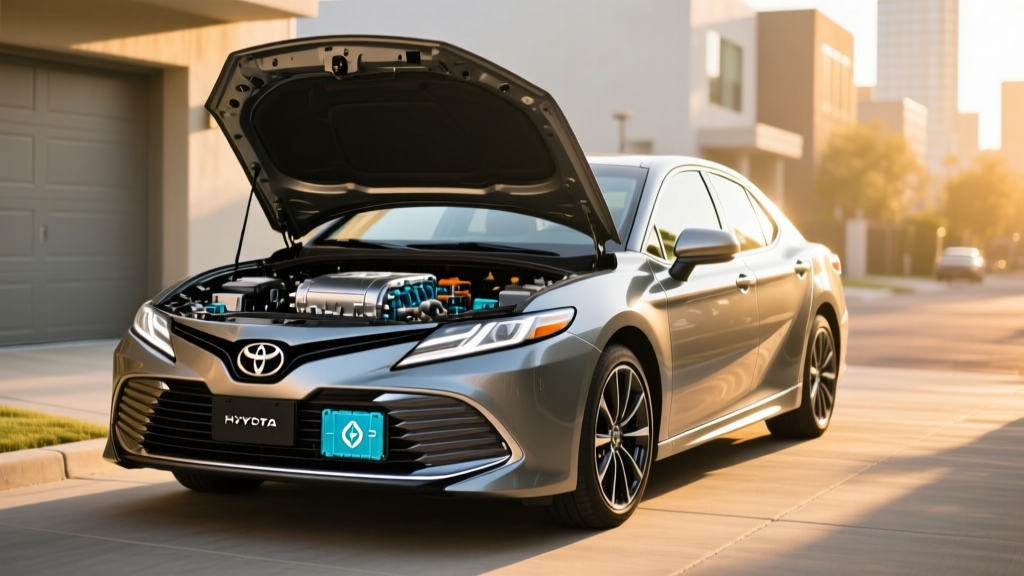
The 2026 Toyota Camry is now exclusively a hybrid. Gone are the V6 and four-cylinder gas-only variants — every Camry rolling off the line carries Toyota's fifth-generation hybrid system. For midsize sedan shoppers, the Toyota Camry hybrid powertrain is no longer an option to consider; it's the only game in town. That makes understanding exactly what you're getting — efficiency numbers, powertrain architecture, battery longevity, and ownership costs — more critical than ever.
This guide breaks down the engineering, the real-world fuel economy, the warranty coverage that protects the hybrid battery, and how the Camry Hybrid stacks up against plug-in hybrids and full battery-electric vehicles. If you're deciding whether this is the right electrified car for your driveway, the data below will make that call straightforward.
HEV vs. PHEV vs. EV: Where the Camry Hybrid Fits
Before examining the powertrain itself, it's worth clarifying what the Camry Hybrid is — and what it isn't. The Camry is a conventional hybrid electric vehicle (HEV). It cannot be plugged in. There is no charging port, no electric-only range to manage, and no dependency on charging infrastructure. The car generates all its electrical energy internally through regenerative braking and the gasoline engine.
HEV vs. PHEV vs. BEV — Quick Reference
| Feature | HEV (Camry Hybrid) | PHEV (e.g., Prius Prime) | BEV (e.g., Tesla Model 3) |
|---|---|---|---|
| Plugs in? | No | Yes | Yes |
| Electric-only range | ~1 mi (low-speed assist) | 30–45 mi typical | 250–350+ mi |
| Fuel needed? | Yes, always | Yes, for longer trips | No |
| Charging infra needed? | None | Helpful (Level 1/2) | Essential |
| Federal tax credit (§30D) | Not eligible | Up to $7,500 if eligible | Up to $7,500 if eligible |
The Camry Hybrid trades electric-only capability for zero lifestyle change — just gas up and drive.
Inside the Toyota Camry Hybrid Powertrain
The 2026 Camry uses Toyota's fifth-generation Hybrid Synergy Drive. The front-wheel-drive (FWD) models pair a 2.5-liter Dynamic Force inline-four engine with two motor-generators (MG1 and MG2) routed through an e-CVT planetary gearset. All-wheel-drive (AWD) trims add a third electric motor (40 hp) on the rear axle — there is no mechanical driveshaft connecting the engine to the rear wheels.
| Specification | FWD | AWD |
|---|---|---|
| Combined system horsepower | 225 hp | 232 hp |
| Engine | 2.5L I-4 (184 hp, 163 lb-ft) | 2.5L I-4 (184 hp, 163 lb-ft) |
| Front electric motor (MG2) | 134 hp, 155 lb-ft | 134 hp, 155 lb-ft |
| Rear electric motor (AWD only) | N/A | 40 hp, 89 lb-ft |
| Transmission | e-CVT (planetary gearset) | e-CVT (planetary gearset) |
| Hybrid battery | ~1.6 kWh lithium-ion | ~1.6 kWh lithium-ion |
| 0–60 mph (est.) | ~7.1 sec | ~6.9 sec |
The 2.5-liter Dynamic Force engine operates on the Atkinson cycle, which sacrifices some low-end torque for greater thermal efficiency — Toyota rates this engine at roughly 40% peak thermal efficiency, among the highest of any mass-production internal combustion engine. The electric motors fill in the torque gap at low speeds, which is why the Camry Hybrid feels surprisingly responsive from a stop despite modest peak horsepower.
The lithium-ion hybrid battery pack sits under the rear seat. At roughly 1.6 kWh, it's tiny compared to a PHEV (13–18 kWh) or a BEV (60–90 kWh). It's not designed to propel the car on electricity alone for meaningful distances — its job is to buffer energy captured from regenerative braking and smooth the engine's power delivery. You'll never need to think about it during normal driving.
Fuel Economy: EPA Ratings and Real-World MPG
The headline number is why buyers choose the Camry Hybrid. Here's the EPA-rated breakdown by drivetrain, sourced from fueleconomy.gov:
| Drivetrain | City | Highway | Combined |
|---|---|---|---|
| FWD (LE/SE) | 53 MPG | 50 MPG | 51 MPG |
| AWD (SE/XLE/XSE) | 51 MPG | 49 MPG | 50 MPG |
Real-World MPG: What Owners Actually See
Hybrids are one of the few vehicle categories where real-world city driving often exceeds the EPA city rating. That's because stop-and-go traffic maximizes regenerative braking and electric-motor assist while minimizing engine runtime. Owners who do predominantly city and suburban driving frequently report 54–58 MPG on the FWD model.
Highway driving is a different story. At sustained 70–80 mph speeds, the electric motor contributes less and the engine does most of the work, so the Camry Hybrid's advantage over a conventional gas sedan narrows. Expect 44–48 MPG on extended highway trips at 75+ mph — still excellent for a midsize sedan, but below the sticker. In cold weather (below 30°F), the engine runs more frequently to maintain cabin heat and catalytic converter temperature, dropping combined economy by roughly 5–8 MPG until the car is fully warmed up.
Battery Warranty, Lifespan, and Replacement Cost
The hybrid battery is the single biggest concern for prospective buyers — and the area where Toyota's track record provides the most reassurance. Toyota's hybrid battery warranty has been upgraded in recent model years and now covers:
Toyota Hybrid Battery Warranty
- Coverage: 10 years / 150,000 miles (whichever comes first)
- Applies to: Hybrid battery pack, hybrid control module, and related hybrid-system components
- Transferable: Yes, to subsequent owners at no cost
- Capacity threshold: Toyota replaces the battery if it fails to hold sufficient charge to operate the hybrid system normally
Beyond the warranty, Toyota's hybrid batteries have a strong longevity record. The Prius — which uses similar architecture — commonly reaches 200,000+ miles on its original battery pack. The Camry Hybrid's smaller, less stressed battery should follow a similar pattern.
If the Battery Does Need Replacement
Out-of-warranty hybrid battery replacement for the Camry runs approximately $2,000–$4,000 at a Toyota dealership, depending on labor rates and whether a new or remanufactured pack is used. Independent hybrid specialists often offer remanufactured battery replacements for $1,500–$2,500. Individual cell module replacement — which addresses a single failed cell rather than the entire pack — can cost as little as $500–$800 at a specialist shop.
For context, that's a fraction of the cost of a BEV battery replacement ($10,000–$20,000+) and comparable to a major engine repair on a conventional car. Given the 10-year/150,000-mile warranty and Toyota's reliability history, most original owners will never face this expense.
2026 Camry Hybrid Pricing and Tax Credit Eligibility
The 2026 Camry Hybrid lineup starts at approximately $29,995 for the LE FWD trim (including destination charge) and climbs to around $36,500 for the fully equipped XSE AWD. Here's the approximate trim breakdown:
- LE FWD: ~$29,995
- SE FWD: ~$31,495
- SE AWD: ~$32,895
- XLE FWD: ~$33,495
- XLE AWD: ~$34,895
- XSE AWD: ~$36,495
Does the Camry Hybrid Qualify for a Federal Tax Credit?
No. The Camry Hybrid is a conventional HEV and does not qualify for the IRS §30D Clean Vehicle Credit. That credit — up to $7,500 — is reserved for plug-in electric vehicles (PHEVs and BEVs) that meet battery capacity, critical-mineral sourcing, MSRP cap, and buyer income requirements. The Camry Hybrid has no plug and a battery far too small to meet the §30D minimum 7 kWh threshold.
Some states and local utilities offer modest rebates for conventional hybrids, but these are typically $250–$500 and vary by jurisdiction. Check your state energy office or utility provider for current programs. For the latest federal credit rules, consult the IRS qualified vehicles page.
Camry Hybrid vs. PHEV vs. BEV: Which Should You Buy?
The right electrified vehicle depends on your driving pattern, charging access, and budget. Here's a practical decision framework:
Choose the Camry Hybrid (HEV) If:
- You lack home or workplace charging access (apartment, street parking)
- You want maximum MPG with zero behavior change
- You regularly take long road trips and don't want to plan charging stops
- Your budget is under $37,000 and you don't qualify for EV tax credits
- You live in an area with sparse public charging infrastructure
Choose a PHEV (e.g., Toyota Prius Prime) If:
- You can charge at home (even a standard 120V outlet works for PHEVs)
- Your daily commute is under 40 miles round-trip (run mostly on electricity)
- You still want gas-engine flexibility for weekend road trips
- You want the §30D federal tax credit (up to $7,500, subject to eligibility)
Choose a BEV (e.g., Tesla Model 3, Hyundai Ioniq 6) If:
- You have reliable home Level 2 charging
- You want to eliminate gasoline entirely and minimize fuel cost per mile
- You want the lowest maintenance costs (no oil changes, fewer moving parts)
- You qualify for the full §30D credit and can absorb higher upfront cost
Reliability and Long-Term Ownership Costs
Toyota's hybrid system is one of the most proven powertrains in automotive history. The Prius has been in continuous production since 1997, and the core planetary-gearset e-CVT design has remained fundamentally unchanged because it works — there are no belts to break, no clutch packs to wear, and no traditional transmission fluid to change on a fixed schedule.
The Camry Hybrid benefits from this maturity. Key reliability advantages include:
- e-CVT durability: The planetary gearset has no friction bands or torque converter — fewer failure points than a conventional automatic
- Reduced brake wear: Regenerative braking handles most deceleration, so friction brake pads commonly last 80,000–100,000+ miles
- No starter motor or alternator: MG1 handles engine starting and electrical generation — two common failure points on gas cars are eliminated
- Engine longevity: The Atkinson-cycle 2.5L runs below peak stress in normal driving, with the electric motor supplementing acceleration loads
Over a 5-year/60,000-mile ownership period, the Camry Hybrid FWD at 51 MPG combined burns roughly 882 gallons of fuel. At a national average of $3.40/gallon, that's about $2,999 in fuel costs. A comparable gas-only midsize sedan at 30 MPG combined would burn 1,500 gallons — $5,100. That's roughly $2,100 in fuel savings over five years, or $420 annually, before accounting for the Camry Hybrid's slightly higher purchase price.
Pros
- 51 MPG combined FWD — best in midsize sedan class
- No charging infrastructure required
- 10-year / 150,000-mile hybrid battery warranty
- AWD available (rare for hybrid sedans)
- Strong resale value and proven reliability
- Low brake wear from regenerative braking
Cons
- No federal tax credit (HEV, not PHEV/BEV)
- Highway MPG drops to mid-40s at 75+ mph
- AWD costs ~$1,400 more and loses 1 MPG
- e-CVT can drone under hard acceleration
- No EV mode for zero-emission short trips
- Higher base price than outgoing gas-only Camry
Frequently Asked Questions
How many MPG does the 2026 Toyota Camry Hybrid get?
The FWD Camry Hybrid is EPA-rated at 53 city / 50 highway / 51 combined MPG. The AWD version drops slightly to 51 city / 49 highway / 50 combined. Real-world city driving often yields 54–58 MPG thanks to regenerative braking, while sustained highway driving at 75+ mph typically returns 44–48 MPG.
Does the Camry Hybrid need to be plugged in?
No. The Camry Hybrid is a conventional HEV with no charging port. It generates electricity through regenerative braking and the gasoline engine. You simply fill it with regular unleaded fuel and drive — no behavior change is required.
How far can the Camry Hybrid go on electric power alone?
Effectively less than one mile, and only at very low speeds (under 25 mph) in specific conditions like creeping through a parking lot. The 1.6 kWh battery is not designed for meaningful electric-only propulsion. If you want 30–40 miles of electric-only range, you need a PHEV like the Toyota Prius Prime.
Is the Camry Hybrid reliable, and what does a battery replacement cost?
Toyota's hybrid system is among the most reliable powertrains available, with a 25+ year track record starting with the Prius. The hybrid battery carries a 10-year / 150,000-mile warranty. If replacement is needed out of warranty, expect $2,000–$4,000 at a dealer or $1,500–$2,500 at an independent hybrid specialist. Most owners never need a replacement.
Does the 2026 Camry Hybrid qualify for a federal tax credit?
No. The IRS §30D Clean Vehicle Credit requires a plug-in vehicle with a battery capacity of at least 7 kWh. The Camry Hybrid's ~1.6 kWh battery and lack of a charging port make it ineligible. The credit applies to qualifying PHEVs and BEVs only. Check the IRS website for current eligible vehicle lists and income/MSRP caps.
Is AWD worth the cost on the Camry Hybrid?
AWD adds approximately $1,400 to the price and costs 1 MPG combined (50 vs. 51). The rear electric motor provides 40 hp for traction in rain and light snow, but it's not a substitute for a dedicated AWD SUV in deep winter conditions. If you live in a mild climate, FWD is the more economical choice. If you deal with snowy winters and want extra confidence without moving to an SUV, AWD is a reasonable upgrade.
What's the total driving range on a full tank?
The Camry Hybrid has a 13.2-gallon fuel tank. At the FWD EPA combined rating of 51 MPG, that yields approximately 673 miles of total range — one of the longest ranges of any vehicle on the road, and far more than most BEVs offer between charges.
Sources: EPA fuel economy data from fueleconomy.gov; vehicle specifications from Toyota Motor North America; federal tax credit rules from irs.gov. Pricing reflects approximate MSRP including destination for the 2026 model year and is subject to change. Always verify current incentive eligibility with a tax professional.