Quick Verdict: The Camry Hybrid's MPG Story in 2026
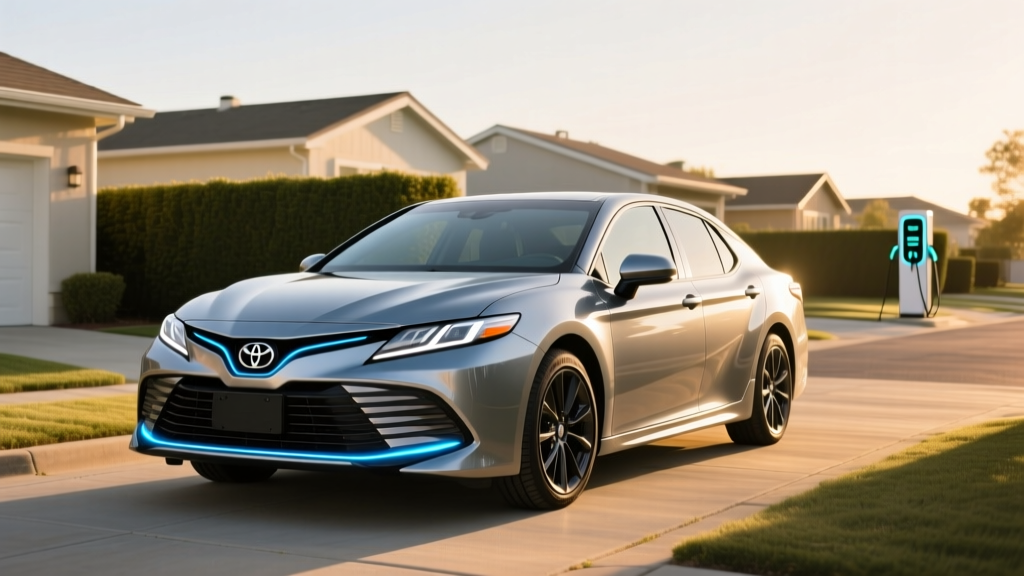
The 2026 Toyota Camry is now exclusively a hybrid. Toyota dropped the four-cylinder gas-only powertrain entirely, making every Camry on dealer lots a hybrid electric vehicle (HEV). For shoppers searching for Toyota Camry mpg hybrid data, the headline number is compelling: up to 53 mpg city, 50 mpg highway, and 51 mpg combined on front-wheel-drive trims, per the EPA.
That's not a laboratory fantasy, either. Toyota's fifth-generation hybrid system pairs a 2.5-liter four-cylinder engine with electric motors in a way that actually overdelivers in stop-and-go traffic — the exact scenario where conventional gas cars burn the most fuel. We'll break down the real-world MPG you can expect, what powers these numbers, battery longevity concerns, and whether the Camry Hybrid is the right electrified choice for your commute versus a PHEV or full EV.
2026 Toyota Camry Hybrid MPG: EPA Numbers and Real-World Results
The 2026 Camry Hybrid comes in multiple trims, and MPG varies slightly depending on drivetrain (FWD vs. AWD) and wheel size. Here's the complete EPA breakdown:
| Trim / Drivetrain | City MPG | Highway MPG | Combined MPG |
|---|---|---|---|
| LE (FWD) | 53 | 50 | 51 |
| SE / XLE / XSE (FWD) | 48 | 47 | 47 |
| LE (AWD) | 51 | 49 | 50 |
| SE / XLE / XSE (AWD) | 46 | 46 | 46 |
The reason the Camry Hybrid excels in city driving is regenerative braking and electric-motor-only operation at low speeds. Every time you lift off the accelerator or brake, kinetic energy recharges the hybrid battery instead of wasting as heat through friction brakes. At stoplights and in traffic under ~25 mph, the car often runs on the electric motor alone, burning zero gasoline.
Hybrid (HEV) vs. Plug-In Hybrid (PHEV): Where the Camry Fits
The 2026 Camry is a conventional hybrid (HEV), not a plug-in hybrid. This is a critical distinction that trips up many shoppers.
HEV vs. PHEV — Key Differences
| Feature | Conventional Hybrid (HEV) | Plug-In Hybrid (PHEV) |
|---|---|---|
| Plug in to charge? | No — charges via regen & engine | Yes — plug in for electric-only range |
| Electric-only driving | Very short distances at low speed | 20-50 miles at full highway speed |
| Battery size | ~1.0-1.6 kWh | 13-20+ kWh |
| Gas engine | Always available, seamlessly blends | Activates after battery depletes |
| Home charging needed | No | Yes, for full benefit |
| Federal tax credit | No | Up to $7,500 (eligibility varies) |
Toyota does not currently offer a Camry PHEV in the US market. If you want plug-in hybrid capability from Toyota, you'd look at the RAV4 Prime (42 miles electric-only, 94 MPGe) or the Prius Prime (44 miles electric-only, 127 MPGe). The Camry Hybrid is designed for buyers who want maximum fuel efficiency without changing their refueling habits — you just fill up at the gas station as usual, less often.
Powertrain Specs: What Powers the Camry Hybrid's Efficiency
The 2026 Camry uses Toyota's fifth-generation hybrid synergy drive system. Here's the complete powertrain breakdown:
| Specification | Detail |
|---|---|
| Engine | 2.5L DOHC 4-cylinder (Dynamic Force) |
| Engine output | 184 hp / 163 lb-ft torque |
| Front electric motor | 134 hp / 155 lb-ft |
| Rear electric motor (AWD only) | 40 hp / 89 lb-ft |
| Combined net horsepower | 225 hp (FWD) / 232 hp (AWD) |
| Transmission | eCVT (electronically controlled) |
| Hybrid battery | Lithium-ion, ~1.0 kWh usable |
| 0-60 mph | ~7.1 seconds (FWD) |
| Drivetrain | FWD standard; electronic AWD available |
The combined 225 hp (FWD) represents a meaningful improvement over previous-generation Camry Hybrids. The eCVT isn't a traditional belt-and-cone continuously variable transmission — it uses a planetary gearset to blend engine and motor power with no fixed gear ratios, which eliminates shift shock and keeps the engine in its most efficient RPM range.
The AWD system is worth explaining: there's no mechanical driveshaft to the rear wheels. Instead, a dedicated 40-hp rear electric motor engages when the system detects slip or during hard acceleration. This means AWD adds capability without the constant parasitic loss of a traditional all-wheel-drive system, which is why the MPG penalty is only 1-3 mpg.
Pricing, Trims, and Tax Credit Eligibility
The 2026 Camry Hybrid starts at approximately $29,490 for the LE trim (including destination charge). Here's the approximate trim-level pricing:
| Trim | MSRP (FWD) | MSRP (AWD add) |
|---|---|---|
| LE | $29,490 | +$1,400 |
| SE | $31,090 | +$1,400 |
| XLE | $34,090 | +$1,400 |
| XSE | $35,090 | +$1,400 |
Hybrid Battery Warranty, Lifespan, and Replacement Cost
Battery longevity is consistently the top concern for hybrid shoppers. Toyota addresses this with one of the strongest hybrid battery warranties in the industry:
Toyota Hybrid Battery Warranty
- Duration: 10 years / 150,000 miles (whichever comes first)
- Coverage: Battery capacity below a defined threshold, defects, and failure
- Transferable: Yes — transfers to subsequent owners automatically
- Hybrid system components: Also covered under 8 years / 100,000 miles (inverter, motors, control module)
In practice, Toyota's hybrid batteries have proven remarkably durable. Data from fleet operators and long-term owners shows that Camry and Prius hybrid batteries routinely last 150,000-200,000+ miles with minimal capacity degradation. The small battery (~1.0 kWh) is never deeply cycled — the hybrid system keeps the state of charge in a narrow band (roughly 40-80%), which dramatically extends lithium-ion cell life.
If replacement is needed out of warranty, a new OEM hybrid battery for the Camry typically costs $2,000-$4,000 installed. Refurbished and aftermarket options are available for $1,000-$2,500. This is a fraction of the cost of replacing a full EV's large traction battery ($8,000-$20,000+), because you're replacing a much smaller pack.
Camry Hybrid vs. Full EV vs. Gas Car: Which Fits Your Life?
Choosing between a conventional hybrid, a plug-in hybrid, a full battery-electric vehicle, or a remaining gas-only midsize sedan comes down to your driving patterns, charging access, and budget.
Choose the Camry Hybrid If:
- You lack access to home or workplace charging
- You want zero behavior change from your gas car
- Your budget is under $35,000
- You drive a mix of city and highway miles
- You want proven long-term reliability with minimal maintenance
- You regularly take road trips and don't want to plan charging stops
Choose a Full EV (e.g., Tesla Model 3, Hyundai Ioniq 6) If:
- You can install a Level 2 home charger
- Your daily commute is under 250 miles round-trip
- You want the lowest per-mile fuel cost (~$0.04/mi on home electricity)
- You qualify for the $7,500 federal tax credit
- You want near-zero routine maintenance (no oil changes, minimal brake wear)
- Instant torque and quiet operation matter to you
The Camry Hybrid's total cost of ownership is compelling. At $3.20/gallon and 51 mpg combined, your annual fuel cost for 15,000 miles is roughly $941. A comparable gas-only midsize sedan at 30 mpg combined would cost about $1,600/year. That's $659 in annual fuel savings — roughly $3,300 over five years — before factoring in the hybrid's slightly higher purchase price.
Compared to a full EV charged at home ($0.13/kWh average, ~3.5 miles/kWh), the EV's annual fuel cost drops to about $557 for 15,000 miles. The EV wins on operating cost, but the Camry Hybrid wins on upfront price, no charging infrastructure requirement, and zero range-planning anxiety on long road trips.
Frequently Asked Questions
How many MPG does the Toyota Camry Hybrid actually get?
The 2026 Toyota Camry Hybrid LE achieves an EPA-estimated 53 mpg city, 50 mpg highway, and 51 mpg combined. Sportier trims (SE, XLE, XSE) with larger wheels drop to 48/47/47 mpg. In real-world driving, city MPG often meets or slightly exceeds the EPA estimate thanks to regenerative braking. Highway driving above 70 mph typically returns 2-4 mpg below the sticker number. Cold weather reduces MPG by 5-10%.
Does the Camry Hybrid need to be plugged in?
No. The Camry Hybrid is a conventional hybrid (HEV), not a plug-in hybrid. The battery charges entirely through regenerative braking and the gasoline engine. You never plug it in — you simply refuel at a gas station as you would with any car, just less frequently.
Is the Camry Hybrid reliable long-term?
Toyota's hybrid system is among the most proven in the automotive industry, with over 25 years of real-world deployment since the original Prius. The hybrid battery carries a 10-year/150,000-mile warranty. Independent data from sources like Consumer Reports consistently ranks Toyota hybrids at or near the top for long-term reliability. The eCVT transmission has fewer moving parts than a conventional automatic and shows excellent durability.
What does it cost to replace the Camry Hybrid battery?
Out-of-warranty hybrid battery replacement typically runs $2,000-$4,000 for a new OEM unit, installed. Refurbished batteries cost $1,000-$2,500. However, most Camry Hybrid batteries last well beyond 150,000 miles, and many reach 200,000+ miles. The 10-year/150,000-mile warranty covers the vast majority of ownership periods.
Does the Toyota Camry Hybrid qualify for a federal tax credit?
No. The conventional Camry Hybrid does not qualify for the federal §30D new clean vehicle tax credit, which requires a battery capacity of at least 7 kWh and plug-in capability. Only BEVs and PHEVs are eligible. Check your state's environmental or energy agency for any state-level hybrid incentives, as a few states offer rebates for conventional hybrids.
Camry Hybrid vs. RAV4 Prime or Prius Prime: which Toyota electrified vehicle is best?
If you can charge at home and want electric-only commuting, the Prius Prime (44 miles EV range, 127 MPGe) or RAV4 Prime (42 miles EV range, 94 MPGe) offer plug-in capability and may qualify for federal tax credits. If you want a midsize sedan with no plug-in requirement and the simplest ownership experience, the Camry Hybrid at 51 mpg combined is the answer. The Camry offers more rear-seat and trunk space than the Prius, and a lower starting price than the RAV4 Prime.