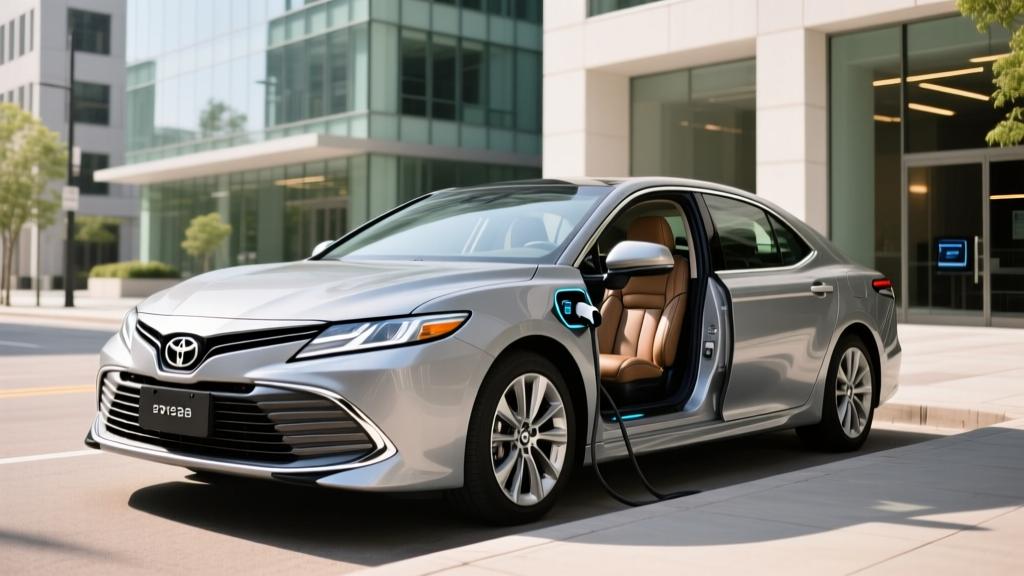
The Toyota Camry has been America's best-selling sedan for decades, and since the 2025 redesign, every Camry rolls off the line as a hybrid. The 2026 Toyota Camry Hybrid carries that all-hybrid strategy forward with a fifth-generation Toyota Hybrid System that delivers 51 MPG combined in front-wheel-drive form, standard Toyota Safety Sense 3.0, and a starting MSRP under $30,000. For buyers weighing a Camry hybrid against a plug-in hybrid or full battery-electric vehicle, this guide breaks down the exact efficiency numbers, ownership costs, and powertrain details you need to decide.
HEV vs PHEV vs EV: Where the Camry Hybrid Fits
Before diving into specs, it is essential to understand what the 2026 Camry is — and what it is not. The Camry Hybrid is a conventional hybrid electric vehicle (HEV). It pairs a gasoline engine with an electric motor and a small battery that recharges through regenerative braking and the engine. You never plug it in. There is no electric-only driving range to manage, no charging cable, and no home charger installation.
This distinguishes it from a plug-in hybrid (PHEV) like the Toyota RAV4 Prime or Prius Prime, which carries a larger battery (typically 13–19 kWh), offers 25–45 miles of electric-only range, and must be plugged into a Level 1 or Level 2 charger to realize its full efficiency benefit. It also differs from a battery-electric vehicle (BEV) like the Tesla Model 3 or Hyundai Ioniq 6, which has no gasoline engine at all and relies entirely on grid charging.
| Feature | HEV (Camry Hybrid) | PHEV (e.g., Prius Prime) | BEV (e.g., Model 3) |
|---|---|---|---|
| Plug-in required | No | Yes (for EV range) | Yes (always) |
| Electric-only range | ~1 mi at low speed | 39–45 mi | 272–363 mi |
| Gasoline engine | Yes (2.5L I4) | Yes (2.0L I4) | No |
| Battery size | ~1.6 kWh (NiMH) | ~13.6 kWh (Li-ion) | 57–82 kWh (Li-ion) |
| Fuel/energy source | Gasoline only | Gasoline + electricity | Electricity only |
| Federal tax credit (§30D) | Not eligible | Up to $7,500* | Up to $7,500* |
*§30D credit eligibility depends on MSRP caps, buyer income limits, battery sourcing, and point-of-sale transfer rules. See IRS.gov §30D for current-year requirements.
2026 Camry Hybrid Powertrain and Performance Specs
Every 2026 Camry uses Toyota's fifth-generation hybrid system, built around a 2.5-liter Dynamic Force four-cylinder engine paired with one or two electric motors depending on drivetrain. Front-wheel-drive (FWD) models use a single front motor; all-wheel-drive (AWD) trims add a rear-mounted electric motor for on-demand rear traction — without a mechanical driveshaft.
| Specification | FWD (LE, SE, XLE, XSE) | AWD (SE, XLE, XSE) |
|---|---|---|
| Engine | 2.5L I4 hybrid | 2.5L I4 hybrid |
| Combined horsepower | 232 hp | 232 hp (net) |
| 0–60 mph | ~7.1 sec | ~6.9 sec |
| Drivetrain | FWD (eCVT) | AWD (eCVT + rear motor) |
| Hybrid battery | ~1.6 kWh NiMH | ~1.6 kWh NiMH |
| Towing capacity | Not rated | Not rated |
The 232 hp combined output is a meaningful step up from the previous-generation Camry Hybrid's 208 hp, and it shows in passing confidence and highway merging. The electronically controlled CVT (eCVT) is smooth and avoids the rubber-band feel that older Toyota hybrids sometimes exhibited. The AWD system's rear motor adds up to 40 hp on demand, primarily for low-traction launches rather than sustained performance driving.
Fuel Economy: EPA Ratings and Real-World MPG
The headline number for the 2026 Camry Hybrid is 51 MPG combined in FWD LE trim — a figure that rivals the Prius and makes it one of the most efficient midsize sedans on the market. AWD and sportier trims sacrifice a few MPG for their added hardware and wider tires.
| Trim / Drivetrain | City MPG | Highway MPG | Combined MPG |
|---|---|---|---|
| LE (FWD) | 53 | 50 | 51 |
| SE (FWD) | 48 | 47 | 47 |
| XLE (FWD) | 48 | 47 | 47 |
| XSE (FWD) | 48 | 47 | 47 |
| SE AWD | 44 | 43 | 44 |
| XLE AWD | 44 | 43 | 44 |
| XSE AWD | 44 | 43 | 44 |
Source: EPA Fuel Economy (fueleconomy.gov). Actual mileage will vary.
Real-World MPG: What Owners Actually See
Toyota hybrids consistently shine in city driving, where the electric motor handles low-speed acceleration and regenerative braking recaptures energy at every stoplight. In real-world ownership, the Camry Hybrid LE frequently exceeds its 53 MPG city EPA rating in stop-and-go traffic — owners on Fuelly report averages of 52–55 MPG in urban commuting.
Highway driving is a different story. At sustained 70–80 mph speeds, the gasoline engine carries most of the load, and real-world highway efficiency typically drops to 44–47 MPG. Cold weather further reduces city efficiency by 3–5 MPG as the engine runs more frequently to heat the cabin and maintain catalytic converter temperature. Expect an overall real-world combined average of 46–50 MPG for the LE trim in mixed driving, and 40–43 MPG for AWD trims.
Pricing, Trims, and Tax Credit Eligibility
The 2026 Camry Hybrid lineup spans four trims, with FWD and AWD availability across most of them. Pricing starts at $29,490 for the LE, making it one of the most affordable hybrid midsize sedans available.
| Trim | Drivetrain | MSRP (incl. destination) |
|---|---|---|
| LE | FWD | $29,490 |
| SE | FWD | $31,090 |
| SE | AWD | $32,490 |
| XLE | FWD | $34,490 |
| XLE | AWD | $35,890 |
| XSE | FWD | $35,090 |
| XSE | AWD | $36,490 |
Does the Camry Hybrid Qualify for a Federal Tax Credit?
No. The conventional Camry Hybrid (HEV) does not qualify for the federal §30D Clean Vehicle Credit. That credit is reserved for plug-in electric vehicles — battery-electric vehicles (BEVs) and plug-in hybrids (PHEVs) with at least 7 kWh of battery capacity. The Camry Hybrid's ~1.6 kWh battery falls far below that threshold.
Some states and local utilities offer rebates for conventional hybrids, but these are increasingly rare as incentive programs shift toward plug-in vehicles. If a federal tax credit is a priority, consider a PHEV like the Prius Prime ($33,445 MSRP, up to $7,500 credit if eligible) or a BEV. Always verify current-year eligibility on IRS.gov and consult a tax professional, as income caps ($150K single / $300K joint), MSRP limits ($55K sedans), and battery-sourcing requirements all apply.
Hybrid Battery Longevity, Warranty, and Replacement Cost
Hybrid battery durability is consistently the top concern among first-time hybrid buyers. Toyota addresses this with one of the strongest hybrid battery warranties in the industry.
Camry Hybrid Battery Warranty
- Hybrid battery: 10 years / 150,000 miles (whichever comes first), transferable to subsequent owners
- Hybrid system components (inverter, motor, control module): 8 years / 100,000 miles
- Capacity retention guarantee: Toyota warrants the hybrid battery against defects and abnormal loss of capacity. There is no published minimum State of Health percentage, as with BEV warranties, because the NiMH pack is small and the system manages charge within a narrow window to minimize degradation.
How Long Do Camry Hybrid Batteries Actually Last?
Toyota's hybrid batteries have a strong longevity track record. The Camry Hybrid's ~1.6 kWh nickel-metal hydride (NiMH) pack operates within a tightly managed state-of-charge window — typically between 40% and 80% — which dramatically reduces stress on the cells. Real-world data from fleet operators, taxi services, and high-mileage owners shows Camry and Prius hybrid batteries routinely lasting 150,000–200,000+ miles before any capacity-related issues arise.
NiMH chemistry is less energy-dense than the lithium-ion packs in PHEVs and BEVs, but it is exceptionally tolerant of the partial-state-of-charge cycling that hybrids demand. Degradation is slow and linear: a 10-year-old Camry Hybrid battery may show 10–15% reduced capacity, which translates to slightly more frequent engine engagement rather than a noticeable loss of performance or fuel economy.
Battery Replacement Cost
If a hybrid battery does fail outside of warranty, replacement costs have decreased as the hybrid fleet has aged. As of 2026:
- New OEM Toyota battery: $2,500–$3,800 (parts + labor at a dealer)
- Refurbished/remanufactured battery: $1,200–$2,000 (independent hybrid specialists)
- Individual cell module replacement: $500–$1,000 (specialists can replace only the weak modules)
Given the 10-year/150,000-mile warranty and typical longevity, most Camry Hybrid owners will never face a battery replacement bill.
Reliability and Safety Ratings
The Camry nameplate carries one of the strongest reliability reputations in the automotive industry, and the hybrid variant is no exception. Toyota's hybrid system has been in continuous production since the 1997 Prius, and the fifth-generation system in the 2026 Camry benefits from nearly three decades of refinement.
The eCVT transmission has no conventional clutch packs, torque converter, or shifting mechanisms — it uses a planetary gearset that is mechanically simple and highly durable. There are no belts to replace, no transmission fluid flushes on a short interval, and no starter motor (the hybrid motor-generator starts the engine).
For safety, the 2026 Camry comes standard with Toyota Safety Sense 3.0, which includes:
- Pre-Collision System with Pedestrian Detection
- Lane Departure Alert with Steering Assist
- Lane Tracing Assist
- Dynamic Radar Cruise Control (full-speed)
- Road Sign Assist
- Automatic High Beams
The previous-generation Camry earned IIHS Top Safety Pick+ status and a 5-star overall NHTSA rating. The 2026 model is expected to carry similar ratings once full crash testing is completed. Note: Toyota Safety Sense is a Level 2 driver-assistance system per SAE definitions — the driver must remain fully engaged and keep hands on the wheel at all times.
Camry Hybrid vs. the Competition
The midsize hybrid sedan segment is smaller than it once was, as competitors have shifted to SUVs. But several strong alternatives remain:
| Vehicle | Combined MPG | Horsepower | Starting MSRP |
|---|---|---|---|
| Toyota Camry Hybrid LE | 51 | 232 hp | $29,490 |
| Honda Accord Hybrid | 48 | 204 hp | $33,990 |
| Hyundai Sonata Hybrid | 47 | 192 hp | $31,250 |
| Kia K5 (no hybrid option) | — | — | — |
The Camry Hybrid leads on fuel economy and horsepower simultaneously — a rare combination. The Accord Hybrid is its closest rival, offering a more spacious rear seat and slightly more refined ride, but trails by 3 MPG combined and 28 hp. The Sonata Hybrid offers a compelling value proposition with its solar roof panel (on Limited trim) and 10-year powertrain warranty, but its dual-clutch hybrid transmission can feel less smooth than Toyota's eCVT in stop-and-go traffic.
Pros
- 51 MPG combined (LE) — best in midsize sedan class
- 232 hp is genuinely quick for a hybrid sedan
- AWD available without major MPG penalty
- 10-year / 150,000-mi hybrid battery warranty
- Standard Toyota Safety Sense 3.0 across all trims
- Sub-$30K starting price for a 51-MPG sedan
- No plug-in required — zero lifestyle change from a gas car
Cons
- No federal tax credit (HEV, not PHEV/BEV)
- AWD trims drop to 44 MPG combined
- Infotainment is functional but not class-leading
- Rear seat is slightly tighter than Accord
- No DC fast charging capability (not applicable to HEV)
- NiMH battery is older chemistry (but proven)
Who Should Buy the Camry Hybrid — and Who Should Look at a PHEV or EV
Choose the Camry Hybrid (HEV) if:
- You cannot charge at home (apartment, street parking, no garage outlet)
- You want maximum MPG with zero change to your fueling routine
- Your budget is under $35K and you want a proven, reliable sedan
- You drive 15,000+ miles per year and want fuel savings without plug-in complexity
- You want AWD for snow-belt winters without stepping up to an SUV
Consider a PHEV (Prius Prime, RAV4 Prime) if:
- You can install a Level 2 home charger or have reliable workplace charging
- Your daily commute is under 40 miles round-trip (you could drive mostly on electricity)
- You want to qualify for the §30D federal tax credit (up to $7,500, income and sourcing rules apply)
- You want to reduce gasoline consumption by 60–80% without range anxiety on road trips
Consider a full EV (Model 3, Ioniq 6) if:
- You have reliable home Level 2 charging and your daily driving is under 250 miles
- You want the lowest per-mile energy cost (~$0.04–$0.06/mile on home electricity vs. ~$0.08–$0.10/mile on gasoline at 50 MPG)
- You want zero tailpipe emissions and minimal maintenance (no oil changes, no engine)
- You qualify for the full $7,500 federal credit, which can offset the higher upfront price
Frequently Asked Questions
How many MPG does the 2026 Toyota Camry Hybrid get?
The Camry Hybrid LE achieves 53 city / 50 highway / 51 combined MPG per the EPA. Sport and luxury trims (SE, XLE, XSE) rate at 48/47/47 MPG in FWD and 44/43/44 in AWD. Real-world owners typically see 46–50 MPG combined in the LE, with highway-heavy driving pulling the average down to the low-to-mid 40s.
Does the Camry Hybrid need to be plugged in?
No. The Camry Hybrid is a conventional hybrid (HEV). Its small battery charges entirely through regenerative braking and the gasoline engine. You fuel it exactly like a conventional gas car — there is no plug, no charging cable, and no electric-only driving range to manage.
How far can the Camry Hybrid drive on electric power alone?
Less than one mile, and only at very low speeds (under 25 mph). The hybrid system uses the electric motor to assist acceleration and enable brief EV-mode coasting, but the ~1.6 kWh battery is far too small for meaningful electric-only driving. If electric-only commuting is your goal, look at a PHEV like the Prius Prime (45 miles EV range) or a full BEV.
Is the Camry Hybrid reliable, and what will battery replacement cost?
Toyota's hybrid system is among the most proven in the industry, with nearly 30 years of production history. The hybrid battery is warrantied for 10 years / 150,000 miles. NiMH packs in Toyota hybrids routinely last 150,000–200,000+ miles. If replacement is needed out of warranty, expect $2,500–$3,800 for a new OEM battery or $1,200–$2,000 for a refurbished unit from a hybrid specialist.
Does the 2026 Camry Hybrid qualify for any tax credit?
The Camry Hybrid does not qualify for the federal §30D Clean Vehicle Credit, which requires a plug-in vehicle with at least 7 kWh of battery capacity. The Camry's ~1.6 kWh NiMH pack does not meet this threshold. Some state or utility incentives may apply to conventional hybrids, but these are uncommon. Check IRS.gov and your state's energy office for current programs.
How does the Camry Hybrid compare to the Prius?
The 2026 Prius achieves up to 57 MPG combined (LE trim) and starts at $28,350, but it is a compact liftback with less rear-seat room and cargo space than the midsize Camry. The Camry Hybrid offers a more comfortable ride, more power (232 hp vs. 196 hp in the Prius), and a more traditional sedan experience. If maximum MPG is your priority and you don't need midsize-sedan space, the Prius wins on efficiency. If you want a larger, more powerful sedan with near-Prius efficiency, the Camry Hybrid is the better fit.
What is the Camry Hybrid's annual fuel cost?
Based on 15,000 miles per year, 55% city / 45% highway driving, and a national average of $3.30/gallon for regular unleaded, the Camry Hybrid LE would cost approximately $970 per year in fuel. For comparison, a typical non-hybrid midsize sedan averaging 30 MPG combined would cost roughly $1,650 per year — a savings of about $680 annually with the Camry Hybrid.
Sources: EPA Fuel Economy (fueleconomy.gov), Toyota Motor North America, IRS §30D Clean Vehicle Credit, IIHS.