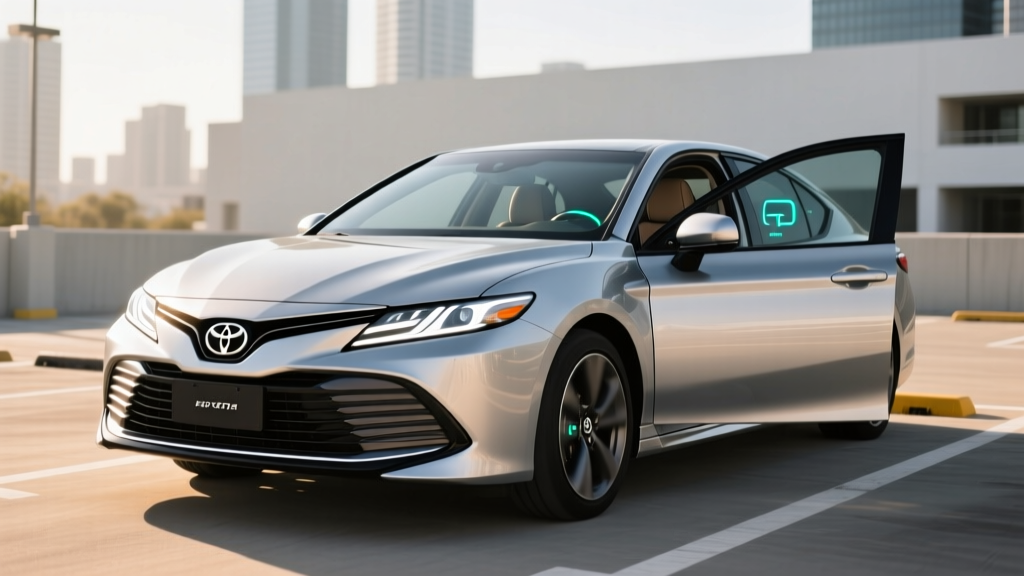
The 2026 Toyota Camry Hybrid arrives at a moment when buyers are recalibrating expectations. Full EVs still carry range and charging-infrastructure concerns for many households, while conventional gas sedans face tightening efficiency standards. The Camry Hybrid sits squarely in the middle: a self-charging hybrid electric vehicle (HEV) that requires no plug, no behavioral change, and no range planning — yet delivers fuel economy that rivals or beats many plug-in alternatives in real-world city driving.
This guide breaks down the 2026 Camry Hybrid's EPA fuel economy, powertrain details, battery longevity, pricing, and tax-credit eligibility so you can decide whether it fits your commute better than a PHEV or full BEV.
HEV vs PHEV: What the Camry Hybrid Actually Is
Before examining specs, it's essential to understand the distinction. The Toyota Camry Hybrid is a conventional hybrid (HEV). It pairs a gasoline engine with an electric motor and a small battery pack that recharges through regenerative braking and the engine itself. You never plug it in.
A plug-in hybrid (PHEV), by contrast, carries a larger battery (typically 12–20 kWh), offers 25–45 miles of electric-only driving, and must be plugged in to realize its full efficiency advantage. Toyota does not currently offer the Camry as a PHEV — the RAV4 Prime and Prius Prime fill that role in Toyota's lineup.
| Feature | Camry Hybrid (HEV) | PHEV (e.g., Prius Prime) | Full EV (BEV) |
|---|---|---|---|
| Plug-in required? | No | Yes (for EV range) | Yes |
| Electric-only range | ~1 mile at low speed | 30–45 miles | 250–400+ miles |
| Battery size | ~1.1 kWh (NiMH/Li-ion) | 13–18 kWh | 60–100+ kWh |
| Fuel/energy flexibility | Gas only | Gas + electricity | Electricity only |
| Federal tax credit | Not eligible (§30D) | Up to $7,500* | Up to $7,500* |
*§30D credit subject to MSRP caps, buyer income limits, and battery-sourcing requirements. See IRS.gov for current-year eligibility.
EPA Fuel Economy: City, Highway, and Combined MPG
The 2026 Camry Hybrid carries forward the fifth-generation Toyota Hybrid System (THS) introduced with the redesigned 2025 model. Front-wheel-drive (FWD) trims achieve the highest EPA ratings, while all-wheel-drive (AWD) variants trade a small efficiency penalty for added traction.
| Trim / Drivetrain | City MPG | Highway MPG | Combined MPG |
|---|---|---|---|
| LE (FWD) | 53 | 50 | 52 |
| SE / XLE (FWD) | 48 | 47 | 47 |
| SE / XLE (AWD) | 46 | 44 | 45 |
Source: EPA Fuel Economy. Figures reflect 2025 model year ratings carried into 2026; verify at fueleconomy.gov for final certification.
Real-World MPG vs EPA Sticker
Hybrids historically outperform their EPA city estimates in stop-and-go traffic because regenerative braking recaptures energy that a gas car wastes as heat. In owner-reported data and independent testing, the Camry Hybrid LE routinely achieves 54–58 MPG in urban driving during warm weather. Highway driving at 70–75 mph typically returns 44–48 MPG — slightly below the EPA highway figure, as aerodynamic drag dominates at higher speeds and the electric motor contributes less.
Cold weather (below 30°F) reduces efficiency by roughly 8–12% because the engine runs more frequently to generate cabin heat and maintain catalyst temperature. Expect winter combined figures closer to 44–47 MPG for the LE FWD in northern climates.
Powertrain Specs: Horsepower, Engine, and Motor Details
The 2026 Camry Hybrid uses a 2.5-liter inline-four Atkinson-cycle engine paired with one or two electric motor-generators (one for FWD, an additional rear motor for AWD). This is Toyota's fifth-generation hybrid architecture, which uses a lithium-ion battery pack rather than the nickel-metal hydride (NiMH) units in older Camry Hybrids.
| Specification | FWD Models | AWD Models |
|---|---|---|
| Combined horsepower | 225 hp | 232 hp |
| Engine | 2.5L I4 Atkinson | 2.5L I4 Atkinson |
| Front motor output | 100 kW (134 hp) | 100 kW (134 hp) |
| Rear motor output | — | 30 kW (40 hp) |
| Hybrid battery | ~1.1 kWh Li-ion | ~1.1 kWh Li-ion |
| Transmission | eCVT | eCVT |
| 0–60 mph (est.) | ~7.1 sec | ~6.9 sec |
| Towing capacity | Not rated | Not rated |
The eCVT is not a traditional belt-and-pulley CVT. It uses a planetary gearset to blend engine and motor power seamlessly — there are no rubber bands or slipping belts, which contributes to the drivetrain's durability reputation.
Pricing and Tax Credit Eligibility
The 2026 Camry Hybrid starts at a competitive price point, and every trim in the Camry lineup is now hybrid-only — Toyota discontinued the gas-only four-cylinder Camry after 2024.
| Trim | MSRP (est.) | Drivetrain |
|---|---|---|
| LE | $29,995 | FWD |
| SE | $31,495 | FWD / AWD (+$1,600) |
| XLE | $34,495 | FWD / AWD (+$1,600) |
Pricing estimated based on 2025 MSRP. Final 2026 pricing confirmed at Toyota.com closer to on-sale date.
Does the Camry Hybrid Qualify for a Federal Tax Credit?
No. The IRS §30D Clean Vehicle Credit applies only to plug-in electric vehicles — battery electric vehicles (BEVs) and plug-in hybrids (PHEVs) with at least 7 kWh of battery capacity. Because the Camry Hybrid is a conventional HEV with a ~1.1 kWh battery and no plug, it does not qualify for the federal purchase credit.
Some states offer separate incentives for high-efficiency vehicles, but these vary by jurisdiction. Check your state's energy office or IRS §30D guidelines for current rules. A tax professional can confirm your specific eligibility.
Battery Warranty, Lifespan, and Replacement Cost
Hybrid battery longevity is consistently the top concern among first-time hybrid buyers. Toyota addresses this with one of the strongest hybrid battery warranties in the industry.
Toyota Hybrid Battery Warranty
- Hybrid battery: 10 years / 150,000 miles (whichever comes first)
- Hybrid system components: 8 years / 100,000 miles
- Capacity retention guarantee: Battery must retain sufficient capacity to allow the hybrid system to function normally; Toyota replaces or reconditions if it fails within the warranty period
How Long Do Camry Hybrid Batteries Actually Last?
Real-world data from fleet operators, taxi services, and high-mileage owners shows that modern Toyota hybrid batteries (particularly the lithium-ion packs introduced in recent generations) routinely exceed 200,000 miles before significant degradation. The Prius, which shares similar THS architecture, has documented cases of original batteries surpassing 300,000 miles.
The smaller ~1.1 kWh battery in the Camry Hybrid operates within a narrow state-of-charge window (roughly 40–80% SoC), which dramatically reduces stress on the cells compared to a full EV battery that cycles from 10–90%. This shallow-cycling strategy is a key reason Toyota hybrid batteries outlast their warranty periods.
Battery Replacement Cost
If a replacement is needed out of warranty, a new OEM Camry Hybrid battery pack costs approximately $2,500–$4,000 including labor at a Toyota dealer. Third-party reconditioned packs are available for $1,500–$2,500. Given the 10-year/150,000-mile warranty and typical battery lifespan, most owners will never face this expense.
Reliability and Ownership Costs
The Camry nameplate has been synonymous with reliability for decades, and the hybrid variant benefits from a powertrain that eliminates several failure-prone components found in conventional gas cars:
- No starter motor — the hybrid motor-generator starts the engine
- No alternator — the hybrid system charges the 12V battery via a DC-DC converter
- No traditional transmission — the eCVT planetary gearset has no belts, clutches, or torque converter
- Regenerative braking reduces wear on friction brake pads, which often last 80,000–100,000+ miles
Toyota's Safety Sense 3.0 suite comes standard on every 2026 Camry Hybrid, including pre-collision braking, adaptive cruise control, lane-tracing assist, and automatic high beams. The Camry consistently earns top marks from both NHTSA and the IIHS.
Estimated 5-Year Ownership Cost
| Cost Category | Camry Hybrid LE | Gas Midsize Sedan (28 MPG avg) |
|---|---|---|
| Fuel (75,000 mi @ $3.40/gal) | $4,904 | $9,107 |
| Maintenance (5 yr) | $2,200 | $2,800 |
| Insurance (5 yr avg) | $7,500 | $7,200 |
| Depreciation (est.) | $12,000 | $13,500 |
| Total (5 yr) | $26,604 | $32,607 |
Fuel cost assumes 52 MPG combined for Camry Hybrid LE vs 28 MPG combined for a typical gas midsize sedan. Actual costs vary by region, driving habits, and fuel prices.
Who Should Choose the Camry Hybrid vs a PHEV or Full EV?
Reasons to Buy the Camry Hybrid
- No home charging access (apartment, street parking, no garage)
- Long highway commutes where PHEV electric range is irrelevant
- Want maximum fuel economy with zero behavioral change
- Prefer lower upfront cost vs PHEV or BEV
- Live in a region with limited public charging infrastructure
- Value Toyota's resale value and reliability track record
Consider a PHEV or Full EV Instead If
- You have home Level 2 charging and a short commute (<40 mi)
- You want electric-only driving for daily errands (PHEV like Prius Prime)
- You want to eliminate gasoline entirely (BEV like Tesla Model 3 or Hyundai Ioniq 6)
- You qualify for the full $7,500 federal tax credit, which narrows the price gap
- You want one-pedal driving and instant EV torque
Decision Framework
Choose the Camry Hybrid if: You drive 30+ miles daily in mixed city/highway conditions, lack reliable plug-in charging access, and want a proven sedan with 50+ MPG and minimal ownership risk.
Choose a PHEV (Prius Prime, RAV4 Prime) if: You can charge at home, your daily commute is under 40 miles, and you want electric-only driving most days with gas backup for road trips.
Choose a full EV (Model 3, Ioniq 6) if: You have dependable home charging, drive under 300 miles between charging opportunities, qualify for the federal tax credit, and want the lowest per-mile fuel cost.
Frequently Asked Questions
How many MPG does the 2026 Toyota Camry Hybrid get?
The FWD LE trim achieves an EPA-estimated 53 city / 50 highway / 52 combined MPG. The SE and XLE FWD trims are rated at 48/47/47 MPG. AWD models drop to 46/44/45 MPG. Real-world city driving often exceeds EPA estimates by 2–6 MPG thanks to regenerative braking, while sustained highway driving above 70 mph may return 2–4 MPG less than the sticker.
Does the Camry Hybrid need to be plugged in?
No. The Camry Hybrid is a conventional HEV. Its small lithium-ion battery recharges automatically through regenerative braking and the gasoline engine. There is no plug, no charging cable, and no electric-only range to manage.
How far can the Camry Hybrid drive on electric power alone?
The Camry Hybrid can creep at very low speeds (under 25 mph) on electric power for roughly one mile or less in ideal conditions. This is not practical electric-only driving — it's a byproduct of the hybrid system's stop-and-go efficiency optimization. If electric-only range matters to you, consider a PHEV like the Toyota Prius Prime (up to 44 miles EV range).
Is the Toyota Camry Hybrid reliable, and what does battery replacement cost?
Toyota's hybrid system is among the most proven in the industry, with over 25 years of production history since the original Prius. The hybrid battery is warranted for 10 years / 150,000 miles, and real-world data shows most batteries last well beyond 200,000 miles. Out-of-warranty replacement costs approximately $2,500–$4,000 at a dealer, though most owners never need one.
Does the Camry Hybrid qualify for any federal tax credit?
No. The IRS §30D Clean Vehicle Credit requires a plug-in vehicle with at least 7 kWh of battery capacity. The Camry Hybrid has a ~1.1 kWh battery and no plug, making it ineligible. Only BEVs and qualifying PHEVs are eligible for the credit, subject to MSRP caps, buyer income limits, and battery-sourcing requirements outlined at IRS.gov.
Is the Camry Hybrid AWD system good in snow?
The electronic AWD system on SE and XLE trims adds a 30 kW rear motor that engages automatically when front-wheel slip is detected, typically during acceleration from a stop or in low-traction conditions. It's not a full-time AWD system like a Subaru's, but it provides meaningful traction improvement in snow and rain for a sedan. It does not include a rear motor at cruising speeds, so it does not affect highway efficiency.
How does the Camry Hybrid compare to the Honda Accord Hybrid?
The 2026 Honda Accord Hybrid is rated at 48 city / 47 highway / 48 combined MPG (Sport trim) — roughly 4 MPG less than the Camry Hybrid LE in combined driving. The Accord Hybrid starts at a similar price and offers a slightly larger trunk and more rear legroom, but the Camry's fuel economy advantage, standard AWD availability, and 10-year hybrid battery warranty give it an edge for efficiency-focused buyers.