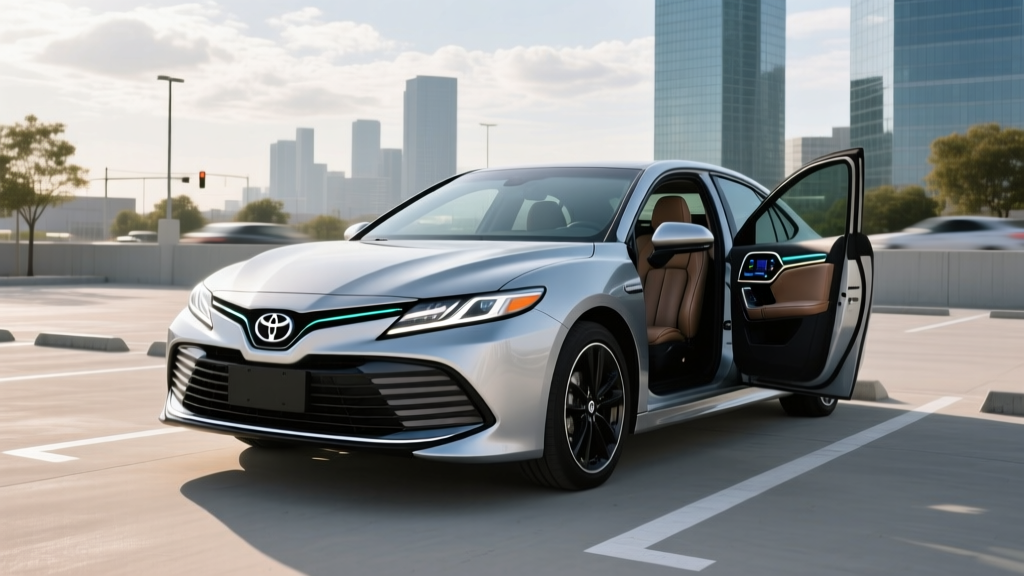
If you're researching a Toyota Camry Hybrid lease, you're likely weighing fuel savings against monthly payments, reliability against depreciation risk, and the simplicity of a conventional hybrid against the complexity of a plug-in. The ninth-generation Camry Hybrid (introduced for the 2025 model year and carried into 2026) is now exclusively hybrid-powered in the U.S. market — Toyota dropped the gasoline-only variant entirely. That makes understanding this powertrain essential before you sign a lease agreement.
This guide covers the exact EPA fuel economy figures, real-world MPG expectations, the hybrid battery warranty that should ease long-term concerns, and how the Camry Hybrid stacks up against plug-in hybrids and full EVs for different driving lifestyles.
2026 Toyota Camry Hybrid: Powertrain and Key Specs
The current Camry uses Toyota's fifth-generation hybrid system pairing a 2.5-liter four-cylinder engine with one or two electric motors (depending on drivetrain). Front-wheel-drive models use a single front motor; all-wheel-drive (AWD) trims add a second rear motor. There is no plug-in hybrid (PHEV) version of the Camry in the U.S. — it is strictly a conventional hybrid (HEV), meaning you never plug it in. The battery recharges through regenerative braking and engine-generated power.
| Spec | FWD Models | AWD Models |
|---|---|---|
| Combined Horsepower | 225 hp | 232 hp |
| Engine | 2.5L 4-cyl + front electric motor | 2.5L 4-cyl + front & rear electric motors |
| Hybrid Battery | ~1.6 kWh lithium-ion (sealed, not plug-in) | |
| Transmission | eCVT (planetary gearset, no traditional gears) | |
| 0–60 mph | ~7.2 sec | ~6.7 sec |
| EPA Combined MPG | 51 MPG | 44–47 MPG |
| Starting MSRP | ~$29,990 (LE trim, before destination) | |
The relatively small 1.6 kWh battery is typical for a conventional hybrid. It doesn't provide meaningful electric-only range — the Camry HEV can creep short distances at low speed on battery alone, but the engine engages almost immediately under normal acceleration. This is by design: the battery smooths power delivery, captures braking energy, and enables engine-off coasting, all of which boost fuel economy without requiring any behavioral change from the driver.
Fuel Economy: EPA Ratings vs. Real-World MPG
Fuel economy is the primary reason buyers consider the Camry Hybrid. Here is the full EPA breakdown by trim and drivetrain, sourced from fueleconomy.gov:
| Trim / Drivetrain | City MPG | Highway MPG | Combined MPG |
|---|---|---|---|
| LE (FWD) | 53 | 50 | 51 |
| SE / XLE / XSE (FWD) | 48 | 47 | 47 |
| SE / XLE / XSE (AWD) | 44–46 | 43–44 | 44–47 |
The LE trim achieves its standout 51 MPG combined partly through lighter weight and lower rolling-resistance tires. Sportier trims (SE, XSE) and the XLE sacrifice a few MPG for wider tires, additional equipment weight, and different tuning.
Real-World MPG: What to Actually Expect
Toyota hybrids consistently perform close to — or even above — their EPA city ratings in real-world urban driving. The regenerative braking system recaptures significant energy in stop-and-go traffic, which is where hybrids shine brightest. Expect 48–55 MPG in mixed city driving on the LE FWD.
Highway driving is a different story. At sustained 70–80 mph speeds, the electric motor contributes less and the gasoline engine does the bulk of the work. Real-world highway MPG for the LE FWD typically falls to 42–46 MPG, below the EPA highway estimate. Cold weather (below 40°F) further reduces efficiency by 10–15% as the engine runs more frequently to generate cabin heat and maintain battery temperature.
HEV vs. PHEV vs. EV: Which Powertrain Fits Your Life?
A common question from Camry Hybrid shoppers is whether they should consider a plug-in hybrid or a full battery-electric vehicle instead. Here's a direct comparison to help you decide:
| Factor | HEV (Camry Hybrid) | PHEV (e.g., Prius Prime) | BEV (e.g., Tesla Model 3) |
|---|---|---|---|
| Plug-in Required? | No | Optional (best if you plug in nightly) | Yes — mandatory |
| Electric-Only Range | Negligible | 30–44 miles typical | 250–360+ miles |
| Home Charging Needed? | No | Recommended (120V or 240V) | Yes (240V strongly recommended) |
| Fuel Cost (Annual Est.) | ~$900–$1,100 | ~$400–$800 (if plugged in regularly) | ~$500–$700 (electricity) |
| Upfront Price Premium | Lowest | Moderate | Highest |
| Federal Tax Credit (§30D) | Not eligible | Up to $7,500 (if eligible) | Up to $7,500 (if eligible) |
| Road-Trip Convenience | Gas stations everywhere | Gas stations + optional EV charging | DC fast-charging network dependent |
Choose the Camry Hybrid (HEV) if: You lack reliable home charging access, want zero behavioral changes from a gas car, drive a mix of city and highway, and prefer the lowest purchase price.
Choose a PHEV (like the Prius Prime) if: You can charge at home nightly, your daily commute is under 40 miles, but you still want gas-engine flexibility for long road trips.
Choose a full BEV if: You have home Level 2 charging, want the lowest per-mile fuel cost, are motivated by tailpipe-emission reduction, and your road trips are within DC fast-charging corridor range.
Leasing the Camry Hybrid: Pricing, Payments, and Tax Credits
Lease deals vary by region and dealer, but here is a realistic framework for a 2026 Camry Hybrid lease based on current market conditions:
| Component | LE FWD (Est.) | XLE FWD (Est.) |
|---|---|---|
| MSRP | ~$29,990 | ~$34,990 |
| Capitalized Cost (Negotiated) | $28,500–$29,500 | $33,000–$34,500 |
| Residual Value (Est. 55–58%) | $16,500–$17,400 | $19,250–$20,300 |
| Estimated Monthly Payment | $320–$400 | $400–$480 |
| Due at Signing (Typical) | $2,500–$3,500 | $3,000–$4,000 |
These figures are estimates before taxes and fees. Actual offers depend on your credit tier, regional incentives, money factor (lease interest rate), and dealer negotiation. Toyota Financial Services periodically offers lease cash incentives on hybrid models — check current programs on Toyota's regional site.
Federal Tax Credit: Does the Camry Hybrid Qualify?
Under current IRS §30D Clean Vehicle Credit rules, the Camry Hybrid does not qualify for the federal EV tax credit. The §30D credit applies only to plug-in electric vehicles (BEVs and PHEVs) with a minimum battery capacity of 7 kWh. The Camry's ~1.6 kWh hybrid battery falls well short of this threshold.
This is a meaningful cost difference when comparing against a PHEV like the Toyota Prius Prime, which does qualify for up to $7,500 in federal credits (subject to buyer income caps of $150,000 single / $300,000 joint, MSRP caps of $55,000 for sedans, and critical-mineral/battery-sourcing requirements). However, the Camry Hybrid's lower base price often narrows the gap, especially for buyers who don't itemize deductions or whose income exceeds the §30D caps.
Some states offer additional incentives for hybrids, though most state EV rebates are also limited to plug-in vehicles. Check your state's energy or environmental agency for current programs.
Hybrid Battery Longevity: Warranty, Degradation, and Replacement
Battery reliability is the top concern for hybrid shoppers, particularly those considering a lease that extends beyond the basic warranty period or buyers planning to purchase at lease-end.
Toyota covers the hybrid battery and all hybrid-system components for 10 years or 150,000 miles (whichever comes first) from the date of first use. This applies to all 2020-and-later Toyota hybrids, including the 2026 Camry. Prior to 2020, coverage was 8 years / 100,000 miles.
Real-World Battery Degradation
Toyota's hybrid battery management system is deliberately conservative. It never allows the battery to fully charge or fully discharge — the usable window is roughly 40–80% state of charge — which dramatically reduces degradation. Real-world data from high-mileage Prius and Camry Hybrid owners shows typical capacity loss of 10–15% over 150,000 miles, which translates to a modest MPG decrease rather than a catastrophic failure.
For a 36-month lease at 12,000 miles per year (36,000 total miles), battery degradation is essentially a non-issue. You'll return the vehicle long before any meaningful capacity loss occurs. If you plan to purchase at lease-end and keep the car to 200,000+ miles, the 10-year/150,000-mile warranty provides substantial coverage.
Battery Replacement Cost
If the hybrid battery fails outside warranty, a new OEM replacement from Toyota currently costs between $3,000 and $5,000 including parts and labor. Refurbished and aftermarket options are available for $1,500–$2,500. However, wholesale failures are rare — most hybrid battery issues involve individual cell modules, which can sometimes be replaced for a fraction of the full-pack cost.
Lease vs. Buy: The Camry Hybrid Ownership Equation
Leasing a Camry Hybrid makes financial sense in specific scenarios but not universally. Here's how the math works:
Leasing advantages for the Camry Hybrid:
- Lower monthly payments than financing the same vehicle
- You drive under full warranty coverage for the entire lease term (3-year basic, 5-year powertrain)
- No concern about long-term hybrid battery health — you return the car before the battery ages meaningfully
- Toyota's strong resale value means competitive residual values, which keeps lease payments reasonable
Buying advantages for the Camry Hybrid:
- At 51 MPG, the Camry Hybrid is one of the cheapest vehicles to fuel in its class — long-term ownership maximizes cumulative fuel savings
- Toyota's legendary reliability means low maintenance costs over 100,000+ miles
- No mileage penalties (lease overage charges typically run $0.15–$0.25 per mile)
- You build equity in a vehicle with historically strong resale values
For a 36-month lease at ~$350/month with $3,000 due at signing, your total out-of-pocket is approximately $15,600 over three years. Fuel costs at 51 MPG and $3.40/gallon average roughly $2,000 over 36,000 miles — for a total three-year cost of ~$17,600. A comparable gas-only midsize sedan at 30 MPG combined would cost ~$3,400 in fuel over the same distance, adding $1,400 in fuel expense alone.
Who Should Lease the Camry Hybrid?
Pros
- 51 MPG combined (LE FWD) — among the best of any midsize sedan
- No plug-in required — zero lifestyle change from a gas car
- 10-year / 150,000-mile hybrid battery warranty
- Competitive ~$30K starting MSRP
- AWD available on most trims
- Standard Toyota Safety Sense 3.0 (adaptive cruise, lane-keep, auto emergency braking)
- Strong resale value reduces lease cost
Cons
- Not eligible for the $7,500 federal §30D tax credit
- No meaningful electric-only driving — always burning gasoline
- AWD models drop to 44 MPG combined
- eCVT can produce a droning engine note under hard acceleration
- Higher trims approach PHEV pricing without the EV tax credit benefit
- Rear-seat headroom slightly reduced vs. prior generation
Frequently Asked Questions
How many MPG does the Toyota Camry Hybrid get?
The 2026 Camry Hybrid LE FWD achieves an EPA-rated 53 city / 50 highway / 51 combined MPG. AWD trims and sportier FWD trims (SE, XSE, XLE) range from 44 to 47 MPG combined. Real-world results typically match or exceed the EPA city rating in urban driving but fall below the highway rating at sustained 70+ mph speeds.
Does the Camry Hybrid need to be plugged in?
No. The Camry Hybrid is a conventional hybrid (HEV), not a plug-in hybrid (PHEV). Its small lithium-ion battery recharges entirely through regenerative braking and the gasoline engine. You simply fill it with gas and drive — no charging cable, no home charger installation, no behavioral change required.
Does the Toyota Camry Hybrid qualify for any tax credit?
The Camry Hybrid does not qualify for the federal §30D Clean Vehicle Credit, which requires a minimum 7 kWh battery and plug-in capability. The Camry's ~1.6 kWh battery does not meet this threshold. Some states may offer separate hybrid incentives, but most state programs also favor plug-in vehicles. Consult a tax professional for your specific situation.
Is the Camry Hybrid reliable, and what does battery replacement cost?
Toyota's hybrid system has an extensive track record of reliability spanning over two decades since the original Prius. The hybrid battery is warranted for 10 years or 150,000 miles. Out-of-warranty replacement costs $3,000–$5,000 for a new OEM battery, though complete failures before 200,000 miles are uncommon. For a typical 36-month lease, battery health is not a practical concern.
Should I lease the Camry Hybrid or buy a plug-in hybrid instead?
If you can install a Level 2 home charger and your daily commute is under 40 miles, a PHEV like the Toyota Prius Prime (44 miles electric-only range, up to $7,500 federal credit) may save more on fuel and qualify for tax incentives the Camry cannot. However, if you lack home charging, frequently drive long highway distances, or want the lowest upfront cost with zero plug-in hassle, the Camry Hybrid remains one of the most efficient and practical sedans available. For a detailed comparison, review the HEV vs. PHEV vs. BEV decision framework above.
What happens if I exceed my lease mileage on the Camry Hybrid?
Most Toyota Financial Services leases charge $0.15–$0.25 per mile over the contracted limit (typically 10,000, 12,000, or 15,000 miles per year). At $0.20/mile, exceeding by 5,000 miles costs $1,000 at lease-end. If you anticipate high mileage, negotiate a 15,000 mi/yr lease upfront — the monthly increase is usually smaller than the end-of-lease penalty.