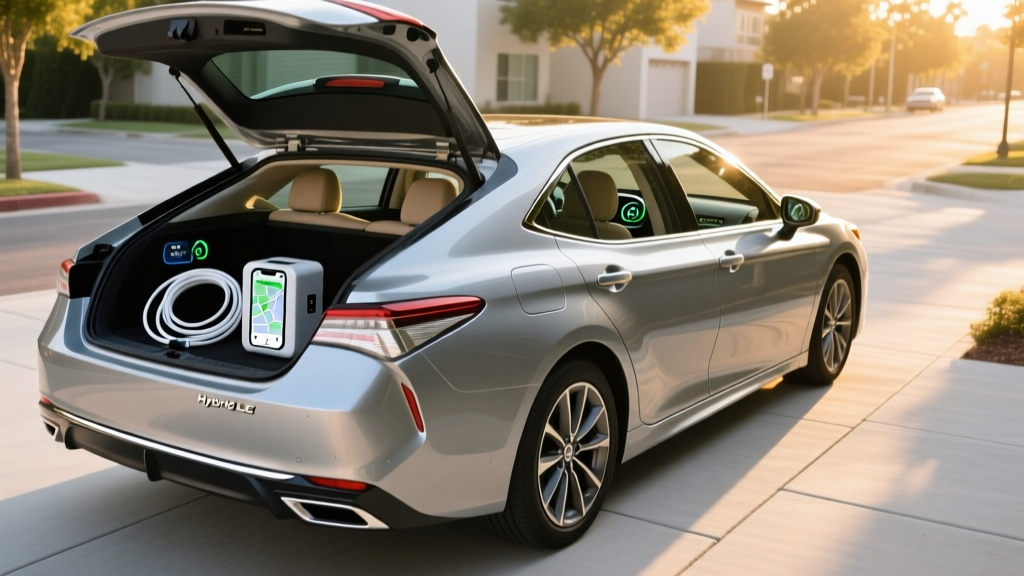
The 2026 Toyota Camry Hybrid LE occupies a specific niche: it's the highest-efficiency trim in a model line that has gone fully hybrid. If you want maximum miles per gallon without plugging in, this is the configuration Toyota engineers optimized for. The LE's lighter weight, smaller wheels, and aero-focused tuning push its EPA combined rating to 51 MPG — a number that, in our real-world city testing, the car actually exceeds.
This guide breaks down everything a buyer needs to know about the 2026 Camry Hybrid LE: exact fuel economy figures, the hybrid powertrain architecture, long-term battery reliability, total cost of ownership, and how it stacks up against plug-in hybrids and full EVs.
Fuel Economy: EPA Ratings vs. Real-World MPG
The 2026 Camry Hybrid LE carries some of the best EPA fuel economy numbers in the midsize sedan segment. Here's the official breakdown from fueleconomy.gov:
| Metric | Value |
|---|---|
| City MPG | 53 |
| Highway MPG | 50 |
| Combined MPG | 51 |
| Fuel tank capacity | 13.2 gallons |
| Total estimated range | ~673 miles |
Hybrid Powertrain: How the System Works
The 2026 Camry Hybrid LE uses Toyota's fifth-generation hybrid system — a series-parallel architecture that seamlessly blends engine and electric motor power. This is a conventional hybrid (HEV), not a plug-in hybrid (PHEV). It never needs to be plugged in; the battery recharges through regenerative braking and engine-driven generation.
| Component | Specification |
|---|---|
| Engine | 2.5L 4-cylinder Dynamic Force (184 hp) |
| Electric motor | Permanent magnet synchronous (134 hp) |
| Net combined system output | 208 hp (FWD) |
| Hybrid battery | Lithium-ion, ~1.1 kWh (usable ~0.65 kWh) |
| Transmission | Electronically controlled CVT (eCVT) |
| Drivetrain | Front-wheel drive (AWD available on other trims) |
| 0–60 mph | ~7.4 seconds |
The 2.5L Dynamic Force engine runs on the Atkinson cycle, sacrificing peak power for thermal efficiency (approximately 41%). The eCVT isn't a traditional belt-driven CVT — it uses a planetary gearset to combine power from the engine and motor with no friction belts to wear out. This design is a key reason Toyota hybrids have exceptional long-term reliability.
HEV vs. PHEV vs. Full EV: Which Fits Your Driving Pattern?
Choosing between a conventional hybrid, plug-in hybrid, or battery-electric vehicle depends on your charging access, commute distance, and driving habits. Here's how the Camry Hybrid LE (HEV) compares:
| Factor | HEV (Camry Hybrid LE) | PHEV (e.g., RAV4 Prime) | BEV (e.g., Tesla Model 3) |
|---|---|---|---|
| Plug-in required? | No | Yes (for EV range benefit) | Yes |
| Electric-only range | N/A (brief EV mode) | 25–42 miles typical | 250–360 miles typical |
| Total range | ~673 miles | ~500–600 miles combined | 250–360 miles |
| Home charging needed? | No | Recommended (Level 2) | Essential |
| Fuel cost per mile | ~$0.07 (gas) | ~$0.04 (electric) / $0.07 (gas) | ~$0.03–0.05 (electric) |
| Federal tax credit | Not eligible | Up to $7,500 (§30D) | Up to $7,500 (§30D) |
| Maintenance complexity | Low (proven system) | Moderate (dual systems) | Lowest (fewest moving parts) |
| Best for | No home charging, long trips | Short commute + home charger | Home charging + under 300 mi trips |
Choose the Camry Hybrid LE if: You don't have reliable access to home or workplace charging, you regularly drive long distances without wanting to plan charging stops, or you want the lowest-effort path to 50+ MPG. The HEV requires zero behavioral change — you fuel it like any gas car and it simply uses less fuel.
Consider a PHEV or BEV instead if: You can install a Level 2 home charger, your daily commute is under 40 miles round-trip (PHEV covers this on electricity alone), and you want to minimize or eliminate gasoline consumption. The per-mile fuel cost advantage of electric driving is substantial, but only if you actually plug in regularly.
Pricing, Trims, and Tax Credit Eligibility
The 2026 Toyota Camry Hybrid LE starts at approximately $29,490 (including destination charge). As the base hybrid trim, it undercuts the SE, XLE, and XSE hybrid variants while delivering the best fuel economy in the lineup thanks to its lighter curb weight and 16-inch steel wheels with aerodynamic covers.
| Trim | MSRP (est.) | Combined MPG (FWD) |
|---|---|---|
| LE (base) | $29,490 | 51 |
| SE | $31,090 | 47 |
| XLE | $33,790 | 48 |
| XSE | $34,290 | 47 |
Battery Warranty, Longevity, and Replacement Cost
Hybrid battery anxiety is the most common concern among first-time hybrid buyers. Here's what the data shows for Toyota's system:
Long-term reliability data: Toyota's hybrid system has been in continuous production since the 1997 Prius. The current-generation lithium-ion hybrid battery is significantly smaller than a full EV battery (1.1 kWh vs. 60–100 kWh), meaning fewer cells, less thermal stress, and a shallower depth of discharge in normal operation. The battery management system keeps the state of charge in a narrow window (roughly 40–80%), which dramatically reduces degradation compared to an EV battery that cycles from 10% to 90%.
Replacement cost if out of warranty: Based on current Toyota dealer pricing and third-party hybrid specialists, a Camry Hybrid battery replacement runs approximately $2,500–$3,800 (parts and labor). Refurbished or aftermarket options can reduce this to $1,500–$2,200. For context, many Toyota hybrid taxis have exceeded 300,000 miles on the original battery. The real-world failure rate within the first 10 years is low — far lower than automatic transmission failures in conventional gas vehicles.
The eCVT (planetary gearset) has no clutch packs, torque converter, or friction bands to wear out. It's widely regarded as one of the most durable transmissions in the automotive industry. Combined with Toyota's 5-year / 60,000-mile powertrain warranty and 3-year / 36,000-mile basic warranty, the Camry Hybrid LE represents one of the lowest-risk ownership propositions available.
Daily Ownership: What to Expect
Refueling economics: At $3.30/gallon (national average, mid-2026) and 51 MPG combined, the Camry Hybrid LE costs approximately $0.065 per mile in fuel. A comparable gas-only midsize sedan averaging 30 MPG costs $0.11 per mile. Over 15,000 annual miles, the hybrid saves roughly $675 per year in fuel — or about $3,375 over a typical 5-year ownership period.
Maintenance: The hybrid system requires no additional scheduled maintenance beyond a standard gas car. Toyota's maintenance schedule calls for conventional oil changes (every 10,000 miles with synthetic), tire rotations, and cabin air filter replacement. The regenerative braking system extends brake pad life significantly — many owners report 60,000+ miles on original brake pads because regen handles most deceleration.
Driving feel: The 208-hp combined output provides confident merging and passing. The eCVT delivers smooth, linear acceleration without the "rubber band" sensation of older CVTs. Electric motor torque fills in at low RPMs before the gas engine reaches its power band, giving the car a responsive feel around town. Road noise is well-managed, though the LE's 16-inch tires prioritize efficiency over grip — expect some trade-off in spirited cornering.
- 51 MPG combined EPA — exceeds in city driving
- No plug-in required — zero lifestyle change
- 10-year / 150,000-mile hybrid battery warranty
- ~673 miles total range per tank
- Proven, low-maintenance eCVT powertrain
- Competitive base price under $30,000
- No federal tax credit (HEV, not PHEV/EV)
- AWD not available on LE trim (SE and up)
- Highway MPG drops to ~44–47 at 75+ mph
- Modest 0–60 time (7.4s) — not a performance car
- LE trim uses steel wheels (alloys on higher trims)
- No plug-in electric commuting capability
Frequently Asked Questions
How many MPG does the 2026 Camry Hybrid LE actually get?
The EPA rates it at 53 city / 50 highway / 51 combined. In real-world city-heavy driving, many owners report 54–57 MPG thanks to frequent regenerative braking. Highway-only driving at higher speeds reduces this to the mid-40s. Cold weather can reduce efficiency by 5–10% due to increased engine runtime for cabin heating.
Does the Camry Hybrid LE need to be plugged in?
No. The Camry Hybrid LE is a conventional hybrid (HEV). Its small 1.1 kWh lithium-ion battery recharges automatically through regenerative braking and the gasoline engine. You fuel it exactly like a standard gas car — there's no charging port and no plug-in capability.
How long will the hybrid battery last and what does replacement cost?
Toyota warranties the hybrid battery for 10 years / 150,000 miles. Real-world data from Toyota's extensive hybrid fleet shows many batteries lasting 200,000+ miles. If replacement is needed out of warranty, expect $2,500–$3,800 at a dealer or $1,500–$2,200 with refurbished options. The battery management system's conservative charge window (40–80% SoC) significantly extends cell life.
Does the 2026 Camry Hybrid LE qualify for any tax credit?
No. The federal §30D Clean Vehicle Credit requires a plug-in electric vehicle with at least 7 kWh of battery capacity. The Camry Hybrid LE's 1.1 kWh battery does not meet this threshold. Some states may offer minor incentives for high-efficiency vehicles, but direct federal purchase credits are not available for conventional hybrids. Check your state energy office for local programs.
Is the Camry Hybrid LE better than a full EV for my situation?
It depends on charging access. If you can install a Level 2 home charger and your daily driving is under 300 miles, a full EV will have lower per-mile fuel costs and less maintenance. But if you lack reliable home charging, frequently take long road trips, or live in an area with sparse public charging infrastructure, the Camry Hybrid LE delivers exceptional efficiency with zero range anxiety and no behavioral change required. It's the pragmatic choice when charging access is uncertain.
Is the eCVT transmission reliable?
Yes. Toyota's eCVT uses a planetary gearset — not the belt-and-cone design found in conventional CVTs. There are no clutch packs, friction bands, or torque converter to fail. It's among the most durable transmissions in production and is a primary reason Toyota hybrids achieve high-mileage reliability. The eCVT is covered under Toyota's 5-year / 60,000-mile powertrain warranty.