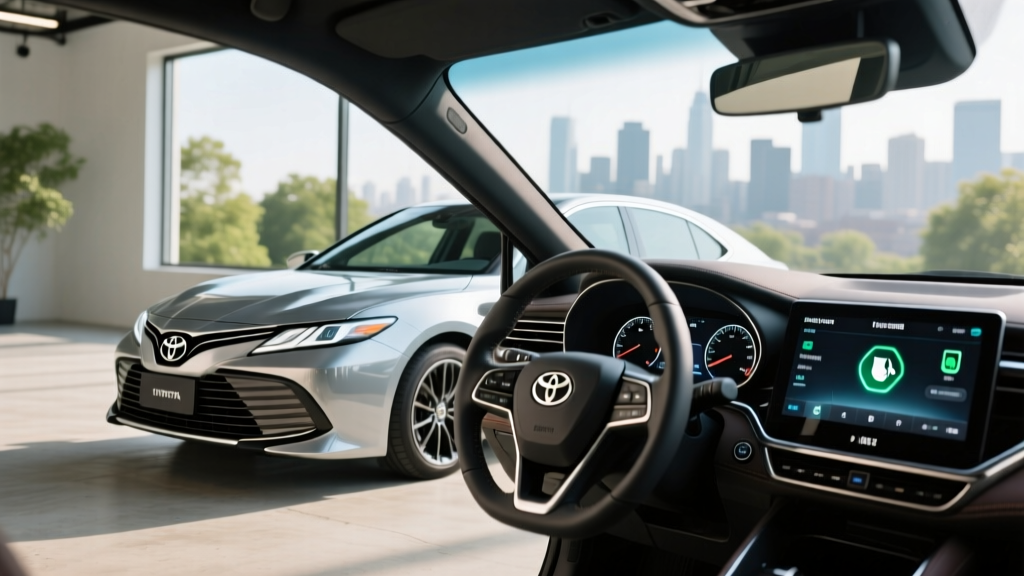
If you have searched for a midsize sedan that sips fuel without asking you to change a single habit, the 2023 Toyota Camry Hybrid is likely on your shortlist. It is a conventional hybrid electric vehicle (HEV), meaning it generates its own electricity from braking and the gasoline engine — no plug, no charging cable, no range anxiety. For the 2026 used-car shopper or the buyer still finding 2023 inventory on dealer lots, this guide covers the exact EPA numbers, real-world MPG expectations, battery longevity, and total cost of ownership you need before signing.
HEV vs PHEV vs EV: Where the Camry Hybrid Fits
Before we dig into specs, it is worth clarifying what the 2023 Camry Hybrid is — and what it is not. Toyota does not sell a plug-in hybrid (PHEV) version of the Camry in the United States. The Camry Hybrid is strictly a self-charging HEV. Here is how the three electrified powertrain types compare for a buyer cross-shopping this sedan:
| Attribute | HEV (Camry Hybrid) | PHEV (e.g., Prius Prime) | BEV (e.g., Tesla Model 3) |
|---|---|---|---|
| Plug-in required? | No | Yes (Level 1/2) | Yes (Level 2/DC) |
| Electric-only range | ~1 mi at low speed | 25–44 mi (model dependent) | 250–350+ mi |
| Total range | 600+ mi | 400–600+ mi | 250–350 mi |
| Fueling | Gas station only | Gas + plug | Plug only |
| Federal tax credit (§30D) | Not eligible | Up to $7,500 (if eligible) | Up to $7,500 (if eligible) |
| Best for | No home charging, long commutes | Short EV commute + road trips | Home charging, daily driving |
If you can charge at home and your daily round-trip commute is under 40 miles, a PHEV like the 2023 Prius Prime lets you drive mostly on electricity while keeping a gas tank for road trips. If you want zero tailpipe emissions and have reliable charging access, a BEV is worth considering. But if you live in an apartment, lack a garage, or simply want maximum simplicity, the Camry Hybrid's HEV system is purpose-built for you.
2023 Camry Hybrid Fuel Economy: EPA and Real-World MPG
The headline number is strong. According to fueleconomy.gov, the 2023 Toyota Camry Hybrid LE achieves:
| Trim | City MPG | Highway MPG | Combined MPG |
|---|---|---|---|
| LE (FWD) | 51 | 53 | 52 |
| SE / XLE (FWD) | 44 | 47 | 46 |
| SE / XLE (AWD-e) | 44 | 43 | 44 |
Why does the LE outperform the SE and XLE by such a wide margin? The LE rides on 16-inch low-rolling-resistance tires and uses a lighter wheel package. The SE and XLE trims add larger 18- or 19-inch alloy wheels, sport-tuned suspension, and additional sound insulation — all of which add weight and rolling resistance.
Real-World MPG: What Owners Actually See
Toyota's hybrid synergy drive system excels in stop-and-go traffic, where the electric motor handles low-speed propulsion and regenerative braking recaptures energy. In real-world driving:
- City commuting (heavy traffic): Owners frequently report 48–55 MPG on the LE, sometimes exceeding the EPA estimate.
- Highway cruising (70–80 mph): Expect 42–48 MPG on the LE; the gas engine does more work at sustained high speed.
- Cold weather (below 30°F): MPG drops 5–12% because the engine runs more often to generate cabin heat and warm the catalytic converter.
- Mountainous terrain: Short-term MPG can dip into the mid-30s on steep grades, though regenerative braking on descents partially offsets the loss.
With a 13.2-gallon fuel tank, the LE trim delivers a theoretical maximum range of roughly 686 miles. Realistic mixed-driving range sits between 550 and 620 miles between fill-ups — enough for most drivers to visit a gas station once every two weeks.
Powertrain, Performance, and Drivetrain Specs
| Specification | 2023 Camry Hybrid |
|---|---|
| Engine | 2.5L inline-4 Atkinson-cycle |
| Electric motor(s) | Permanent-magnet synchronous (front; + rear on AWD-e) |
| Net combined horsepower | 208 hp (FWD) / 219 hp (AWD-e) |
| 0–60 mph | ~7.2 sec (FWD) / ~7.0 sec (AWD-e) |
| Transmission | eCVT (planetary gearset) |
| Drivetrain | FWD or electronic AWD (AWD-e) |
| Hybrid battery | ~1.6 kWh (sealed NiMH, self-charging) |
| Cargo volume | 15.1 cu ft (trunk) |
| Towing capacity | Not rated for towing |
The AWD-e system is worth a closer look. Unlike a mechanical AWD setup, Toyota uses a separate 40-hp rear electric motor that engages automatically from a stop and up to about 43 mph when front-wheel slip is detected. It adds roughly 150 lbs and costs about 2 MPG combined versus the FWD SE/XLE, but it provides genuine traction benefits in rain and light snow without the parasitic drivetrain loss of a traditional AWD system.
Trim Pricing and Tax Credit Eligibility
The 2023 Camry Hybrid launched with the following MSRPs (destination charge included):
- Hybrid LE: ~$28,990
- Hybrid SE: ~$30,590
- Hybrid XLE: ~$33,490
As of 2026, used examples on dealer lots or the private market typically list between $22,000 and $30,000 depending on mileage, trim, and condition.
Does the Camry Hybrid Qualify for a Federal Tax Credit?
No. Under IRS §30D Clean Vehicle Credit rules, only plug-in electric vehicles (PHEVs and BEVs) with sufficient battery capacity qualify for the federal tax credit of up to $7,500. The Camry Hybrid's ~1.6 kWh battery and lack of a plug-in port make it ineligible. This applies to both new and used purchases.
However, some states offer their own incentives for high-efficiency hybrids — check your state's energy office or department of environmental quality for current programs. A handful of states have offered rebates or HOV-lane access for hybrids in the past, though many of these programs have shifted focus to PHEVs and BEVs.
Battery Longevity, Warranty, and Replacement Cost
This is the question every hybrid buyer asks, and it is fair: will the hybrid battery fail and leave me with a five-figure repair bill?
2023 Camry Hybrid Battery Warranty
- Hybrid battery coverage: 10 years / 150,000 miles (whichever comes first), transferable to subsequent owners
- Hybrid system components: 8 years / 100,000 miles (inverter, motor, control module)
- Capacity retention threshold: Toyota covers the battery if it fails to function as intended — there is no published percentage degradation threshold as with BEVs, because the small NiMH pack is managed conservatively and rarely cycles deeply
Toyota has been building Camry Hybrids since the 2007 model year. Real-world data from owners and repair shops shows that the vast majority of Camry Hybrid batteries last well beyond 150,000 miles. Taxis and rideshare vehicles routinely exceed 250,000 miles on the original hybrid battery.
What Does a Replacement Cost?
If your hybrid battery does fail outside warranty:
- New OEM battery (Toyota dealer): $3,000–$4,500 installed
- Refurbished / reconditioned battery: $1,500–$2,500 installed
- Individual cell/module replacement: $500–$1,200 at a hybrid specialist shop (only the failed modules are replaced)
The NiMH chemistry in the 2023 Camry Hybrid is less energy-dense than the lithium-ion packs in modern BEVs, but it is remarkably durable. Unlike NMC lithium-ion cells, NiMH tolerates a wide temperature range and does not suffer from the same calendar-aging degradation. The small pack size (~1.6 kWh) also keeps replacement costs far below the $10,000–$20,000 BEV battery replacement figures.
Who Should Buy the 2023 Camry Hybrid?
Pros
- Up to 52 MPG combined (LE) — among the best of any midsize sedan
- No plug required — works with any lifestyle or housing situation
- 10-year / 150,000-mile hybrid battery warranty
- AWD-e available for all-weather traction
- Strong Toyota reliability reputation and resale value
- Comfortable ride, spacious rear seat, large 15.1 cu ft trunk
- Toyota Safety Sense 2.5+ standard (AEB, adaptive cruise, lane-keep)
Cons
- No federal tax credit eligibility (HEV, not PHEV/BEV)
- eCVT drone under hard acceleration — no traditional gear shifts
- SE/XLE trims sacrifice 6–8 MPG versus the LE
- Infotainment feels dated versus competitors (2023 pre-refresh)
- No DC fast charging (not applicable — no plug)
- 208 hp is adequate, not sporty — this is an efficiency sedan
Decision Framework: Is This the Right Car for You?
- Choose the Camry Hybrid if: You want maximum MPG without plugging in, you drive 15,000+ miles per year, you lack home charging access, or you want a proven, low-risk ownership experience.
- Choose a PHEV (e.g., Prius Prime) if: You have a garage or driveway for a Level 2 charger, your daily commute is under 40 miles round-trip, and you want to drive mostly on electricity while keeping gas for road trips. You may also qualify for the §30D federal tax credit.
- Choose a BEV (e.g., Tesla Model 3, Hyundai Ioniq 6) if: You have reliable home or workplace charging, you want zero tailpipe emissions, you want access to the federal tax credit, and your road trips are under 300 miles or you are comfortable with DC fast charging stops.
2023 Camry Hybrid vs Key Competitors
| Model | Type | Combined MPG / MPGe | Starting MSRP (2023) | Federal Credit |
|---|---|---|---|---|
| Toyota Camry Hybrid LE | HEV | 52 MPG | ~$28,990 | No |
| Honda Accord Hybrid | HEV | 48 MPG | ~$32,990 | No |
| Hyundai Sonata Hybrid | HEV | 47 MPG | ~$30,250 | No |
| Toyota Prius Prime (PHEV) | PHEV | 44 mi EV + 52 MPG | ~$33,445 | Up to $7,500 |
| Tesla Model 3 RWD | BEV | 132 MPGe (272 mi) | ~$40,240 | Up to $7,500 |
The Camry Hybrid LE's 52 MPG combined leads the midsize hybrid sedan segment. The Accord Hybrid is a close competitor with a more refined interior, and the Sonata Hybrid offers a solar roof panel on its top trim. But none match the Camry Hybrid LE's efficiency or its 10-year battery warranty — Honda covers its hybrid battery for 8 years / 100,000 miles, and Hyundai covers its hybrid battery for 10 years / 100,000 miles (lower mileage cap than Toyota).
Frequently Asked Questions
How many MPG does the 2023 Toyota Camry Hybrid actually get?
The EPA rates the LE trim at 51 city / 53 highway / 52 combined. The SE, XLE, and AWD-e trims are rated between 43 and 47 MPG combined. In real-world city driving, many owners meet or slightly exceed the EPA number, while highway-heavy driving at 75+ mph typically yields 42–48 MPG.
Does the Camry Hybrid need to be plugged in?
No. The 2023 Camry Hybrid is a conventional HEV. It charges its small hybrid battery through regenerative braking and the gasoline engine. There is no plug, no charging port, and no electric-only driving range to manage.
How far can the Camry Hybrid drive on electric power alone?
Essentially zero meaningful distance. The HEV system uses the electric motor to assist the gas engine and to propel the car at very low speeds (under ~15 mph for brief distances in parking lots). It cannot sustain highway speeds or meaningful distances on battery power alone. If electric-only range is a priority, look at a PHEV like the Prius Prime (44 miles EV range).
Is the Camry Hybrid reliable, and what is the battery replacement cost?
Toyota's hybrid system is among the most proven in the industry, with over two decades of Camry Hybrid production. The hybrid battery is covered for 10 years / 150,000 miles. Out-of-warranty replacement costs range from $1,500 (refurbished) to $4,500 (new OEM). Most batteries last well beyond 150,000 miles based on long-term owner data.
Does the 2023 Camry Hybrid qualify for any tax credit?
No. The federal §30D Clean Vehicle Credit applies only to plug-in vehicles (PHEVs and BEVs) with battery packs of at least 7 kWh. The Camry Hybrid's ~1.6 kWh NiMH battery does not meet this threshold. Some states may offer separate incentives for high-MPG vehicles — check your state's energy office for current programs.
How does the Camry Hybrid compare to a full EV like the Tesla Model 3?
They serve different needs. The Camry Hybrid costs roughly $11,000 less upfront, requires no charging infrastructure, and delivers 600+ miles of total range. The Model 3 offers zero tailpipe emissions, far lower per-mile fuel cost (electricity vs. gasoline), instant torque, and access to the federal tax credit. If you can charge at home and drive under 270 miles daily, the Model 3 has a lower 5-year total cost of ownership. If you cannot charge at home or regularly drive 400+ miles between stops, the Camry Hybrid is the more practical choice.
Is the AWD-e system worth the MPG penalty?
If you live in a region with frequent rain, snow, or icy roads, the AWD-e system provides meaningful traction benefits for a modest 2 MPG combined penalty (44 vs 46 MPG). It adds no mechanical complexity — the rear motor engages only when needed and otherwise stays dormant. For buyers in dry, warm climates, the FWD trims are the more efficient choice.
The 2023 Toyota Camry Hybrid remains one of the most rational purchases in the midsize sedan segment. It does not try to be an EV. It does not ask you to install a charger or plan your road trips around DC fast-charging stations. It simply delivers 50+ MPG, a comfortable cabin, Toyota's Safety Sense suite, and a hybrid battery warranty that outlasts most ownership cycles. For buyers who want electrified efficiency without the lifestyle adjustments a plug-in demands, it is still the benchmark.