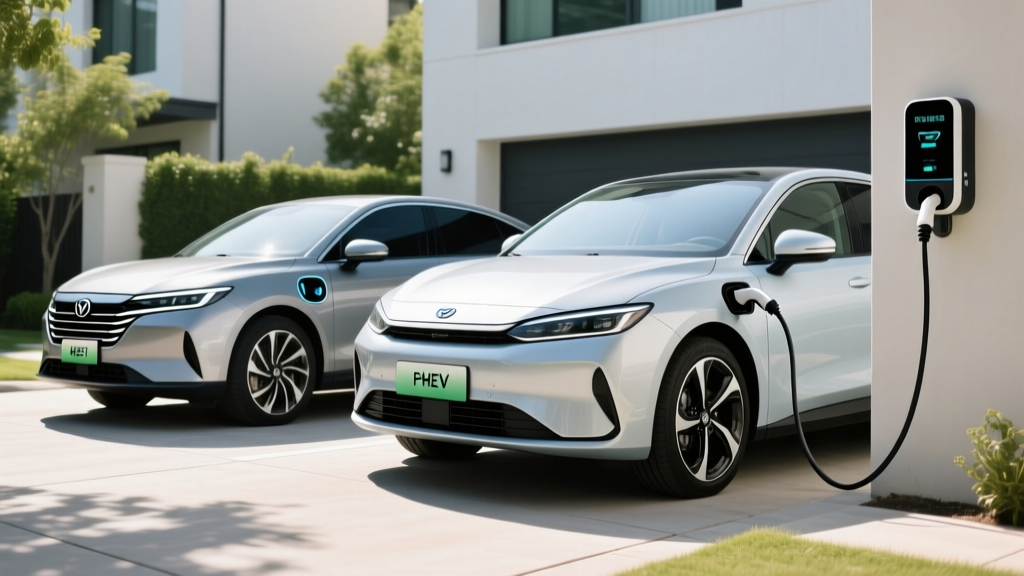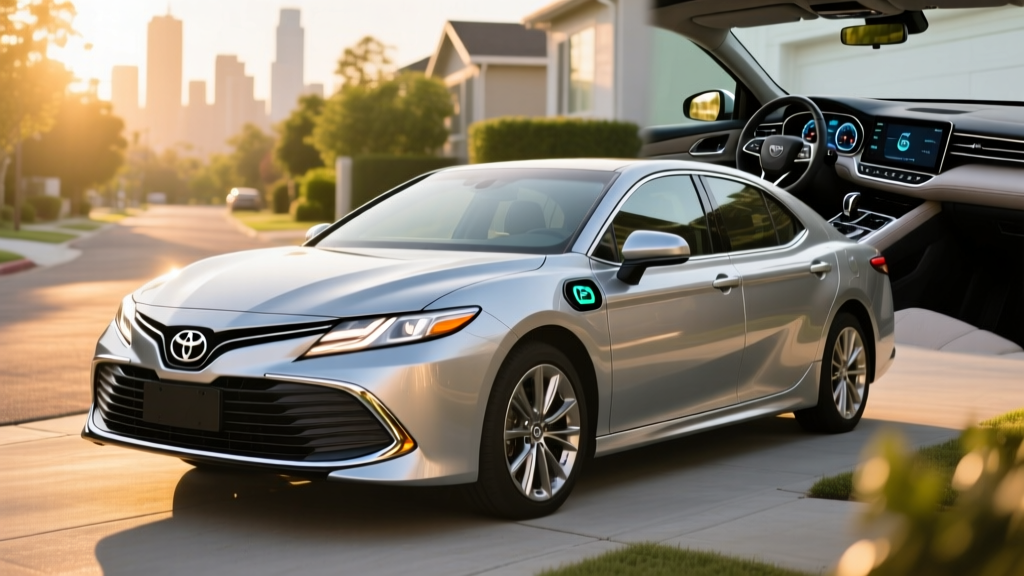
The Toyota Camry has been America's best-selling sedan for years, and for 2026 it's available exclusively as a hybrid — with all-wheel drive as a popular option across every trim. The Camry AWD Hybrid pairs a 2.5-liter four-cylinder engine with three electric motors (one driving the rear axle) to deliver strong fuel economy without sacrificing traction in rain or snow. If you're cross-shopping this against a plug-in hybrid or a full battery-electric vehicle, this guide breaks down every number that matters.
2026 Camry AWD Hybrid Powertrain: How It Works
The 2026 Camry AWD uses Toyota's fifth-generation hybrid system. Up front, a 2.5-liter Atkinson-cycle four-cylinder engine produces 184 horsepower on its own, working in tandem with two motor-generators integrated into the transaxle. A separate rear-mounted electric motor drives the rear wheels when the system detects slip, acceleration demand, or low-traction conditions. Combined system output is 232 horsepower — a meaningful bump over the front-wheel-drive Camry Hybrid's 225 hp.
This is a conventional hybrid electric vehicle (HEV), not a plug-in hybrid (PHEV). You never plug it in. The 1.6 kWh nickel-metal hydride (NiMH) traction battery recharges through regenerative braking and the gasoline engine. That small battery is enough to enable brief low-speed electric-only driving (typically under 1 mile at parking-lot speeds), but the engine is always available and engages automatically. The appeal is simplicity: fuel it like any gas car, and the hybrid system handles the rest.
HEV vs PHEV — What's the Difference?
| Feature | Camry AWD Hybrid (HEV) | Typical PHEV (e.g., RAV4 Prime) |
|---|---|---|
| Plug-in charging required? | No | Yes (for EV range benefit) |
| Electric-only range | ~1 mi at low speed | 35–42 mi EPA |
| Battery capacity | 1.6 kWh (NiMH) | 18.1 kWh (Li-ion) |
| Federal tax credit (§30D) | Not eligible | Up to $7,500 (if eligible) |
| Home charging needed? | No | Recommended for EV benefit |
EPA Fuel Economy and Real-World MPG
The 2026 Camry AWD Hybrid is rated by the EPA at 51 MPG city / 49 MPG highway / 50 MPG combined in the LE trim. Higher trims (SE, XLE, XSE) with larger 18- or 19-inch wheels carry slightly lower ratings: 48/47/47 MPG combined. These numbers come from fueleconomy.gov, the official EPA database.
| Trim (AWD) | City MPG | Highway MPG | Combined MPG |
|---|---|---|---|
| LE | 51 | 49 | 50 |
| SE | 48 | 47 | 47 |
| XLE | 48 | 47 | 47 |
| XSE | 48 | 47 | 47 |
Real-World MPG: What to Actually Expect
Toyota's hybrid system excels in stop-and-go city driving, where regenerative braking recaptures energy and the electric motor handles low-speed acceleration. Many Camry Hybrid owners report exceeding the EPA city estimate in real-world suburban commuting — 52–55 MPG is achievable on routes with frequent stops and moderate speeds.
Highway driving is a different story. At sustained 70–75 MPH, the gasoline engine does most of the work, and aerodynamic drag dominates. Expect highway fuel economy in the range of 44–48 MPG on the LE, and 42–46 MPG on the heavier, larger-wheeled trims. In cold weather (below 30°F), the engine runs more frequently to maintain cabin heat and battery temperature, which typically drops city MPG by 3–6 points. Using the seat heaters instead of cranking cabin heat can recover some of that loss.
Driving Performance and AWD Behavior
With 232 combined horsepower, the Camry AWD Hybrid hits 0–60 MPH in approximately 6.7 seconds — quick enough for confident highway merging and passing. The rear electric motor engages in under a second when the front wheels lose grip, sending up to 50% of available torque to the rear axle. This isn't a performance AWD system like you'd find in a Subaru WRX; it's a traction-assist system optimized for wet roads, light snow, and hill starts. The rear motor disengages during steady cruising to minimize parasitic losses and protect fuel economy.
Toyota's eCVT (electronically controlled continuously variable transmission) means there are no fixed gear ratios and no shift shock. Acceleration is linear, though the engine note under hard acceleration is a sustained drone — typical of Atkinson-cycle hybrid powertrains. For most daily driving, the powertrain is unobtrusive and impressively smooth.
Pricing and Tax Credit Eligibility
The 2026 Camry AWD Hybrid starts at an MSRP of approximately $30,495 for the LE trim, including destination charge. Fully loaded XSE AWD models reach roughly $38,000 with options.
| Trim | MSRP (AWD) | Key Features |
|---|---|---|
| LE AWD | $30,495 | 8" touchscreen, TSS 3.0, 16" wheels |
| SE AWD | $32,095 | Sport suspension, 18" wheels, paddle shifters |
| XLE AWD | $34,595 | Leather-trimmed seats, 12.3" display, 19" wheels |
| XSE AWD | $36,095 | Sport leather, panoramic roof option, JBL audio |
Does the Camry Hybrid Qualify for a Federal Tax Credit?
No. The federal §30D Clean Vehicle Credit applies only to plug-in electric vehicles (BEVs and PHEVs) with battery capacities of at least 7 kWh and specific critical-mineral and battery-component sourcing requirements. The Camry Hybrid's 1.6 kWh NiMH battery does not meet these thresholds. It also does not qualify for most state-level EV rebates, which similarly target plug-in vehicles. The purchase incentive here is at the pump: at 50 MPG combined and $3.30/gallon gas, the Camry AWD Hybrid costs roughly $0.066 per mile in fuel — about half what a comparable non-hybrid AWD sedan would burn.
For current federal credit rules on plug-in vehicles, refer to the IRS Clean Vehicle Tax Credits page.
Hybrid Battery Warranty and Longevity
Toyota Hybrid Battery Coverage
- Hybrid battery warranty: 10 years / 150,000 miles (whichever comes first)
- Hybrid system components: 8 years / 100,000 miles
- Capacity retention guarantee: Toyota warrants the battery against defects and abnormal loss of function — not a specific percentage of original capacity, as EV batteries are warranted
- Replacement cost (out of warranty): $2,000–$4,000 for a refurbished or new NiMH hybrid battery pack, plus labor
Toyota's hybrid battery track record is among the best in the industry. The Prius, which uses similar NiMH chemistry, has demonstrated hybrid batteries lasting 150,000–200,000+ miles with minimal degradation. Unlike full EV batteries, the Camry Hybrid's small NiMH pack is never deeply cycled — the system keeps the state of charge between roughly 40% and 80%, which dramatically reduces stress on the cells. Real-world failure before 150,000 miles is uncommon, and independent shops now offer refurbished replacements for well under $3,000 if needed beyond the warranty window.
This is a meaningful advantage over BEV ownership uncertainty: a hybrid battery replacement is a $2,000–$4,000 event, not a $10,000–$20,000 one.
Camry AWD Hybrid vs. PHEV vs. Full EV: Which Fits You?
The Camry AWD Hybrid sits in a specific niche. Here's how to decide whether it's the right electrified vehicle for your situation:
Choose the Camry AWD Hybrid (HEV) if:
- You don't have access to home or workplace charging
- You want AWD for weather without the cost premium of a PHEV or EV
- You drive 10,000–15,000 miles/year and want maximum fuel savings without behavioral changes
- You plan to own the car 8–12 years and value Toyota's long-term reliability record
Choose a PHEV (e.g., Toyota RAV4 Prime) if:
- You can install a Level 2 home charger
- Your daily commute is under 40 miles round-trip (coverable on electric only)
- You want EV-like daily driving with gas flexibility for road trips
- You qualify for the §30D federal tax credit (income and sourcing dependent)
Choose a full EV (e.g., Tesla Model Y, Hyundai Ioniq 5) if:
- You have reliable home Level 2 charging
- You want zero tailpipe emissions and the lowest per-mile energy cost
- You drive under 250 miles/day and have access to DC fast charging for road trips
- You want the §30D credit plus potential state EV rebates
Ownership Costs: 5-Year Outlook
At 15,000 miles per year and 50 MPG combined, the Camry AWD Hybrid uses roughly 300 gallons of fuel annually. At $3.30/gallon, that's $990/year in fuel costs — about $1,100 less than a comparable non-hybrid AWD midsize sedan getting 28 MPG combined. Over five years, fuel savings alone approach $5,500.
Maintenance costs are low. The hybrid system eliminates the traditional starter motor and alternator (the motor-generators handle those functions), and regenerative braking extends brake pad life significantly — many owners report original brake pads lasting 80,000+ miles. Toyota's standard maintenance plan covers the first two years / 25,000 miles of scheduled service. Insurance premiums for the Camry Hybrid are typically in line with the non-hybrid version, as the vehicle has strong IIHS safety ratings and a large repair network.
Pros and Cons at a Glance
Pros
- 50 MPG combined (LE AWD) — best-in-class for AWD sedans
- AWD traction with no plug-in requirement
- 232 hp provides confident acceleration
- 10-year / 150,000-mile hybrid battery warranty
- Low long-term maintenance (no starter, alternator, or frequent brake jobs)
- Strong resale value — Camry Hybrids hold value well
Cons
- No federal or state tax credit eligibility
- Engine drone under hard acceleration (eCVT trait)
- AWD system is traction-assist, not performance-oriented
- Higher trims lose 3 MPG to larger wheels
- No DC fast charging capability (not applicable to HEV)
- Rear battery packaging slightly reduces trunk pass-through
Frequently Asked Questions
How many MPG does the 2026 Camry AWD Hybrid get?
The EPA rates the Camry AWD Hybrid LE at 51 city / 49 highway / 50 combined. SE, XLE, and XSE trims are rated at 48/47/47. In real-world driving, expect to exceed the city estimate in stop-and-go traffic (52–55 MPG) and fall slightly below the highway estimate at sustained 70+ MPH speeds (44–48 MPG on the LE).
Does the Camry AWD Hybrid need to be plugged in?
No. The Camry AWD Hybrid is a conventional hybrid (HEV). Its 1.6 kWh battery charges entirely through regenerative braking and the gasoline engine. You fuel it like any other car — there's no plug, no charging cable, and no home charger to install.
Is the Camry Hybrid battery expensive to replace?
Out of warranty, a replacement NiMH hybrid battery pack costs approximately $2,000–$4,000 including labor. However, Toyota's hybrid batteries are engineered for shallow cycling (staying between ~40–80% state of charge), and many last well beyond 150,000 miles. The 10-year / 150,000-mile warranty provides strong coverage.
Does the Camry AWD Hybrid qualify for any tax credit?
The Camry Hybrid does not qualify for the federal §30D Clean Vehicle Credit, which is limited to plug-in vehicles (BEVs and PHEVs) with batteries of 7 kWh or more. It also generally does not qualify for state EV rebates. The financial benefit comes from fuel savings — roughly $1,100/year less than a comparable non-hybrid AWD sedan.
How does the AWD system work on the Camry Hybrid?
A dedicated electric motor on the rear axle engages automatically when the system detects front-wheel slip, heavy acceleration, or low-traction conditions (wet roads, snow, gravel). It can send up to 50% of available torque rearward. During steady highway cruising, the rear motor disengages entirely to preserve fuel economy. This is an on-demand traction system, not a permanent AWD system like Subaru's.
Camry Hybrid vs. RAV4 Prime PHEV — which should I buy?
If you can charge at home and your daily commute is under 42 miles, the RAV4 Prime PHEV lets you drive on electricity most days while keeping gas for road trips — and it may qualify for the $7,500 federal tax credit. If you can't charge at home, want a sedan, or prefer a lower purchase price with no charging logistics, the Camry AWD Hybrid is the simpler, more affordable path to 50 MPG.