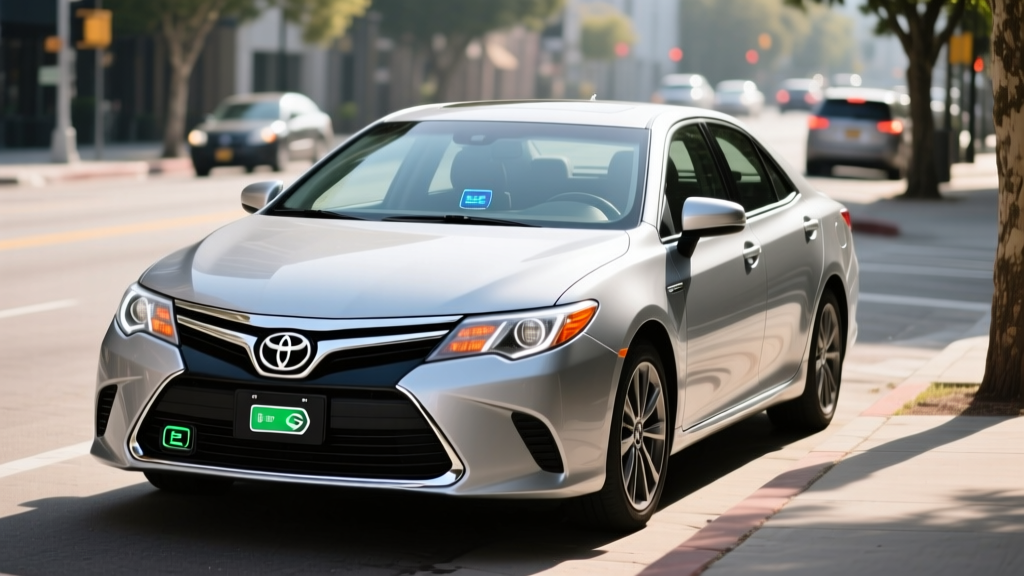
The 2013 Toyota Camry Hybrid occupies a specific niche in the used-car market: a midsize sedan that delivers genuine hybrid fuel economy without the complexity of a plug-in system or the range limitations of a full EV. With EPA ratings of 43 city / 39 highway / 41 combined MPG, it remains one of the most efficient non-plug-in sedans you can buy on the secondary market. But at over a decade old, the real question for prospective buyers centers on battery health, replacement costs, and whether this generation's Hybrid Synergy Drive still holds up.
This guide covers the exact specifications, real-world efficiency data, battery longevity expectations, and ownership economics you need to evaluate a used 2013 Camry Hybrid in today's market.
HEV vs PHEV: What the 2013 Camry Hybrid Actually Is
The 2013 Camry Hybrid is a conventional hybrid electric vehicle (HEV), not a plug-in hybrid (PHEV). This distinction matters because it defines how the car operates and what you should expect from it:
Conventional Hybrid (HEV) — 2013 Camry Hybrid
- No plug-in charging required. The battery recharges through regenerative braking and the gasoline engine.
- No electric-only driving range beyond very low-speed, short-distance creeping (under 1 mile at parking-lot speeds).
- Smaller battery pack (1.6 kWh nickel-metal hydride) that acts as a power buffer, not a primary energy source.
- No federal tax credit eligibility for used purchases under current IRS §30D or §25E rules — the §25E used-EV credit applies only to plug-in vehicles (BEVs and PHEVs).
Plug-in Hybrid (PHEV) — For Comparison
- Requires plug-in charging to access electric-only range (typically 20-50 miles in modern PHEVs).
- Larger battery (8-20+ kWh) with external charging capability.
- May qualify for federal tax credits when purchased new; used PHEVs may qualify for the §25E used credit (up to $4,000) if income and price caps are met.
The 2013 Camry Hybrid never offered a plug-in variant. Toyota did not introduce a Camry-based PHEV for the US market. If you need electric-only commuting capability, you'll need to look at vehicles like the Toyota Prius Prime, Chrysler Pacifica Hybrid, or a full BEV.
Fuel Economy: EPA Ratings and Real-World MPG
The 2013 Camry Hybrid carries EPA fuel economy ratings that remain competitive with newer hybrids:
| Driving Condition | EPA MPG | Real-World Expectation |
|---|---|---|
| City | 43 MPG | 40-46 MPG (hybrids often exceed EPA in stop-and-go) |
| Highway | 39 MPG | 35-40 MPG (aerodynamic drag reduces hybrid advantage at speed) |
| Combined | 41 MPG | 38-43 MPG depending on driving mix |
Real-world note: Conventional hybrids like this Camry typically exceed their EPA city rating in actual urban driving because regenerative braking recaptures more energy in heavy stop-and-go traffic. Highway efficiency drops relative to the EPA estimate because the electric motor provides less assistance at sustained high speeds, and the 2.5-liter Atkinson-cycle engine does most of the work. Expect 38-43 MPG combined in mixed driving, with owners reporting figures up to 46 MPG on city-heavy commutes according to fueleconomy.gov user data.
For context, the 2013 gas-only Camry LE (2.5L 4-cylinder) rated 25 city / 35 highway / 28 combined MPG. The hybrid delivers a 46% improvement in combined fuel economy — a substantial gap that translates to roughly $400-$600 in annual fuel savings at current gas prices and 15,000 miles/year.
Powertrain Specifications
| Specification | 2013 Toyota Camry Hybrid |
|---|---|
| Engine | 2.5L 4-cylinder Atkinson-cycle (156 hp, 156 lb-ft) |
| Electric Motor | Permanent-magnet synchronous (105 kW / 141 hp) |
| Combined Net Horsepower | 200 hp |
| Transmission | eCVT (planetary gearset, not a belt-driven CVT) |
| Hybrid Battery | 1.6 kWh Nickel-Metal Hydride (NiMH), 244.8V nominal |
| Drivetrain | Front-wheel drive |
| 0-60 mph | ~7.6 seconds |
| Curb Weight | ~3,435 lbs |
The Hybrid Synergy Drive system in this generation uses Toyota's proven planetary-gearset eCVT, which is fundamentally different from the rubber-belt CVTs found in some competitors. There are no friction bands, clutches, or torque converters to wear out — the power-split device has proven exceptionally durable in long-term service. The 200 hp combined output provides adequate acceleration for highway merging and passing, though this is not a performance-oriented powertrain.
Battery Longevity, Warranty, and Replacement Cost
Original Hybrid Battery Warranty
8 years / 100,000 miles (10 years / 150,000 miles in California and states adopting CARB emissions standards: CT, ME, MA, NJ, NY, OR, RI, VT, WA)
Capacity threshold: Toyota warranted the battery to retain sufficient capacity to operate the hybrid system normally — not a specific percentage retention figure as with modern BEVs.
For a 2013 model, the original hybrid battery warranty has expired for most vehicles unless the car was purchased very late in the model year and driven minimally. This makes battery condition the single most important factor when evaluating a used 2013 Camry Hybrid.
Real-World Battery Lifespan Data
Toyota's NiMH hybrid batteries in this generation have demonstrated strong longevity:
- Typical lifespan: 150,000-200,000 miles or 12-15 years before significant degradation
- Failure mode: Gradual capacity loss rather than sudden failure; the car continues to operate but with reduced fuel economy and more frequent engine engagement
- Taxi fleet data: Camry Hybrids in taxi service routinely reach 250,000+ miles on original batteries, though this involves daily driving that keeps the battery thermally stable and regularly cycled
Battery Replacement Cost (2026 Estimates)
| Option | Cost Range | Warranty |
|---|---|---|
| New OEM Toyota battery | $3,500 - $4,500 (parts + labor) | 3 years / unlimited miles |
| Remanufactured battery | $1,800 - $2,800 (parts + labor) | 1-3 years typically |
| Used/salvage battery | $800 - $1,500 (parts + labor) | 30-90 days typically |
| Individual module replacement (independent shop) | $500 - $1,200 | Varies by shop |
The NiMH pack in the 2013 Camry Hybrid is well-understood by independent hybrid specialists. Many shops now offer individual module replacement (the pack contains 34 modules) rather than full-pack replacement, which can extend battery life at significantly lower cost. A pre-purchase hybrid battery health check — available at Toyota dealers and hybrid-specialist shops — is strongly recommended before buying.
Ownership Costs and Tax Credit Eligibility
Used Market Pricing (Early 2026)
The 2013 Camry Hybrid typically trades between $8,000 and $14,000 depending on mileage, condition, and trim level (LE or XLE). Clean-title examples under 100,000 miles command the upper end of this range.
Federal Tax Credit Status
The 2013 Camry Hybrid does not qualify for any current federal tax credit:
- §30D New Vehicle Credit: Not applicable — this credit applies only to new plug-in vehicles (BEVs and PHEVs) meeting battery-sourcing and critical-mineral requirements.
- §25E Used EV Credit: Not applicable — this credit (up to $4,000 or 30% of sale price) applies only to used BEVs and PHEVs with plug-in capability. Conventional HEVs are excluded.
The original §30D hybrid credit that applied to the Camry Hybrid when new expired for Toyota in 2007 after the manufacturer hit the 60,000-unit cap. Per IRS guidance, conventional hybrids without plug-in capability are not eligible for current clean-vehicle credits.
Annual Operating Cost Estimate
| Expense | 2013 Camry Hybrid | 2013 Camry Gas (2.5L) |
|---|---|---|
| Fuel (15,000 mi/yr, $3.40/gal) | ~$1,244 | ~$1,821 |
| Insurance (national avg) | ~$1,400 - $1,700 | ~$1,350 - $1,650 |
| Maintenance (annual avg) | ~$400 - $550 | ~$400 - $550 |
| Total annual operating | ~$3,044 - $3,494 | ~$3,571 - $4,021 |
The hybrid saves approximately $500-$600 per year in fuel costs versus the gas-only equivalent. Maintenance costs are comparable — the hybrid system adds no routine maintenance items (no hybrid-specific fluid changes required beyond normal service), and regenerative braking extends brake pad life significantly.
Reliability and Safety Record
The 2013 Camry Hybrid benefits from Toyota's strong reliability reputation and a mature hybrid system that was in its third generation by this model year. Key reliability notes:
- Hybrid system: The inverter, electric motor, and power-split device have proven extremely reliable. Inverter failures were reported in some 2012-2014 Camry Hybrids — check for recall completion (Toyota issued extended warranty coverage for certain inverter assemblies).
- Brake actuator: Some owners reported brake actuator assembly failures (regenerative-to-friction braking transition). Replacement cost: $1,200-$1,800.
- 12V auxiliary battery: Located in the trunk; a standard AGM-type 12V battery that typically lasts 4-6 years. The hybrid system cannot start if the 12V battery is dead, even if the high-voltage traction battery is fully charged.
Safety ratings from NHTSA: The 2013 Camry earned a 5-star overall safety rating. The IIHS rated it "Good" in most crash tests, though it received a "Marginal" rating in the small-overlap front test — a common result for vehicles designed before this test was introduced in 2012.
Who Should Buy the 2013 Camry Hybrid vs Alternatives
Pros
- 41 MPG combined with no plug-in requirement — ideal for apartment dwellers or those without home charging
- Proven hybrid powertrain with extensive independent-shop support
- Spacious midsize sedan interior (15.4 cu ft trunk, comparable to gas model)
- Lower annual fuel cost vs gas Camry (~$577/year savings)
- Strong reliability record and low cost of ownership
- Smooth, quiet operation with seamless engine/motor transitions
Cons
- No electric-only driving range — engine runs frequently
- Original hybrid battery warranty expired; replacement is a real cost consideration
- No federal or state tax credit eligibility
- Dated infotainment and driver-assistance technology vs modern vehicles
- Marginal IIHS small-overlap crash rating
- Not eligible for HOV lane access in most states (expired or never qualified)
Choose the 2013 Camry Hybrid if:
- You want maximum MPG without plug-in charging infrastructure
- Your budget is $8,000-$14,000 and you want low operating costs
- You drive 12,000-20,000 miles/year in mixed city/highway conditions
- You prioritize reliability and low maintenance over modern tech features
Choose a used PHEV (e.g., Prius Prime, Fusion Energi) if:
- You have home charging access and a short commute (under 25 miles)
- You want some electric-only driving to reduce gasoline use further
- You want potential eligibility for the §25E used-EV credit (up to $4,000)
Choose a used BEV (e.g., Leaf, Bolt, Model 3) if:
- You have reliable home Level 2 charging
- Your daily driving is under 200 miles and you want zero gasoline use
- You want lower per-mile "fuel" cost (electricity vs gasoline) and less routine maintenance
Frequently Asked Questions
How many MPG does the 2013 Toyota Camry Hybrid get?
The EPA rates it at 43 city / 39 highway / 41 combined MPG. Real-world owners report 38-46 MPG depending on driving conditions, with city-heavy commutes often exceeding the EPA estimate thanks to regenerative braking.
Does the 2013 Camry Hybrid need to be plugged in?
No. This is a conventional hybrid (HEV), not a plug-in hybrid. The 1.6 kWh battery charges entirely through regenerative braking and the gasoline engine. There is no plug, no charging port, and no electric-only driving range beyond low-speed parking-lot movement.
How long does the hybrid battery last and what does replacement cost?
Toyota's NiMH hybrid batteries in this generation typically last 150,000-200,000 miles or 12-15 years. A new OEM replacement costs $3,500-$4,500 installed; remanufactured units run $1,800-$2,800. Independent shops can sometimes replace individual battery modules for $500-$1,200. The original 8-year/100,000-mile warranty has expired for nearly all 2013 examples.
Is the 2013 Camry Hybrid reliable?
Yes. The Hybrid Synergy Drive system is one of the most proven hybrid powertrains in production. The main concerns for a 2013 example are age-related: hybrid battery degradation, potential brake actuator issues, and standard wear items. A pre-purchase hybrid health check is recommended.
Does the 2013 Camry Hybrid qualify for any tax credit?
No. As a conventional hybrid without plug-in capability, it does not qualify for the federal §30D new-vehicle credit, the §25E used-EV credit, or most state EV incentives. These programs require plug-in vehicles (BEVs or PHEVs). The original hybrid tax credit for Toyota vehicles expired in 2007.
What's the difference between the LE and XLE trims?
The LE is the base hybrid trim with cloth seats, automatic climate control, and a 6.1-inch touchscreen. The XLE adds leather-trimmed seats, heated front seats, a premium JBL audio system, keyless entry with push-button start, and an auto-dimming rearview mirror. Both share the same powertrain and EPA fuel economy ratings.