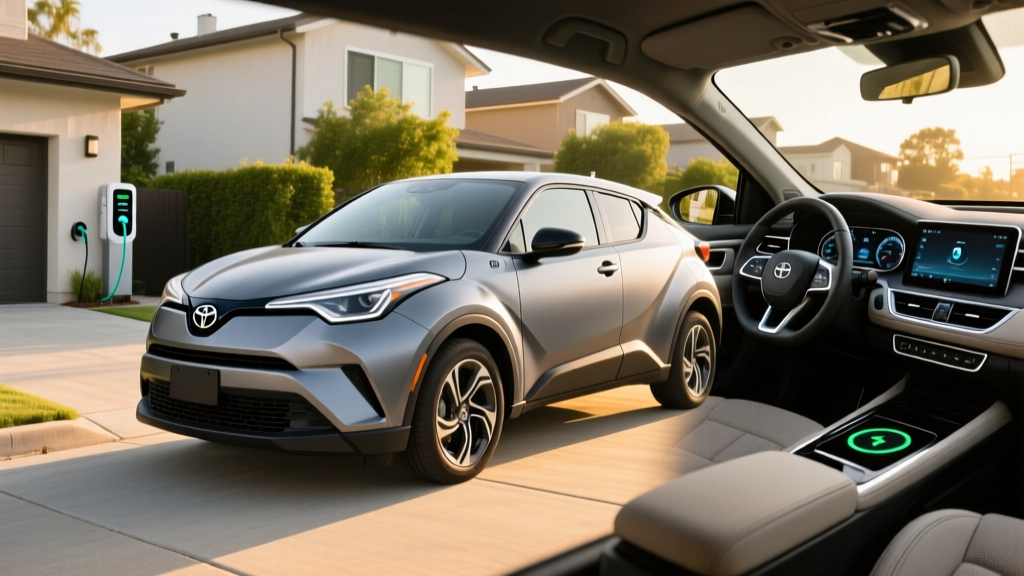
The subcompact crossover segment has never been short on choices, but the Toyota C-HR Hybrid occupies a specific niche: a stylish, city-friendly runabout that sips fuel without asking you to plug in or rethink your routine. For 2026, Toyota continues to offer the C-HR with its proven hybrid powertrain in global markets, while the U.S. lineup has shifted. This guide covers everything a prospective buyer needs — EPA fuel economy, real-world MPG, powertrain specs, battery longevity, and whether this hybrid (or its plug-in sibling) fits your life better than a full EV or a conventional gas car.
HEV vs. PHEV: What's the Difference?
Conventional Hybrid (HEV): Uses a small battery (typically 1–2 kWh) charged entirely by the engine and regenerative braking. You never plug it in. The C-HR Hybrid falls here.
Plug-In Hybrid (PHEV): Carries a larger battery (typically 10–20 kWh) that you can charge from a wall outlet or public charger, giving 25–50 miles of electric-only driving before the gas engine kicks in. Toyota offers the C-HR PHEV in select European and Asian markets for 2026, but it is not currently sold in the United States.
2026 Toyota C-HR Hybrid: Powertrain and Performance
The 2026 Toyota C-HR Hybrid uses Toyota's fifth-generation hybrid system, pairing a 2.0-liter four-cylinder engine with an electric motor integrated into the transaxle. Combined output stands at 196 horsepower — a meaningful bump over the outgoing 1.8L system. The setup sends power to the front wheels via an e-CVT (electronically controlled continuously variable transmission), with an available AWD-i rear electric motor on select trims adding roughly 40 hp to the rear axle for traction, not performance.
| Spec | Value |
|---|---|
| Powertrain | 2.0L I4 + electric motor (e-CVT) |
| Combined Horsepower | 196 hp (FWD) |
| Hybrid Battery | ~1.6 kWh, lithium-ion (NiMH on base trims) |
| 0–60 mph | ~7.4 seconds (est.) |
| Drivetrain | FWD standard; AWD-i available |
| EPA Fuel Economy | See table below |
| Cargo Volume | ~19.0 cu ft (rear seats up) |
| Base MSRP (Global) | ~€32,000 / ~£29,000 (market dependent) |
Note: The Toyota C-HR was discontinued in the U.S. market after the 2022 model year. U.S. buyers seeking a similar Toyota hybrid crossover should consider the Corolla Cross Hybrid (196 hp, AWD, EPA 42 MPG combined) as the spiritual successor. Pricing and availability discussed here reflect global markets where the C-HR Hybrid remains on sale for 2026.
Fuel Economy: EPA MPG and Real-World Numbers
Fuel efficiency is the C-HR Hybrid's headline act. Toyota's 2.0L hybrid system is optimized for low-speed, stop-and-go driving — exactly the conditions where conventional gas engines waste the most fuel.
| Cycle | EPA Est. MPG | Real-World Expectation |
|---|---|---|
| City | 53 | 50–58 (hybrids often beat EPA in city) |
| Highway | 46 | 40–44 (sustained high speed reduces regen benefit) |
| Combined | 50 | 46–52 |
Why hybrids often exceed EPA in the city: At low speeds, the C-HR Hybrid runs on its electric motor far more than the gas engine. Every stop recharges the battery via regenerative braking. On the highway, the engine runs continuously, and aerodynamic drag on the C-HR's tall, coupe-like bodywork works against efficiency. Expect roughly 40–44 MPG at a sustained 75 mph.
Cold-weather impact: Hybrid fuel economy drops 10–20% in freezing temperatures. The engine runs more often to provide cabin heat and keep the catalytic converter warm, and battery efficiency declines in the cold. Plan on 38–44 MPG combined in winter conditions — still well above a comparable gas-only crossover.
C-HR PHEV: Electric-Only Range and Charging (Global Markets)
For buyers in Europe and select Asian markets, Toyota offers the C-HR Plug-In Hybrid alongside the conventional HEV. This variant pairs a 2.0L engine with a larger 13.8 kWh lithium-ion battery, enabling genuine zero-emission commuting for short distances.
| Spec | Value |
|---|---|
| Battery Capacity | 13.8 kWh (usable ~11.5 kWh) |
| EV-Only Range (WLTP) | ~41 miles (66 km) |
| EV-Only Range (EPA est.) | ~33 miles (if U.S. certified) |
| Total Combined Range | ~470 miles (EV + gas) |
| Level 1 Charging (120V) | ~10 hours (full charge) |
| Level 2 Charging (240V, 3.3 kW) | ~3.5 hours (full charge) |
| DC Fast Charging | Not supported |
| Combined System Power | 223 hp |
Important caveat on range: WLTP figures (used in Europe) are more generous than EPA estimates. If the C-HR PHEV were EPA-certified, expect roughly 30–35 miles of electric-only range. That's enough for most daily commutes under 30 miles round-trip, meaning many owners could run almost entirely on electricity during the week and use the gas engine only for weekend trips.
The C-HR PHEV does not support DC fast charging — a common limitation among PHEVs. Level 2 charging at 3.3 kW is adequate for overnight replenishment but means you won't top up quickly at a public station during the day.
Battery Longevity, Warranty, and Replacement Costs
Hybrid battery anxiety is the top concern for first-time hybrid buyers. Here's what the data shows after two decades of Toyota hybrid production:
Toyota Hybrid Battery Warranty
Hybrid Battery: 10 years / 150,000 miles (whichever comes first) in most global markets. In U.S.-spec Toyota hybrids, the warranty is 10 years / 150,000 miles per Toyota's official warranty guide.
Hybrid System Components: 8 years / 100,000 miles for the inverter, electric motor, and related control electronics.
Coverage threshold: Toyota warrants the hybrid battery to retain sufficient capacity for normal hybrid operation. If capacity drops below a functional threshold during the warranty period, Toyota replaces it at no cost.
Real-world longevity: Data from fleet operators and long-term owner surveys (including Consumer Reports reliability studies) consistently show Toyota hybrid batteries lasting 150,000–200,000+ miles before significant degradation. Failures before 100,000 miles are rare. The Prius, which shares the same hybrid architecture, has documented cases exceeding 300,000 miles on the original battery.
Replacement cost if out of warranty: A new OEM hybrid battery for the C-HR Hybrid (HEV) runs approximately $2,000–$3,500 including labor. Third-party refurbished batteries are available for $1,200–$2,000. The PHEV's larger 13.8 kWh battery is significantly more expensive — expect $6,000–$9,000 for a full replacement, though these units are newer and long-term failure data is still limited.
Maximizing battery life: Toyota's hybrid system manages battery state of charge automatically, keeping it between roughly 40% and 80% — the sweet spot for lithium-ion longevity. You don't need to baby it. Avoid prolonged storage at extreme temperatures with a fully depleted battery, and the system handles the rest.
Pricing, Tax Credits, and Total Cost of Ownership
For the conventional C-HR Hybrid (HEV), pricing in global markets starts around €32,000 (~$35,000 USD equivalent) for the base Design trim, climbing to roughly €40,000 (~$44,000) for the top GR Sport with AWD-i.
Federal tax credit (§30D): The conventional C-HR Hybrid does not qualify for the U.S. federal EV tax credit. Under current IRS §30D rules, only battery electric vehicles (BEVs) and plug-in hybrids (PHEVs) with at least 7 kWh of battery capacity are eligible. The C-HR HEV's ~1.6 kWh battery falls far short of this threshold.
The C-HR PHEV's 13.8 kWh battery theoretically meets the capacity requirement, but eligibility also depends on:
- MSRP cap: Vans/SUVs must be under $80,000; sedans under $55,000
- Buyer income cap: Modified AGI ≤ $150,000 (single) / $300,000 (joint)
- Battery sourcing: Critical minerals and battery components must meet phased percentages from U.S. or FTA-partner countries (increasing annually through 2030)
- Final assembly: Vehicle must be assembled in North America
Since the C-HR PHEV is assembled in Japan/Turkey and not sold in the U.S., the federal credit is effectively moot for American buyers. Some states offer separate hybrid or PHEV rebates — check your state energy office for current programs.
| Cost Factor | C-HR Hybrid (50 MPG) | Gas Crossover (28 MPG) |
|---|---|---|
| Fuel (75,000 mi @ $3.50/gal) | $5,250 | $9,375 |
| Maintenance (5 yr) | ~$2,200 | ~$3,000 |
| Insurance (avg.) | ~$7,500 | ~$7,000 |
| 5-Year Running Total | ~$14,950 | ~$19,375 |
The hybrid saves roughly $4,400 over five years in fuel and maintenance — enough to offset a modest price premium over a gas equivalent. Hybrids also avoid the higher insurance premiums that some EVs carry.
Hybrid vs. PHEV vs. EV: Which Fits You?
Choose the C-HR Hybrid (HEV) if:
- You can't charge at home (apartment, street parking, no garage)
- Your commute is under 40 miles and mostly city driving
- You want maximum simplicity — no plugs, no range planning, no charging apps
- Budget is a priority and you want a lower purchase price than a BEV
Choose the C-HR PHEV if:
- You have home charging (Level 1 or 2) and a commute under 35 miles
- You want electric daily driving but gas flexibility for road trips
- You live in a market where the PHEV variant is available and priced competitively
Choose a Full EV (BEV) if:
- You have reliable home Level 2 charging
- Your daily driving is under 250 miles and you can plan road-trip charging
- You want to eliminate gas entirely and qualify for the §30D federal tax credit (up to $7,500)
- Lower per-mile "fuel" cost and zero tailpipe emissions are priorities
Pros and Cons at a Glance
✓ Pros
- 50 MPG combined — outstanding for a crossover
- No plug-in required; zero lifestyle change from a gas car
- Toyota's proven hybrid reliability (20+ years of data)
- 10-year / 150,000-mile hybrid battery warranty
- Strong city MPG that often beats the EPA sticker
- Lower maintenance than gas (no alternator, starter, or accessory belt)
✗ Cons
- Not available in the U.S. for 2026 (discontinued after 2022)
- Highway MPG drops to ~40–44 at sustained 75 mph
- Tight rear seat and cargo space vs. Corolla Cross or RAV4
- No federal tax credit eligibility (HEV)
- CVT drone under hard acceleration
- PHEV variant lacks DC fast charging
Frequently Asked Questions
How many MPG does the Toyota C-HR Hybrid get?
The 2026 C-HR Hybrid is rated at approximately 53 city / 46 highway / 50 combined MPG (EPA equivalent). Real-world owners report 46–56 MPG depending on driving mix. City-heavy commutes often exceed the EPA sticker thanks to regenerative braking and electric-only low-speed operation.
How far can the C-HR PHEV go on electric only?
The C-HR Plug-In Hybrid delivers approximately 41 miles of EV-only range on the WLTP cycle, which translates to roughly 30–35 miles EPA-equivalent. That covers most daily commutes. Once the battery depletes, it operates as a conventional hybrid with the gas engine, delivering total combined range of approximately 470 miles.
Does the Toyota C-HR Hybrid qualify for any tax credit?
No. The conventional C-HR Hybrid (HEV) does not qualify for the U.S. federal §30D clean vehicle credit — that credit requires a battery of at least 7 kWh and plug-in capability. The C-HR PHEV meets the battery threshold but is not sold in the U.S. and wouldn't meet North American assembly requirements. Check your state for any local hybrid incentives.
Is the C-HR Hybrid reliable? What does battery replacement cost?
Toyota's hybrid system is among the most reliable powertrains on the road, backed by over two decades of Prius data. The hybrid battery is warranted for 10 years / 150,000 miles. Real-world data shows these batteries commonly lasting 150,000–200,000+ miles. If replacement is needed out of warranty, expect $2,000–$3,500 for the HEV battery and $6,000–$9,000 for the PHEV battery.
Do I need to plug in the C-HR Hybrid?
No. The conventional C-HR Hybrid (HEV) charges its own battery through the gas engine and regenerative braking. You simply fill it with gas and drive — exactly like a conventional car. Only the PHEV variant requires (or benefits from) plugging in.
Hybrid vs. full EV — which should I choose?
Choose the hybrid if you lack home charging, drive long highway stretches, or want zero behavioral change. Choose a full EV if you have Level 2 home charging, drive under 250 miles daily, and want the lowest per-mile energy cost (roughly $0.04–$0.06/mile for electricity vs. $0.10–$0.14/mile for the hybrid on gas). The PHEV splits the difference for those who can charge at home but need road-trip flexibility.
Sources: EPA fuel economy data via fueleconomy.gov; Toyota global specifications; IRS §30D clean vehicle credit rules via irs.gov. Pricing and availability reflect 2026 model-year information for markets where the C-HR Hybrid is sold. U.S. buyers should consider the Corolla Cross Hybrid as the closest domestic alternative.