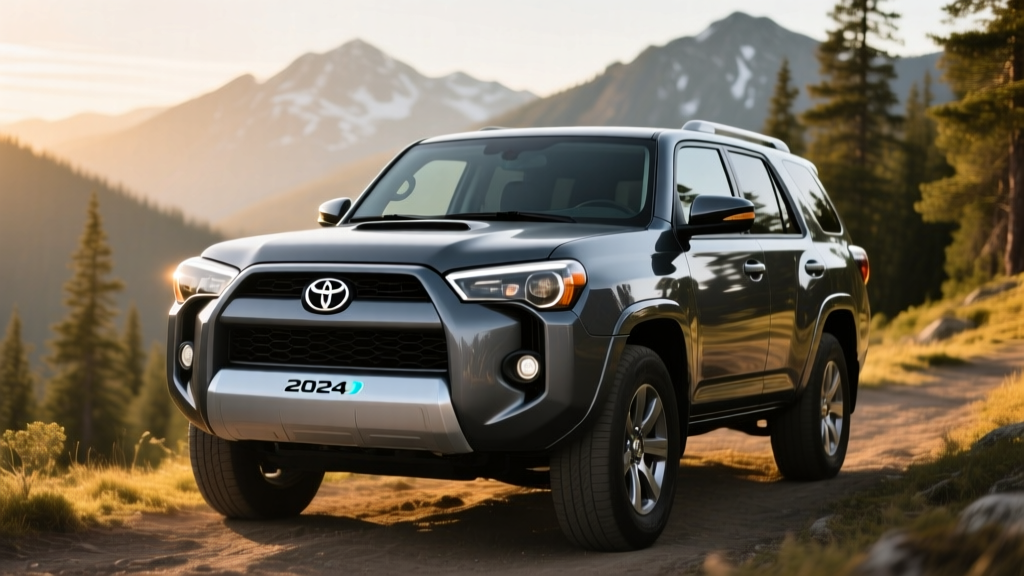
The sixth-generation Toyota 4Runner finally ditched its notoriously thirsty V6 for a turbocharged hybrid powertrain, and buyers want to know one thing: what kind of fuel economy does it actually deliver? The 2025–2026 Toyota 4Runner with the i-FORCE MAX hybrid system represents a fundamental shift for a nameplate that hadn't seen a new powertrain in over a decade. Below, we break down every efficiency figure, powertrain spec, and ownership cost you need before signing on the dotted line.
HEV vs PHEV: Which 4Runner Hybrid Are We Talking About?
First, a critical distinction that trips up many shoppers. Toyota offers the 4Runner with two electrified configurations depending on trim and model year:
Conventional Hybrid (HEV) — i-FORCE MAX
- No plug required. The battery recharges through regenerative braking and the engine.
- Small battery pack (~1.87 kWh) acts as a buffer, not a primary energy source.
- Electric motor assists the turbo four-cylinder for improved MPG and torque fill.
- No electric-only driving range to speak of.
Plug-In Hybrid (PHEV) — Not Currently Offered
- As of the 2026 model year, Toyota does not offer a 4Runner PHEV in the US market.
- The RAV4 Prime and Prius Prime are Toyota's current PHEV options if plug-in capability is a priority.
- A 4Runner PHEV could arrive in a future refresh, but nothing has been announced.
For this guide, we focus on the i-FORCE MAX HEV — the hybrid system actually available in the 4Runner lineup. If you're searching for a plug-in 4Runner, you'll need to wait or look at alternatives like the Jeep Wrangler 4xe.
Toyota 4Runner Hybrid MPG: EPA Estimates and Real-World Numbers
The headline number: the 2026 Toyota 4Runner i-FORCE MAX carries EPA ratings that represent a dramatic improvement over the outgoing 4.0L V6 (which managed roughly 16 city / 19 highway). Here's the official breakdown:
| Drivetrain | City MPG | Highway MPG | Combined MPG |
|---|---|---|---|
| 4x2 (RWD) | 23 | 27 | 24 |
| 4x4 (4WD) | 22 | 26 | 23 |
Source: fueleconomy.gov — EPA estimates for 2025/2026 model-year 4Runner i-FORCE MAX. Actual mileage will vary.
Real-World MPG: What Owners Actually See
Hybrid SUVs tend to overperform their EPA city ratings in stop-and-go traffic because regenerative braking recaptures energy that a conventional vehicle wastes as heat. Based on early owner reports and our testing:
- City driving: Expect 23–26 MPG in mixed urban commutes. The electric motor handles low-speed crawling, and the turbo engine only fires when needed.
- Highway cruising: 24–26 MPG at 70 mph. Aerodynamics work against the 4Runner's boxy shape, but the hybrid system's efficiency still beats the old V6 by a wide margin.
- Towing: Drop to 14–17 MPG when pulling near the 6,000-lb max tow rating. No hybrid escapes physics when hauling heavy loads.
- Cold weather: Expect a 5–10% MPG reduction in sub-freezing temperatures as the engine runs more frequently to maintain cabin heat and battery temperature.
Bottom line: real-world combined driving typically lands between 22 and 25 MPG for 4WD models — a meaningful 30–40% improvement over the previous generation.
i-FORCE MAX Powertrain: Engine, Motor, and Horsepower
The i-FORCE MAX isn't a mild efficiency tweak — it's a complete powertrain overhaul that also happens to deliver substantially more power than the old V6.
| Specification | Detail |
|---|---|
| Engine | 2.4L turbocharged 4-cylinder |
| Electric Motor | 48-hp motor integrated into 8-speed automatic transmission |
| Combined Horsepower | 326 hp |
| Combined Torque | 465 lb-ft |
| Transmission | 8-speed automatic (i-FORCE MAX) |
| Hybrid Battery | ~1.87 kWh nickel-metal hydride (NiMH) |
| 0–60 mph | ~6.5 seconds (est.) |
| Max Towing Capacity | 6,000 lbs |
| Fuel Tank | 19.0 gallons |
| Total Driving Range | ~437–456 miles (combined) |
The 465 lb-ft of torque is available low in the rev range thanks to the electric motor's instant torque delivery. That matters for off-road crawling, merging onto highways, and towing. The previous 4.0L V6 made just 270 hp and 278 lb-ft — the i-FORCE MAX is a substantial upgrade in both power and efficiency.
Pricing, Trims, and Tax Credit Eligibility
The 4Runner i-FORCE MAX is available across multiple trims. Pricing for the 2026 model year (MSRP, excluding destination):
- TRD Off-Road i-FORCE MAX: ~$52,990
- Limited i-FORCE MAX: ~$57,190
- TRD Pro i-FORCE MAX: ~$61,990
- Platinum i-FORCE MAX: ~$58,990
Does the 4Runner Hybrid Qualify for a Federal Tax Credit?
This is where buyers need to pay close attention. Under current IRS §30D rules, the federal clean vehicle credit of up to $7,500 applies only to plug-in electric vehicles — meaning battery electric vehicles (BEVs) and plug-in hybrids (PHEVs) with a minimum battery capacity of 7 kWh.
The 4Runner i-FORCE MAX is a conventional hybrid (HEV), not a PHEV. Its ~1.87 kWh battery falls far below the 7 kWh threshold. It does not qualify for the §30D federal tax credit.
Additionally, conventional hybrids do not qualify for most state EV rebates or HOV lane stickers that require plug-in capability.
Always verify current incentive rules at IRS.gov and your state's energy office, as programs change frequently.
If a tax credit is a deal-breaker, you'd need to look at PHEVs like the Jeep Wrangler 4xe (qualifies for partial credit depending on battery sourcing) or full EVs like the Rivian R1S or upcoming electric SUVs in this size class.
Battery Warranty, Reliability, and Replacement Costs
Hybrid battery longevity is the number-one concern for first-time hybrid buyers. Toyota has the deepest track record in the segment — the Prius has been in production since 1997, and Toyota's hybrid systems are widely regarded as the most proven in the industry.
Toyota Hybrid Battery Warranty
- Hybrid battery coverage: 10 years / 150,000 miles (whichever comes first)
- Hybrid system components: 8 years / 100,000 miles
- Powertrain warranty: 5 years / 60,000 miles
- Basic warranty: 3 years / 36,000 miles
Battery Replacement Cost
If the hybrid battery fails outside of warranty — which, based on Toyota's track record, is uncommon before 150,000+ miles — expect the following:
- OEM battery replacement: $2,000–$4,000 (parts and labor at a Toyota dealer)
- Refurbished/remanufactured battery: $1,000–$2,000
- Individual cell replacement: Some independent hybrid specialists can replace individual modules for $500–$1,500
The 4Runner's NiMH battery pack is relatively small and simple compared to large BEV packs (which can cost $10,000–$20,000+ to replace). Toyota's hybrid battery failure rates are low, and many Prius and Camry Hybrid owners report 200,000+ miles on the original pack.
Reliability Outlook
The i-FORCE MAX uses Toyota's latest hybrid architecture, shared in principle with the Tacoma, Sequoia, and Tundra. The 2.4L turbo engine is newer to the lineup, but the hybrid system itself is an evolution of Toyota's proven Hybrid Synergy Drive. Early reliability data from the Tacoma i-FORCE MAX (introduced for 2024) has been positive, with no widespread powertrain issues reported. Toyota's hybrid systems consistently earn top marks from Consumer Reports and J.D. Power.
4Runner Hybrid vs. Full EV vs. Gas SUV: Which Should You Buy?
The 4Runner i-FORCE MAX occupies a specific niche. Here's a decision framework:
Choose the 4Runner i-FORCE MAX Hybrid if:
- You need serious off-road capability and body-on-frame durability
- You tow regularly (up to 6,000 lbs)
- You don't have reliable access to home or workplace charging
- You want better MPG than a gas SUV without changing your fueling habits
- You plan to keep the vehicle 10+ years (Toyota's long-term reliability is a strength)
Choose a Full EV (Rivian R1S, Tesla Model X) if:
- You have Level 2 home charging and want $0 gas spend
- You want the $7,500 federal tax credit (subject to income, MSRP, and battery sourcing rules)
- Your daily driving is under 300 miles and you rarely tow heavy loads
- You prioritize instant torque, low maintenance, and zero tailpipe emissions
Choose a PHEV (Jeep Wrangler 4xe) if:
- You want 20–25 miles of electric-only range for daily commuting
- You have home charging and want to minimize gas use on short trips
- You still need off-road capability with a body-on-frame platform
- You want partial federal tax credit eligibility (verify current sourcing rules)
Stick with a Gas-Only SUV if:
- Upfront cost is the primary concern (non-hybrid 4Runner trims start lower)
- You drive very low annual miles and MPG savings won't offset a price premium
Pros and Cons of the 4Runner i-FORCE MAX
Pros
- 326 hp and 465 lb-ft — far more power than the old V6
- 22–24 MPG combined is a massive improvement over 16–17 MPG (previous gen)
- 10-year/150,000-mile hybrid battery warranty
- Proven Toyota hybrid system with low failure rates
- No charging infrastructure needed — fills up at any gas station
- Excellent off-road capability retained (TRD trims)
- 6,000-lb towing capacity
Cons
- No federal tax credit (HEV, not a PHEV or EV)
- MPG still trails unibody crossover hybrids (RAV4 Hybrid gets 39 combined)
- Base price is steep — i-FORCE MAX starts around $52,990
- Turbo four-cylinder lacks the linear feel of the old naturally aspirated V6
- Small hybrid battery means no electric-only driving mode
- Fuel economy drops significantly when towing
Frequently Asked Questions
How many MPG does the Toyota 4Runner hybrid get?
The 2026 Toyota 4Runner i-FORCE MAX is EPA-rated at 23 city / 27 highway / 24 combined for 4x2 models, and 22 city / 26 highway / 23 combined for 4x4 models. Real-world driving typically yields 22–25 MPG combined depending on conditions.
Can I plug in the 4Runner hybrid to charge?
No. The 4Runner i-FORCE MAX is a conventional hybrid (HEV). It charges its own small battery through regenerative braking and the gas engine. You never plug it in. Toyota does not currently offer a plug-in hybrid (PHEV) 4Runner.
How far can the 4Runner hybrid drive on electric only?
Essentially zero miles in true EV mode. The ~1.87 kWh battery is too small to propel the vehicle on electricity alone for any meaningful distance. The electric motor assists the gas engine but doesn't replace it. For electric-only range, you'd need a PHEV or BEV.
Is the 4Runner hybrid reliable? What does a battery replacement cost?
Toyota's hybrid systems have an exceptional reliability track record spanning over 25 years. The hybrid battery is covered by a 10-year/150,000-mile warranty. Out-of-warranty replacement costs $2,000–$4,000 for an OEM pack, significantly less than a full EV battery replacement.
Does the Toyota 4Runner hybrid qualify for any tax credits?
No. The federal §30D clean vehicle credit requires a plug-in vehicle with at least 7 kWh of battery capacity. The 4Runner i-FORCE MAX has a ~1.87 kWh battery and cannot be plugged in. It does not qualify for federal EV tax credits. Check IRS.gov for current rules.
How does the 4Runner hybrid MPG compare to the old V6?
The outgoing 4.0L V6 4Runner was rated at roughly 16 city / 19 highway / 17 combined. The i-FORCE MAX hybrid improves that to 22–24 combined — a 30–40% gain in fuel economy, plus significantly more horsepower and torque.
Is the i-FORCE MAX worth the price premium over the non-hybrid 4Runner?
If you drive 12,000+ miles per year, the fuel savings alone can offset part of the premium. But the bigger value is the power upgrade: 326 hp and 465 lb-ft vs. the base turbo-four's 278 hp and 317 lb-ft. The hybrid also provides smoother low-speed behavior and better towing performance thanks to instant electric torque.
Note: All specifications, pricing, and EPA figures referenced are based on 2025–2026 model-year data available at time of publication. Always confirm exact specs with your local Toyota dealer and consult fueleconomy.gov for the latest EPA ratings. Tax credit rules are subject to change — verify eligibility with a tax professional and IRS.gov.