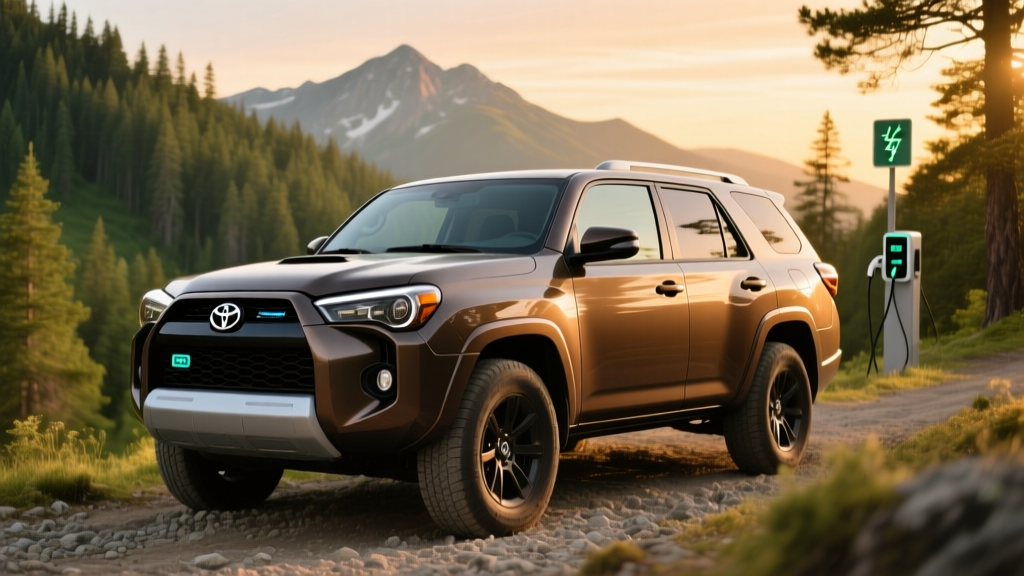
The sixth-generation Toyota 4Runner finally arrived for the 2025 model year with a complete overhaul — and with it, Toyota introduced the i-FORCE MAX hybrid powertrain across multiple trims. For buyers researching Toyota 4Runner hybrid gas mileage, the headline is clear: this is a conventional hybrid electric vehicle (HEV), not a plug-in hybrid. You never plug it in. It charges its own small battery through regenerative braking and the gasoline engine, and it delivers meaningfully better fuel economy than the standard turbocharged 4Runner while retaining the rugged, body-on-frame capability the nameplate is known for.
Below, we break down the exact EPA MPG figures, real-world efficiency expectations, powertrain specifications, pricing, warranty coverage, and how the 4Runner Hybrid stacks up against full EVs and conventional gas trucks for different buyer profiles.
2025 Toyota 4Runner Hybrid MPG: EPA Numbers and Real-World Expectations
The 2025 Toyota 4Runner with the i-FORCE MAX hybrid powertrain carries the following EPA fuel economy ratings, as published on fueleconomy.gov:
| Metric | MPG |
|---|---|
| City | 23 MPG |
| Highway | 24 MPG |
| Combined | 23 MPG |
For context, the standard (non-hybrid) 2025 4Runner with the i-FORCE 2.4L turbo engine is rated at approximately 20 MPG combined (19 city / 22 highway, depending on trim and drivetrain). That makes the hybrid roughly a 15% improvement in combined driving — a meaningful difference over 15,000 annual miles.
Toyota's hybrid system excels in stop-and-go city driving, where regenerative braking recaptures energy and the electric motor handles low-speed propulsion. Expect to meet or slightly exceed the 23 MPG city rating in urban commuting. Highway efficiency at sustained 75–80 mph speeds may dip to 21–22 MPG, especially with all-terrain tires or a loaded roof rack. Towing will reduce fuel economy substantially — expect 14–16 MPG when pulling near the 6,000-lb rated capacity. Cold weather (below 30°F) typically costs hybrids 1–3 MPG due to extended engine warm-up cycles and reduced battery efficiency.
i-FORCE MAX Powertrain: How the 4Runner Hybrid Works
The i-FORCE MAX is Toyota's hybridized version of the new 2.4-liter turbocharged inline-four engine. Here's the complete powertrain breakdown:
| Specification | Detail |
|---|---|
| Engine | 2.4L turbocharged inline-4 |
| Electric Motor | Integrated between engine and transmission |
| Combined Horsepower | 326 hp |
| Combined Torque | 465 lb-ft |
| Transmission | 8-speed automatic |
| Drivetrain | Rear-wheel drive or 4WD (trim dependent) |
| Hybrid Battery | ~1.87 kWh nickel-metal hydride (NiMH) |
| Max Towing Capacity | 6,000 lbs |
| 0–60 mph (est.) | ~6.0 seconds |
Unlike a plug-in hybrid (PHEV), the 4Runner's hybrid battery is small — roughly 1.87 kWh of capacity — and is never charged from an external source. The system uses the electric motor to assist acceleration, capture energy during braking, and enable brief engine-off coasting. The result is seamless torque fill at low RPMs (465 lb-ft arrives much earlier than the gas-only engine's peak) and reduced fuel consumption without any change to your refueling habits.
The 2025 4Runner Hybrid is a conventional hybrid (HEV). Toyota does not currently offer a plug-in hybrid (PHEV) version of the 4Runner.
- HEV (this vehicle): No plug. Small battery charges via regen braking and the gas engine. Better MPG, no electric-only range. Refuel at any gas station.
- PHEV (e.g., Toyota RAV4 Prime): Plug in to charge a larger battery (~18 kWh). Get 30–42 miles of electric-only driving before the gas engine engages. Requires home or public charging access for maximum benefit.
- BEV (e.g., Rivian R1S): Fully electric. No gas engine. 300+ miles of range, zero tailpipe emissions. Requires reliable charging infrastructure.
How the 4Runner Hybrid MPG Compares to Competitors
Body-on-frame, three-row SUV buyers have limited hybrid options. Here's how the 4Runner i-FORCE MAX stacks up against adjacent models:
| Vehicle | Powertrain | Combined MPG | HP | Towing |
|---|---|---|---|---|
| 2025 Toyota 4Runner i-FORCE MAX | HEV | 23 | 326 | 6,000 lbs |
| 2025 Toyota Land Cruiser | HEV (i-FORCE MAX) | 23 | 326 | 6,000 lbs |
| 2025 Ford Explorer Hybrid | HEV | 21 | 318 | 5,000 lbs |
| 2025 Jeep Grand Cherokee 4xe | PHEV | 23 (gas) / 56 MPGe | 375 | 6,000 lbs |
| 2025 Toyota Grand Highlander Hybrid | HEV (Hybrid MAX) | 27 | 362 | 5,000 lbs |
The Grand Cherokee 4xe is the only plug-in hybrid in this group, offering about 26 miles of electric-only range before operating as a conventional hybrid. If you have home charging and a short commute, the 4xe can run mostly on electricity — but its gas-only MPG drops below the 4Runner Hybrid once the battery is depleted. The Grand Highlander Hybrid MAX achieves better fuel economy but sacrifices the 4Runner's off-road hardware (locking differentials, disconnecting sway bar, and available 33-inch tires).
Pricing, Trims, and Tax Credit Eligibility
The 2025 Toyota 4Runner i-FORCE MAX hybrid powertrain is available on the following trims (MSRP before destination):
| Trim | Starting MSRP |
|---|---|
| TRD Off-Road (i-FORCE MAX) | ~$52,560 |
| Limited (i-FORCE MAX) | ~$56,150 |
| TRD Pro (i-FORCE MAX) | ~$64,660 |
| Platinum (i-FORCE MAX) | ~$62,960 |
Prices reflect 2025 model-year MSRP as published by Toyota. Destination charges add approximately $1,450.
The IRS §30D Clean Vehicle Credit applies to plug-in electric vehicles (PHEVs and BEVs) with a minimum battery capacity of 7 kWh. Because the 4Runner i-FORCE MAX is a conventional hybrid (HEV) with a ~1.87 kWh battery, it does not qualify for the federal §30D tax credit (up to $7,500). It also does not qualify for the §25E used EV credit. Some states offer separate incentives for hybrid vehicles — check your state's energy office or department of revenue for current programs. Always consult a tax professional for eligibility guidance. Source: IRS.gov.
Hybrid Battery Warranty, Reliability, and Replacement Cost
Hybrid battery longevity is consistently the top concern for first-time hybrid buyers. Here's what Toyota provides:
- Duration: 10 years / 150,000 miles (whichever comes first)
- Coverage: Defects in materials/workmanship and capacity below a defined threshold
- Additional: Hybrid system components (inverter, motor, control module) covered under 8-year/100,000-mile hybrid system warranty
Toyota has over two decades of real-world hybrid battery data dating back to the 2001 Prius. The nickel-metal hydride (NiMH) pack in the 4Runner i-FORCE MAX is far less stressed than the lithium-ion packs in full EVs — it operates within a narrow state-of-charge window (roughly 40–80%), which dramatically reduces degradation. Independent data from fleet operators and long-term Prius owners suggests Toyota NiMH hybrid batteries routinely last 150,000–200,000+ miles before needing replacement.
Out-of-warranty replacement cost: If the hybrid battery does require replacement beyond the warranty period, expect to pay between $3,000 and $5,000 for a new OEM battery pack including labor. Refurbished or reconditioned packs are available for $1,500–$2,500. For context, this is significantly less than a full EV traction battery replacement ($10,000–$20,000+), and hybrid battery failures within the warranty period are handled at no cost to the owner.
The 4Runner's overall reliability outlook benefits from Toyota's long track record with the i-FORCE MAX powertrain, which also powers the current-generation Tacoma, Land Cruiser, and Grand Highlander. Early model-year teething issues are possible with any redesigned platform, but the hybrid system itself is a mature, well-proven architecture.
Real-World Ownership: Annual Fuel Cost and Efficiency in Practice
To translate the 4Runner Hybrid's EPA rating into actual ownership cost, consider the following calculation based on current national fuel prices:
| Vehicle | Combined MPG | Annual Gallons | Annual Cost ($3.40/gal) |
|---|---|---|---|
| 4Runner i-FORCE MAX Hybrid | 23 | 652 | $2,217 |
| 4Runner i-FORCE (Gas Only) | 20 | 750 | $2,550 |
| Jeep Wrangler (Gas V6) | 19 | 789 | $2,683 |
| Ford Bronco (Gas EcoBoost) | 20 | 750 | $2,550 |
The hybrid saves roughly $333 per year in fuel costs compared to the gas-only 4Runner at 15,000 miles annually. Over a 10-year ownership cycle, that's approximately $3,330 in fuel savings — enough to offset a meaningful portion of the hybrid powertrain premium over the base i-FORCE engine (roughly $2,000–$2,500 depending on trim).
For drivers who do significant city and suburban driving — school runs, commuting in traffic, errands around town — the real-world savings may be larger. Toyota's hybrid system delivers its biggest gains in low-speed, stop-and-go conditions where the electric motor does the heavy lifting and regenerative braking recaptures energy that would otherwise be lost as heat in the brake rotors.
Who Should Choose the 4Runner Hybrid vs. a Gas, PHEV, or Full EV?
Choose the 4Runner i-FORCE MAX Hybrid if:
- You want a body-on-frame SUV with genuine off-road capability (locking diffs, sway-bar disconnect, crawl control)
- You don't have access to home or workplace charging — or don't want to think about charging at all
- You tow a boat, trailer, or camper and need 6,000-lb capacity
- You want better fuel economy than the gas 4Runner without any behavior change
- You plan to own the vehicle 8–15 years and value Toyota's hybrid reliability record
Choose a PHEV (e.g., Jeep Grand Cherokee 4xe) if:
- You have Level 2 home charging and a commute under 25 miles round-trip
- You want to drive mostly on electricity during the week and use gas for road trips
- You want to qualify for the federal §30D tax credit (up to $7,500, subject to income/MSRP/sourcing rules)
Choose a full EV (e.g., Rivian R1S, Tesla Model X) if:
- You have reliable home charging and live in an area with good public DC fast-charging infrastructure
- You want zero tailpipe emissions, minimal maintenance, and the lowest per-mile "fuel" cost
- You don't need body-on-frame off-road hardware or maximum towing capacity
Stick with the gas-only 4Runner (i-FORCE) if:
- You're on the tightest budget and the SR5 trim (starting ~$42,220) fits your needs
- You drive primarily highway miles where the hybrid advantage is smallest
- You plan to keep the vehicle under 5 years and the fuel savings won't offset the hybrid premium
- 23 MPG combined — best-in-class for a body-on-frame off-road SUV
- 326 hp / 465 lb-ft — more torque than the gas-only engine
- No plug required — zero behavior change from a gas vehicle
- 10-year / 150,000-mile hybrid battery warranty
- Full off-road hardware retained (TRD trims)
- 6,000-lb towing capacity maintained
- No federal tax credit eligibility (HEV, not PHEV/BEV)
- ~$2,000–$2,500 price premium over gas-only i-FORCE
- 23 MPG is still low compared to crossover hybrids (Grand Highlander: 27+ MPG)
- Highway MPG advantage over gas model is modest
- No electric-only driving capability
- First model year of new generation — potential early-production unknowns
Frequently Asked Questions
How many MPG does the Toyota 4Runner Hybrid get?
The 2025 Toyota 4Runner i-FORCE MAX Hybrid is EPA-rated at 23 MPG combined (23 city / 24 highway). In real-world city driving, owners may match or slightly exceed this figure thanks to the hybrid system's stop-and-go efficiency. Highway driving at 75+ mph may return 21–22 MPG.
Is the Toyota 4Runner Hybrid a plug-in?
No. The 4Runner i-FORCE MAX is a conventional hybrid (HEV). You never plug it in. The hybrid battery charges automatically through regenerative braking and the gasoline engine. Toyota does not currently offer a plug-in hybrid (PHEV) version of the 4Runner.
Does the 4Runner Hybrid qualify for a federal tax credit?
No. The IRS §30D Clean Vehicle Credit requires a plug-in vehicle with at least 7 kWh of battery capacity. The 4Runner Hybrid's ~1.87 kWh battery does not meet this threshold. Some states may offer separate hybrid incentives — check your state's energy office for details.
How long will the 4Runner Hybrid battery last?
Toyota covers the hybrid battery for 10 years or 150,000 miles. Based on Toyota's extensive history with NiMH hybrid batteries (Prius, Camry Hybrid, Highlander Hybrid), these packs routinely last 150,000–200,000+ miles in real-world use. The battery operates in a narrow charge window that minimizes degradation.
What does it cost to replace the 4Runner Hybrid battery?
Out-of-warranty replacement for the hybrid battery pack is estimated at $3,000–$5,000 for a new OEM unit including labor. Refurbished packs are available for $1,500–$2,500. This is substantially less than full EV battery replacements, and most owners will never need to replace the hybrid battery during typical ownership.
Is the hybrid 4Runner worth it over the gas model?
If you drive 12,000–15,000+ miles per year with significant city or suburban driving, the hybrid's $333+ annual fuel savings will offset its ~$2,000–$2,500 price premium within 6–8 years. You also gain 465 lb-ft of torque (vs. 310 lb-ft on the gas model) for better acceleration and towing feel. If you drive primarily highway miles or plan to sell within 3–4 years, the gas-only model may make more financial sense.
Can the 4Runner Hybrid tow as much as the gas version?
Yes. The i-FORCE MAX Hybrid retains the 4Runner's full 6,000-pound towing capacity. In fact, the hybrid's 465 lb-ft of torque provides stronger low-RPM pulling power than the gas-only engine, which can make towing feel more composed off the line and on grades.