Why the 2010 Highlander Hybrid Still Matters in 2026
If you're researching the Toyota 2010 Highlander Hybrid today, you're likely shopping the used market for a three-row SUV that sips fuel without the complexity of a plug. The 2010 model year represents the final year of Toyota's first-generation Highlander Hybrid (XU40), built on a proven 3.3-liter V6 paired with Toyota's Hybrid Synergy Drive. With examples now trading between $6,000 and $11,000 depending on mileage and condition, it occupies a specific niche: affordable family hauling with better city fuel economy than most gas-only midsize SUVs of its era.
This guide covers exactly what you need to know before buying one in 2026 — EPA fuel economy, real-world MPG expectations, the hybrid battery's remaining lifespan, replacement costs, and how this 16-year-old HEV stacks up against modern hybrids, plug-in hybrids, and full EVs.
HEV vs. PHEV vs. EV: Where the 2010 Highlander Hybrid Fits
The 2010 Highlander Hybrid is a conventional hybrid electric vehicle (HEV). It does not plug in. It has no electric-only driving range. Its small nickel-metal hydride (NiMH) battery recharges exclusively through regenerative braking and the gasoline engine. This is fundamentally different from:
| Feature | HEV (2010 Highlander Hybrid) | PHEV (e.g., 2026 RAV4 Prime) | BEV (e.g., 2026 Kia EV9) |
|---|---|---|---|
| Plugs in? | No | Yes | Yes |
| Electric-only range | 0 miles | 35–42 miles | 230–300+ miles |
| Battery size | ~1.9 kWh (NiMH) | 18.1 kWh (Li-ion) | 77–100 kWh (Li-ion) |
| Fuel source | Gasoline only | Gasoline + electricity | Electricity only |
| Home charging needed? | No | Recommended | Required |
| Federal tax credit (§30D) | Not eligible | Up to $7,500 (if eligible) | Up to $7,500 (if eligible) |
If you want plug-in capability and electric-only commuting, this isn't the vehicle. But if you simply want better fuel economy from a vehicle you can fuel at any gas station with zero lifestyle changes, the HEV format still has a role — even a 2010-era one.
2010 Highlander Hybrid Powertrain and Performance Specs
The 2010 Highlander Hybrid pairs a 3.3-liter 3MZ-FE V6 engine with Toyota's Hybrid Synergy Drive system, using a front electric motor and a rear electric motor for electronic on-demand AWD ( marketed as "4WD-i"). There is no mechanical driveshaft to the rear wheels — the rear motor engages independently when slip is detected or under hard acceleration.
| Specification | 2010 Toyota Highlander Hybrid |
|---|---|
| Engine | 3.3L V6 (3MZ-FE) |
| Engine horsepower | 208 hp @ 5,600 rpm |
| Combined net system horsepower | 270 hp |
| Front electric motor | 123 kW (165 hp) |
| Rear electric motor | 50 kW (67 hp) |
| Transmission | eCVT (planetary gearset) |
| Drivetrain | Electronic AWD (4WD-i) |
| Battery type | Nickel-metal hydride (NiMH) |
| Battery capacity | ~1.9 kWh (nominal) |
| 0–60 mph | ~7.8 seconds |
| Towing capacity | 3,500 lbs |
| Curb weight | ~4,555 lbs |
| Seating | 7 passengers (3 rows) |
The 270 combined horsepower was genuinely quick for a three-row SUV in 2010, and it still holds up adequately in 2026 highway merging. The eCVT is a planetary gearset — not a belt-driven CVT — which contributes to its long-term reliability since there are no belts or cones to wear.
Fuel Economy: EPA Ratings vs. Real-World MPG
Here's what the EPA rated the 2010 Highlander Hybrid at when new:
| Driving Cycle | EPA MPG |
|---|---|
| City | 27 MPG |
| Highway | 25 MPG |
| Combined | 26 MPG |
Owners on Fuelly and hybrid forums report 24–28 MPG combined in mixed driving. City-heavy routes often yield 27–29 MPG because the hybrid system recovers energy during stop-and-go. Highway cruising at 75+ MPH drops to 22–24 MPG since the heavy curb weight and boxy aero work against you, and the hybrid system provides less benefit at sustained speed.
Cold-weather penalty: Expect 2–4 MPG loss in sub-freezing temperatures. The engine runs more frequently to provide cabin heat and maintain battery temperature, reducing electric-motor assist time.
For context, the gas-only 2010 Highlander V6 AWD was rated at 17 city / 22 highway / 19 combined. The hybrid's 26 combined represents a 37% improvement over its gas counterpart — meaningful savings at any fuel price.
Hybrid Battery Lifespan, Reliability, and Replacement Cost
This is the single biggest concern for any used hybrid buyer, and it's especially relevant for a 2010 model where the original battery is now 16 years old.
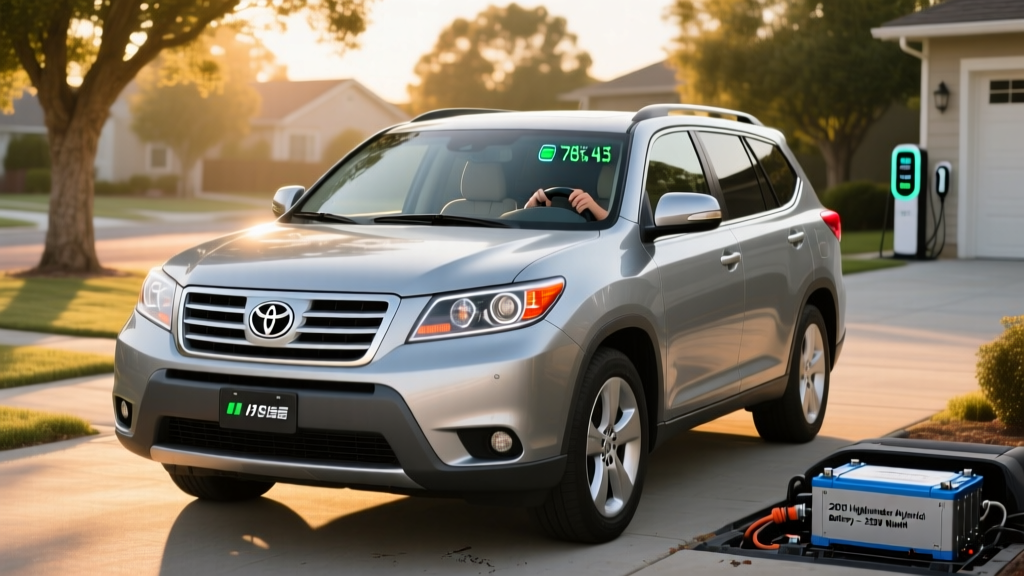
Battery chemistry and degradation: The 2010 Highlander Hybrid uses a NiMH battery pack — the same chemistry Toyota used across the Prius and Camry Hybrid of that era. NiMH packs are known for gradual capacity loss rather than sudden failure. By 2026, any original battery will have lost significant capacity, meaning reduced electric-motor assist, slightly lower MPG, and more frequent engine engagement.
Replacement cost breakdown:
| Replacement Option | Estimated Cost (2026) | Warranty |
|---|---|---|
| New OEM Toyota battery | $3,000 – $3,800 (parts + labor) | 3 yr / 36,000 mi |
| Refurbished/reconditioned pack | $1,200 – $2,000 | 1–3 yr (varies by vendor) |
| Individual module replacement | $400 – $900 (if only 1–2 modules are bad) | Minimal / shop-dependent |
| Used salvage yard battery | $500 – $1,000 | 30–90 days typical |
Reliability track record: The 3MZ-FE V6 is one of Toyota's most durable engines, routinely reaching 250,000+ miles with basic maintenance. The eCVT planetary gearset has no wear-prone belts or clutches. The primary failure points on high-mileage examples are the hybrid battery (as discussed), the hybrid inverter coolant pump (a $200–$400 fix), and standard wear items like struts, brakes, and wheel bearings. NHTSA records show no systemic safety defects unique to the hybrid powertrain.
Pricing and Tax Credit Eligibility in 2026
The 2010 Highlander Hybrid is available only on the used market. Current pricing based on mileage and condition:
| Condition / Mileage | Typical Asking Price (2026) |
|---|---|
| Under 100K miles, excellent | $9,500 – $11,500 |
| 100K–150K miles, good | $7,500 – $9,500 |
| 150K–200K miles, fair | $5,500 – $7,500 |
| Over 200K miles / needs battery | $4,000 – $5,500 |
Federal tax credit: The 2010 Highlander Hybrid does not qualify for the federal §30D new clean vehicle credit (it applies only to new vehicle purchases). It may qualify for the Used Clean Vehicle Credit (up to $4,000 or 30% of sale price, whichever is less) under IRS rules, but only if:
- The sale price is $25,000 or less (most 2010 Highlander Hybrids qualify)
- The buyer's modified adjusted gross income falls below IRS thresholds ($75,000 single / $112,500 head of household / $150,000 joint)
- The vehicle is purchased from a licensed dealer (private-party sales do not qualify)
- The vehicle has a minimum 2 kWh battery capacity (the 2010 Highlander Hybrid's ~1.9 kWh pack is borderline — verify with the dealer and your tax professional)
State incentives: Most state hybrid incentives have expired or shifted to PHEVs and BEVs. Check your state's energy office or DMV for current programs.
Who Should Buy the 2010 Highlander Hybrid — and Who Shouldn't
✅ Buy It If
- You need three rows and AWD on a sub-$10K budget
- Your driving is city-heavy (where the hybrid system shines)
- You want Toyota reliability without plug-in complexity
- You tow occasionally (3,500-lb capacity)
- You've confirmed the hybrid battery is healthy or budgeted for replacement
❌ Skip It If
- You want electric-only commuting (look at a RAV4 Prime or Ioniq 5)
- You mostly drive highway miles (the hybrid advantage shrinks)
- You can't budget $2,000–$3,500 for a potential battery replacement
- You want modern safety tech (no automatic emergency braking, no lane-keeping)
- You want Apple CarPlay / Android Auto (not available in 2010)
- Choose the 2010 Highlander Hybrid if: You need a budget three-row AWD SUV, drive mostly in the city, and can verify battery health before purchase.
- Choose a modern PHEV (e.g., 2026 Grand Highlander Hybrid or RAV4 Prime) if: You have a larger budget ($40K+), want electric-only commuting, and have home charging access.
- Choose a full EV (e.g., Kia EV9, Tesla Model X) if: You want zero gas, have reliable home charging, and can spend $50K+.
- Choose a newer used hybrid (2018+ Highlander Hybrid) if: You want the HEV simplicity but need modern safety tech and better fuel economy (29 MPG combined).
Pre-Purchase Checklist for a Used 2010 Highlander Hybrid
Before handing over cash, verify these items specific to this model:
- Hybrid battery health check: Have a Toyota dealer or hybrid specialist run a battery diagnostic. Ask for individual module voltage readings — any module more than 0.3V below the pack average signals impending failure.
- Inverter coolant pump: Check for recalls and replacement history. A failed pump can overheat the hybrid inverter ($2,000+ repair).
- Brake actuator: The regenerative braking system uses an electro-hydraulic actuator. Listen for unusual grinding or a firm pedal at low speeds — replacement runs $1,200–$1,800.
- Transmission fluid: The eCVT uses Toyota ATF WS fluid. It should be pink/red, not brown or burnt-smelling. Service interval was often neglected on older examples.
- Rust inspection: If the vehicle spent time in the Rust Belt, check subframe, rear suspension mounting points, and brake lines.
Frequently Asked Questions
How many MPG does the 2010 Toyota Highlander Hybrid get?
The EPA rates it at 27 city / 25 highway / 26 combined. Real-world owners typically see 24–28 combined, with city driving yielding the best results and sustained highway speeds dropping to 22–24 MPG.
Does the 2010 Highlander Hybrid need to be plugged in?
No. It is a conventional hybrid (HEV), not a plug-in hybrid (PHEV). The battery charges through regenerative braking and the gasoline engine. You fuel it exclusively at gas stations.
How much does it cost to replace the hybrid battery?
A new OEM battery from Toyota runs $3,000–$3,800 installed. Refurbished packs cost $1,200–$2,000. Individual module replacement (if only one or two cells fail) can cost $400–$900 at a hybrid specialist.
Is the 2010 Highlander Hybrid reliable?
Yes, with caveats. The 3MZ-FE V6 engine and eCVT are among Toyota's most durable components. The primary age-related concern is the hybrid battery, which is well past its original 8-year/100,000-mile warranty. Budget for a battery replacement or confirm a recent replacement before purchase.
Does the 2010 Highlander Hybrid qualify for any tax credit?
Not for the new-vehicle §30D credit. It may qualify for the Used Clean Vehicle Credit (up to $4,000) if purchased from a dealer for under $25,000 and your income falls within IRS limits. However, the battery's ~1.9 kWh capacity is borderline for the 2 kWh minimum requirement — confirm eligibility with a tax professional before relying on the credit.
How does it compare to a modern hybrid SUV?
The 2026 Toyota Grand Highlander Hybrid achieves 36 MPG combined — a 38% improvement over the 2010 model — while offering more cargo room, modern safety tech (TSS 3.0), and a fresh battery warranty. If your budget allows $40K+, a newer hybrid is substantially better in every measurable spec. The 2010 model's advantage is purely its low acquisition cost.
Can the 2010 Highlander Hybrid tow?
Yes. It's rated for 3,500 pounds when properly equipped, which covers small boat trailers, utility trailers, and light campers. This matches the gas V6 Highlander and remains adequate for most light-duty towing needs.