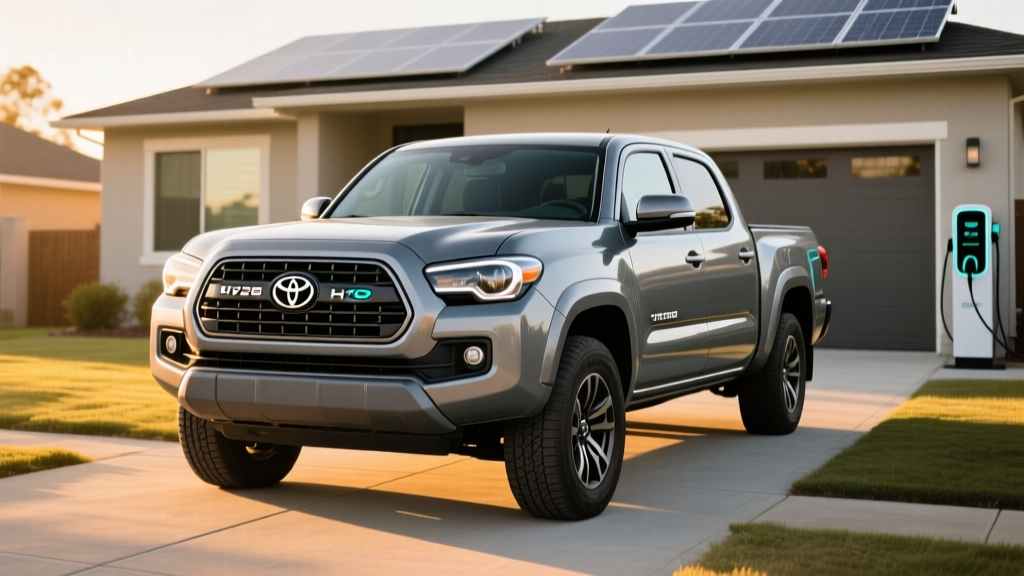
The Toyota Tacoma went hybrid-only with its fourth-generation redesign, and the i-FORCE MAX powertrain has become one of the most discussed setups in the midsize truck segment. If you've been searching for Tacoma hybrid MPG numbers to see whether this electrified truck delivers meaningful fuel savings over its gas-only predecessors, you're in the right place. This guide covers EPA ratings, real-world fuel economy expectations, powertrain specs, pricing, tax credit eligibility, and long-term battery reliability — everything you need to decide if the Tacoma Hybrid fits your driving life.
Tacoma Hybrid MPG: EPA Ratings and Real-World Numbers
The 2026 Toyota Tacoma Hybrid uses Toyota's i-FORCE MAX powertrain across all trims. Unlike a conventional economy-car hybrid optimized purely for fuel savings, the Tacoma's hybrid system prioritizes torque and towing capability while still delivering measurable MPG improvements over the previous-generation gas V6. Here's how the EPA rates it:
| Drivetrain | City MPG | Highway MPG | Combined MPG |
|---|---|---|---|
| 4×2 (select trims) | 23 | 27 | 24 |
| 4×4 (most trims) | 22 | 25 | 23 |
Source: EPA Fuel Economy Guide (fueleconomy.gov)
In mixed suburban and city driving, Tacoma Hybrid owners frequently report matching or slightly exceeding the EPA combined rating — landing between 23–26 MPG on 4×4 models. Toyota's hybrid system recovers energy during stop-and-go driving, which is where this truck outperforms its gas-only competitors most noticeably. However, sustained highway driving at 75+ mph, heavy towing (above 4,000 lbs), and cold-weather operation can drop real-world fuel economy to 19–21 MPG. If your commute is mostly urban or suburban, expect to beat the sticker. If you tow frequently or drive rural highways, plan for the lower end.
i-FORCE MAX Powertrain: Engine, Motor, and Horsepower
The Tacoma Hybrid is not a plug-in hybrid (PHEV). It's a conventional hybrid electric vehicle (HEV), meaning you never plug it in. The system charges its battery through regenerative braking and the gasoline engine. Here's the full powertrain breakdown:
| Specification | Detail |
|---|---|
| Engine | 2.4L turbocharged 4-cylinder |
| Electric Motor | 48-hp motor integrated into 8-speed automatic transmission |
| Combined System Output | 326 hp / 465 lb-ft torque |
| Transmission | 8-speed automatic |
| Battery Type | 1.87 kWh nickel-metal hydride (NiMH), sealed |
| Drivetrain | Rear-wheel drive (4×2) or part-time/full-time 4WD (4×4) |
| Max Towing Capacity | Up to 6,000 lbs (trim-dependent) |
| 0–60 mph | ~6.5 seconds (4×4 crew cab, estimated) |
The 465 lb-ft of torque is available low in the rev range thanks to the electric motor's instant delivery, which makes the Tacoma Hybrid feel significantly more responsive off the line than the outgoing 3.5L V6 it replaced. The 1.87 kWh battery pack is small by EV standards — it's not designed for electric-only driving. Instead, it acts as a buffer to smooth power delivery, enable stop/start, and recapture braking energy.
HEV vs. PHEV: Understanding What the Tacoma Hybrid Is (and Isn't)
There is no plug-in hybrid version of the Tacoma as of the 2026 model year. Every Tacoma Hybrid on the road is a self-charging conventional hybrid (HEV). This distinction matters for buyers cross-shopping electrified trucks:
Tacoma Hybrid (HEV)
- No plug-in charging required
- No electric-only driving range
- Gas engine + electric motor work together
- Battery charges via regen braking & engine
- Does NOT qualify for federal §30D EV tax credit
Typical PHEV (e.g., RAV4 Prime)
- Plug-in charging via Level 1/Level 2
- 25–42 miles electric-only range
- Gas engine kicks in after battery depletes
- Larger battery (14–18 kWh)
- May qualify for up to $7,500 federal credit (if eligible)
If you're looking for electric-only commuting in a Toyota truck, the Tacoma doesn't offer that yet. The hybrid system here is about torque multiplication and incremental fuel savings, not plug-in electrification.
Hybrid vs. Gas vs. Full EV: Which Truck Fits Your Needs?
The Tacoma Hybrid sits in a specific niche. Here's a decision framework to help you choose:
Choose the Tacoma Hybrid (HEV) if:
- You want a midsize truck with strong low-end torque for towing and trail use
- You don't have access to home or workplace charging (no plug needed)
- Your driving is a mix of city, suburban, and highway
- You want 2–4 MPG better than a comparable gas turbo-4 without changing fueling habits
Consider a full EV truck (e.g., Ford F-150 Lightning, Rivian R1T) if:
- You can install a Level 2 home charger
- You want zero tailpipe emissions and lower per-mile fuel cost
- Your daily driving is under 250 miles and you rarely tow heavy loads long-distance
- You want access to the federal §30D tax credit (up to $7,500 for eligible buyers/vehicles)
Stick with a conventional gas truck if:
- You regularly tow near max capacity over long highway distances (MPG advantage shrinks)
- You prioritize lowest upfront purchase price and don't mind higher fuel cost
2026 Tacoma Hybrid Pricing by Trim
The i-FORCE MAX hybrid powertrain is standard on upper trims and optional on several mid-tier trims for 2026. Here's the approximate MSRP range (destination included):
| Trim | Starting MSRP | Notes |
|---|---|---|
| TRD Sport (i-FORCE MAX available) | ~$42,990 | Hybrid optional on some configs |
| TRD Off-Road (i-FORCE MAX) | ~$44,490 | Popular hybrid trail trim |
| Limited (i-FORCE MAX standard) | ~$52,090 | Fully loaded luxury trim |
| TRD Pro (i-FORCE MAX standard) | ~$64,990 | Off-road flagship, hybrid standard |
| Trailhunter (i-FORCE MAX standard) | ~$61,990 | Overland-oriented, hybrid standard |
Prices reflect approximate 2026 model-year MSRP as published by Toyota. Dealer markups and regional variations apply.
Tax Credit Eligibility: Does the Tacoma Hybrid Qualify?
No. The Toyota Tacoma Hybrid is a conventional HEV, not a plug-in electric vehicle. It does not qualify for the IRS §30D New Clean Vehicle Credit (up to $7,500). The federal tax credit under current IRS rules applies only to battery electric vehicles (BEVs) and plug-in hybrids (PHEVs) with sufficient battery capacity and qualifying critical-mineral/battery-component sourcing.
Some states offer separate rebates or incentives for conventional hybrids, but these are typically smaller ($500–$1,500) and vary widely by jurisdiction. Check your state energy office or department of environmental quality for current programs. A tax professional can confirm eligibility for any federal or state incentive.
Battery Reliability, Warranty, and Replacement Cost
Toyota's hybrid battery track record is among the strongest in the industry, dating back to the 2001 Prius. The Tacoma Hybrid uses a compact 1.87 kWh NiMH pack that operates within a narrow state-of-charge window (roughly 40–80%), which significantly reduces stress and extends cycle life compared to an EV battery that regularly charges to 100%.
Toyota covers the Tacoma Hybrid battery with a 10-year / 150,000-mile warranty (whichever comes first) in all 50 states. This covers defects and capacity loss below a functional threshold. Additional hybrid system components (inverter, motor, control module) are covered under the same 10-year/150,000-mile hybrid system warranty.
Expected lifespan: Based on data from Toyota's broader hybrid fleet (Prius, Camry Hybrid, RAV4 Hybrid), NiMH hybrid battery packs routinely last 150,000–200,000+ miles before needing replacement. Many first-generation Prius packs exceeded 250,000 miles.
Replacement cost (out of warranty): If a Tacoma Hybrid battery eventually needs replacement beyond the warranty period, expect a dealer-installed new pack to cost between $2,000–$3,500 (parts and labor). Refurbished or reconditioned packs from independent hybrid specialists may run $1,200–$2,000. This is significantly less than EV traction battery replacement, which can exceed $10,000–$20,000.
Towing, Payload, and Efficiency Under Load
The Tacoma Hybrid's 6,000-lb max towing rating (on properly equipped 4×2 trims; 4×4 models rate slightly lower at approximately 5,800 lbs) is competitive for the midsize segment. However, towing is where the hybrid MPG advantage narrows considerably:
- Unloaded, mixed driving: 22–26 MPG (4×4 real-world)
- Towing 3,000–4,000 lbs: 14–17 MPG typical
- Towing 5,000+ lbs: 11–14 MPG typical
- Off-road, low-speed trail use: 10–14 MPG (hybrid system provides smooth low-speed torque control)
The electric motor's instant torque is a genuine advantage for low-speed maneuvering on trails and initial trailer pull-away, but aerodynamic drag and weight dominate fuel consumption at highway towing speeds. If you tow a 5,000-lb camper every weekend, the MPG benefit over a gas turbo-4 Tacoma shrinks to roughly 1–2 MPG.
Frequently Asked Questions
How many MPG does the Tacoma Hybrid get in real-world driving?
The EPA rates the 2026 Tacoma Hybrid 4×4 at 22 city / 25 highway / 23 combined MPG. In real-world mixed suburban driving, many owners report 23–26 MPG. Highway-only trips at 75+ mph or heavy towing will drop this to 17–21 MPG.
Does the Tacoma Hybrid need to be plugged in?
No. The Tacoma Hybrid is a conventional hybrid (HEV). It charges its own small battery through regenerative braking and the gas engine. You fuel it like any other truck — at a gas station.
Is there a plug-in hybrid (PHEV) Tacoma?
Not as of the 2026 model year. Toyota has not announced a Tacoma PHEV. If you need electric-only commuting in a Toyota, the RAV4 Prime (42 miles EV range) is the closest current option.
Does the Tacoma Hybrid qualify for the $7,500 federal tax credit?
No. The federal §30D credit applies only to plug-in vehicles (BEVs and PHEVs). The Tacoma Hybrid is a conventional HEV and does not qualify. Check your state for any hybrid-specific rebates.
How long will the Tacoma Hybrid battery last?
Toyota's hybrid batteries are warrantied for 10 years / 150,000 miles. Based on Toyota's long hybrid track record, these packs commonly last 150,000–200,000+ miles. Out-of-warranty replacement runs $2,000–$3,500 at a dealer.
Is the Tacoma Hybrid good for off-roading?
Yes. The i-FORCE MAX's 465 lb-ft of low-end torque is excellent for technical trail crawling. TRD Off-Road, TRD Pro, and Trailhunter trims all come standard with the hybrid powertrain and include locking differentials, crawl control, and upgraded suspension. Expect 10–14 MPG on trails.
How does Tacoma Hybrid MPG compare to competitors?
The Ford Maverick Hybrid (FWD) achieves an EPA-estimated 42 city / 35 highway / 40 combined MPG, but it's a smaller unibody truck with lower towing capacity (2,000 lbs). The Chevrolet Colorado and GMC Canyon do not currently offer hybrid powertrains. Among body-on-frame midsize trucks, the Tacoma Hybrid has no direct hybrid rival as of 2026.